
超级人工智能(ASI)

Search documents
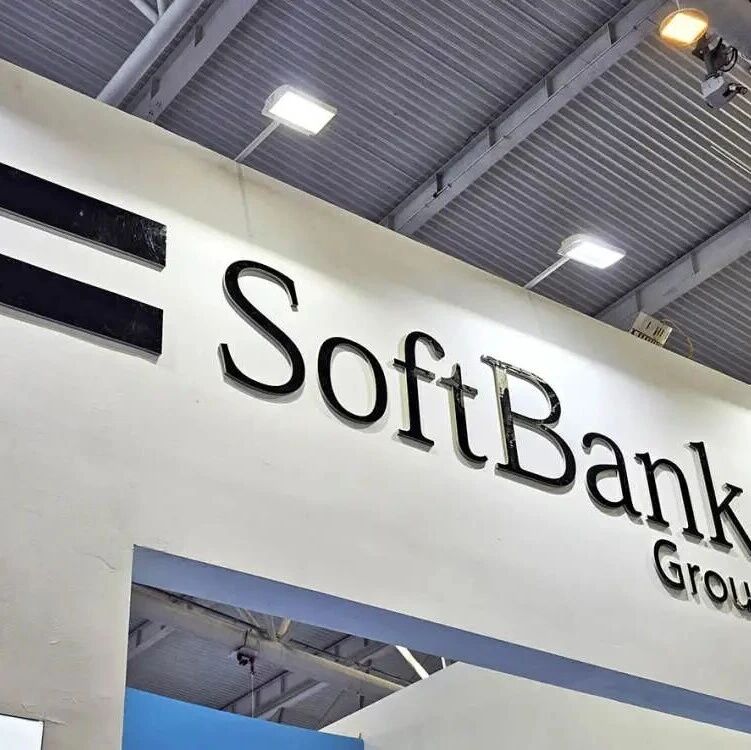
孙正义豪掷382亿,抄底全球机器人巨头
21世纪经济报道· 2025-10-10 01:58
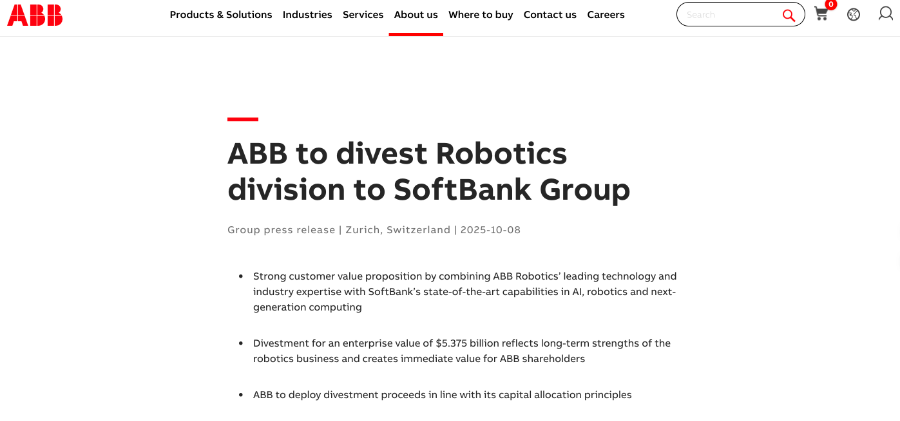
Core Viewpoint - The industrial robotics landscape is undergoing significant changes, with SoftBank making a substantial investment of $5.375 billion (approximately 38.3 billion RMB) to acquire ABB's robotics business, leading ABB to abandon its plans for a separate IPO of this unit [1][3]. Group 1: ABB's Robotics Business - ABB has signed an agreement to sell its robotics business unit to SoftBank for $5.375 billion, which will no longer pursue its previously planned independent listing [3]. - The robotics business generated $2.3 billion in sales in 2024, accounting for 7% of ABB's total revenue, with an operating EBITDA margin of 12.1% [3]. - ABB's decision to sell comes after a period of considering a 100% spin-off of its robotics unit, which was aimed at enhancing focus and governance within the business [3][5]. Group 2: Market Dynamics - The global industrial robotics market has experienced a slowdown in growth after years of rapid expansion, with local competitors in China gaining market share, putting pressure on multinational firms [4][5]. - The sale to SoftBank reflects ABB's strategic shift towards electrification and automation, reducing its business focus to three main divisions [5]. Group 3: SoftBank's Strategic Vision - SoftBank's CEO Masayoshi Son has a long history of investing in robotics, with previous attempts yielding mixed results, including the acquisition of Aldebaran and the launch of the Pepper robot [7]. - The recent acquisition of ABB's robotics business aligns with SoftBank's ambition to integrate artificial superintelligence (ASI) with robotics, aiming to create a new frontier in physical AI [8]. - SoftBank's broader strategy includes investments in AI chips, AI robots, and AI data centers, with plans to invest $500 billion in AI infrastructure in the U.S. [8].


假期24亿人次跨区域流动,新基金发售迎小高潮 | 财经日日评
吴晓波频道· 2025-10-10 00:20
Group 1: Travel and Tourism - During the National Day and Mid-Autumn Festival holiday, a total of 2.432 billion people are expected to travel across regions, with an average of 304 million people per day, marking a year-on-year increase of 6.2% and setting a historical record [2] - Online travel platforms report that both the number of bookings and the average spending per person have increased year-on-year, with hotel and tour package bookings up by 4.6% and average spending up by 14.6% [2] - There is a noticeable shift in travel behavior, with more residents opting for nearby cities for self-driving trips rather than long-distance travel, indicating a trend towards short-distance travel and experiential tourism [2][3] Group 2: Automotive Industry - In September, several automotive companies reported growth in sales, with Seres selling 44,700 electric vehicles, a year-on-year increase of 19.44%, and Great Wall Motors achieving a total sales volume of 133,600 units, up 23.29% [6] - The market is increasingly dominated by new energy vehicles, with companies like BYD and Geely leading the growth through technological advancements, while traditional automakers are rapidly transitioning to electric models [7] - The upcoming reduction in subsidies for new energy vehicles may lead to a surge in demand before the end of the year, but a significant decline in sales is expected in the first quarter of the following year [7] Group 3: Government and Economic Impact - The U.S. federal government has been shut down for over a week due to funding issues, marking the first government shutdown in seven years, with significant implications for government operations and employee salaries [4][5] - The budget deficit for the U.S. federal government reached $1.8 trillion, with only a slight reduction compared to the previous year, indicating ongoing fiscal challenges [4] Group 4: Technology and AI - Google scientists have won the Nobel Prize in Physics for their groundbreaking contributions to quantum mechanics, which could significantly impact the field of quantum computing [8][9] - OpenAI has signed contracts worth approximately $1 trillion for computing power to run AI models, indicating a strong push for infrastructure investment in AI [10][11] - The acquisition of ABB's robotics business by SoftBank for $5.375 billion reflects a strategic move to build a comprehensive AI ecosystem, emphasizing the importance of robotics in AI applications [12][13] Group 5: Investment and Fundraising - A total of 23 new funds were launched recently, with a focus on actively managed equity funds and technology-themed funds, reflecting a strong interest in the tech sector [14][15] - The market for actively managed equity funds is recovering, while index funds continue to gain popularity, potentially stabilizing market volatility [15] Group 6: Stock Market Performance - The Shanghai Composite Index rose above 3900 points, reaching its highest level since August 2015, driven by strong market sentiment following the holiday [16] - The market is experiencing a surge in demand for commodities, particularly in the metals sector, as expectations for a weaker dollar grow [16][17]

软银孙正义豪掷53亿美元 收购ABB机器人业务
2 1 Shi Ji Jing Ji Bao Dao· 2025-10-09 15:53
Group 1 - SoftBank has made a significant investment of $5.375 billion to acquire ABB's robotics business, leading ABB to abandon its plans for a separate IPO of this unit [4][6][7] - ABB's robotics business generated $2.3 billion in sales in 2024, accounting for approximately 7% of ABB's total revenue, with an EBITDA margin of 12.1% [4][5] - The decision to sell the robotics unit reflects ABB's shift in focus towards electrification and automation, reducing its operations to three main divisions [7] Group 2 - The global industrial robotics market has experienced a slowdown in growth, with increasing competition from local Chinese manufacturers impacting multinational companies [5] - SoftBank's CEO Masayoshi Son has a long-term vision for AI, emphasizing the potential of Artificial Super Intelligence (ASI) and its integration with robotics [12][13] - The acquisition aligns with SoftBank's strategy to build an ecosystem around AI, including investments in AI chips, robotics, and data centers [13]

从AGI到ASI:万亿赛道潜力待释放
Xin Lang Ji Jin· 2025-10-09 10:30
Core Insights - The realization of Artificial General Intelligence (AGI) is seen as a certainty, with the ultimate goal being the development of Artificial Superintelligence (ASI) that surpasses human intelligence [1][2] - The evolution towards ASI is divided into three key stages: emergence of intelligence ("Learning Human"), autonomous action ("Assisting Human"), and self-iteration ("Surpassing Human") [1][2] Stage Summaries - **Stage 1: Emergence of Intelligence - "Learning Human"** The development of digital knowledge through the internet has laid the foundation for intelligent technologies. Current large models exhibit generalized intelligence and basic multi-step reasoning capabilities, marking the entry into the "Learning Human" phase [1] - **Stage 2: Autonomous Action - "Assisting Human"** AI is currently in this critical stage, characterized by the ability to break through language interaction limitations. AI can decompose complex tasks and autonomously interact with both digital and physical worlds, significantly impacting reality [2] - **Stage 3: Self-Iteration - "Surpassing Human"** This stage requires AI to connect with comprehensive raw data from the physical world and achieve autonomous learning. As AI penetrates more physical scenarios and understands raw data better, its capabilities will significantly enhance, leading to self-iteration and surpassing human intelligence [2] Investment Trends - Significant investments are being made in AI infrastructure to prepare for the era of superintelligence. For instance, a major domestic tech company has initiated a three-year AI infrastructure plan worth 380 billion yuan, with plans for continued investment [2] - Globally, AI investment is rapidly increasing, with IDC forecasting that total AI IT investment will grow from $315.9 billion in 2024 to $1,261.9 billion by 2029, reflecting a compound annual growth rate (CAGR) of 31.9% [2] Market Potential - AI is poised to reshape production efficiency and unlock trillion-dollar markets. The global AI market is projected to surge from $189 billion in 2023 to $4.8 trillion by 2033, representing a 25-fold increase over ten years [4] - The share of AI in global cutting-edge technology is expected to rise from 7% to 29%, establishing itself as a dominant force in the sector [4] - In light of the technological evolution and capital influx into ASI, AI-related sectors are becoming focal points for investors [4]

马云彻底翻身,阿里未来不可估量
Sou Hu Cai Jing· 2025-10-09 02:32
Core Viewpoint - Alibaba is transforming from a retail company into a "super intelligent entity" that aims to lead in the global AI industry, focusing on the development of Artificial Super Intelligence (ASI) to address major scientific challenges like climate change and energy crises [1][3][5]. Group 1: AI Development Strategy - Alibaba's CEO, Wu Yongming, stated that achieving Artificial General Intelligence (AGI) is a certainty, but the ultimate goal is to develop ASI that can self-iterate and surpass human intelligence [1][3]. - The company is investing significantly in AI infrastructure, with a plan to allocate 380 billion yuan (approximately 53 billion USD) over three years to support this initiative [5]. - The strategy aims to position Alibaba as a leading force in AI innovation, competing with top firms like OpenAI [3][5]. Group 2: Technological Advancements - Alibaba has recently updated its large model offerings, including seven new models that cover various fields such as language processing and programming, achieving breakthroughs in multiple areas [4]. - The company is also collaborating with NVIDIA to integrate Physical AI technologies, enhancing its AI platform capabilities and shortening development cycles for applications like autonomous driving [11][13]. Group 3: Market Positioning and Future Outlook - The shift towards ASI is seen as a necessary move for Alibaba to secure its future market position and to transition from a traditional e-commerce platform to an industry enabler [6][15]. - The company aims to leverage ASI to penetrate various sectors, including manufacturing and healthcare, addressing efficiency and innovation challenges [6][10]. - Alibaba's recent resurgence in e-commerce growth and technological advancements has restored market confidence, positioning the company for future success in the AI domain [15][16].


大模型、硬件厂商共进,2026年有望成为端侧AI大年
Tianfeng Securities· 2025-09-29 12:35
Investment Rating - Industry Rating: Outperform the Market (Maintained Rating) [12] Core Insights - The report highlights that 2026 is expected to be a significant year for edge AI, driven by policy support and major tech companies leading innovation in AI terminal products [16][18] - The report emphasizes the potential of AI terminal devices, with a focus on new product innovations and the release of various AI applications across different sectors [20][21] Summary by Sections Edge AI - The report notes that Meta has raised its sales expectations for AI glasses due to strong demand, increasing orders to suppliers by 20% [18] - A joint policy document from multiple government departments aims to stimulate digital consumption and innovation in AI terminal products, including smartphones and wearables [20][21] - JD.com has launched an AI ecosystem, introducing three major AI products aimed at enhancing user experience and operational efficiency [23][24] AI Cloud - OpenAI is developing a series of new edge AI devices expected to launch by the end of 2026 or early 2027, including a screenless smart speaker [29] - The report mentions that Alibaba is enhancing its cloud infrastructure with significant investments to support AI development [8][9] - The report highlights the IPO of Moore Threads, which aims to accelerate the commercialization of domestic GPUs for AI applications [7][8] Consumer Electronics - Apple has launched the iPhone 17 series, which features significant upgrades in performance and display technology, with strong pre-sale demand [40][45] - The report indicates that Apple's new products, including AirPods Pro 3 and Apple Watch Series 11, have introduced advanced features and improvements [41][42][44] - The report suggests that companies like Luxshare Precision are leading innovations in AR technology and AI solutions, showcasing multiple new products at industry events [30][36] Recommendations - The report recommends focusing on key players in the consumer electronics supply chain, including Luxshare Precision, BYD Electronics, and others, as they are expected to benefit from the growth in AI and digital consumption [10]



迈向超级人工智能之路
3 6 Ke· 2025-09-29 09:33
Core Insights - The core viewpoint is that AI represents a new leap in technology, with the potential to enhance human intelligence and evolve into Artificial Superintelligence (ASI) beyond Artificial General Intelligence (AGI) [1][11][19] - The increasing adoption of AI Agents in business operations is leading to automation of repetitive tasks, improved efficiency, and enhanced decision-making capabilities [1][2][16] Group 1: AI Agent Adoption and Impact - A survey by PwC revealed that 79% of companies are already using AI Agents in some capacity, with 66% reporting productivity improvements and 57% noting cost reductions [1][2] - Major tech companies are actively developing AI Agents, with products like OpenAI's Agent Mode and Microsoft's Copilot gaining traction [2][3] - Alibaba Cloud's Bailian platform aims to provide a comprehensive environment for enterprises to develop and deploy AI Agents, integrating all necessary components for effective implementation [2][12] Group 2: Infrastructure and Model Development - Alibaba Cloud has upgraded to a "full-stack AI service provider," focusing on building robust infrastructure and foundational models to support AI Agent deployment [3][19] - The strength of foundational models, such as the Tongyi Qianwen series, is crucial for the performance of AI Agents, with recent evaluations showing competitive advantages over international counterparts [5][6] - The introduction of multiple new models at the Yunqi Conference demonstrates Alibaba Cloud's commitment to advancing AI capabilities across various applications [6][8] Group 3: Scalability and Reliability - Scalability is a primary requirement for AI platforms, with Alibaba Cloud offering serverless architectures to handle unpredictable traffic and resource demands [7][9] - High availability and stability are essential for enterprises to trust AI Agents in critical processes, with Alibaba Cloud ensuring low-cost, high-concurrency storage and reliable computing capabilities [7][9] - The integration of memory management and retrieval systems is vital for AI Agents to evolve and retain knowledge over time, enhancing their productivity [8][9] Group 4: Development Framework and Business Integration - Alibaba Cloud's "1+2+7" framework for enterprise-level AI Agents includes a model service, two development modes, and seven key capabilities to facilitate integration into business processes [13][14] - The dual-track approach allows companies to quickly prototype using low-code solutions and transition to high-code for deeper customization, reducing exploration costs and ensuring business continuity [14][15] - Successful implementations of AI Agents in various sectors, such as finance and recruitment, highlight the tangible benefits and efficiency gains achieved through Alibaba Cloud's solutions [15][16] Group 5: Strategic Positioning and Future Outlook - Alibaba Cloud's leadership in the AI and cloud computing market is underscored by its significant market share and the trust of over 100,000 enterprise customers [18][21] - The development of AI Agents is seen as a critical step in the evolution of AI from theoretical models to practical applications that drive business growth [19][21] - The comprehensive strategy of combining models, platforms, and infrastructure positions Alibaba Cloud as a global leader in the AI space, enabling local enterprises to innovate without relying on foreign solutions [21]
ASI宣言引领前瞻方向,AI应用场景全面提速
AVIC Securities· 2025-09-28 15:00
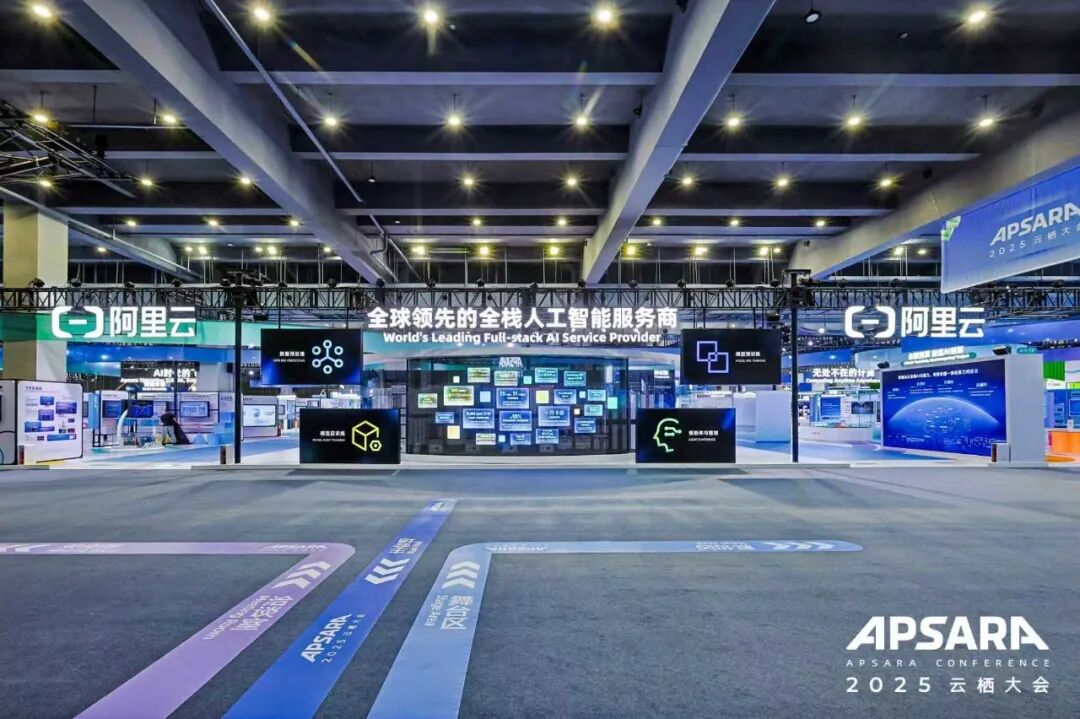
Investment Rating - The industry investment rating is "Overweight," indicating that the growth level of the industry is expected to be higher than that of the CSI 300 index over the next six months [26]. Core Insights - The ASI declaration by Alibaba signifies a new direction for the AI industry, with a focus on collaboration between government and enterprises, and the acceleration of AI applications across various sectors [2][21]. - The AI industry is currently experiencing a phase of multiple resonances in policy, technology, and application, which is expected to lead to systematic implementation rather than isolated breakthroughs [21]. - Short-term developments in policy implementation and standardized evaluation systems are anticipated to drive the industry towards a more regulated and sustainable growth trajectory [21]. - In the medium to long term, the multi-dimensional upgrades of large models are expected to accelerate their penetration into sectors such as education and film, enhancing application implementation and industrialization processes [21]. Summary by Sections Market Performance Review - The social services sector index experienced a weekly decline of 5.92%, ranking 31 out of 31 in the Shenwan first-level industry performance [7]. - The performance of sub-industries showed declines, with tourism and hospitality sectors facing significant drops of 9.46% and 9.18%, respectively [7][19]. Core Insights - The ASI declaration and collaboration with NVIDIA highlight the industry's forward-looking signals, emphasizing the importance of computational power and AI agent evolution [2][21]. - The collaboration between Alibaba and NVIDIA covers various aspects of Physical AI, including data synthesis, model training, and environment simulation [2][21]. - The AI applications are transitioning from isolated pilot projects to cross-regional and cross-scenario implementations, supported by initiatives like the China-ASEAN AI cooperation [18]. Industry News Dynamics - The Ministry of Education and other departments have launched a plan to enhance the quality of high schools in rural areas, focusing on resource expansion and digital education [22]. - A joint initiative to promote electrification in buildings has been proposed, aiming to reduce carbon emissions and enhance energy efficiency [23].
【港股一周见】医药板块承压回调,AI战略驱动科技股
Xin Lang Cai Jing· 2025-09-28 13:21
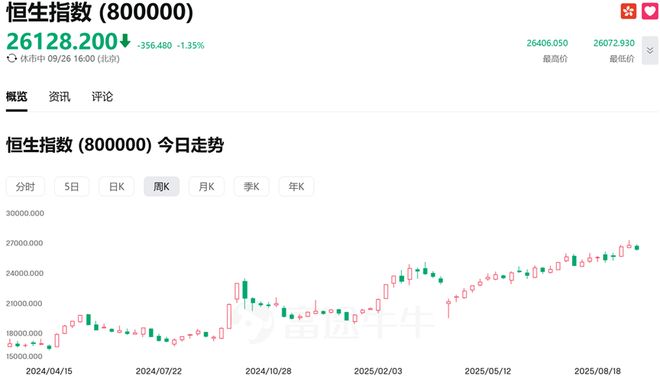
Market Overview - The Hang Seng Index closed at 26,128.2 points, down 1.57% for the week, while the Hang Seng Tech Index fell 1.58% to 6,195.11 points, and the National Enterprises Index decreased by 1.79% to 9,303.10 points [1] Fund Flow - The net inflow for the Hong Kong Stock Connect (Shanghai to Hong Kong) over the past 5 days was +23.253 billion, and for the Shenzhen to Hong Kong was +20.706 billion. Over the past 20 days, the inflow was +72.618 billion and +102.073 billion respectively. For the past 60 days, the inflow reached +182.005 billion and +231.819 billion [4] Alibaba's Performance - Alibaba's stock rose 4.65% to HKD 166.50, with a notable single-day increase of 9.16% on September 24. This performance was driven by positive signals from the 2025 Alibaba Cloud Summit, where the CEO announced an increased investment in AI infrastructure and a goal to enhance data center energy efficiency by tenfold by 2032. The company also introduced its new AI model Qwen3-Max, which performed well in global evaluations [5] Pharmaceutical Sector - The pharmaceutical sector experienced a downturn, with Fosun Pharma dropping 11.19%. Other companies like Kanglong Chemical and 3SBio also saw declines. The primary reasons for this adjustment were overseas policy disturbances, including fluctuating expectations of interest rate cuts by the Federal Reserve and proposed tariffs on pharmaceutical products by Trump. However, the actual impact on Chinese innovative pharmaceutical companies is expected to be limited due to their licensing models [6] New Energy Sector - The new energy sector showed strong performance, with Zhongxin New Energy rising 15.36% to HKD 30.94, marking over 140% increase year-to-date. This growth is attributed to robust performance in the company's energy storage business and positive institutional evaluations. Policy support from the government, including tax incentives and technological advancements, is expected to foster further growth in the sector [7] Online Travel Industry - The online travel sector is witnessing a transformation, with cross-province travel orders increasing by 45% year-on-year during the "Golden Week." Companies are shifting from price competition to AI-driven value creation, enhancing user experience through AI applications. Major platforms are integrating AI into their services, indicating a shift in competitive dynamics from resource monopolization to technological service capabilities [8] U.S. Market Signals - The U.S. bond market is showing concerning signals, with investment-grade corporate bond risk premiums at a 27-year low and signs of rising consumer defaults. These trends echo pre-2007 financial crisis characteristics. Additionally, the Trump administration's trade protectionist policies are reshaping global trade dynamics, with tariffs on various products potentially leading to a restructuring of global supply chains [9]
从英伟达到ASI,算力景气再确认
GOLDEN SUN SECURITIES· 2025-09-28 09:06
Investment Rating - The report maintains a "Buy" rating for companies in the computing power sector, particularly recommending leading firms in the optical module industry such as Zhongji Xuchuang and Xinyi Sheng [8][11]. Core Insights - The collaboration between Nvidia and OpenAI marks a significant milestone, indicating that the demand for computing power is a long-term trend rather than a short-term phenomenon [24][25]. - Alibaba's CEO outlined a three-phase roadmap towards Artificial Super Intelligence (ASI), emphasizing the critical role of computing power in this evolution [27][28]. - The report highlights the ongoing arms race in computing infrastructure among major AI players, with unprecedented capital investments aimed at securing resources for future AI developments [30]. Summary by Sections Investment Strategy - The report suggests focusing on the computing power sector, particularly in optical communication, with specific companies recommended for investment [16]. - Key companies include Zhongji Xuchuang, Xinyi Sheng, and Tianfu Communication, among others [9][16]. Market Overview - The communication sector experienced a decline, with quantum communication performing relatively well [20][21]. - The report notes that the overall market sentiment is influenced by significant investments in AI infrastructure, particularly from Nvidia and OpenAI [19][24]. AI Development and Computing Power - The partnership between Nvidia and OpenAI involves deploying at least 10 GW of AI data centers, with Nvidia planning to invest up to $100 billion [25][26]. - OpenAI's active user base has surpassed 700 million, highlighting the increasing demand for computing resources [26]. Phases of ASI Evolution - The three phases towards ASI include: 1. Emergence of general AI (AGI) 2. Autonomous action phase 3. Self-iterative phase, which demands nearly limitless computing power [29][28]. Future Outlook - The report anticipates a significant increase in capital expenditures (CAPEX) in the domestic market, driven by recent actions from major players like Alibaba [30][7]. - The computing power supply chain is expected to benefit across various segments, including AI chips, servers, and cooling solutions [30].


