
钢铝关税

Search documents
国际观察:日美贸易谈判何以陷入僵局
Xin Hua Wang· 2025-07-03 07:17
Core Viewpoint - The US-Japan trade negotiations are at a standstill, with Japan facing potential increases in tariffs on its exports, particularly in the automotive sector, as the deadline for a trade agreement approaches [1][5][6] Group 1: Negotiation Status - Japan's Economic Revitalization Minister, Akira Amari, has made multiple trips to the US but has not achieved any progress in negotiations [1] - The US has set a 24% tariff rate on Japan, while Japan seeks to bundle this with the removal of tariffs on automobiles and steel [2] - The Japanese government emphasizes its contributions to the US economy through investments and job creation, seeking to leverage this for tariff reductions [2] Group 2: Key Issues in Negotiations - The automotive sector is a major sticking point, with Japan exporting 1.37 million vehicles to the US in 2024, valued at 7.2 trillion yen, which constitutes 34% of Japan's total exports to the US [3] - A 25% tariff on Japanese automobiles could lead to a potential loss of 13 trillion yen for Japan's economy, affecting over 5.58 million jobs across related industries [3] - The US aims to reduce its trade deficit with Japan, but American cars have struggled to gain traction in the Japanese market due to size and fuel efficiency issues [3] Group 3: Agricultural Concerns - Agriculture is another contentious area, with Japan's ruling Liberal Democratic Party (LDP) facing pressure to protect domestic agricultural interests ahead of the upcoming Senate elections [4] - The Japanese government is unwilling to sacrifice agricultural protections for concessions on automotive tariffs, emphasizing the need to maintain national interests [4] Group 4: Outlook and Implications - The negotiations are increasingly uncertain, with President Trump expressing skepticism about reaching an agreement and hinting at raising tariffs to 30-35% if no deal is made [5][6] - If tariffs are implemented as proposed, Japan's actual GDP could decrease by 0.9% over five years [6]
钢铝关税难撼美国LNG开发信心
Zhong Guo Hua Gong Bao· 2025-06-20 02:11
Core Insights - Despite the rising costs due to steel and aluminum tariffs, U.S. LNG developers remain confident in making final investment decisions for new facilities this year, with at least seven projects aiming for approval [1] - If these projects proceed, U.S. LNG export capacity could double by 2030 [1] - Developers are actively seeking to mitigate tariff impacts by selling stakes to infrastructure funds and securing long-term LNG purchase agreements [1] Group 1: Company Developments - Woodside is the first company to make a final investment decision on a U.S. export project this year, approving the Louisiana LNG project, previously acquired for $1.2 billion [2] - Woodside sold 40% of its stake in the Louisiana LNG project to Stonepeak, which is expected to provide $5.7 billion in capital expenditure for the facility [2] - Market expectations indicate that more U.S. LNG export projects will make final investment decisions this year, with Cheniere Energy expressing confidence in obtaining necessary regulatory approvals for its expansion projects [2] Group 2: Project Timelines and Strategies - Sempra plans to make a final investment decision on the Arthur Port LNG Phase 2 project by the end of 2025, while acknowledging macroeconomic uncertainties [3] - Energy Transfer aims to finalize investment for its Charles Lake LNG export project in Louisiana by the end of this year, as it works on securing LNG purchase volumes [3] - Venture Global is urging the Federal Energy Regulatory Commission (FERC) to approve its third liquefaction plant, CP2, in Louisiana by mid-year, indicating a supportive regulatory environment for the U.S. LNG industry [3]
深观察丨美国消费者正体会到“关税带来的无数间接成本”
Sou Hu Cai Jing· 2025-06-06 10:28
Core Viewpoint - The increase of tariffs on imported steel and aluminum from 25% to 50% is expected to significantly raise costs for various industries in the U.S., leading to higher prices for consumers and potential job losses in sectors reliant on these materials [4][10][25]. Group 1: Impact on Industries - The steel cable industry, represented by companies like Walz's, faces severe challenges due to increased raw material costs and competition from foreign products [1]. - The manufacturing sector, particularly metal manufacturing, is projected to incur an additional cost of $22.4 billion for imported steel and aluminum, with derivative product costs rising by $29 billion [7]. - The construction industry anticipates an increase in average new home costs by over $10,000 due to the tariffs, exacerbating existing pressures from high housing prices and mortgage rates [16][18]. Group 2: Consumer Impact - The tariffs are expected to raise prices across a wide range of consumer goods, including automobiles, household appliances, and canned foods, disproportionately affecting low-income households [10][14]. - The cost of essential items, such as canned foods and housing, is likely to rise significantly, impacting affordability for ordinary families [14][16]. Group 3: Employment Effects - The tariffs may lead to a net loss of jobs, with estimates suggesting that while the steel industry could gain around 1,000 jobs, other sectors like manufacturing and construction could lose approximately 75,000 jobs [25][29]. - The overall economic outlook is pessimistic, with recent data showing a slowdown in job creation, indicating that the tariffs may be counterproductive to the goal of protecting American jobs [22][25].

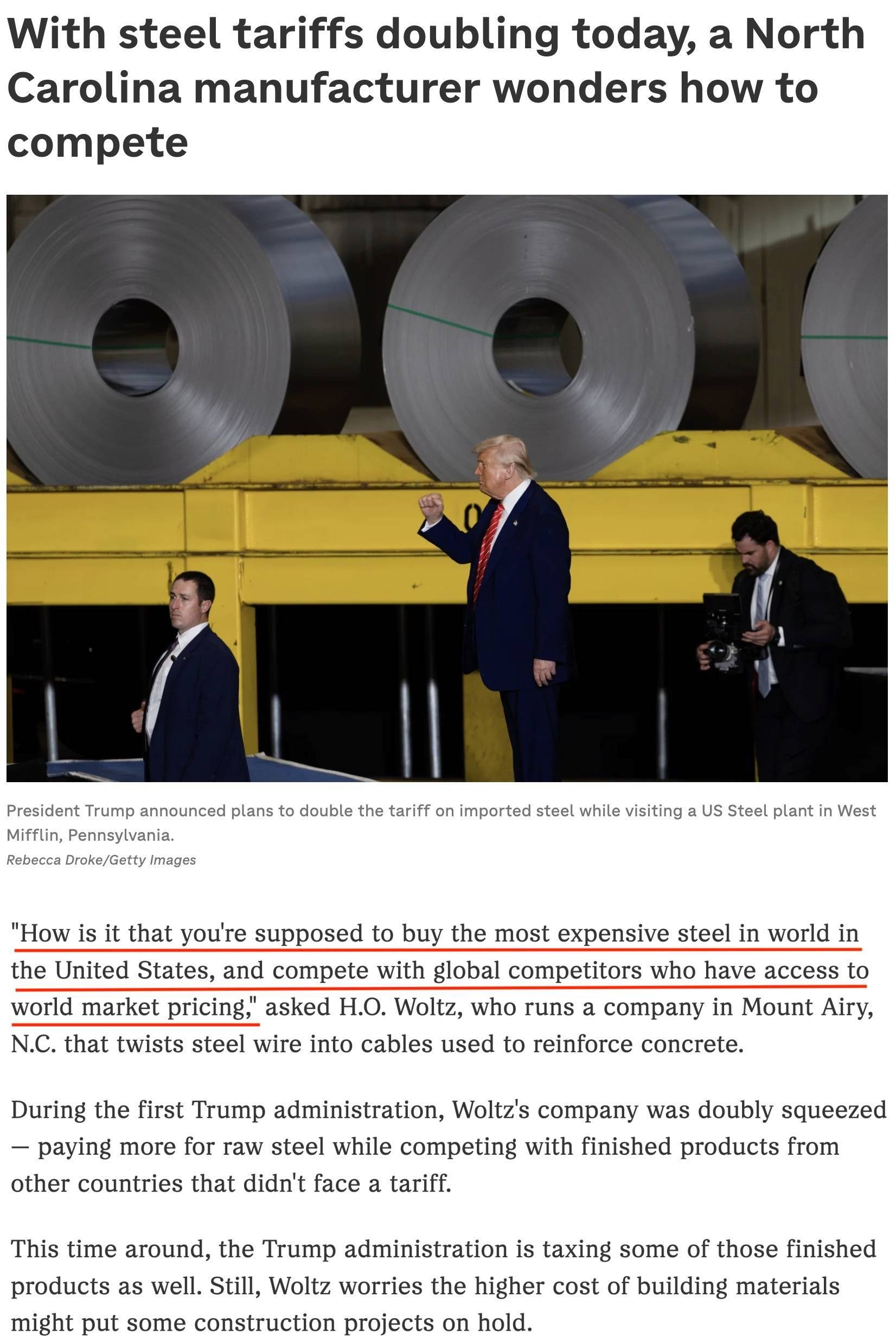
美宣布提高进口钢铝关税至50% 加拿大总理:毫无正当性
news flash· 2025-06-04 18:35
Core Viewpoint - Canadian Prime Minister Mark Carney stated that the U.S. tariffs on steel and aluminum lack justification and legal basis, negatively impacting both American workers and industries as well as Canadian industries [1] Group 1 - Canada is the largest supplier of steel and aluminum to the U.S. [1] - Carney indicated that Canada will respond to the tariffs imposed by the U.S. [1]
特朗普将钢铝关税提高至50%的命令生效,英国得以豁免上调。
news flash· 2025-06-04 04:04
Group 1 - The core point of the article is that President Trump has increased tariffs on steel and aluminum to 50%, while the UK has been granted an exemption from this increase [1] Group 2 - The increase in tariffs is part of a broader trade policy aimed at protecting domestic industries [1] - The exemption for the UK may influence trade relations and negotiations between the US and other countries [1]
山金期货黑色板块日报-20250604
Shan Jin Qi Huo· 2025-06-04 03:43
1. Report Industry Investment Rating - Not provided in the report 2. Core Views of the Report - For the steel market, with Trump raising steel and aluminum tariffs to 50%, there is greater pressure on steel exports. The policy - driven positive factors have basically been priced in. The real - estate market in core cities has stabilized, while that in lower - tier cities is still bottoming out. The peak of apparent demand has passed, and with the arrival of the rainy season and high - temperature weather, demand will further weaken. The market is shifting from strong reality to weak reality, and the weak expectation remains unchanged. Technically, prices have broken through the recent trading range and are expected to continue the downward trend [1]. - For the iron ore market, steel mills' profitability is acceptable, but iron - water production is expected to decline further due to the end of the downstream consumption peak and steel - mill production restrictions. The global iron - ore shipment is at a relatively high level and rising seasonally. The port inventory decline is slowing down, and the high proportion of trade - mine inventory exerts pressure on futures prices. The futures price may break downward under the influence of falling steel prices [3]. 3. Summary by Relevant Catalogs 3.1. Threaded Steel and Hot - Rolled Coil - **Market Factors**: Trump's tariff increase, real - estate market conditions, demand seasonality, and limited impact of production - cut rumors. The market is changing from strong to weak reality, and prices are expected to continue falling [1]. - **Operation Suggestion**: Hold short positions [1]. - **Data Summary**: - **Prices**: The closing prices of threaded - steel and hot - rolled - coil futures and spot prices have declined. For example, the threaded - steel futures main - contract closing price is 2,928 yuan/ton, down 1.74% from last week [1]. - **Production**: The national building - materials steel - mill threaded - steel production is 225.51 tons, down 2.58% from last week, while hot - rolled - coil production is 319.55 tons, up 4.54% [1]. - **Inventory**: The total inventory of five major steel products has decreased. For instance, the threaded - steel social inventory is 394.59 tons, down 5.25% from last week [1]. - **Trading Volume**: The national building - materials trading volume (7 - day moving average) is 13.95 tons, down 30.08% from last week [1]. 3.2. Iron Ore - **Market Factors**: Steel mills' iron - water production is expected to decline. The global iron - ore shipment is rising seasonally, and port inventory decline is slowing. The futures price may break downward [3]. - **Operation Suggestion**: Hold short positions lightly [3]. - **Data Summary**: - **Prices**: The settlement price of DCE iron - ore futures main contract is 695.5 yuan/dry ton, down 0.43% from last week. Spot prices of various iron - ore powders have also declined [3]. - **Shipment**: The global iron - ore shipment in the week of May 27 - June 2, 2025, is 3,431.0 tons, up 242.3 tons from the previous week [5]. - **Inventory**: The port inventory of iron ore is 13,866.58 tons, down 0.87% from last week. The inventory of imported sintered powder ore in 64 sample steel mills is 1,210.52 tons, down 2.65% [3]. - **Shipping and Exchange Rates**: BCI freight rates have increased, and the US dollar index has risen 0.55% [3].
24小时环球政经要闻全览 | 6月4日
Ge Long Hui A P P· 2025-06-04 00:57
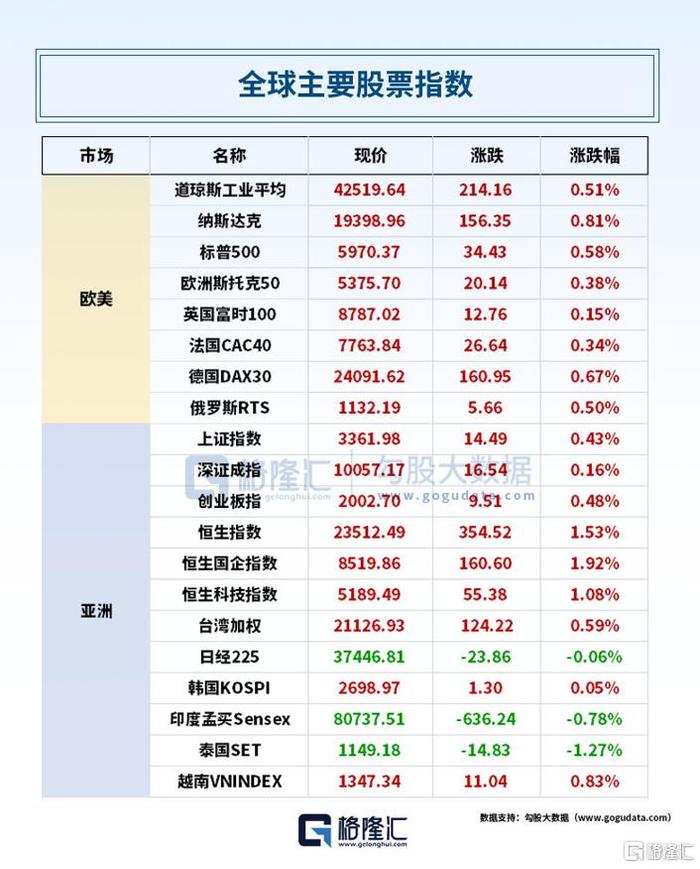
Market Overview - Major US indices showed positive performance with the Dow Jones Industrial Average up by 0.51% to 42,519.64, Nasdaq increased by 0.81% to 19,398.96, and S&P 500 rose by 0.58% to 5,970.37 [2] - European markets also experienced gains, with the European Stoxx 50 up by 0.38% to 5,375.70 and Germany's DAX 30 rising by 0.67% to 24,091.62 [2] - In Asia, the Hang Seng Index increased by 1.92% to 8,519.86, while the Indian Sensex fell by 0.78% to 80,737.51 [2] Steel and Aluminum Tariffs - The US government announced an increase in tariffs on imported steel and aluminum from 25% to 50%, effective from June 4, 2025 [3] - Tariffs on steel and aluminum imports from the UK will remain at 25% until a new agreement is reached by July 9 [4] South Korea's Political Landscape - Lee Jae-myung of the Democratic Party was confirmed as the President of South Korea with a vote share of 49.42%, while his main opponent received 41.15% [4] - Lee emphasized his commitment to boosting the economy and improving living standards from the moment of his election [4] Ukraine Conflict - Ukraine's security agency reported a successful underwater attack on the Crimean Bridge, marking the third assault on the structure [5] - The operation involved 1,100 kg of TNT, causing significant damage to the bridge's underwater supports without civilian casualties [5] US Economic Outlook - The OECD revised down its global economic growth forecasts for 2025 and 2026 to 2.9%, a decrease of 0.2 and 0.1 percentage points respectively [11] - The US economic growth forecast for this year was also lowered to 1.6%, down by 0.6 percentage points from previous estimates [11] Nvidia's Market Position - Nvidia regained its position as the world's most valuable publicly traded company with a market capitalization of $3.45 trillion, surpassing Microsoft [12] - The stock rose approximately 3% on the day, with a month-to-date increase of nearly 24% [12] Tesla's Sales Performance - Tesla's new car sales in the UK fell by 45.8% year-on-year in May, totaling 1,758 vehicles, despite an overall increase in new car registrations in the country [13] Volkswagen's Workforce Changes - Volkswagen announced that around 20,000 employees have agreed to voluntary departure as part of a restructuring plan to address uneven demand [14] - The company aims to reduce costs significantly at its Wolfsburg plant and accelerate its transformation [14] Semiconductor Industry Developments - Broadcom announced the delivery of its Tomahawk® 6 series switch chip, achieving a record industry capacity of 102.4 Tbps per chip, doubling the bandwidth of existing Ethernet switch products [14]


加拿大总理办公室称,美国对加拿大钢铝加征关税“不合法且不合理”;政府正进行紧张且“实时的谈判”,以促使美国取消关税。
news flash· 2025-06-04 00:28
Core Viewpoint - The Canadian government asserts that the U.S. tariffs on Canadian steel and aluminum are "illegal and unreasonable" and is engaged in urgent and "real-time negotiations" to persuade the U.S. to lift these tariffs [1] Group 1 - The Canadian government is actively negotiating with the U.S. regarding the tariffs [1] - The tariffs imposed by the U.S. on Canadian steel and aluminum are characterized as unjust by the Canadian government [1] - The negotiations are described as tense and ongoing, indicating a high level of urgency [1]