AI视频

Search documents
AI视频的“1毛钱战争”与“万亿生意”
创业邦· 2026-01-30 06:07
Core Insights - The article discusses the rapid evolution of AI video technology, highlighting the competitive landscape between companies like ByteDance's Jimo AI and Kuaishou's Keling AI, which are racing to innovate and capture market share in the burgeoning AI video sector [5][11][12]. Group 1: AI Video Technology Advancements - AI video technology is iterating quickly, with companies releasing new models and features at an unprecedented pace, such as PixVerse's project that generates videos based on user prompts and Runway's Gen 4.5 model that mimics professional cinematography [5][7]. - The competition is fierce, with companies like Jimo AI and Keling AI undergoing multiple iterations of their core products, indicating a "gold rush" mentality in the AI video space [9][11]. - The advancements in AI video capabilities are expected to extend beyond short videos to include longer formats like dramas and films, potentially leading to a significant market explosion [9][11]. Group 2: Differentiation in Product Strategy - Jimo AI focuses on optimizing its multi-modal model, Seedance, which supports various content types, while Keling AI emphasizes refining its video generation model for better user experience [16][20]. - The two companies have adopted different approaches: Jimo aims for technological breakthroughs, while Keling prioritizes product innovation and user control features [22][31]. - Jimo's strategy has resulted in a much larger user base, with 20.37 million monthly active users compared to Keling's 4.5 million, showcasing the effectiveness of its approach [28]. Group 3: Financial Performance and Market Position - Keling AI's revenue is primarily driven by professional creator subscriptions, with a projected annual revenue of 1 billion yuan, while Jimo AI has yet to break the 100 million yuan mark in annual recurring revenue [37][39]. - The article notes that Keling's business model is more focused on immediate revenue generation, while Jimo is investing heavily in long-term growth potential [32][41]. - Jimo's aggressive pricing strategy, with video generation costs as low as 0.1-0.19 yuan per video, contrasts sharply with Keling's higher costs, which can reach 1.25-1.5 yuan per video [44]. Group 4: Challenges and Future Outlook - Despite the rapid advancements, the AI video generation market faces challenges, including high production costs and low user retention rates for some products [35][33]. - The article suggests that while Keling has established a solid user base, the long-term potential for Jimo could be significantly larger, with estimates suggesting a market size ten times that of its current operations [41][42]. - The future of AI video generation remains uncertain, with both companies navigating different strategies to capture market share and adapt to evolving consumer needs [50].



AI视频的“1毛钱战争”与“万亿生意”
3 6 Ke· 2026-01-29 01:31
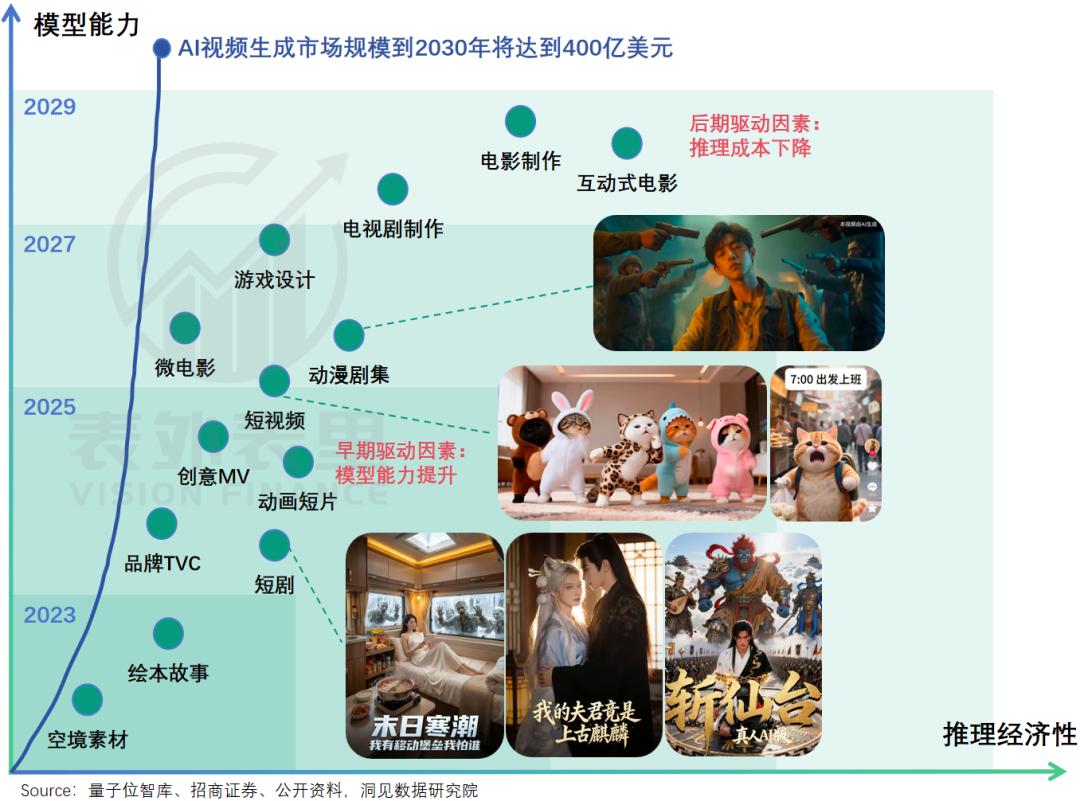
不止海外,国内公司也踩死油门,字节旗下的即梦AI,核心版本两年内历经9次关键迭代;快手的可灵AI,问世以来升级30余次。厂商们"你追我赶",一 个模型月初份额很高,月底就可能被挤下去。 它们卷生卷死,在于退一步是"流量危机",进一步是"万亿蓝海"。 抖音、快手们的成功,证明了"视频"杀时间的能力,而AI视频或许还会带来更沉浸的体验。目前,已有大量AI短视频、AI短剧杀入内容平台,抢夺用户 的注意力。 AI视频技术,正以"周"为单位快速迭代。 两周前,PixVerse发布新项目:人在下边输入提示词,AI在上边同步生成视频,实现连续视觉输出。 Source:PixVerse 上周,Runway又上新Gen 4.5模型,AI在3秒内连切近、中、远景,运镜构图堪比专业导演,且人脸上的纹理清晰可见。 Source:Runway 随着模型能力提升和推理成本降低,狂热的"淘金潮"还会蔓延至漫剧、游戏甚至电影等领域,届时AI视频可能迎来一轮大爆发。 AI 不仅是技术进步,更是个性体验、内容生产和商业效率的"三重革命"。 对字节、快手等 视频 玩家来说,这是一 场 不得不跟的 牌局。只不过同一命 题,它们打出了截然不同的牌面。 ...
AI视频三岔路:Sora变现遇阻,可灵务实养家,即梦生态筑梦
3 6 Ke· 2026-01-26 04:28
Core Insights - The article discusses three distinct paths taken by companies in the AI video sector: Sora2's rapid growth but poor retention, Keling AI's successful monetization, and Jimeng AI's long-term ecological strategy [1][5][14] - The competition reflects differing understandings of AI video technology and its commercialization timing, impacting product strategies and resource allocation [16][27] Group 1: Company Performances - Keling AI has achieved over 12 million monthly active users and is projected to generate $140 million in revenue by 2025, benefiting from a clear tool positioning and monetization model targeting professional creators and enterprises [2][11] - Sora2, despite reaching 1 million downloads in just 5 days, faces a significant drop in user retention, with only 1% remaining after 30 days, indicating a lack of sustainable engagement [3][8] - Jimeng AI, backed by ByteDance, focuses on building a long-term content ecosystem rather than immediate monetization, with a user base of 8.93 million as of March 2025 [14][18] Group 2: Strategic Approaches - Keling AI's business model is centered around professional creators, with nearly 70% of its revenue coming from paid subscriptions, showcasing effective monetization [10][17] - Sora2's attempt to blend tool and social media functionalities has resulted in a lack of clarity in product positioning, leading to low user retention and engagement [10][16] - Jimeng AI emphasizes ecological construction and reducing content creation barriers, supporting AI-generated short dramas with significant funding and promotional exposure [23][18] Group 3: Industry Challenges - The high cost of generating quality videos remains a fundamental challenge, with industry estimates placing the cost at $30 to $50 per minute, complicating profitability for many AI video companies [25] - User behavior exacerbates the issue, as the need for repeated generation due to unpredictable results leads to increased costs without guaranteed outputs [26] - The future of AI video will depend on balancing technology, ecology, and sustainability, with companies needing to address the controllability of generated content to transition from novelty to reliable tools [27][25]

可灵开年爆火 万兴科技等第三方提供商引领AI视频生成赛道
智通财经网· 2026-01-23 09:48
Core Insights - The video AIGC sector is experiencing a significant "strong realization" moment, with Kling AI surpassing 12 million monthly active users and a 350% increase in paid users on the app [1] - Kling AI's revenue for 2025 is projected to reach $140 million, significantly exceeding the initial target of $60 million, with December 2025 alone generating over $20 million [1] - The commercial viability of AI video generation is being recognized, moving beyond mere technical demonstrations to widespread practical applications [1] Group 1: Market Dynamics - AI video creation is crossing a critical threshold, with user scale, usage frequency, and payment capabilities forming a positive feedback loop [2] - Enhanced generation capabilities lead to clearer usage value, while efficiency improvements in real production scenarios drive users to continue paying for tools [2] - The market is shifting from "can it generate" to "is it worth paying for and can it be reliably used in production" [2] Group 2: Technological Advancements - The acceleration in AI video creation is driven by the maturity of multimodal models and video generation technologies, improving coherence, stylistic consistency, and controllability [2] - Optimizations in computing costs and inference efficiency are lowering the barriers for large-scale usage [2] - The demand from users is evolving, with a surge in interest for AI video content, particularly in emerging sectors like AI comic dramas [2] Group 3: Company Case Study - Wankang Technology exemplifies the integration of AI capabilities into creative tools, building a comprehensive product matrix around video generation, editing, and templated production [3] - The establishment of the "AI Video Large Model Laboratory" in collaboration with Huawei Cloud has led to the development of advanced multimedia models with notable performance in professional video production [3] - The recent launch of Wankang's updated video editing software enhances the efficiency of the entire video creation process, reducing time and cost associated with switching between multiple tools [3] Group 4: Industry Applications - Wankang Technology's capabilities have been validated in high-standard projects such as the National Games and Hunan TV's Mid-Autumn Festival event, highlighting the importance of content quality, delivery stability, and compliance [5] - The evaluation criteria for AI video in practical applications are shifting towards cost reduction, efficiency enhancement, and compliance [5] - The strong commercial performance of Kling AI indicates a transition in the AI video sector from early technical development to practical application, focusing on refining tools and optimizing workflows to meet diverse creative needs [5]

AI视频独角兽Higgsfield:靠“伺候”社媒营销人,9个月赚了2亿美元
3 6 Ke· 2026-01-22 12:49
Core Insights - In 2025, AI is rapidly producing videos, with Higgsfield emerging as a leading player in the AI video startup space, achieving a valuation of $1.3 billion after raising $80 million in funding [1][3][17] - Higgsfield's user base has grown to over 15 million within 9 months, generating 4.5 million videos daily and doubling its annual revenue to $200 million in just two months [1][16] - The company's success is attributed to its focus on social media marketers, with 85% of users utilizing the platform for brand content and marketing materials [1][14] Company Overview - Higgsfield is positioned as a full-stack AI video workflow tool aimed at creators and marketing teams, emphasizing collaboration and modular video production [4][10] - The platform features a central workspace called Canvas, where users can design scenes and manage visual styles, supported by a multi-agent collaboration system that mimics a virtual film crew [4][10][12] - Higgsfield's tools are designed to meet the needs of the advertising industry, offering over 50 preset camera movement modes and advanced editing capabilities [10][12] Business Model and Strategy - The company employs a "creator-first" strategy, focusing on monetizable content creation and providing tools that align with professional workflows [1][14] - Higgsfield incentivizes creators through a "creator bonus" program, offering up to $100,000 weekly to encourage content production [14][16] - The platform's revenue model is validated by its rapid growth, achieving an annual recurring revenue (ARR) of $200 million within 9 months [16] Industry Trends - The AI video generation market is experiencing significant investment, with multiple companies securing large funding rounds, indicating a competitive landscape [17][18] - Companies like Aishi Technology and Shengshu Technology are also gaining traction, with innovative products and substantial user bases [17][18] - The trend is shifting towards integrated multi-modal models that combine generation, distribution, and monetization, moving away from single-point tools [23]

软件ETF(515230)涨超1.6%,近10日净流入超28亿元,海外多模态有望在2026年进一步迭代
Mei Ri Jing Ji Xin Wen· 2026-01-22 04:58
Group 1 - The software ETF (515230) rose over 1.6%, with a net inflow of over 2.8 billion yuan in the past 10 days, indicating strong investor interest [1] - Multi-modal technology is expected to be a key factor in AI applications by 2026, benefiting primarily AI video and robotics/autonomous driving sectors [1] - In the AI video sector, advancements such as the resolution of physical consistency issues with Sora2 and Veo3 are expected to accelerate development, with a generative environment anticipated by Q4 2025 [1] Group 2 - The software index (H30202) tracked by the software ETF reflects the overall performance of publicly listed companies in the software industry, focusing on system software, application software development, and related services [1] - The index emphasizes the information technology sector, characterized by high growth potential and innovation [1] - Long-term prospects for AI video based on multi-modal technology are expected to provide rich "spiritual nourishment" for humanity [1]
AI视频迎来了它的DeepSeek时刻
Jing Ji Guan Cha Wang· 2026-01-21 06:39
Core Insights - PixVerse R1, launched by Aishi Technology, represents a significant advancement in AI video generation, allowing users to create videos in real-time without needing prompts, marking a transformative moment in the AI video industry [1][2][4] Group 1: Product Features - PixVerse R1 can generate videos instantly, adapting to user commands with remarkable speed, creating an immersive digital world where user input directly influences the narrative [1][3] - The model utilizes an Omni native multimodal architecture, integrating text, images, audio, and video into a unified processing framework, enhancing its generative capabilities [3][4] - It employs a self-regressive flow generation method, allowing it to remember previous inputs and generate content with a "long-term memory," which differentiates it from traditional video generation methods [4][7] Group 2: Market Impact - Aishi Technology secured a strategic investment of $14.2 million from Chinese company Ruyi, which will facilitate collaboration in film, streaming, and gaming sectors, indicating strong market interest in PixVerse R1 [5][6] - The partnership aims to explore innovative applications of AI technology in the film industry, highlighting the potential for significant transformation in content creation [6][7] - The product has already attracted attention from various game companies, indicating its potential to revolutionize interactive media and gaming experiences [8][9] Group 3: Competitive Landscape - Aishi Technology is positioned as a leader in the real-time video generation space, with no other companies having launched similar products, showcasing its competitive edge [7][9] - The company has rapidly gained traction, with over 100 million global users and a monthly active user count exceeding 16 million, reflecting its strong market presence [9][10] - The PixVerse R1 is recognized as the first universal real-time world model supporting up to 1080P resolution, setting a new standard in the industry [9][10] Group 4: Future Prospects - The introduction of PixVerse R1 is expected to blur the lines between video production and consumption, allowing users to generate and edit content in real-time, thus redefining user engagement in media [7][11] - The technology is anticipated to enable new forms of interactive storytelling and AI-native games, where narratives evolve based on user interactions, creating a dynamic digital ecosystem [7][8] - Aishi Technology's founder emphasizes that PixVerse R1 represents a new media form, where AI can create a continuously evolving world based on user intent, marking the beginning of a new era in real-time content generation [11]

互联网传媒周报:AI应用二级投资机会-20260112
Shenwan Hongyuan Securities· 2026-01-12 07:14
Investment Rating - The industry investment rating is "Overweight," indicating that the industry is expected to outperform the overall market [11]. Core Insights - The report highlights that AI applications are entering a critical phase of user growth and monetization, with significant developments in both domestic and international markets [2][3]. - The report emphasizes the importance of capturing marginal changes in the industry and being aware of rotation rhythms, particularly in the context of AI applications [2]. - Key companies in the gaming and media sectors are identified as having strong potential due to low price-to-earnings (PE) ratios and upcoming seasonal demand [3]. Summary by Relevant Sections Industry Overview - The report discusses the transformation of traffic operation mechanisms driven by technological advancements, which will impact marketing and e-commerce services [3]. - It notes that AI assistants are expected to reshape traffic patterns, with companies leveraging e-commerce advantages [3]. Gaming Sector - The gaming sector is highlighted for its low PE ratios and potential growth during the upcoming Spring Festival, with recommendations for companies like Giant Network and 37 Interactive Entertainment [3]. AI Video and IP - The report mentions the rapid advancement of AI video and domestic AI comic dramas, with a focus on copyright as a core competitive advantage [3]. Key Company Valuations - A detailed valuation table is provided, showcasing the market capitalization, revenue, and profit forecasts for key companies in the sector, indicating growth potential and varying PE ratios [5].
字节“上新”AI视频应用,正面迎战OpenAI、阿里
3 6 Ke· 2026-01-09 11:25
Core Insights - 2025 is a significant year for ByteDance's app factory, with Doubao leading AI applications with over 100 million daily active users, and Hongguo short videos surpassing 200 million monthly active users [1] - Despite these successes, the core platform Douyin may become a vulnerability for ByteDance, especially with the emergence of competitors like OpenAI's Sora App, which briefly gained popularity [1][11] - The launch of the new app "Suibian" by ByteDance aims to fill potential gaps in the short video market and explore the next generation of video platforms [3][4] ByteDance's New App "Suibian" - "Suibian" is positioned as a trendy community under Douyin, aiming to attract users with AI features and creative video ideas [4][6] - The app serves as both a defensive measure against competition and an experimental platform for new video functionalities [3][6] - Initial user feedback indicates mixed reactions, with some praising it as a "pure version of Douyin" while others criticize it for being another similar app [7] Competitive Landscape - OpenAI's Sora App, despite initial success, faced significant user retention challenges, highlighting the difficulties of maintaining engagement on AI-driven platforms [11][13] - Alibaba's Qianwen App is also entering the AI video space, introducing features like "AI Theater" to differentiate itself from Doubao and attract users [15][17] - The competition is intensifying as both Douyin and Kuaishou are actively developing AI video and social platforms, indicating a strategic race for the next generation of entertainment [19][21] Future Trends - The integration of AI capabilities in video and social interactions is expected to become increasingly important, with users seeking more engaging and personalized experiences [19][23] - As the technology matures and costs decrease, applications like Keling AI may transition to free models, potentially increasing user adoption and competition in the AI video space [23][24] - The ongoing developments suggest a looming battle among major players for dominance in the AI entertainment sector, with significant implications for user engagement and content creation [24]