
食品安全

Search documents
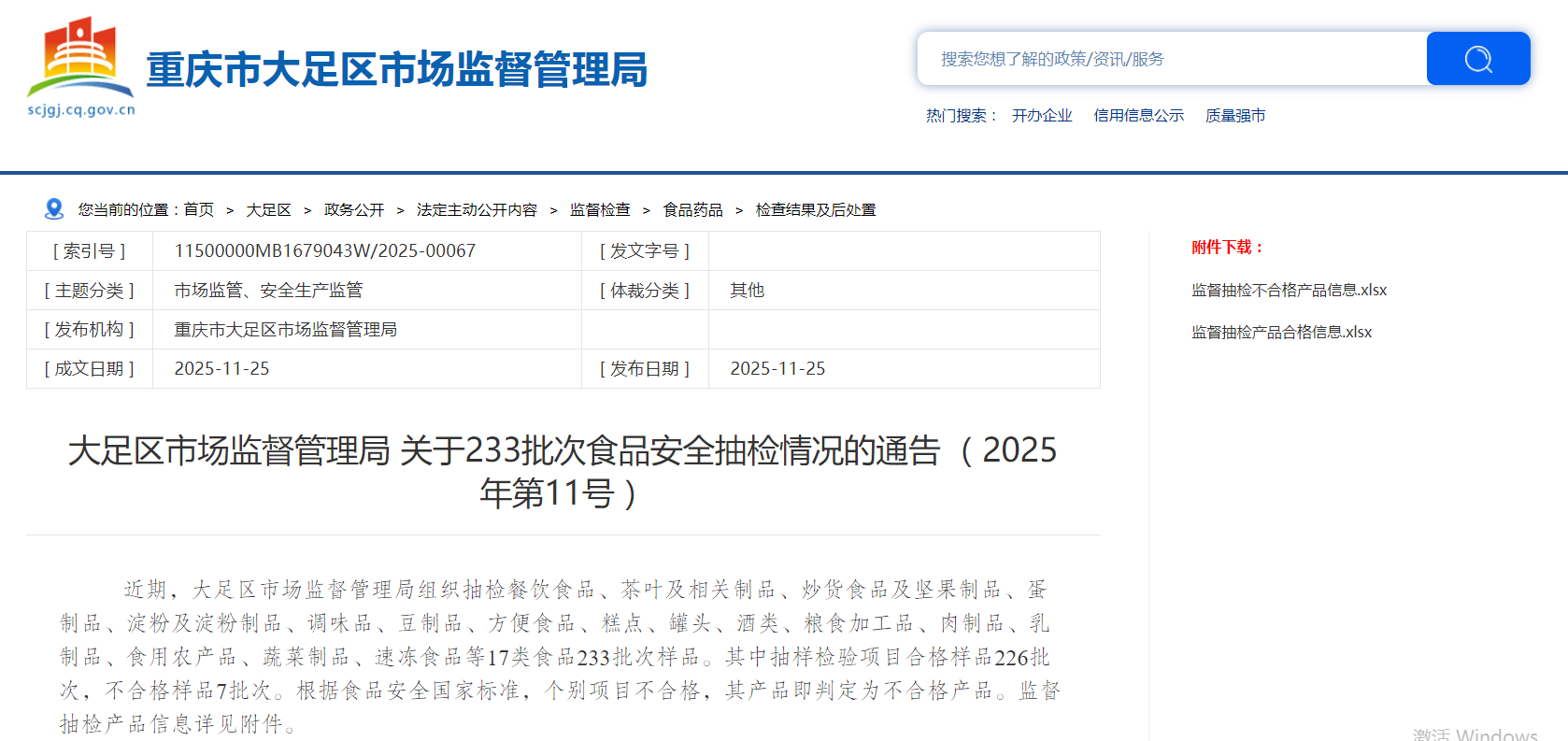
重庆市大足区市场监督管理局关于233批次食品安全抽检情况的通告 (2025年第11号)
Zhong Guo Zhi Liang Xin Wen Wang· 2025-12-03 08:17
Summary of Key Points Core Viewpoint The Dazhu District Market Supervision Administration conducted a food safety inspection, revealing that out of 233 food samples tested, 226 were compliant while 7 were found to be non-compliant, prompting immediate corrective actions and product recalls [3]. Group 1: Inspection Results - A total of 233 food samples were tested across 17 categories, including dairy, meat, and processed foods [3]. - 226 samples passed the inspection, while 7 samples failed to meet national food safety standards [3]. - The non-compliant products were subjected to legal actions and risk control measures, including recalls and analysis of the causes of non-compliance [3]. Group 2: Non-Compliant Products - Specific non-compliant products included dried longan with a sulfur dioxide residue of 0.233 g/kg, exceeding the permissible limit of 0.05 g/kg [3]. - Other non-compliant items included fried sunflower seeds and various nut products with peroxide values exceeding the acceptable limits [3]. - The inspection identified multiple vendors and their respective non-compliant products, necessitating further investigation and corrective measures [3].

浙江省丽水市市场监管局食品安全监督抽检信息通告 (2025年第15期)
Zhong Guo Zhi Liang Xin Wen Wang· 2025-12-03 07:03
Core Viewpoint - The Lishui Market Supervision Administration conducted a food safety inspection of 180 samples across 21 categories, revealing 173 compliant and 7 non-compliant samples, with issues related to pesticide residues, food additives, and quality standards [2][4][6]. Group 1: Pesticide Residue Exceedances - Non-compliance was found in the sale of small台芒 by Qingtian County Fangxin Supermarket, with the pesticide residue of pyraclostrobin exceeding the national food safety standard [2]. - Non-compliance was also noted for yam sold at Chen Cailing's stall in Qingtian County Oil Bamboo Street Market, with residues of mefenoxam and mefenoxam manganese salt exceeding the national food safety standard [2][3]. Group 2: Exceedances of Food Additives - A non-compliance case was reported for self-made hot pot rice noodles sold at Zhenxian Spicy Hot Pot in Qingyuan County, where the level of dehydroacetic acid and its sodium salt exceeded the national food safety standard [4]. - The product "Lotus Leaf, Honeysuckle, and Poria Drink" sold by Qianhe Pharmaceutical Co., Ltd. on Tmall was found to have a sulfur dioxide residue exceeding the national food safety standard, with the company disputing the results but failing to overturn the initial findings upon re-inspection [4]. - The yellow rice cake produced by Suichang Zhanxu Food Processing Plant also had sulfur dioxide residue exceeding the national food safety standard, with the plant disputing the results but the re-inspection confirming the initial findings [4]. Group 3: Quality Standard Non-compliance - The brewed vinegar produced by Suichang Jianguang Food Co., Ltd. did not meet the product's stated acidity standards [5]. Group 4: Regulatory Actions - The Lishui Market Supervision Administration has mandated local market regulatory authorities to immediately halt the production and sale of the non-compliant food products, implement measures such as product removal from shelves, and ensure proper follow-up actions including risk control and traceability [6].

假奶粉畅销不只造假者“有罪”
Bei Jing Shang Bao· 2025-12-02 15:53
Core Viewpoint - The exposure of a counterfeit milk powder scandal highlights severe food safety issues and the exploitation of vulnerable populations, particularly infants and the elderly, by unscrupulous manufacturers [1][3]. Group 1: Scandal Details - A recent investigation revealed that criminals mixed milk powder substitutes like milk essence, starch, and solid beverages to create fake "imported milk powder," selling it on various e-commerce platforms with a total involvement of hundreds of thousands of yuan [1]. - The counterfeit milk powder contained almost no actual milk and had a production cost of only 2 yuan, raising public outrage over the violation of food safety standards [1]. Group 2: Legal and Regulatory Implications - Three main perpetrators were sentenced to 15 years in prison for producing and selling inferior products, along with fines, emphasizing the need for strict legal repercussions against such crimes [1]. - The investigation revealed significant regulatory failures, including the fraudulent use of import identities, customs clearance, and inspection certifications, necessitating a thorough review and tightening of regulatory loopholes [1]. Group 3: Role of E-commerce Platforms - E-commerce platforms play a crucial role in connecting merchants and consumers, but they have also become hotspots for counterfeit goods, particularly in the booming live-streaming sales environment [2][3]. - The rise of live-streaming sales has led to increased instances of false advertising, misleading sales practices, and product quality issues, raising concerns about consumer safety and the integrity of the marketplace [2][3]. Group 4: Recommendations for Improvement - To combat the counterfeit milk powder issue, there is a call for comprehensive regulatory measures that include strict penalties for dishonest merchants and rigorous checks on the qualifications of vendors on e-commerce platforms [3]. - Ensuring thorough verification of product origins and maintaining accountability at every stage of the supply chain are essential to uphold food safety standards and protect consumers [3].
【西街观察】假奶粉畅销,不只造假者“有罪”
Bei Jing Shang Bao· 2025-12-02 13:43
Group 1 - The core issue highlighted is the exposure of counterfeit infant formula products, which are made from low-quality ingredients and sold under false pretenses, raising significant public outrage regarding food safety [1][3] - The counterfeit formula was produced using milk powder substitutes like milk essence, starch, and solid beverages, with a production cost as low as 2 yuan, leading to a total fraud amounting to several million yuan [1] - The case has resulted in severe legal consequences for the perpetrators, with three main offenders sentenced to 15 years in prison and fined for producing and selling inferior products [1] Group 2 - The role of e-commerce platforms is critical in the distribution of goods, acting as a bridge between sellers and consumers, but they have also become hotspots for counterfeit products due to issues like false advertising and product quality defects [2][3] - The rise of live-streaming sales has exacerbated the problem, making it essential to implement stringent regulations to prevent counterfeit goods from infiltrating the market [3] - Comprehensive regulatory measures are necessary to ensure that every step of the supply chain is monitored and that sellers are held accountable for the quality of their products, thereby safeguarding public health [3]
650万元牛奶羊奶驼奶全是“狠活” 平台失察纵容,难辞其咎
Mei Ri Jing Ji Xin Wen· 2025-12-02 13:39
Core Viewpoint - The recent investigation by CCTV has exposed a fraudulent milk powder production chain, revealing the alarming presence of counterfeit dairy products in the market, which has raised significant concerns about food safety in China [1][4]. Group 1: Fraudulent Production and Distribution - The counterfeit milk powder was produced in unsanitary conditions, using low-cost ingredients like vegetable fat and maltodextrin, and was falsely marketed as high-quality imported products [1]. - The scale of the fraud involved over 6 million yuan, with more than 6,000 boxes of fake milk powder distributed nationwide through e-commerce and social media platforms [1]. - The profit margins for the counterfeiters exceeded 10 times, with production costs ranging from 2 to 4 yuan, while retail prices on e-commerce platforms reached 30 to 88 yuan [1]. Group 2: Role of E-commerce Platforms - E-commerce platforms facilitated the distribution of counterfeit products through precise algorithmic targeting, reaching health-conscious consumers and price-sensitive groups [2]. - The low-cost, wide-reaching distribution model allowed small-scale producers to access a national market without the need for physical storefronts, significantly enhancing the scale of fraud [2]. - Trust in these platforms was manipulated by influencers promoting the products as "overseas direct supply" and "duty-free specials," which misled consumers and created a false sense of security [2]. Group 3: Regulatory and Legal Implications - Existing laws, such as the Food Safety Law and the E-commerce Law, clearly define the responsibilities of e-commerce platforms in ensuring food safety and holding them accountable for counterfeit products [3]. - The involved platforms failed to verify essential documentation for the counterfeit products, indicating a serious neglect of their regulatory responsibilities [3]. - The legal framework emphasizes that platforms cannot evade responsibility by claiming non-self-operated sales, and regulatory bodies must enhance accountability measures against negligent platforms [4].
雨润集团宣布2035年全面采购非笼养鸡蛋及鸡肉
Xin Lang Cai Jing· 2025-12-02 12:05
Core Viewpoint - Yurun Group announced its commitment to fully sourcing cage-free eggs and meat chickens in its global factories by 2035 or earlier, reflecting its dedication to sustainable food procurement and responding to growing consumer demand for health and ethical consumption [3][8]. Group 1: Commitment to Sustainable Practices - Yurun Food's decision to transition to cage-free sourcing is a key milestone in its corporate social responsibility and sustainability strategy, aiming to provide safer and healthier product choices for consumers [3][8]. - The initiative is expected to inspire more companies to join the sustainable development movement, enhancing the reputation of Chinese enterprises in the global market [3][10]. Group 2: Benefits of Cage-Free Farming - Cage-free eggs allow hens to roam indoors or outdoors, improving animal welfare and enhancing the nutritional quality of eggs while significantly reducing food safety risks, with studies showing a 25-fold lower probability of Salmonella contamination compared to caged farms [5][8]. - Cage-free meat chickens also benefit from increased space and natural behaviors, leading to better health and higher quality meat, aligning with consumer preferences for humane treatment of animals [5][10]. Group 3: Company Overview - Yurun Group is a diversified enterprise encompassing seven industries, including food, real estate, and logistics, with its food division ranked 112th among China's top 500 companies and 8th among private enterprises [10][11]. - The company operates a comprehensive food safety chain from source to end, offering a wide range of products, including fresh and frozen meats, and has established several well-known brands [10][11]. Group 4: Research and Development Leadership - Yurun Group leads the industry in research and development, being the first domestic food company to establish multiple key laboratories and research centers focused on meat processing and quality control [11]. - The company has undertaken over 40 significant national and provincial research projects, contributing to advancements in food safety and processing technologies [11].


官方通报“成都串串摊主重复使用锅底汤料”:情况属实,依法严肃处罚
Zhong Guo Xin Wen Wang· 2025-12-02 08:10
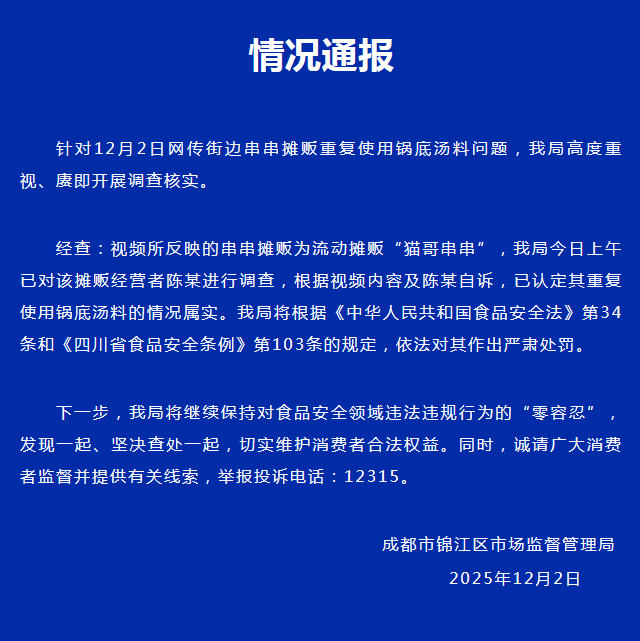
官方通报"成都串串摊主重复使用锅底汤料":情况属实,依法严肃处罚 中新网12月2日电 据"锦江市场监管"微信公众号消息,成都市锦江区市场监督管理局2日发布情况通报 称,针对12月2日街边串串摊贩重复使用锅底汤料问题,成都市锦江区市场监督管理局高度重视、赓即 开展调查核实。 经查:视频所反映的串串摊贩为流动摊贩"猫哥串串",成都市锦江区市场监督管理局今日上午已对该摊 贩经营者陈某进行调查,根据视频内容及陈某自诉,已认定其重复使用锅底汤料的情况属实。成都市锦 江区市场监督管理局将根据《中华人民共和国食品安全法》第34条和《四川省食品安全条例》第103条 的规定,依法对其作出严肃处罚。 下一步,成都市锦江区市场监督管理局将继续保持对食品安全领域违法违规行为的"零容忍",发现一 起、坚决查处一起,切实维护消费者合法权益。同时,诚请广大消费者监督并提供有关线索,举报投诉 电话:12315。 广告等商务合作,请点击这里 本文为转载内容,授权事宜请联系原著作权人 中新经纬版权所有,未经书面授权,任何单位及个人不得转载、摘编或以其它方式使用。 关注中新经纬微信公众号(微信搜索"中新经纬"或"jwview"),看更多精彩财经资 ...
网传成都一街边串串摊贩重复使用锅底汤料 官方通报
Yang Shi Wang· 2025-12-02 08:01
央视网消息:12月2日,成都市锦江区市场监督管理局发布情况通报。针对12月2日网传街边串串摊贩重 复使用锅底汤料问题,该局高度重视、赓即开展调查核实。 经查:视频所反映的串串摊贩为流动摊贩"猫哥串串",该局今日上午已对该摊贩经营者陈某进行调查, 根据视频内容及陈某自诉,已认定其重复使用锅底汤料的情况属实。该局将根据《中华人民共和国食品 安全法》第34条和《四川省食品安全条例》第103条的规定,依法对其作出严肃处罚。 下一步,该局将继续保持对食品安全领域违法违规行为的"零容忍",发现一起、坚决查处一起,切实维 护消费者合法权益。同时,诚请广大消费者监督并提供有关线索,举报投诉电话:12315。 ...
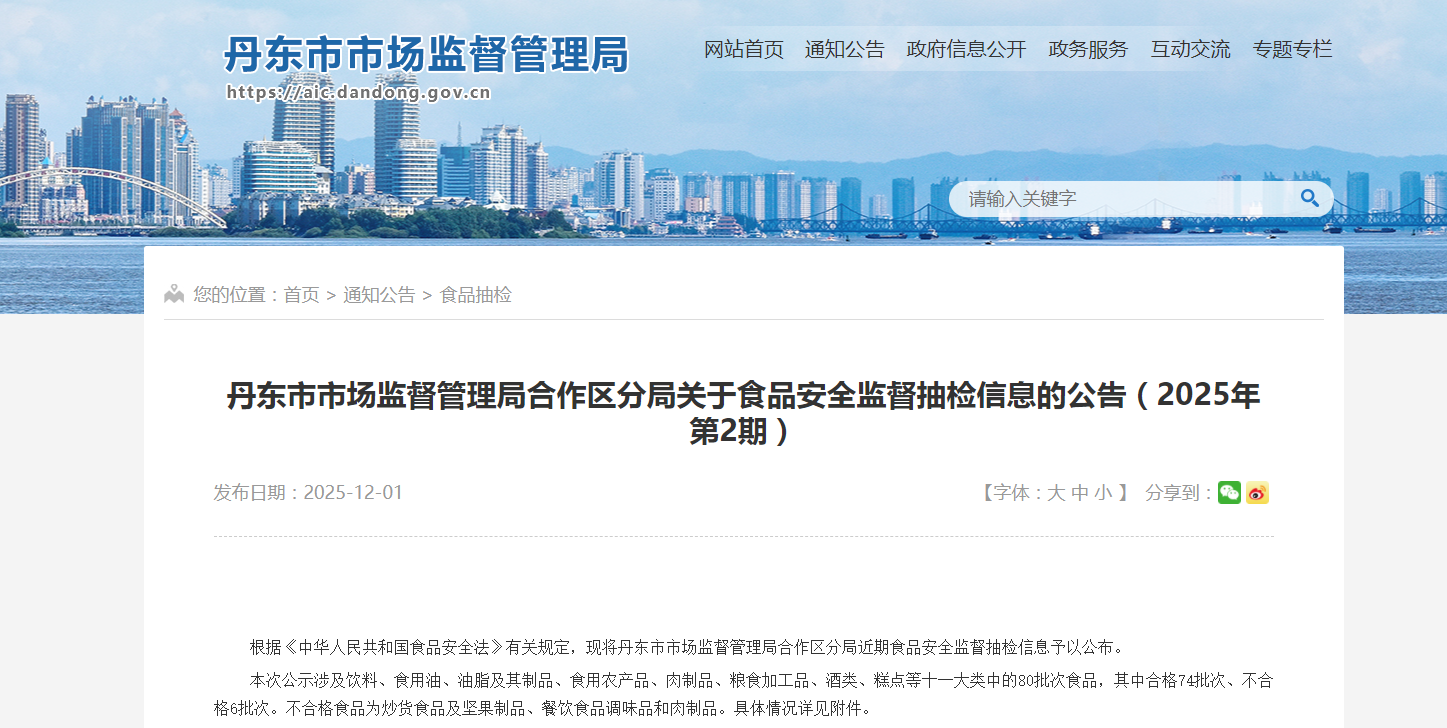
辽宁省丹东市市场监督管理局合作区分局关于食品安全监督抽检信息的公告(2025年第2期)
Zhong Guo Zhi Liang Xin Wen Wang· 2025-12-02 07:51
Summary of Key Points Core Viewpoint The Dandong Market Supervision Administration has released recent food safety inspection results, indicating that out of 80 batches of food tested, 74 were found to be compliant while 6 were deemed non-compliant. The non-compliant items include snack foods, condiments, and meat products. Relevant authorities have initiated investigations and corrective actions regarding the non-compliant products [3]. Group 1: Inspection Results - A total of 80 batches of food were tested, with 74 passing and 6 failing the safety standards [3]. - The categories of food tested include beverages, edible oils, agricultural products, meat products, grain products, alcoholic beverages, and pastries [3]. - The non-compliant products specifically include snack foods and nuts, condiments for dining, and meat products [3]. Group 2: Regulatory Actions - The Dandong Market Supervision Administration has commenced verification and handling procedures for the non-compliant food items [3]. - The announcement serves as a public disclosure of the food safety inspection results, adhering to the Food Safety Law of the People's Republic of China [3].
西贝升级“阳光厨房” 每家门店6个摄像头“直播”后厨
Xin Jing Bao· 2025-12-02 05:54
Core Viewpoint - The company Xibei is implementing enhanced food safety measures across all its stores by adopting the "Sunshine Kitchen" policy, which includes live streaming the kitchen operations to ensure transparency and customer oversight [1] Group 1: Food Safety Measures - Starting December 1, all Xibei stores will upgrade their food safety measures by fully implementing the "Sunshine Kitchen" policy [1] - Each store will be equipped with six cameras to live stream the kitchen operations, allowing continuous public supervision [1] - The founder of Xibei, Jia Guolong, announced a "food safety top priority strategy" requiring all stores to adopt the "Sunshine Kitchen" [1] Group 2: Background and Implementation - The "Sunshine Kitchen" initiative was piloted in regions like Zhejiang and Guangdong in 2013, aiming to enhance food safety transparency and promote social governance [1] - This policy is not a nationwide mandatory food safety standard; it was categorized into open transparent and video monitoring types by the Shenzhen Food and Drug Administration in 2015 [1] Group 3: Additional Measures - In addition to the "Sunshine Kitchen," each store will appoint a "Food Safety Officer" who must pass an internal food safety assessment [1] - Employees will also serve as "Food Safety Guardians," categorized into three star levels based on assessment standards, with the highest level earning a bonus of 300 yuan per month [1] - The headquarters has mandated a change in the practice of pre-setting tableware, requiring that utensils be placed only after customers are seated [1]