电动化转型

Search documents
燃油老将转身:捷达瞄准十万级新能源市场,四款新车在路上
Guan Cha Zhe Wang· 2025-08-29 04:37
Core Insights - Jetta brand plans to launch four new energy vehicles by 2028, with the first model expected to be released in 2026 [1][4] - The initiative is part of a broader strategy by Volkswagen Group (China) to capitalize on the growing entry-level electric vehicle market in China [2][3] - The compact vehicle segment is projected to account for about half of the new energy vehicle market by 2030, with entry-level models around 100,000 yuan being key growth drivers [3] Company Strategy - Volkswagen Group (China) aims to electrify the Jetta brand, introducing dedicated technology solutions for the entry-level market [2][4] - The Jetta brand's product plan is a significant part of Volkswagen's largest-ever new energy product push in China, with plans to launch around 50 new energy vehicles by 2030, including approximately 30 pure electric models [4] - A new company will be established to support the electrification transition, integrating existing resources and attracting local investment to enhance market responsiveness [5] Market Expansion - Jetta plans to expand into overseas markets, starting with Central Asia, leveraging China's manufacturing advantages and competitive products [4][5] - The new Jetta company aims to create a trillion-level industrial value chain covering research, production, supply, and sales by 2030 [5]
只会“窝里横” 一汽奥迪销量创新低:嘲讽上汽保正统
Xin Lang Ke Ji· 2025-08-29 03:49
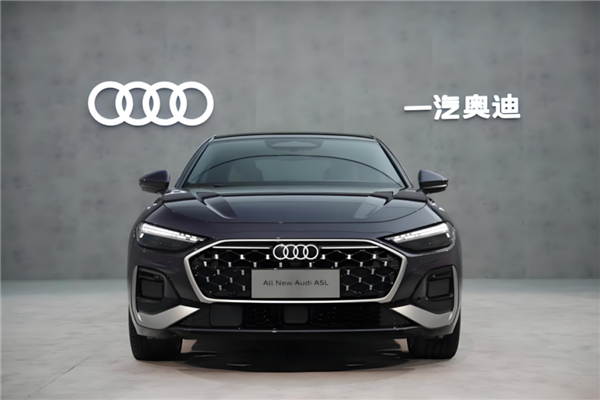
Core Viewpoint - Audi's pricing strategy has collapsed under intense competition, leading to a significant drop in sales and profits, particularly in the Chinese market, despite aggressive pricing tactics [1][12]. Group 1: Sales and Financial Performance - The 2025 model of the FAW Audi A3 has seen its base price drop to 112,400 yuan, equivalent to a 34% discount [1]. - FAW Audi's sales for 2024 are projected to plummet by 12.5% to 611,100 units, marking a new low [13]. - Audi's overall sales in China for 2024 are expected to be 649,400 units, with FAW Audi contributing 611,100 units, representing over 94% of total sales [13]. - Audi's financial report for the first half of 2025 shows a revenue increase of 5.3% to 32.57 billion euros, but a 37.5% decline in net profit to 1.346 billion euros [15]. Group 2: Competitive Dynamics - The competition between FAW Audi and SAIC Audi has intensified, with both brands targeting similar market segments but with different styling and branding strategies [6][8]. - SAIC Audi launched a new luxury electric brand, AUDI, which has further complicated the competitive landscape for FAW Audi [8][16]. - FAW Audi's recent statements emphasizing the "four rings" logo are perceived as a direct critique of SAIC Audi, highlighting the ongoing internal conflict [10][11]. Group 3: Strategic Responses - FAW Audi is attempting to revitalize its brand by introducing new models equipped with advanced technology, such as the Huawei QianKun driving system [17]. - The company has initiated a "fusion direct sales" model to streamline sales processes and pricing, which may disrupt traditional dealership operations [19][20]. - The pricing strategy for the FAW Audi A5L has been adjusted to remain competitive against SAIC Audi, with the A5L priced at 239,800 yuan, lower than SAIC Audi's A5L Sportback [7][8].

只会“窝里横”,一汽奥迪销量创新低,嘲讽上汽保正统?
Hu Xiu· 2025-08-29 02:00
Core Viewpoint - Audi's sales and profits have declined despite aggressive pricing strategies, particularly in the Chinese market, leading to internal conflicts between FAW Audi and SAIC Audi [2][4][19]. Group 1: Pricing and Sales Performance - The starting price for the 2025 FAW Audi A3 has dropped to 112,400 yuan, equivalent to a 34% discount [1]. - FAW Audi's sales fell by 12.5% in 2024, reaching a new low of 611,100 units, following a previous decline of 9.3% in 2022 [4][22]. - In contrast, Audi's overall sales in China for 2024 were 649,400 units, with FAW Audi contributing 611,100 units, accounting for over 94% of total sales [19]. Group 2: Internal Competition and Brand Strategy - FAW Audi and SAIC Audi have been in ongoing competition, with both brands targeting different market segments: FAW Audi focuses on traditional business styles, while SAIC Audi emphasizes sporty and modern designs [7]. - The launch of SAIC Audi's luxury electric brand AUDI has intensified competition, potentially undermining FAW Audi's transition to electric vehicles [11][26]. - FAW Audi's recent statements about the four-ring logo were perceived as a jab at SAIC Audi, indicating a struggle for brand identity and market positioning [15][16]. Group 3: Financial Performance and Market Position - Audi's financial report for the first half of 2025 showed a 5.3% increase in revenue to 32.57 billion euros, but a 37.5% drop in net profit to 1.346 billion euros [23]. - Audi's vehicle deliveries decreased by 5.9% to 783,500 units, with a 10.2% decline in the Chinese market [24]. - Compared to competitors, Audi's performance in China has lagged, with Mercedes and BMW achieving higher sales figures [25]. Group 4: Strategic Initiatives and Future Outlook - FAW Audi has introduced a new "fusion direct sales" model to streamline sales processes and integrate dealer networks, aiming to stabilize sales amid declining performance [32][33]. - The introduction of new models, such as the FAW Audi Q6L e-tron and A5L, is part of an effort to enhance competitiveness, although the success of these initiatives remains uncertain [28][30].
只会「窝里横」!一汽奥迪销量创新低,嘲讽上汽保正统?
Xin Lang Ke Ji· 2025-08-29 01:58
Core Viewpoint - Audi's pricing strategy has collapsed under intense competition, leading to a significant decline in sales and profits, particularly in the Chinese market [1][3][14]. Group 1: Pricing and Sales Performance - The starting price for the 2025 model of the FAW Audi A3 has dropped to 112,400 yuan, equivalent to a 34% discount [2][20]. - Despite the low pricing strategy, Audi's sales have not improved, with a reported 12.5% drop in sales for 2024, marking a new low [3][16]. - In 2024, Audi's total sales in China were 649,400 units, with FAW Audi contributing 611,100 units, accounting for over 94% of the total [14]. Group 2: Internal Competition and Brand Strategy - FAW Audi and SAIC Audi have been in ongoing competition, with both brands targeting different market segments; FAW Audi focuses on traditional business styles while SAIC Audi emphasizes sporty and modern designs [5][11]. - The launch of SAIC Audi's luxury electric brand AUDI has further complicated the competitive landscape, as it potentially undermines FAW Audi's transition to electric vehicles [7][17]. - FAW Audi's recent statements about the four-ring logo are perceived as a critique of SAIC Audi, highlighting the struggle for brand identity and market share [11][12]. Group 3: Financial Performance and Future Outlook - Audi's financial report for the first half of 2025 shows a 5.3% increase in revenue to 32.57 billion euros, but a 37.5% decline in net profit to 1.346 billion euros [16]. - The company has revised its annual revenue forecast down from 67.5-72.5 billion euros to 65-70 billion euros, with a significant reduction in expected operating profit margin from 7%-9% to 5%-7% [16]. - FAW Audi's sales decline is attributed to a lack of electric vehicle offerings and competition from new entrants in the market, necessitating a shift in strategy to regain market share [19][21].

中德合资一汽-大众捷达品牌加速电动化转型和海外布局
Zhong Guo Jin Rong Xin Xi Wang· 2025-08-29 01:49
Core Viewpoint - The collaboration between China FAW Group, Volkswagen Group (China), and Chengdu Economic Development Zone aims to establish a new company for the Jetta brand, accelerating the electrification transformation and expanding into overseas markets [1][2]. Group 1: Strategic Initiatives - The Jetta brand plans to launch five new products by 2028, including four electric vehicles, with the first model expected to debut in 2026 [2]. - The partnership emphasizes leveraging both Chinese and German strengths to enhance local operational efficiency and self-research capabilities, contributing to the high-quality transformation of the Sichuan automotive industry [1]. Group 2: Market Focus - The Jetta brand will focus on the entry-level electric vehicle market, aiming to serve a broader customer base and achieve comprehensive coverage of the mainstream segments in the new energy vehicle market [1]. - The strategy includes utilizing the Chengdu International Railway Port to diversify overseas market layouts, starting with the Central Asian market [2]. Group 3: Historical Context - FAW-Volkswagen was established on February 6, 1991, and is one of China's major automotive joint ventures, with brands including Audi, Volkswagen, and Jetta, and five production bases located in Changchun, Foshan, Chengdu, Qingdao, and Tianjin [2].
只会“窝里横”! 一汽奥迪销量创新低,嘲讽上汽保正统? | 次世代车研所
Xin Lang Cai Jing· 2025-08-29 00:49
Core Viewpoint - Audi's pricing strategy has collapsed under intense competition, leading to a significant drop in sales and profits, particularly in the Chinese market, despite aggressive pricing tactics [2][9]. Group 1: Pricing and Sales Performance - The starting price for the 2025 FAW Audi A3 has dropped to 112,400 yuan, equivalent to a 34% discount [2]. - FAW Audi's sales fell by 12.5% in 2024, reaching a new low of 611,100 units, following a previous decline of 9.3% in 2022 [11]. - Audi's overall sales in China for 2024 were 649,400 units, with FAW Audi contributing 611,100 units, accounting for over 94% of total sales [9]. Group 2: Internal Competition - FAW Audi and SAIC Audi have been in a competitive struggle, with both brands offering similar models at different price points, leading to a price war [4][5]. - The launch of SAIC Audi's luxury electric brand AUDI has further complicated the competitive landscape, as it targets the same market segment that FAW Audi aims to penetrate [12]. Group 3: Brand and Market Strategy - FAW Audi emphasizes its "four rings" branding to assert its position as the original Audi in China, while also expressing concerns over brand dilution from SAIC Audi's new branding [7][9]. - The introduction of a new "fusion direct sales" model by FAW Audi aims to streamline sales processes and improve pricing consistency, but it poses challenges for traditional dealership operations [14]. Group 4: Future Outlook and Challenges - FAW Audi's reliance on traditional fuel vehicles remains high, with over 90% of its sales coming from this segment, which is increasingly threatened by new entrants in the electric vehicle market [13]. - The success of FAW Audi's new models, particularly those equipped with Huawei's advanced driving technology, is crucial for reversing the sales decline, with potential sales increases projected for Q4 [14].
捷达品牌新公司将成立:引入本地投资,2028年前推四款入门级新能源车
Mei Ri Jing Ji Xin Wen· 2025-08-28 15:11
Core Viewpoint - The establishment of a new company for the Jetta brand aims to enhance resource integration, attract local investment, and accelerate the brand's market responsiveness, particularly in the electric vehicle sector [3][4]. Group 1: Company Strategy - The new Jetta brand company will operate as a subsidiary of Volkswagen while maximizing synergies with Volkswagen Group and FAW-Volkswagen [3]. - The Jetta brand's electrification process will be expedited, with plans to launch its first pure electric model by 2026, targeting the entry-level market [3][4]. - By 2028, the Jetta brand plans to introduce four new energy models equipped with competitive electric, digital, and advanced driver-assistance systems (ADAS) features [3][4]. Group 2: Market Expansion - The Jetta brand new company intends to leverage its competitive products and China's manufacturing advantages to explore overseas markets, starting with Central Asia [4]. - Volkswagen Group (China) predicts that by 2030, compact models will account for about half of the new energy vehicle market, with entry-level models around 100,000 yuan being a significant growth driver [4]. - The product planning for Jetta is part of Volkswagen Group's largest-ever new energy product push in China, with plans to launch approximately 50 new energy vehicles, including around 30 pure electric models, by 2030 [4]. Group 3: Local Development and Collaboration - The signing of the agreement is seen as a response to China's high-level opening-up policy and the Belt and Road Initiative, aiming to enhance local operational efficiency and self-research capabilities [4]. - The goal is to create a trillion-yuan industrial value chain encompassing research, production, supply, and sales by 2030, further integrating the Jetta brand into the automotive ecosystem in Sichuan Province and the southwest region [4].

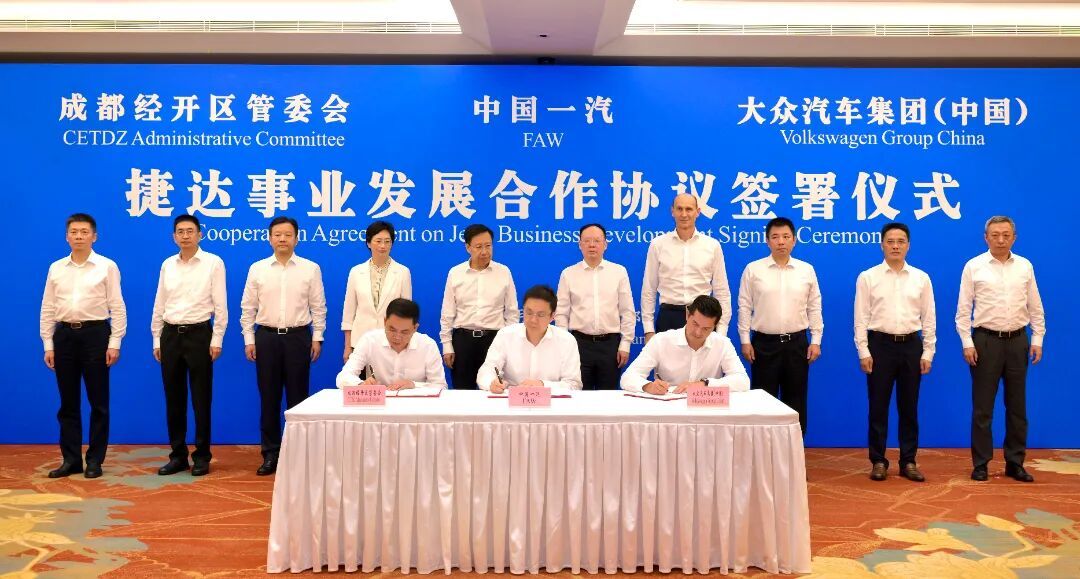
捷达加速电动化转型,三方签署合作协议
Jing Ji Guan Cha Wang· 2025-08-28 13:12
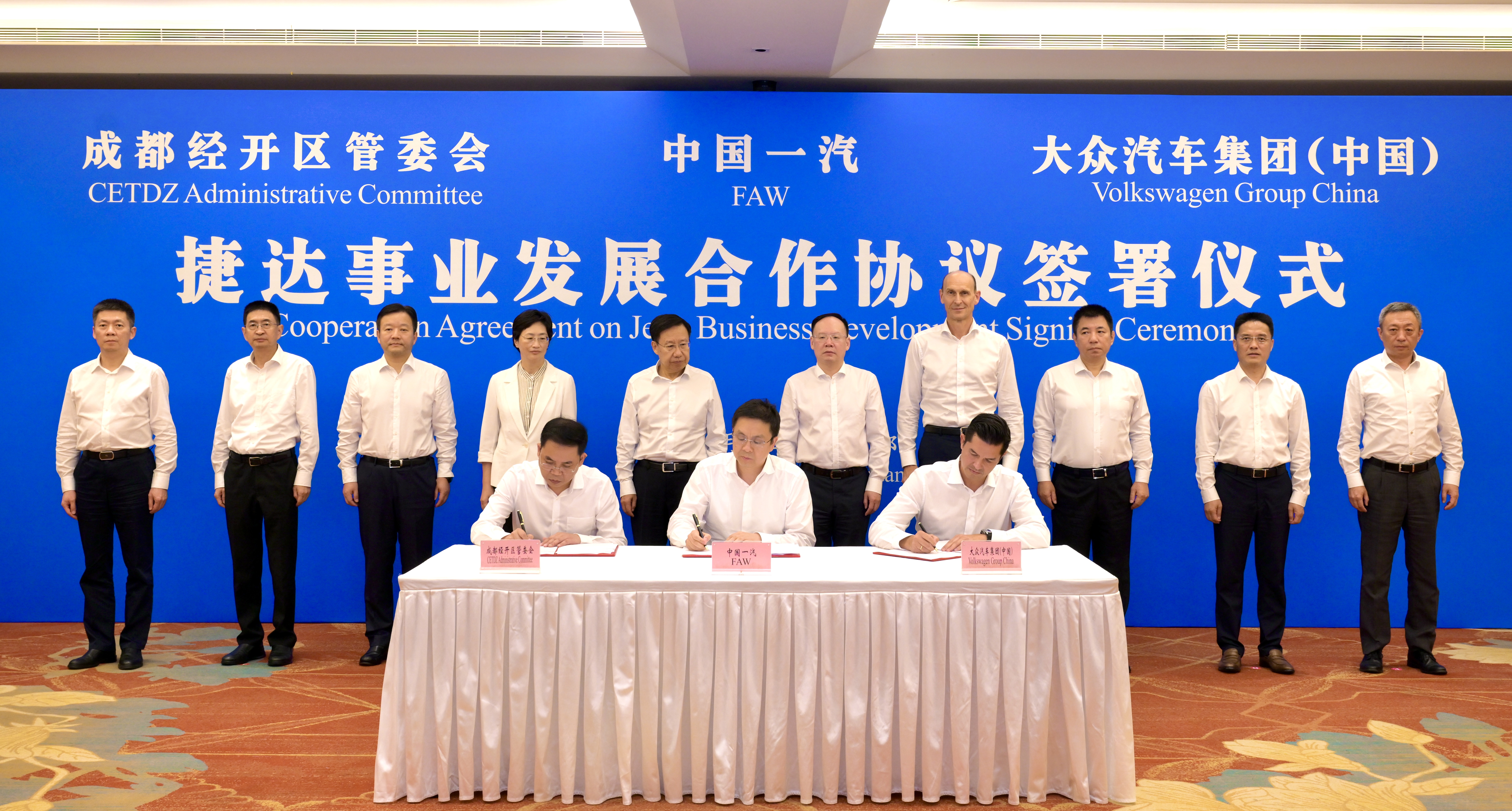
经济观察网讯,2025年8月28日,大众汽车集团(中国)、一汽集团与成都经济技术开发区签署《捷达事 业发展合作协议》,将加速捷达子品牌电动化转型并提升运营效能。 根据协议,依托成都生产基地,未来将成立捷达品牌新公司,整合现有资源并引入本地投资,以发挥区 域产业协同优势,捷达仍作为大众旗下子品牌,最大化与集团及一汽-大众的协同效应。 计划到2028年,捷达将推出四款入门级新能源车型,配备针对性技术解决方案并保持价格竞争力;同 时,依托产品及中国制造优势,以中亚为起点开拓海外市场。 ...
捷达将组建独立公司:三方合资协议签署 成都地方资本入局
Jing Ji Guan Cha Wang· 2025-08-28 13:05
Core Viewpoint - The signing of the cooperation agreement between Volkswagen Group (China), FAW Group, and Chengdu Economic and Technological Development Zone marks a significant step towards accelerating the electrification of the Jetta brand, with plans to establish a new company that integrates local investment and resources [3][4][5]. Group 1: Agreement Details - The new company will fully integrate existing Jetta resources and introduce local capital as a new investor [3]. - Jetta will continue to operate as a sub-brand of Volkswagen, maximizing synergies with the Volkswagen Group and FAW-Volkswagen [3][4]. - By 2028, Jetta plans to launch four new energy models targeting the entry-level market, equipped with competitive electric, digital, and advanced driver-assistance systems (ADAS) [3][6]. Group 2: Strategic Importance - The establishment of the new company aims to leverage regional industrial synergies to accelerate Jetta's electrification process and enhance operational efficiency [4][5]. - This partnership represents a significant transformation in Jetta's development path and joint venture model, marking a breakthrough in Volkswagen's collaboration approach [5][6]. Group 3: Market Position and Future Goals - Jetta's brand will further localize, with the introduction of local capital being a novel approach in the joint venture model [5][7]. - The goal is to create a trillion-level industrial value chain by 2030, deepening Jetta's integration within the automotive ecosystem in Sichuan Province and the Southwest region [8]. - The compact car segment, where Jetta operates, is crucial for Volkswagen's market share in China, with projections indicating that compact models will account for nearly half of the Chinese new energy vehicle market by 2030 [8][9]. Group 4: Product Strategy - The successful electrification of the Jetta brand is essential for Volkswagen to achieve full coverage in the smart new energy vehicle market, from entry-level to luxury models [9]. - Volkswagen plans to launch approximately 50 new energy vehicles in China by 2030, including around 30 pure electric models [9].
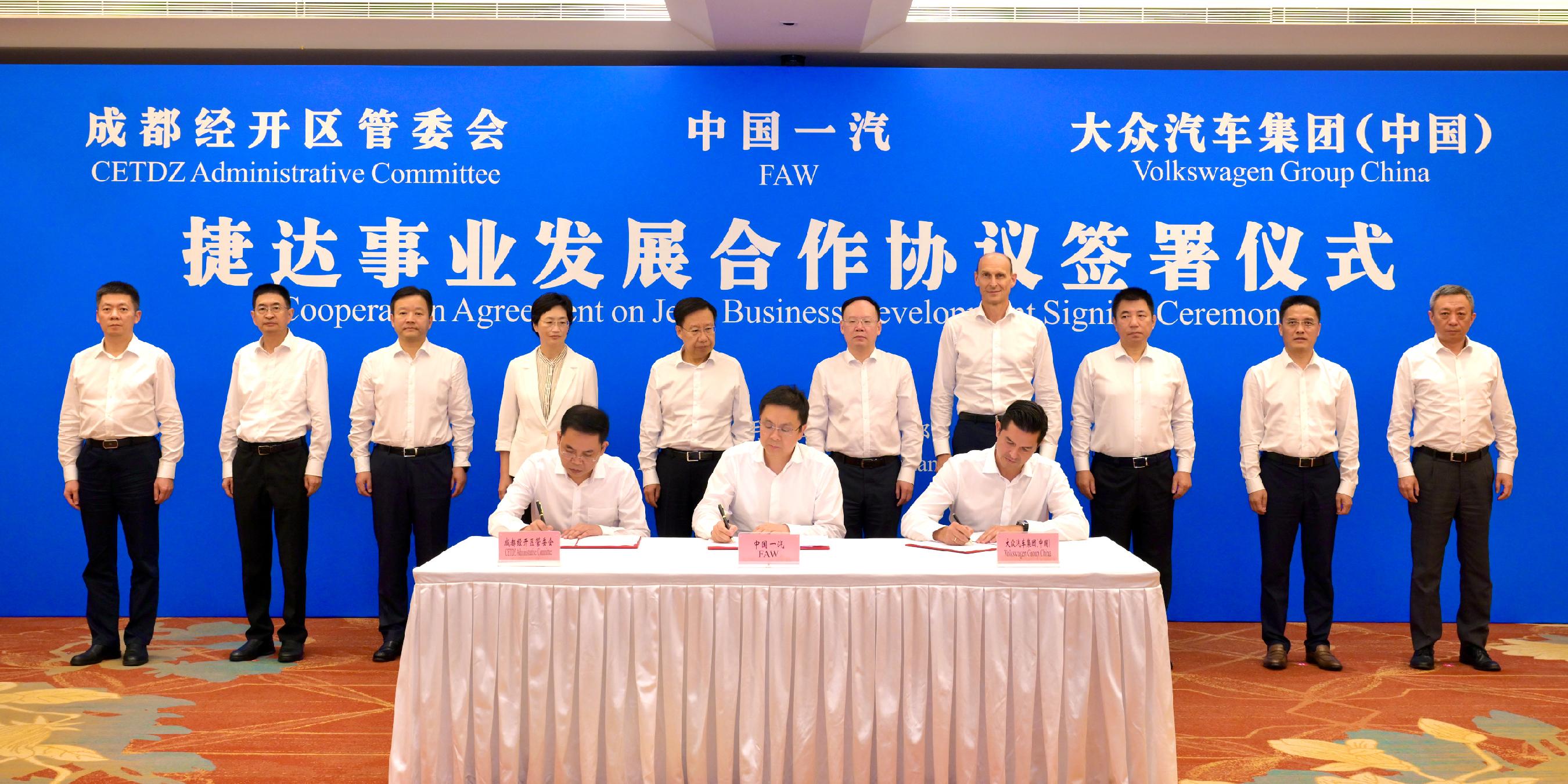
大众联手一汽、成都成立新公司,捷达电动转型剑指千亿产业链
Zhong Guo Qi Che Bao Wang· 2025-08-28 12:42
Core Viewpoint - The signing of the "Jetta Business Development Cooperation Agreement" marks a strategic partnership between Volkswagen Group (China), FAW Group, and Chengdu Economic and Technological Development Zone to establish a new Jetta brand company, aiming to develop Jetta into a leading enterprise in Sichuan's automotive industry while promoting its electrification transformation [4][5][8]. Group 1: Company Strategy and Development - The new Jetta brand company will integrate existing resources and attract local investment to enhance its market position in Sichuan [4][5]. - Jetta plans to launch its first new energy vehicle by 2026 and aims to have four entry-level new energy models by 2028, focusing on the entry-level market segment [4][6]. - The establishment of the Jetta brand company reflects Volkswagen Group's commitment to deepening its "In China, For China" strategy and innovating joint venture cooperation models [8][9]. Group 2: Market Position and Product Planning - The compact car segment is expected to account for about half of China's new energy vehicle market by 2030, with entry-level models priced around 100,000 yuan being key growth drivers [6]. - Jetta's electrification strategy aims to leverage its historical success in the affordable fuel vehicle market, having sold over 5 million units in China [6][10]. - Volkswagen Group plans to introduce approximately 50 new energy vehicles in China by 2030, including around 30 pure electric models, creating a comprehensive product matrix from entry-level to luxury vehicles [6][10]. Group 3: Collaboration and Innovation - The partnership with FAW Group and local authorities aims to enhance local operational efficiency and strengthen research and development capabilities, contributing to the high-quality transformation of Sichuan's automotive industry [7][9]. - The new Jetta company will adhere to Volkswagen's global standards while allowing local teams the flexibility to make decisions, improving market responsiveness to consumer needs [9]. - Volkswagen Group has invested over 3.5 billion euros in Hefei to establish an intelligent connected vehicle innovation center, focusing on local customer demands through collaborations with domestic companies [10].