
AI芯片

Search documents
百度回应昆仑芯分拆上市传闻:评估中 不保证最终落地
Zheng Quan Ri Bao Zhi Sheng· 2025-12-08 17:08
Group 1 - Baidu's AI chip subsidiary Kunlun Core is preparing for a Hong Kong IPO with a post-financing valuation of approximately 21 billion RMB (about 3 billion USD) [1] - Baidu has clarified that it is evaluating the proposed spin-off and listing of Kunlun Core, which requires regulatory approval, and there is no guarantee that the spin-off will proceed [1] - Kunlun Core, which was established as an independent entity in April 2021, is currently 59.45% owned by Baidu and has launched two generations of AI chips, with the second generation achieving nearly three times the computing power of the first [1] Group 2 - Successful spin-off of Kunlun Core could enhance its technological iteration and market expansion, boosting the influence of domestic AI chips [2] - Baidu's smart cloud revenue reached 6.4 billion RMB in Q3 2025, a 12% year-on-year increase, indicating the profitability of the segment supported by Kunlun Core's self-developed chips [2] - Kunlun Core has made significant commercial progress, winning a major AI computing device procurement project from China Mobile and serving over a hundred clients, including major companies like China Merchants Bank and Vivo [2] Group 3 - Morgan Stanley predicts Kunlun Core's revenue could increase from approximately 1.3 billion RMB in 2025 to 8.3 billion RMB in 2026, representing a nearly sixfold growth [3] - The potential spin-off may allow Kunlun Core to secure independent financing and accelerate expansion, but it could also weaken Baidu's control over its core computing infrastructure [3] - Future developments will depend on regulatory attitudes and strategic considerations by the company [3]

商汤、中国移动重金押注,本周10起重磅融资透视:具身智能、AI芯片成最大赢家
3 6 Ke· 2025-12-08 12:05
Group 1: Financing Events - Qingwei Intelligent completed over 2 billion RMB in Series C financing, led by Beijing-based state-owned enterprise Jingneng Group, with funds aimed at enhancing core technology R&D, product mass production, and market promotion for reconfigurable computing chips [1] - Curative raised 150 million USD in Series B financing, led by Upside Vision Fund, to reshape the U.S. healthcare insurance system with innovative plans that have no copay or deductible [2] - Luming Robotics secured several hundred million RMB in Pre-A financing, with funds allocated for continuous investment in embodied intelligence data and hardware [3] - Pollo AI raised 14 million USD in its first round of financing, with plans to use the funds for product refinement, technology development, and talent recruitment [4] - TBL New Energy completed 40 million RMB in B+ round financing to advance the industrialization of semi-solid batteries [5] - Nextie, founded by the creator of Microsoft's Xiaoice, received early investment from Qiji Chuangtan, with plans for a new round of financing in the millions of USD [6][7] - Daimeng Robotics obtained a strategic financing of over 100 million RMB, with cumulative financing reaching several hundred million RMB, aimed at technological breakthroughs and global market expansion [8] - IREN announced a total financing plan exceeding 3.6 billion USD, including 2 billion USD in convertible bonds to support AI cloud business expansion [9] - Brevo raised 583 million USD in a unicorn round, with funds to accelerate growth in the U.S. market and invest in AI R&D [10] - Artera.io received 65 million USD in growth investment, aiming for 100 million USD in annual recurring revenue by the end of 2025 [11] Group 2: Company Profiles - Qingwei Intelligent is a chip design company originating from Tsinghua University, focusing on reconfigurable computing chips for AI and IoT applications [1] - Curative is a U.S. healthcare company known for COVID-19 testing, now transitioning into health insurance [2] - Luming Robotics specializes in embodied intelligence robots and core components, collaborating with leading enterprises [3] - Pollo AI is an AI video generation platform that aggregates various advanced models for video and image creation [4] - TBL New Energy focuses on the development and industrialization of new solid-state lithium batteries [5] - Nextie aims to optimize decision-making through collaborative AI agents [6][7] - Daimeng Robotics, founded by experts from Hong Kong University of Science and Technology, innovates in tactile perception and dexterous manipulation technologies [8] - IREN is transitioning from cryptocurrency mining to AI cloud services, operating significant data center capacities [9] - Brevo, formerly Sendinblue, provides an integrated digital marketing platform for businesses [10] - Artera.io enhances patient communication through a combination of human and AI agents [11]

百度回应“拟分拆昆仑芯赴港上市”
Sou Hu Cai Jing· 2025-12-08 11:00
Core Viewpoint - Baidu has clarified that it is evaluating the potential spin-off and independent listing of its subsidiary Kunlun Chip (Beijing) Technology Co., Ltd., and there is no guarantee that this will proceed [1][2]. Group 1: Company Developments - Media reports indicated that Kunlun Chip aims to apply for a listing on the Hong Kong Stock Exchange as early as Q1 2026, with a target IPO completion in early 2027 [2]. - Kunlun Chip has recently completed a new financing round of $283 million, achieving a valuation of $2.97 billion (approximately 21 billion RMB) [2]. - The company has transitioned from being part of Baidu's internal AI chip and architecture department to an independent entity, having completed its D-round financing by July 2025 [4]. Group 2: Financial Performance and Projections - Although Baidu has not disclosed specific financial data for Kunlun Chip, it is reported that the company may achieve breakeven this year [5]. - Morgan Stanley projects that Kunlun Chip's revenue will surge from approximately 1.3 billion RMB in 2025 to 8.3 billion RMB in 2026, marking a sixfold increase [5]. - The company has secured over a hundred clients, including major firms like China Merchants Bank and Vivo, with delivery scales ranging from tens to thousands of units [4]. Group 3: Product Development - Baidu's self-developed Kunlun Chip series, including the third-generation P800 products, has entered mass production, with plans to introduce new products annually over the next five years starting in 2026 [5]. - The training cluster for Baidu's multimodal large models has expanded to over 10,000 units, with the self-developed XPU cluster achieving model computation utilization rates comparable to GPU clusters [4].

申购热度超摩尔线程,688802即将上市
Di Yi Cai Jing· 2025-12-08 11:00
作者 |第一财经魏中原 在摩尔线程(688795.SH)上市首日被市场"预付"约3000亿元市值之后,沐曦股份(688802.SH)即将登陆科创板,再度考验资本对国产算力的买单意愿。 2025年12月7日,沐曦股份(688802.SH)公告其科创板IPO网上发行最终中签率为0.03348913%,低于此前摩尔线程的0.03635%,足见投资者申购沐曦股 份的热情高涨。 作为专注高性能通用GPU及AI推理芯片的硬科技企业,沐曦股份不仅吸引了国家人工智能产业投资基金、中国电信天翼资本、京东、美团等重量级战略 投资者,更在网下询价阶段引发机构抢筹。 2025.12.08 本文字数:2099,阅读时长大约4分钟 沐曦股份是国内少数真正实现千卡集群大规模商业化应用的GPU供应商,已成功支持128BMoE大模型等完成全量预训练。截至2025年3月,沐曦股份已累 计交付超过2.5万颗GPU芯片,成功部署于新华三、苏州瑞芯、汇天网络等核心客户,完成10余个智算集群的商业化落地。 更值得关注的是,根据发行安排,沐曦股份以104.66元/股的价格公开发行4010万股,若发行后总股本为40010万股,对应发行市值已达418.74亿 ...

百度回应分拆昆仑芯上市传闻!
Sou Hu Cai Jing· 2025-12-08 08:20
Core Viewpoint - Baidu is evaluating the potential spin-off and independent IPO of its AI chip subsidiary Kunlun Chip, with no guarantee that the process will proceed [3] Group 1: Company Developments - Baidu has clarified that it is assessing the proposed spin-off of Kunlun Chip for an independent listing, which will require regulatory approval [3] - The company has shifted its business model to prioritize AI, with AI cloud services now accounting for approximately 25% of Baidu's core revenue, becoming a major growth driver [3] - Kunlun Chip has experienced rapid business growth, with external customers making up about 40% of its client base, including internet giants and state-owned enterprises [6] Group 2: Financial Projections - Morgan Stanley forecasts that Baidu's self-developed AI chip revenue will surge from 1.3 billion yuan this year to 8.3 billion yuan next year, a sixfold increase, contributing to a doubling of Baidu's GPU computing revenue by 2026 [3] - Kunlun Chip is expected to achieve revenue exceeding 1 billion yuan in 2024, surpassing other companies that have filed for or completed IPOs [6] Group 3: IPO Plans - Reports indicate that Kunlun Chip initially planned to list on the Sci-Tech Innovation Board but has since decided to pursue a listing on the Hong Kong Stock Exchange, with a timeline aiming for an application in Q1 2026 and an IPO by early 2027 [4] - The company has completed a new round of financing, with a post-investment valuation of approximately 21 billion yuan (about 3 billion USD) [4] Group 4: Product Development - Kunlun Chip has launched its second-generation AI chip, which is based on a 7nm process and significantly enhances performance and versatility, supporting major deep learning frameworks [7][8] - The latest AI chips, Kunlun M100 and M300, were announced, with M100 targeting large-scale AI inference and M300 designed for ultra-large-scale multimodal model training and inference, expected to be available in early 2026 and early 2027, respectively [8]
美国拟30个月内全面对华禁售高端AI芯片!
是说芯语· 2025-12-08 04:57
Core Viewpoint - The recent bipartisan proposal in the U.S. Congress aims to prohibit the export of advanced AI chips to countries like China and Russia, reinforcing the ongoing trend of tightening technology controls against China [1][3]. Group 1: Legislative Actions - A bipartisan bill led by Republican Senator Peter and Democratic Senator Chris requires the U.S. Department of Commerce to ban exports of AI chips that exceed current licensing standards to China and Russia within the next 30 months [1]. - This legislative move is seen as a counterbalance to potential policy relaxations by the Trump administration regarding technology exports to China [3]. - The proposal reflects a continuation of the alternating tightening and loosening of U.S. chip control policies, which can be traced back to early 2025 when Nvidia's H20 chip was added to the control list [3]. Group 2: Impact on U.S. Companies - Companies like Nvidia and AMD, which had received partial export licenses for certain chips, will find their next-generation products, such as the H200, completely barred from export to China [3]. - The U.S. government's tightening of AI chip exports has led to significant losses for American chip manufacturers, as they can no longer sell high-end GPUs to China, resulting in a substantial loss of orders [4]. Group 3: China's Response - Despite the U.S. tightening its grip on AI chip exports, China's AI development has not stalled; instead, it has accelerated due to a shift towards domestic chip production and self-reliance [3][4]. - Reports indicate that the demand for AI chips in China is increasingly being met by domestic manufacturers, with the market share of local AI chips expected to rise to approximately 40% by 2026 [4].



百度昆仑芯拟拆分上市!
国芯网· 2025-12-08 04:53
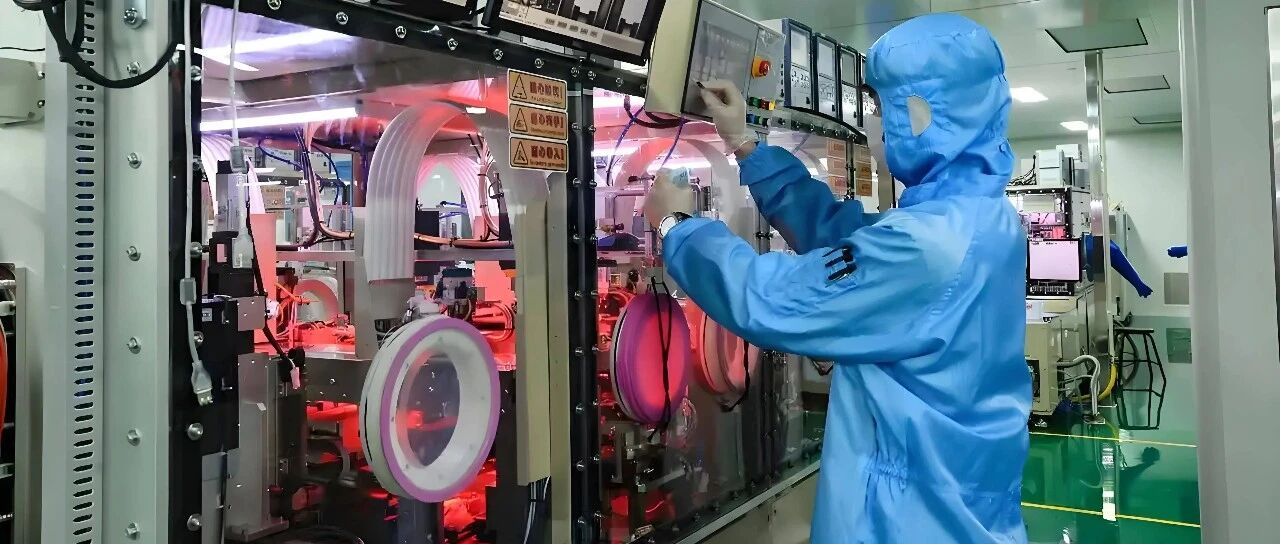
Core Viewpoint - Baidu Group is considering the spin-off and independent listing of its subsidiary Kunlun Chip (Beijing) Technology Co., Ltd., which is currently under evaluation and subject to regulatory approval [1][3]. Group 1: Company Overview - Kunlun Chip is Baidu's main entity for general AI acceleration chips, recognized as a key player in high-performance computing within China's tech sector [3]. - The company has recently completed a new round of financing, achieving a post-investment valuation of approximately 21 billion RMB [3]. - Baidu launched the "Kunlun" AI chip in 2018, which includes the training chip Kunlun 818-300 and the inference chip Kunlun 818-100, marking it as China's first cloud-based full-function AI chip [3]. Group 2: Shareholding Structure - Kunlun Chip (Beijing) Technology Co., Ltd. has 44 shareholders, with Baidu (China) Co., Ltd. as the controlling shareholder, holding a 59.4505% stake [3]. - Other notable shareholders include Beijing Artificial Intelligence Industry Investment Fund (1.4996%) and China Internet Investment Fund (1.0915%), along with CITIC Securities and BYD Company, each holding approximately 0.2729% [3].
美国拟30个月内全面对华禁售高端AI芯片!
国芯网· 2025-12-08 04:53
Core Viewpoint - The article discusses the recent bipartisan legislative proposal in the U.S. to impose stricter export controls on advanced AI chips to China and other countries, highlighting the implications for both U.S. and Chinese semiconductor industries [2][4]. Group 1: Legislative Actions - A bipartisan bill led by U.S. Senators Peter and Chris aims to prohibit the export of advanced AI chips to China and Russia for the next 30 months [2]. - This legislation serves as a counterbalance to potential policy relaxations by the Trump administration regarding technology exports to China [4]. - The proposal reflects a continuation of the U.S. policy of alternating between tightening and loosening restrictions on semiconductor exports to China, dating back to early 2025 [4]. Group 2: Impact on U.S. Companies - Companies like NVIDIA and AMD, which previously received export licenses for certain chips, will now face restrictions on their next-generation products, such as the H200 AI chip [4]. - The inability to sell high-end GPUs to China has resulted in significant order losses for U.S. chip manufacturers, indicating a failure of the export control strategy [5]. Group 3: China's Semiconductor Industry - Despite the tightening of U.S. export controls, China's AI development continues to thrive, driven by domestic innovation and a shift towards local chip alternatives [4][5]. - The market share of domestic AI chips in China is projected to rise to approximately 40% by 2026, as local manufacturers accelerate their research and development efforts [5].
传闻引发股价大涨,百度回应:正就昆仑芯拟分拆上市进行评估,不保证会进行
Jin Rong Jie· 2025-12-08 04:03
Core Viewpoint - Baidu Group has clarified that it is evaluating the potential spin-off and independent listing of its subsidiary Kunlun Chip (Beijing) Technology Co., Ltd. The company does not guarantee that the proposed spin-off and listing will occur, as it requires regulatory approval [1][3]. Group 1: Company Developments - On December 5, market rumors suggested that Kunlun Chip was preparing for a listing in Hong Kong and had completed a new round of financing, with a post-investment valuation of approximately 21 billion RMB [3]. - Following the rumors, Baidu's stock price surged over 7% during trading on December 5, closing up 5.01% at 121.6 HKD per share [3]. - Kunlun Chip, which was established as an independent entity in 2021, has undergone three generations of product iterations, with the third generation P800 series set for mass production in 2024 [5][6]. Group 2: Financial Performance - Baidu's Q3 2025 financial report indicated total revenue of 31.2 billion RMB, a year-on-year decrease of 7%, and a net loss of 11.232 billion RMB, compared to a net profit of 7.632 billion RMB in the same period last year [6]. - The AI business revenue grew over 50% year-on-year, with intelligent cloud infrastructure revenue reaching 4.2 billion RMB (up 33% year-on-year) and AI application revenue increasing by 6% to 2.6 billion RMB [6].
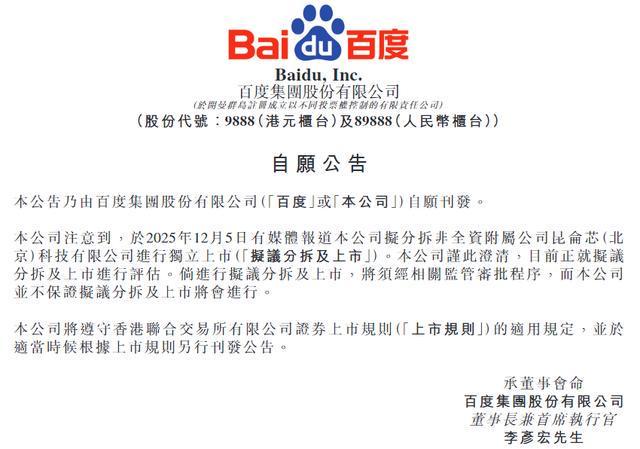
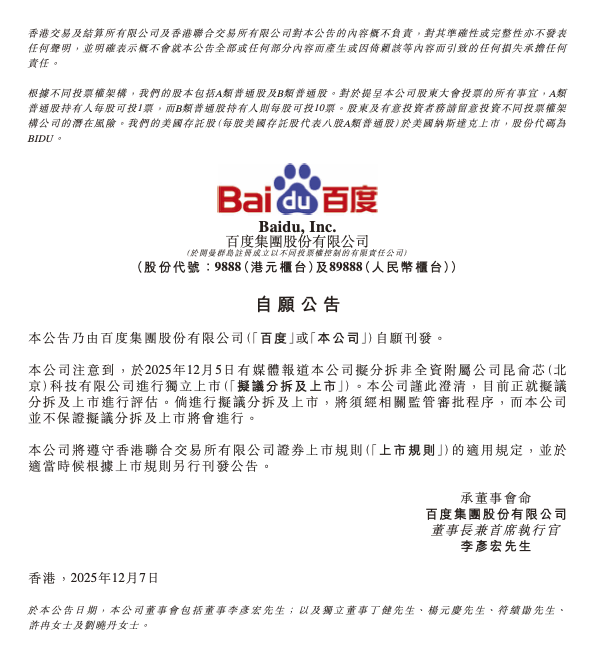
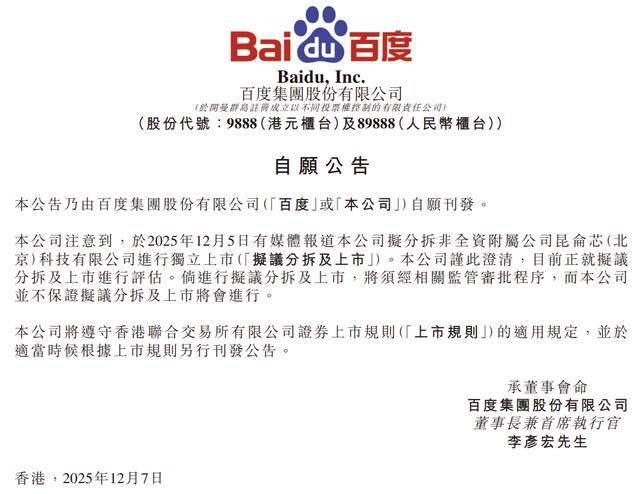
百度回应拟分拆昆仑芯赴港上市:正在评估,不保证上市
Xin Lang Cai Jing· 2025-12-08 03:50
来源:@新财富杂志微博 【#百度回应拟分拆昆仑芯赴港上市#:正在评估,不保证上市】12月7日晚间,百度集团港股公告,公 司注意到于2025年12月5日有媒体报道公司拟分拆非全资附属公司昆仑芯(北京)科技有限公司进行独立 上市。公司澄清目前正就拟议分拆及上市进行评估。若进行分拆及上市,将须经相关监管审批程序,而 公司并不保证分拆及上市将会进行。天眼查显示,昆仑芯是由百度内部孵化的AI芯片公司,于2021年4 月完成独立融资,首轮估值约130亿元,百度为控股股东,持股比例为59.45%。截至2025年7月,昆仑 芯已经历了D轮融资,投资方包括上河动量资本、山证投资、国新基金下属的高层次人才基金、中移和 创等。 ...