
核心CPI

Search documents
国家统计局公布7月CPI数据!肉、蛋、菜价格同比明显下降,飞机票、旅游、宾馆住宿价格环比上涨
新浪财经· 2025-08-09 06:29
Core Viewpoint - The Consumer Price Index (CPI) in July 2025 remained flat year-on-year, influenced by a significant decline in food prices, while non-food prices showed a slight increase [2][10][13]. Price Changes Overview - In July, food prices decreased by 1.6% year-on-year, contributing to a 0.29 percentage point drop in CPI. The decline in fresh vegetable prices was particularly notable at 7.6% [4][13]. - Non-food prices increased by 0.3% year-on-year, marking a 0.2 percentage point rise compared to the previous month [13]. Monthly Price Movements - Month-on-month, the CPI rose by 0.4%, with urban areas increasing by 0.4% and rural areas by 0.3%. This was a reversal from a 0.1% decline in the previous month [2][10]. - Service prices rose by 0.6% month-on-month, significantly impacting the CPI increase, particularly due to seasonal factors such as summer travel [11]. Core CPI Insights - The core CPI, excluding food and energy, increased by 0.8% year-on-year, the highest since March 2024, indicating a steady recovery in consumer demand [10][12]. - Prices of gold and platinum jewelry saw substantial increases of 37.1% and 27.3% respectively, contributing to the overall CPI rise [12]. Sector-Specific Price Changes - In the food category, egg prices fell by 11.2%, while meat prices, including pork, decreased by 9.5%, significantly affecting the CPI [4][5]. - Other categories showed mixed results, with transportation and communication prices declining by 3.1%, while other goods and services saw increases [5][8].

重要数据发布!环比上涨0.4%
Zhong Guo Zheng Quan Bao· 2025-08-09 04:53
Group 1 - The core viewpoint is that the effects of domestic demand expansion policies are becoming increasingly evident, with the Consumer Price Index (CPI) showing a month-on-month increase of 0.4% in July, reversing a previous decline of 0.1% [1][2] - The core CPI, excluding food and energy prices, rose by 0.8% year-on-year in July, marking the highest increase since March 2024, and the growth rate has expanded for three consecutive months [5][6] - The increase in CPI is primarily driven by rising prices in the service sector and industrial consumer goods, with service prices up 0.6% month-on-month, contributing approximately 0.26 percentage points to the CPI increase [4][5] Group 2 - The Producer Price Index (PPI) decreased by 0.2% month-on-month in July, but the decline has narrowed by 0.2 percentage points compared to the previous month, marking the first contraction in the rate of decline since March [6][8] - Seasonal factors and uncertainties in the international trade environment have led to price declines in certain industries, while domestic market competition continues to improve, resulting in a reduced downward impact on PPI [8][9] - Year-on-year, the PPI fell by 3.6% in July, with the decline remaining consistent with the previous month, indicating some improvement in supply-demand relationships in certain sectors due to ongoing macroeconomic policies [8][9]

积极变化!重要数据,最新公布
券商中国· 2025-08-09 04:53
Core Viewpoint - The article discusses the recent trends in China's Consumer Price Index (CPI) and Producer Price Index (PPI), highlighting a shift in consumer prices and the implications for economic policy and market conditions [1][2][7]. CPI Analysis - In July, the CPI increased by 0.4% month-on-month, reversing a previous decline of 0.1%, and remained flat year-on-year. The core CPI, excluding food and energy, rose by 0.8%, marking the highest increase since March 2024 [1][6]. - The rise in CPI was primarily driven by increases in service prices (up 0.6%) and industrial consumer goods prices (up 0.5%). Seasonal factors and the impact of summer travel contributed to higher prices for air tickets, tourism, and accommodation [4][6]. - Food prices decreased by 1.6% year-on-year, influenced by a high base from the previous year, with fresh vegetables and fruits being significant contributors to this decline [6]. PPI Analysis - The PPI fell by 0.2% month-on-month, but this decline was the smallest since March, indicating a potential stabilization in industrial prices. Year-on-year, the PPI decreased by 3.6%, consistent with the previous month [2][8]. - The decline in PPI is attributed to seasonal factors, market order optimization, and uncertainties in international trade. Specific industries such as non-metallic mineral products and coal mining experienced price drops due to reduced demand [9][10]. - Despite the overall decline, the competitive market environment has led to a narrowing of price decreases in several sectors, including coal and steel, suggesting a potential for price stabilization in the future [10]. Economic Policy Implications - The article emphasizes the importance of coordinated monetary and fiscal policies to support economic stability and reasonable price levels. The People's Bank of China has indicated a need for moderately loose monetary policy to address domestic demand issues and low price levels [7].

0.8%
Shang Hai Zheng Quan Bao· 2025-08-09 04:51
Group 1: CPI Analysis - In July, the CPI remained flat year-on-year, with a month-on-month increase of 0.4%. The core CPI, excluding food and energy, rose by 0.8%, marking the highest increase since March 2024 [1][3][4] - The year-on-year stability of the CPI was primarily influenced by lower food prices, which decreased by 1.6% compared to the same month last year. Fresh vegetable prices fell by 7.6%, while fresh fruit prices increased by 2.8% [3][4] - The month-on-month increase in CPI was driven by rising service and industrial consumer goods prices, with service prices up by 0.6% and industrial consumer goods prices up by 0.5% [4][3] Group 2: PPI Analysis - In July, the PPI decreased by 3.6% year-on-year, with the decline consistent with June's figures. However, the month-on-month decline of 0.2% showed a narrowing compared to June [5][6] - Certain industries experienced improved supply-demand relationships, leading to positive price changes. For instance, the price of caustic soda rose by 3.6%, and the price of glass manufacturing saw a reduced decline of 0.9% compared to June [6][7] - The month-on-month decline in PPI was influenced by seasonal factors, with prices in the coal mining and washing industry, black metal smelting, and photovoltaic equipment manufacturing showing reduced declines compared to the previous month [7][6] Group 3: Future Price Trends - The National Bureau of Statistics indicated that prices are expected to gradually recover in the second half of the year, driven by effective policies aimed at expanding domestic demand, which will stimulate consumption and push up consumer goods prices [8] - The holiday effect is anticipated to stabilize or increase service prices, while the downward pressure from tailing factors on both CPI and PPI is expected to diminish [8]
利好!重要数据公布,积极信号显现!
证券时报· 2025-08-09 03:46
Group 1 - The core CPI has shown an expanding growth for three consecutive months, indicating positive changes in prices [1][7] - In July, the CPI increased by 0.4% month-on-month, which is 0.1 percentage points higher than the seasonal level [3] - The rise in CPI is primarily driven by increases in service and industrial consumer goods prices, with service prices up 0.6% and industrial consumer goods prices up 0.5% [5] Group 2 - The core CPI, excluding food and energy, rose by 0.8% year-on-year, marking the highest increase since March 2024 [9] - Food prices have decreased by 1.6% year-on-year, significantly impacting the overall CPI [8] - The prices of gold and platinum jewelry increased by 37.1% and 27.3% year-on-year, respectively, contributing to the CPI increase [9] Group 3 - The PPI decreased by 0.2% month-on-month, but the decline has narrowed for the first time since March [12] - The decline in PPI is influenced by seasonal factors, market order optimization, and uncertainties in the international trade environment [14] - The competitive order in the domestic market has improved, leading to a reduction in the downward pressure on prices in several industries [17]

7月核心CPI同比涨幅连续3个月扩大 下半年价格低位温和回升支撑因素有哪些
Di Yi Cai Jing· 2025-08-09 03:22
Group 1: Consumer Price Index (CPI) - In July, the CPI increased by 0.4% month-on-month, reversing a 0.1% decline from the previous month, with year-on-year growth remaining flat [1][3] - The year-on-year CPI was primarily influenced by lower food prices, which decreased by 1.6%, contributing approximately 0.29 percentage points to the CPI decline [1] - Core CPI, excluding food and energy, rose by 0.8% year-on-year, marking the highest increase since March 2024 [1] Group 2: Producer Price Index (PPI) - The PPI decreased by 0.2% month-on-month in July, but the decline was less than the previous month, marking the first narrowing of the decline since March [5] - Seasonal factors and uncertainties in the international trade environment contributed to price decreases in several industries, including a 1.4% drop in non-metallic mineral products [5][6] - The prices in coal mining and washing, black metal smelting, and photovoltaic equipment manufacturing saw reduced declines compared to the previous month, indicating improved market competition [6] Group 3: Economic Outlook - The National Bureau of Statistics indicated that prices are expected to gradually rise in the second half of the year, supported by stable economic performance and effective domestic demand expansion policies [6]
7月核心CPI同比涨幅连续3个月扩大,下半年价格低位温和回升支撑因素有哪些
Di Yi Cai Jing· 2025-08-09 03:20
Group 1: CPI Analysis - The core CPI, excluding food and energy prices, increased by 0.8% year-on-year, marking the highest growth since March 2024, with a 0.1 percentage point increase from the previous month [2] - In July, the CPI rose by 0.4% month-on-month, reversing a 0.1% decline from the previous month, primarily driven by increases in service and industrial consumer goods prices [4] - The decrease in food prices, particularly fresh vegetables and fruits, significantly impacted the CPI, with fresh vegetable prices down 7.6% year-on-year and fruit prices up 2.8% [1][4] Group 2: PPI Analysis - The PPI fell by 0.2% month-on-month in July, but the decline was less than the previous month, marking the first narrowing of the month-on-month decline since March [6] - Seasonal factors and uncertainties in the international trade environment contributed to price decreases in several industries, including non-metallic mineral products and coal mining [6][7] - The competitive market environment in industries such as coal, steel, and photovoltaic manufacturing has led to a reduction in price declines compared to the previous month [7] Group 3: Future Price Trends - The National Bureau of Statistics anticipates a moderate recovery in prices in the second half of the year, supported by stable economic performance, effective demand expansion policies, and reduced low-price competition among enterprises [7]
7月份CPI同比持平 环比上涨0.4%
Xin Hua Wang· 2025-08-09 02:50
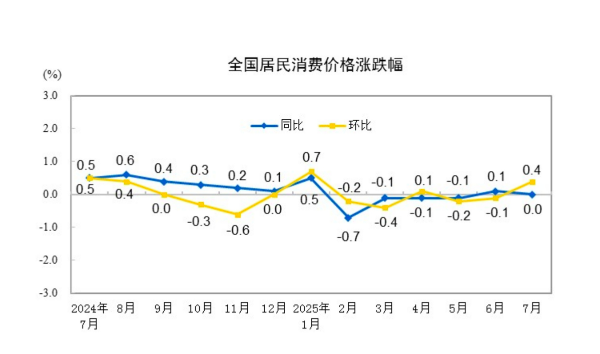
国家统计局城市司首席统计师董莉娟分析,CPI同比持平,主要受食品价格较低影响。其中,鲜菜 价格同比下降7.6%,降幅比上月扩大7.2个百分点,鲜果价格同比上涨2.8%,涨幅比上月回落3.3个百分 点,二者对CPI同比的下拉影响合计比上月增加约0.21个百分点,是带动CPI同比由涨转平的主因。 环比上涨主要受服务和工业消费品价格上涨带动。服务价格环比上涨0.6%,影响CPI环比上涨约 0.26个百分点,占CPI总涨幅六成多。工业消费品价格环比上涨0.5%,涨幅比上月扩大0.4个百分点,影 响CPI环比上涨约0.17个百分点。 新华社北京8月9日电(记者王雨萧)国家统计局9日发布数据显示,7月份,扩内需政策效应持续显 现,全国居民消费价格指数(CPI)同比持平,环比由上月下降0.1%转为上涨0.4%,扣除食品和能源价 格的核心CPI同比上涨0.8%,涨幅连续3个月扩大。 统计数据显示,7月份,食品价格同比下降1.6%,非食品价格同比上涨0.3%;消费品价格同比下降 0.4%,服务价格同比上涨0.5%。1至7月平均,CPI比上年同期下降0.1%。 ...
7月份物价数据发布!金饰品价格同比上涨37.1%
Zheng Quan Ri Bao Wang· 2025-08-09 02:27
Group 1: CPI Analysis - The Consumer Price Index (CPI) increased by 0.4% month-on-month in July, which is 0.1 percentage points higher than the seasonal level [3] - The rise in CPI was primarily driven by increases in service and industrial consumer goods prices, with service prices up 0.6% and industrial consumer goods prices up 0.5% [3] - Seasonal factors, such as the summer travel peak, contributed to significant price increases in air tickets (17.9%), tourism (9.1%), hotel accommodation (6.9%), and vehicle rentals (4.4%) [3] Group 2: Core CPI Insights - The core CPI, excluding food and energy, rose by 0.8% year-on-year, marking the highest level since March 2024 [4] - Jewelry prices, particularly gold and platinum, saw substantial increases of 37.1% and 27.3% respectively, contributing approximately 0.22 percentage points to the CPI [4] - Food prices experienced a year-on-year decline of 1.6%, primarily due to high base effects from the previous year, which negatively impacted the overall CPI [4] Group 3: PPI Overview - The Producer Price Index (PPI) decreased by 0.2% month-on-month, but the decline was less severe than in previous months, marking the first month of narrowing decline since March [5] - Seasonal factors and uncertainties in international trade contributed to price decreases in certain industries, while domestic market competition improved, leading to reduced price declines in sectors like coal, steel, and solar energy [5][6] - Year-on-year, the PPI fell by 3.6%, with some industries experiencing price recoveries due to macroeconomic policies and demand improvements [6]
国家统计局:7月核心CPI同比持续回升 PPI环比降幅收窄
Di Yi Cai Jing· 2025-08-09 01:58
Group 1: CPI Analysis - The Consumer Price Index (CPI) showed a month-on-month increase of 0.4% in July, reversing a previous decline of 0.1% in June, primarily driven by rising service and industrial goods prices [2][3] - The core CPI, excluding food and energy, rose by 0.8% year-on-year, marking the highest increase since March 2024, with jewelry prices significantly contributing to this rise [2][3] - Food prices decreased by 1.6% year-on-year, influenced by a high base from the previous year, which negatively impacted the overall CPI [3] Group 2: PPI Analysis - The Producer Price Index (PPI) decreased by 0.2% month-on-month, but the decline was less severe than in previous months, indicating a potential stabilization in certain sectors [4][5] - Year-on-year, the PPI fell by 3.6%, with some industries experiencing price recovery due to improved supply-demand dynamics and ongoing industrial upgrades [5][6] - Specific sectors such as traditional industries and emerging industries showed positive price movements, with notable increases in prices for products like caustic soda and aircraft manufacturing [5][6]