
AI技术

Search documents
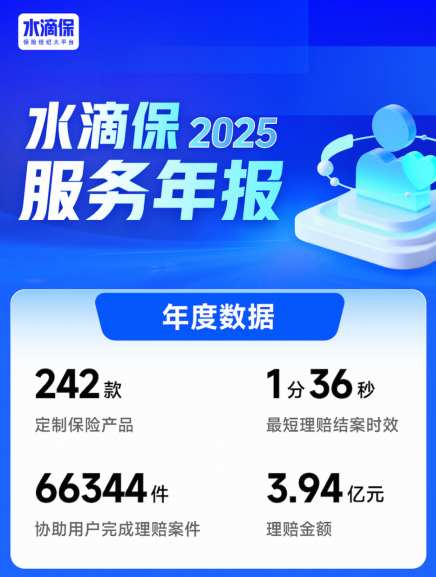
水滴保2025服务年报:AI驱动“三好服务”升级,上线242款定制产品
智通财经网· 2026-01-29 08:22
Core Insights - Waterdrop Insurance has released its 2025 annual service report, highlighting its focus on inclusive product innovation and the integration of AI technology to enhance its service system [1][15] Product Innovation - In 2025, Waterdrop Insurance launched a total of 242 customized insurance products, including 57 products that do not require health declarations [3][4] - The company is particularly focused on the needs of specific demographics such as those with pre-existing conditions, the elderly, and maternal and infant groups [3] - The average claim amount for the elderly demographic has surpassed 10,000 yuan, reaching 11,265.13 yuan, with 221 elderly-friendly products launched [4] Claims Assistance - Waterdrop Insurance assisted users in completing 66,344 claims, with a total claim amount of 394 million yuan [1] - The claims for users with pre-existing conditions amounted to 55.9852 million yuan, representing a year-on-year increase of 46.83% [4] AI Integration - The application of AI technology has significantly improved service efficiency, with a 16.49% increase in claims processing speed, and the fastest claim resolution time recorded at just 1 minute and 36 seconds [1] - AI customer service, "Bao Xiaohui," provides real-time assistance with an average response time of 1.5 seconds, available 24/7 [5] - AI-driven risk control models have been implemented to proactively prevent illegal activities, enhancing user safety [8][10] Consumer Protection - Waterdrop Insurance has taken active measures to combat insurance fraud, successfully collaborating with law enforcement to dismantle illegal operations [9][10] - The company has established a user-platform-insurer collaborative mechanism to ensure early detection and resolution of risks [10] Professional Services - The company has upgraded its online brokerage team to provide a more professional and user-centered service ecosystem, maintaining a customer satisfaction rate of over 95% [12] - The "Help Help Claim" 1V1 claims hotline served 94,079 users in 2025, a 394.68% increase year-on-year, securing 4.9693 million yuan in reasonable claims for users [12] Future Outlook - Waterdrop Insurance aims to continue enhancing its service efficiency and broadening its coverage through the integration of AI and inclusive product innovation [15]


国产智能基座方案提供商润芯微科技完成近4亿元B+轮融资
Mei Ri Jing Ji Xin Wen· 2026-01-29 05:51
Core Insights - RIVOTEK, a domestic intelligent base solution provider, has completed nearly 400 million yuan in B+ round financing [1] - The financing was participated by multiple state-owned and industrial capital entities, including Chongqing Changjia Zongheng Private Equity Investment Fund, Hengxu Capital, Jiangsu Province War New Fund, and Suzhou High-speed Rail New City State Control [1] - The raised funds will be primarily used for the iteration and upgrade of domestic computing platform solutions, evolution of AI operating systems, and development of edge AI models [1]
AI营销领涨两市!指数冲高回落显分歧,资金博弈进入白热化
Sou Hu Cai Jing· 2026-01-29 04:56
美联储宣布1月份"不降息",这一消息对美股并没有影响,反而让美黄金一度突破5600美元/盎司,大宗商品出现剧烈震荡,全球金融巨鳄也开始对黄金的上 涨观点出现分化。A股一月份三大指数月线都是在5日线上拉升,这种走势是相当不错的,给人一种"一马当先"的感觉,只不过"降温"后的调整期会让人适应 起来"很难受"。现在要关心的是春节将至,这一波红包行情能否快速开启,让大家在马年开开心心过大节! 创业板指数周四低开高走,盘面出现明显的反扑行情,从开盘的跌多到涨多,这种行情远比指数上涨要强得多!市场结构未变,目前仍处在"政策抑制快涨 与市场情绪亢奋"的拉扯阶段,市场情绪降温的仍然导致指数的震荡态势加剧。午后注意创业板指数能否在3330点之上稳住。 7 K 当日综合评分 技术面6.9 资金面7.0 短期大盘趋势偏强 当日点评 短期大盘趋势偏强,增量资金入场较明显,市场赚钱效应 骑牛看熊发现近期AI营销板块迎来爆发式上涨,板块指数近30日涨幅达86%,显著跑赢大盘,背后是技术突破、政策红利、需求升级与估值重塑的多重共 振。AI技术的迭代突破的是板块上涨的核心驱动力,已从"辅助工具"升级为营销全链路的"决策中枢",形成可量化的效 ...

铜-棋至中局-稳定性凸显
2026-01-29 02:43
铜:棋至中局,稳定性凸显 20260128 摘要 XT 合约价差飙升至 100 美元,创 1998 年来最大单日涨幅,导致 COMEX 与 LME 价差转负,北美隐性库存增加缓解 LME 低库存,短期 内铜价相对其他品种偏弱。 长期来看,美国或通过高价维持电解铜进口优势,远端虹吸效应持续。 全球铜矿生产干扰率高,如智利 Capstone 铜金矿罢工,限制供应。预 计春节前后铜价横盘整理,长期供应紧张和电力需求增长支撑铜价。 铜需求与电力紧密相关,新能源和 AI 技术革命带动电力需求。美国人均 用铜量与人均 GDP 呈 M 型趋势,AI 技术开支大幅上行,类似 90 年代 互联网周期,电力相关用铜需求将持续增长。 过去十年铜矿资本支出偏低,新扩建项目不足以弥补大规模新矿山开发 所需产能。高利润背景下劳资关系紧张及资源国保护主义政策提高生产 干扰率,供应端长期受限。 全球范围内铜供应存在结构性紧缺将持续存在。建议关注紫金、洛钼、 五矿等资源储备丰富的公司,以及中国有色矿业、铜陵、江铜等自给率 提升显著的企业。 紫金收购联合黄金矿区后黄金产量有望提升,洛钼完成巴西黄金矿山收 购交割,为公司提供利润支撑。在当前宏观复 ...
康波萧条期的资源繁荣-百年变局与资源价格
2026-01-29 02:43
康波萧条期的资源繁荣 - 百年变局与资源价格 20260128 全球商品定价受金融和实物属性双重影响,美元主导金融属性,中国需 求主导实物属性,贱金属受实物供需驱动,贵金属受金融属性驱动,基 本金属兼具两者。 当前仍处于康波萧条期,AI 技术虽发展迅速但未广泛应用于工业领域, 难以构成新一轮康波回升,历次康波回升均伴随硬件革命,创造新需求 和就业。 中美贸易战并未改变全球贸易格局,仅导致贸易流向转移,关税措施无 法解决根本问题,只会促使供应链调整,如中国经东盟间接出口至美国, 美墨贸易增加。 中国正处于工业化成熟期,类似于 1976 年日本或 1,938 年美国,高端 制造业竞争力提升,低端劳动密集型产业外移,但仍具备较强发展潜力。 美国再工业化难以实现,制造业占国民经济比重持续下降,财政赤字与 贸易赤字存在孪生关系,削减贸易赤字需先削减财政赤字,但受内部结 构性问题制约。 Q&A 如何理解商品的金融属性和实物属性,以及它们在定价中的作用? 商品的定价具有两个主要属性:金融属性和实物属性。实物属性指的是供应和 需求形成的产出缺口,而金融属性则涉及到计价货币的影响。在大宗商品市场 中,计价货币通常是美元,因此美 ...
“创新+产品+客户”打造三重护城河 舜宇智行赴港IPO开启成长新篇章
智通财经网· 2026-01-29 02:25
Industry Overview - The automotive industry is undergoing a significant technological revolution driven by AI, transitioning from L2 level assisted driving to higher levels of autonomous decision-making [1] - Vehicles are being redefined from mere transportation tools to highly intelligent "smart third spaces" with real-time perception and interaction capabilities [1] - The demand for in-vehicle optical hardware is significantly increasing, with global electric vehicles expected to average 4.8 cameras by 2024, compared to 2.1 for traditional fuel vehicles [1] Company Profile - Sunny Optical Technology has submitted a listing application to the Hong Kong Stock Exchange, gaining market attention as a leading company in vehicle optical technology [2] - The company has developed a comprehensive product system centered on intelligent perception and smart cockpit solutions, expanding into emerging fields such as LiDAR and smart lighting [2] Technological Innovation - Sunny Optical has established three core development advantages: building a solid technological "moat" through independent innovation, expanding growth space through forward-looking layouts, and solidifying a global customer network through deep cooperation [3] - The company maintains a stable R&D expense ratio of around 9%, positioning itself as one of the earliest providers of automotive-grade optical solutions and ADAS camera solutions [3] - Recent advancements include the development of thinner, higher-transparency, and more stable glass-plastic hybrid lenses for intelligent cameras, addressing performance needs in various lighting conditions [3] Product Development - The company has developed the π-Mirror system for real-time monitoring of vehicle blind spots, enhancing driving safety [4] - Sunny Optical has launched the world's first ultra-high-resolution DLP PGU for 92-inch cinema-grade AR-HUD, providing an immersive visual experience [4] - The company holds 823 authorized patents, including 543 invention patents, establishing a strong technological barrier and intellectual property protection [4] Market Position and Strategy - The spin-off listing of Sunny Optical is expected to optimize the business structure of the parent company, focusing resources on core strengths and improving operational efficiency [5] - Independent listing will provide Sunny Optical with greater operational autonomy, allowing for quicker responses to market changes and expanding financing channels [5] Growth Potential - In the context of the high-growth smart mobility sector, Sunny Optical is positioned as an innovative leader, marking a new phase in its development with the IPO [6] - The IPO presents a golden opportunity for market investors to participate in the long-term growth of a quality leading enterprise and share in the benefits of the smart mobility era [6]
AI技术重塑生态研究范式
Ke Ji Ri Bao· 2026-01-29 01:27
随着AI技术在生态学中的广泛应用,生态学的研究方式正经历深刻变革。许多学者如今在室内分 析数字化标本、图像、DNA或传感器数据,而非亲赴野外。 英国《自然》网站在本月报道中指出,从脚下的土地,转向屏幕上跳动的像素,这种"全自动化监 测"提升了研究的规模与效率,使大范围生态变化得以追踪。但有专家担忧,远离田野调查可能导致研 究失去对自然的直接感知,造成误差、偏见和过度简化,削弱生态学的本质——与自然的亲密联系。或 许,唯有技术与田野观测的"双向奔赴",才能织就生态学的美好未来。 智慧之"眼"洞察自然 他与联合研究者在去年3月发表论文,提出"自然经验消失"这一沉重命题:基于田野调查的研究与 教育正逐渐式微,其后果不仅限于技能的退化,更可能动摇整个学科对生态系统的深层理解。他们警 示,这种脱节还将削弱科学家与当地社区的联系,而后者,正是生态保护得以落地的灵魂所在。 尽管尚无确凿的定量研究全面验证这一观点,但趋势已然清晰。一项对1980—2014年间生态文献的 分析显示,纯粹依赖实地考察的研究占比下降了20%;而建模与数据分析则分别激增600%和800%。数 字背后,是一个学科重心的悄然迁移:从脚下的土地,转向屏幕上 ...
AI技术重塑生态研究范式 学者呼吁仍需坚持田野调查
Ke Ji Ri Bao· 2026-01-29 01:01
随着AI技术在生态学中的广泛应用,生态学的研究方式正经历深刻变革。许多学者如今在室内分析数 字化标本、图像、DNA或传感器数据,而非亲赴野外。 英国《自然》网站在本月报道中指出,从脚下的土地,转向屏幕上跳动的像素,这种"全自动化监测"提 升了研究的规模与效率,使大范围生态变化得以追踪。但有专家担忧,远离田野调查可能导致研究失去 对自然的直接感知,造成误差、偏见和过度简化,削弱生态学的本质——与自然的亲密联系。或许,唯 有技术与田野观测的"双向奔赴",才能织就生态学的美好未来。 智慧之"眼"洞察自然 从尘封百年的标本到天空飞过的禽鸟,从深林中的昆虫到大地上蔓延的入侵植物……面对如此浩瀚的数 据海洋,传统方法早已力不从心,AI正成为推动生态学研究驶向智能化的旗舰。 如今,AI不仅能精准识别物种,更可构建复杂的物种分布模型与生命谱系树。一些学者预见,生成式 AI或将催生能自主模拟生态过程、预测物种对气候变化响应情况的智能系统。 若缺乏真正了解野外生态的专家参与训练与校验,AI可能陷入"精致的错误"——精准识别出常见物种, 却对新出现的入侵者视而不见,或误判濒危种群的真实状态。 而北欧TABMON项目则用声音"编织" ...
这是成都科技创新发展的一个缩影
Xin Lang Cai Jing· 2026-01-28 21:00
Group 1 - The article highlights the innovative development of Chengdu's technology sector, exemplified by the "Chengdu-made" smart glasses showcased at the city's annual legislative meeting [3][4] - The smart glasses feature real-time translation capabilities, displaying translated text directly on the lenses, facilitating seamless cross-language communication [3] - The product, developed by Sichuan Yingmu Technology Co., is the first mass-produced AI glasses with a detachable battery design, allowing for all-day wear, and supports real-time translation in 261 languages with an accuracy rate of 98% [3] Group 2 - The Austrian Consul General in Chengdu expressed admiration for the smart glasses, noting their impressive application of AI technology, particularly in meeting scenarios requiring real-time discussions [4] - The event attracted significant attention from various international consular officials, who were eager to experience the latest flagship products and understand the city's developments [3][4]

《团圆令》背后的两岸团圆之盼
Xin Lang Cai Jing· 2026-01-28 20:59
Group 1 - The core theme of the news revolves around the upcoming animated film "Reunion Order," which is inspired by the giant pandas gifted from mainland China to Taiwan, symbolizing the emotional connection between the two regions [1][2]. - The film narrates the story of panda siblings "Tuanzi" and "Yuan Niu," who are separated due to a disaster and eventually reunite, reflecting the deep-rooted desire for unity among people from both sides of the Taiwan Strait [1][2]. - The film's release is seen as a cultural bridge, enhancing the understanding and appreciation of Chinese culture among Taiwanese youth, thereby strengthening cultural identity and confidence [2][4]. Group 2 - "Reunion Order" utilizes innovative AI technology for animation production, significantly reducing the typical production time from 2-3 years to just a few months, while enhancing the quality of character expressions and textures [3]. - The film is expected to invigorate cultural exchanges between the two sides, breaking down barriers and fostering emotional connections through cinematic storytelling [3][4]. - The collaboration between Taiwan and mainland China in the film industry has grown, with Taiwan becoming a crucial partner and market for mainland productions, leading to a thriving cultural ecosystem [4].