生成式AI

Search documents
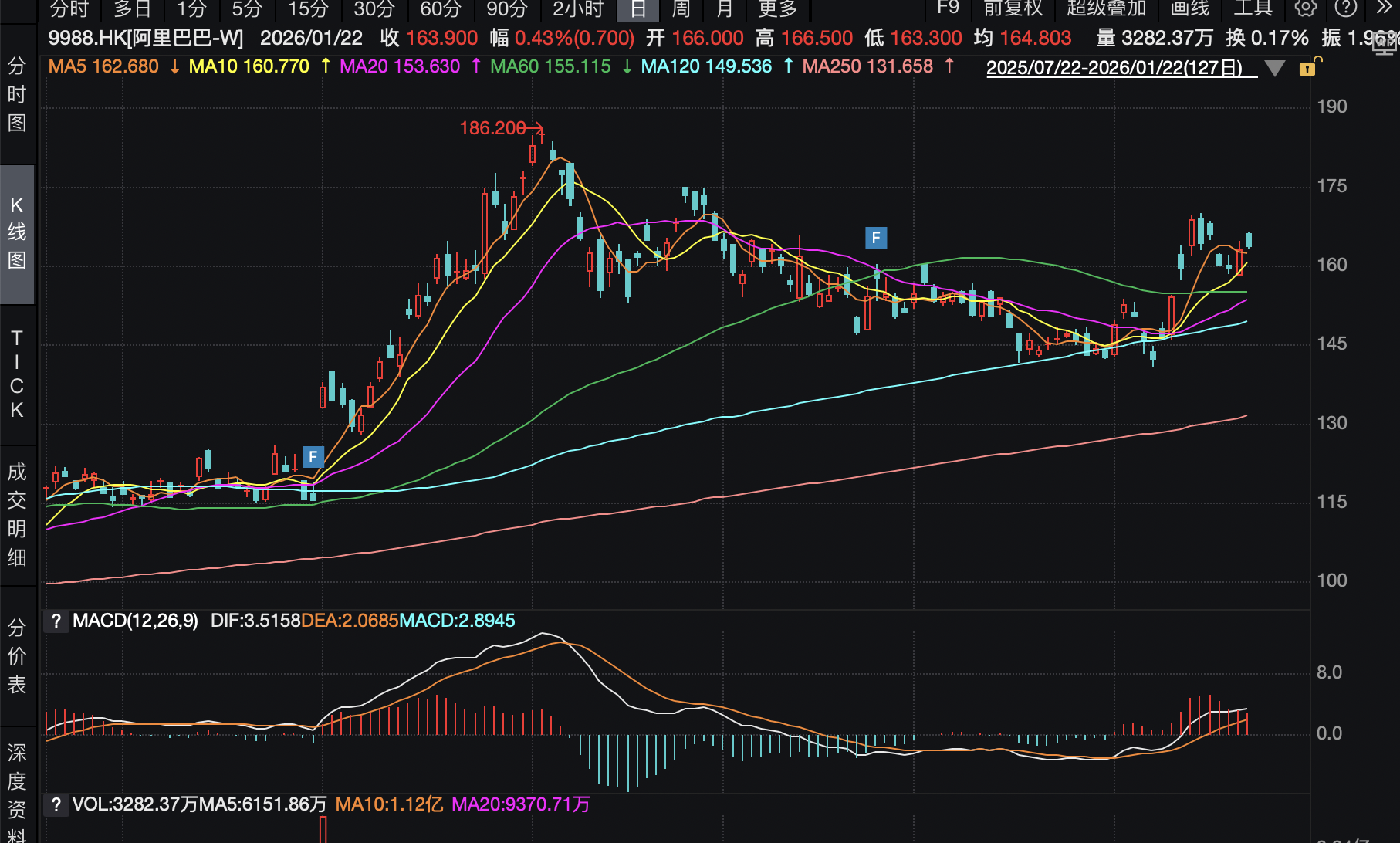
阿里股价较去年同日翻倍,今年涨幅达15%
Di Yi Cai Jing· 2026-01-22 05:00
Core Viewpoint - AI has driven the stock prices of Alibaba and other internet giants back into an upward trend over the past year [1][3] Group 1: Stock Performance - Alibaba's Hong Kong stock (9988.HK) closed at 163.9 HKD per share on January 22, up 0.43%, with a total market capitalization exceeding 3.13 trillion HKD, marking a year-on-year price doubling [1] - Alibaba's US stock (BABA.US) closed at 168.67 USD on January 21, up 3.87%, also achieving a year-on-year price doubling from 83.96 USD [3] - Since the beginning of 2026, Alibaba's Hong Kong stock has increased by 14.78%, while its US stock has risen by over 15% [3] Group 2: AI Developments - The Hugging Face community reported that Alibaba's Qianwen derivative models have surpassed 200,000, making it the first open-source large model to achieve this milestone globally [3] - The Qianwen series models have been downloaded over 1 billion times, averaging 1.1 million downloads per day, significantly surpassing Llama [3] - Alibaba's consumer-facing AI application, Qianwen APP, has fully integrated with various Alibaba ecosystem services, contributing to the rise in its US stock price above 170 USD [3] Group 3: Analyst Outlook - JPMorgan recently expressed a positive outlook on Alibaba's trading prospects for the next 6 to 12 months, expecting the stock price to overcome short-term profit pressures [3] - The firm anticipates that Alibaba Cloud's revenue growth will accelerate in the coming quarters as generative AI workloads expand from pilot phases to broader deployments [3] - However, JPMorgan has lowered its target price for Alibaba's US stock from 230 USD to 215 USD and for its Hong Kong stock from 225 HKD to 210 HKD due to increased investments in user acquisition for delivery, instant retail, and generative AI applications [4]


明略科技-W再涨超7% 月内累涨逾四成 GEO有望重塑广告营销行业商业模式
Zhi Tong Cai Jing· 2026-01-22 03:44
Core Viewpoint - Minglue Technology (02718) has seen a significant stock price increase of over 40% in the month, with a current price of 279.6 HKD and a trading volume of 19.7 million HKD. The company is positioned to capitalize on the growing GEO market, which is expected to reshape the advertising industry [1][1]. Group 1: Market Potential - According to the China Business Advertising Association, the global GEO market is projected to reach 11.2 billion USD by 2025, with the Chinese market expected to grow to 2.9 billion CNY. By 2030, the global market is anticipated to expand to 100.7 billion USD, while the Chinese market is expected to increase to 24 billion CNY [1][1]. - The shift from SEO to GEO is becoming a trend, indicating significant potential for growth in the GEO market, which is expected to transform the business model of the advertising and marketing industry [1][1]. Group 2: Company Strategy - Minglue Technology plans to focus on the GEO sector starting from the end of 2024, with a comprehensive solution set to be launched in early 2025 [1][1]. - Data from Minglue Technology indicates that over 80% of domestic users are obtaining consumer information through AI, with nearly 35% of consumers engaging in high-frequency interactions with AI daily. This trend highlights the increasing mainstream behavior of consumers consulting AI for consumption-related inquiries [1][1]. Group 3: Future Projections - The GEO market is experiencing rapid growth driven by generative AI, with projections indicating that the global GEO market could reach 24 billion USD by 2026 and potentially 100 billion USD by 2030 [1][1].
港股异动 | 明略科技-W(02718)再涨超7% 月内累涨逾四成 GEO有望重塑广告营销行业商业模式
智通财经网· 2026-01-22 03:38
Core Viewpoint - Minglue Technology-W (02718) has seen a significant increase in stock price, rising over 7% today and accumulating a rise of over 40% within the month, indicating strong market interest and potential growth in the GEO sector [1] Company Summary - Minglue Technology plans to focus on the GEO market starting from the end of 2024, with a comprehensive solution set to launch in early 2025 [1] - The company has reported that over 80% of users in China are utilizing AI to obtain consumer information, with nearly 35% of consumers engaging in high-frequency interactions with AI for consumption-related inquiries [1] Industry Summary - According to the China Business Advertising Association, the global GEO market is projected to reach USD 11.2 billion by 2025, with the Chinese market expected to grow to CNY 2.9 billion [1] - By 2030, the global GEO market is anticipated to expand to USD 100.7 billion, while the Chinese market is expected to increase to CNY 24 billion, highlighting the significant growth potential in the GEO sector [1] - The shift from SEO to GEO is becoming a trend, with the GEO market poised to reshape the advertising and marketing industry [1] - The global GEO market is expected to reach USD 24 billion by 2026 and could potentially reach USD 100 billion by 2030, driven by advancements in generative AI [1]
Anthropic主管抨击英伟达对华出售先进芯片!科创人工智能ETF华夏(589010)开盘冲高,震荡上行
Mei Ri Jing Ji Xin Wen· 2026-01-22 02:19
Group 1 - The core viewpoint of the news highlights the performance of the Huaxia Sci-Tech AI ETF (589010), which experienced a peak increase of 1.93% during trading, with a latest price of 1.618 yuan, reflecting a rise of 0.06% from the opening price [1] - The ETF tracks 30 constituent stocks, with 16 showing gains, including significant increases from companies like Lanke Technology, which rose over 7%, while a few stocks weakened [1] - The trading volume for the ETF reached 25.94 million yuan, with a turnover rate of 0.98%, indicating normal trading activity levels [1] Group 2 - The U.S. government recently overturned a ban, allowing exports of Nvidia's H200 and AMD series to designated customers in China, albeit with multiple restrictions [1] - Despite Nvidia being a major partner and investor in Anthropic, the CEO of Anthropic publicly opposed this decision at the Davos Forum, citing national security implications for AI models [1] - Investment in the AI sector in the U.S. is on the rise, with significant increases in both fiscal budgets and private investments, positioning the U.S. as a global leader in AI infrastructure development [1] - China is also witnessing continuous growth in AI investments, particularly in emerging technologies like generative AI, indicating substantial potential and vitality in the sector [1] Group 3 - The Huaxia Sci-Tech AI ETF closely tracks the Shanghai Stock Exchange Sci-Tech Innovation Board AI Index, covering high-quality enterprises across the entire industry chain [2] - The ETF benefits from high R&D investment and policy support, with a 20% price fluctuation limit and small-cap elasticity aiding in capturing the "singularity moment" of the AI industry [2]

24小时环球政经要闻全览 | 1月22日
Sou Hu Cai Jing· 2026-01-22 00:50
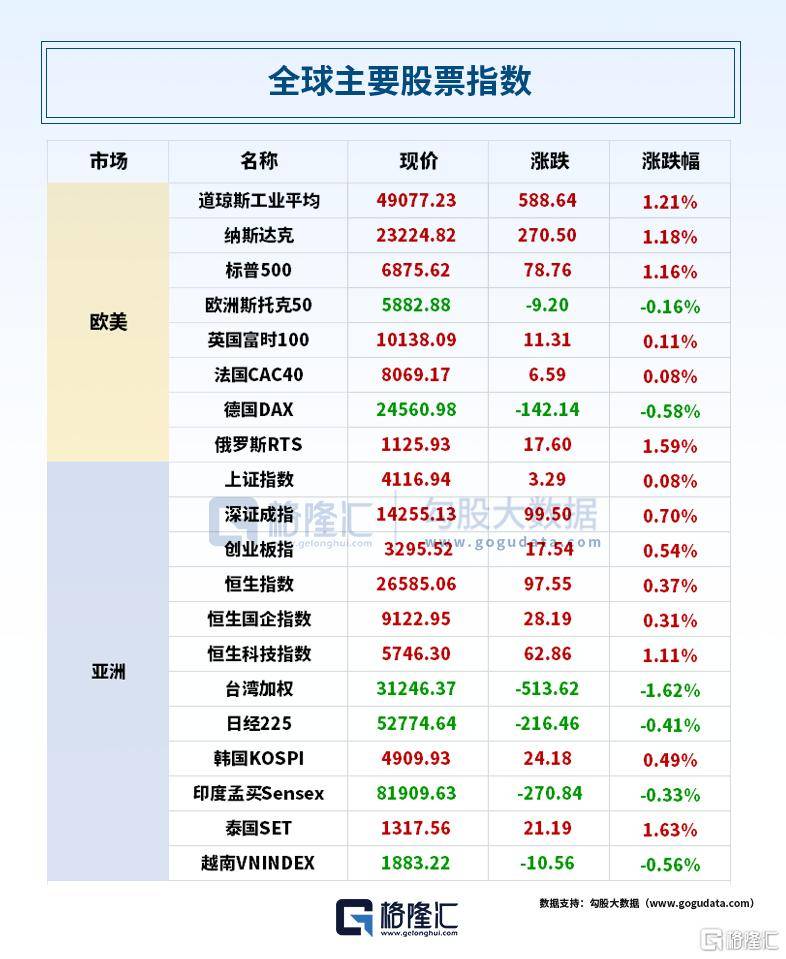
| | | 全球主要股票指数 | | | | --- | --- | --- | --- | --- | | 市场 | 名称 | 现价 | 涨跌 | 涨跌幅 | | 欧美 | 道琼斯工业平均 | 49077.23 | 588.64 | 1.21% | | | 纳斯达克 | 23224.82 | 270.50 | 1.18% | | | 标普500 | 6875.62 | 78.76 | 1.16% | | | 欧洲斯托克50 | 5882.88 | -9.20 | -0.16% | | | 英国富时100 | 10138.09 | 11.31 | 0.11% | | | 法国CAC40 | 8069.17 | 6.59 | 0.08% | | | 德国DAX | 24560.98 | -142.14 | -0.58% | | | 俄罗斯RTS | 1125.93 | 17.60 | 1.59% | | ## | 上证指数 | 4116.94 | 3.29 | 0.08% | | | 深证成指 | 14255.13 | 99.50 - | 0.70% | | | | 创业板指 gelongnul com 329 ...

苹果将对语音助手Siri进行重大改版 打造为AI聊天机器人
Xin Lang Cai Jing· 2026-01-22 00:13
Siri目前缺乏聊天式体验,也不具备像OpenAI的ChatGPT或谷歌的Gemini那样的AI对话能力。改版后Siri 的能力将得到大幅提升。 因相关计划尚未公开而要求匿名的知情人士透露,苹果计划在6月份举行的全球开发者大会上发布这项 新功能,并于9月正式推出。 责任编辑:王永生 苹果计划今年晚些时候对语音助手Siri进行重大改版,使其成为该公司首个人工智能(AI)聊天机器 人,加入由OpenAI和谷歌主导的生成式AI竞赛。 知情人士透露,这款代号为Campos的聊天机器人将深度嵌入iPhone、iPad和Mac的操作系统,并取代当 前的Siri界面。用户唤起新服务的方式与Siri相同。 苹果计划今年晚些时候对语音助手Siri进行重大改版,使其成为该公司首个人工智能(AI)聊天机器 人,加入由OpenAI和谷歌主导的生成式AI竞赛。 知情人士透露,这款代号为Campos的聊天机器人将深度嵌入iPhone、iPad和Mac的操作系统,并取代当 前的Siri界面。用户唤起新服务的方式与Siri相同。 Siri目前缺乏聊天式体验,也不具备像OpenAI的ChatGPT或谷歌的Gemini那样的AI对话能力。改版后 ...


苹果计划将Siri重塑为内置聊天机器人,或在6月官宣
Zhi Tong Cai Jing· 2026-01-22 00:08
据报道,苹果(AAPL.US)计划在今年晚些时候对Siri进行重大改造,将其升级为该公司的首个AI聊天机 器人,从而与OpenAI和谷歌为主导的生成式AI竞争。 财经频道更多独家策划、专家专栏,免费查阅>> 责任编辑:栎树 据知情人士透露,这款代号为Campos的聊天机器人将深度嵌入iPhone、iPad和Mac操作系统,并取代现 有的Siri界面。用户将可以像现在使用Siri一样,通过语音喊出"Siri"命令或长按iPhone或iPad的侧边按钮 来唤醒新服务。 据知情人士透露,聊天机器人功能将在今年晚些时候推出,公司计划在六月的全球开发者大会 (WWDC)上首次展示,并在九月正式发布。 ...
苹果首个AI聊天机器人要来了:大改Siri 将整合入三大系统
Feng Huang Wang· 2026-01-21 23:11
Core Viewpoint - Apple plans to transform Siri into its first AI chatbot, named "Campos," to compete in the generative AI space dominated by OpenAI and Google [1][2] Group 1: Product Development - The new chatbot will be deeply integrated into the operating systems of iPhone, iPad, and Mac, replacing the current Siri interface [1] - Users will still be able to activate the new service using voice commands or by pressing the side button on their devices [1] - The capabilities of Campos will significantly exceed those of the current Siri, which lacks the conversational abilities of competitors like ChatGPT and Google Gemini [1] Group 2: Release Timeline - The chatbot functionality is expected to be announced at the Global Developers Conference in June and officially launched in September [2] - Campos will support both voice and text input modes and will be a major new feature in the upcoming operating systems, including iOS27, iPadOS27, and macOS27 [2] Group 3: Current Siri Updates - Apple had previously committed to a non-chatbot upgrade for Siri, which will retain the existing interface and is set to be released in the upcoming iOS 26.4 [1] - This upgrade aims to introduce features such as screen content analysis and improved network search capabilities, alongside personal data utilization [1]

上证早知道|泡泡玛特,一周两度回购;国产GPU第一股,最新业绩预告公布
Shang Hai Zheng Quan Bao· 2026-01-21 23:06
Group 1 - The Ministry of Housing and Urban-Rural Development emphasizes the ongoing progress of new urbanization in China, highlighting the potential for high-quality development in the real estate sector and the importance of city-specific policies for market regulation [4] - The Ministry of Finance, the State Taxation Administration, and the China Securities Regulatory Commission announced the extension of tax policies for innovative enterprises issuing depositary receipts (CDRs) from January 1, 2026, to December 31, 2027, including tax exemptions on capital gains and differentiated tax policies on dividends [4] - A notification was issued to establish and adjust a number of duty-free shops at ports, significantly increasing the number of such shops across 41 ports, including Wuhan Tianhe International Airport, thereby expanding the coverage of duty-free shopping [5] Group 2 - The State Grid reported a record high electricity load due to a cold wave, with the maximum load reaching 1.168 billion kilowatts, a 12.2% increase from the previous year's peak of 1.041 billion kilowatts, indicating a rising demand for electricity and the need for enhanced supply capabilities [7] - The investment focus of the State Grid during the 14th Five-Year Plan includes the construction of a new power system to support an annual increase of approximately 200 million kilowatts in renewable energy capacity, with R&D expenditures expected to exceed 240 billion yuan [8] - The People's Bank of China is accelerating the development of a cross-border payment system for the renminbi, aiming for high-quality development of the modern payment system, which may create new opportunities for digital renminbi and related infrastructure [9] Group 3 - Intel's CFO indicated that the demand for data center and client CPUs has exceeded expectations, leading to a rapid depletion of chip inventory, with potential supply challenges anticipated in Q1 2026 [10] - The domestic GPU company Moer Technology expects to achieve revenue of 1.45 to 1.52 billion yuan in 2025, representing a year-on-year growth of 230.7% to 246.67%, despite a projected net loss of 950 million to 1.06 billion yuan [12] - The company Demingli forecasts a net profit of 650 to 800 million yuan for 2025, reflecting a growth of 85.42% to 128.21% year-on-year, driven by enhancements in storage solutions and manufacturing capabilities [12]

腾讯研究院AI速递 20260122
腾讯研究院· 2026-01-21 16:01
Group 1 - DeepSeek's Model 1 has been discovered in the FlashMLA codebase, potentially indicating an upcoming release, featuring a 512-dimensional architecture and support for NVIDIA's Blackwell architecture [1] - Liquid AI has launched the open-source inference model LFM2.5-1.2B-Thinking, which operates on a liquid neural network architecture and requires only 900MB of memory on mobile devices, achieving a score of 88 on MATH-500 [2] - The xAI engineer revealed that AI is being tested as a "colleague" in the MacroHard project, achieving human speeds eight times faster, and the company is considering utilizing idle computing power from approximately 4 million Tesla vehicles in North America [3] Group 2 - Research indicates that models like DeepSeek-R1 can spontaneously form multi-role debate mechanisms, significantly improving accuracy through internal social dialogue [4][5] - Medical SAM3, a new model developed by the University of Central Florida, allows for expert-level segmentation in medical imaging using only text prompts, achieving an average accuracy increase from 11.9% to 73.9% across 33 datasets [6] - Anthropic's CEO predicts that AI will fully take over software engineering roles within 6-12 months, with a significant portion of entry-level jobs expected to disappear in the next 1-5 years [7] Group 3 - The Sequoia xbench team reported that top agents can handle over 60% of 104 daily tasks, indicating that foundational agent capabilities have become commoditized [8] - OpenAI's CFO discussed the maturation of multi-agent systems by 2026, emphasizing that AI bubbles should be measured by API call volumes rather than stock prices, with productivity increases of 27-33% for cutting-edge companies [9]