GDP

Search documents
The market is likely to broaden out in 2026, says Citi's Rob Rowe
CNBC Television· 2025-08-18 15:51
GDP & Economic Outlook - Private consumption historically represented 70% of GDP growth, but in 2025, AI spending is projected to contribute the same amount [1] - The US GDP growth is anticipated to slow to 1-1.5% in the first half of the year and 1% in the second half [2] - Markets are looking beyond a potential US slowdown this year, anticipating growth from tech and innovation next year [3] AI & Tech Investment - AI companies are fairly valued versus growth when looking at PEG ratios [4] - Concerns exist regarding the economy's reliance on AI and capex spending, as this spending could be turned off more easily than consumer spending [5] - Infrastructure growth, including data centers, power grids, and chips, is necessary to support AI development [6][7] - Digital services exports are growing exponentially and now account for 40% of global exports [7] - Current capex and infrastructure investments are primarily funded by strong cash flows, unlike the overleveraged situations in the past [8][9] Market Strategy - The industry expects a broadening out of investment opportunities to other sectors next year [10] - The industry is currently overweighting tech and communications due to their growth prospects [10]


前瞻:新西兰预计重启降息,杰克逊霍尔央行年会登场!
Sou Hu Cai Jing· 2025-08-18 08:57
Group 1 - The article provides a forward-looking analysis of global economic events and data releases for the upcoming week, focusing on the potential for the Reserve Bank of New Zealand to restart interest rate cuts and the highly anticipated Jackson Hole global central bank conference [1] - Key economic indicators to watch include US housing market data, Canadian CPI, UK and Eurozone CPI, Federal Reserve meeting minutes, global PMI data, and German GDP along with UK retail sales [1] Group 2 - On Monday and Tuesday, the US housing market data will be released, including the NAHB housing market index and July new housing starts and building permits, indicating resilience in the US residential construction sector despite high interest rates and economic uncertainty [3] - The Canadian CPI for July will also be released, with market expectations suggesting the Bank of Canada may maintain a pause on interest rate cuts, potentially lowering rates to 2.25% by year-end [3] Group 3 - On Wednesday, the Reserve Bank of New Zealand is expected to announce a 25 basis point interest rate cut due to weak labor market data and low inflation expectations, following a significant rate reduction of 225 basis points since last August [5] - The UK and Eurozone CPI reports will be closely monitored, with the UK CPI unexpectedly rising to its highest level in over a year, which may influence the Bank of England's future decisions [5] Group 4 - On Thursday, the Federal Reserve will release its meeting minutes, providing insights into the Fed's stance on interest rate cuts, while the Jackson Hole global central bank conference will feature key speeches, including one from Fed Chair Powell [6][7] - Initial PMI data for August will be released, with a focus on manufacturing and services sectors across various countries, indicating potential economic expansion or contraction [6] Group 5 - On Friday, attention will turn to Germany's second-quarter GDP final value, which is expected to confirm a 0.1% contraction, alongside retail sales data from the UK and Canada [9] - The UK retail sales for July are anticipated to show a continuation of the rebound seen in the previous month, driven by seasonal factors [9]
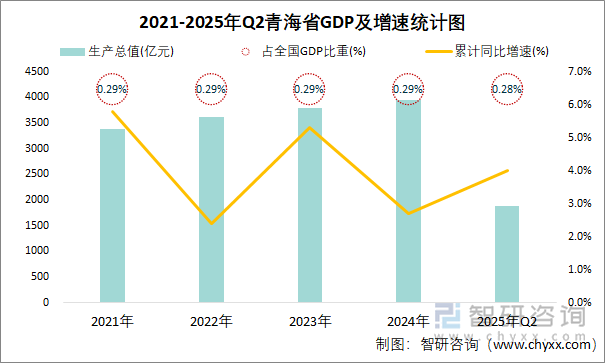
2021-2025年Q2青海省GDP统计分析:2025年Q2青海省GDP为1875.68亿元,同比增长4%
Chan Ye Xin Xi Wang· 2025-08-17 01:39
Core Insights - In Q2 2025, Qinghai Province's GDP reached 187.568 billion yuan, accounting for 0.28% of the national GDP, a decrease of 0.01 percentage points compared to the same period last year [1] - The cumulative year-on-year growth of GDP, calculated at constant prices, was 4% [1] - The value added by the three major industries in Q2 2025 was 5.695 billion yuan, 80.813 billion yuan, and 101.06 billion yuan, representing 3%, 43.1%, and 53.9% of GDP respectively [1] - The per capita GDP in Qinghai Province was 31,600 yuan, an increase of 1,200 yuan compared to the same period last year [1] - The year-on-year growth rates for the three major industries, calculated at constant prices, were 5.4%, 4.8%, and 3.3% respectively [1]
X @Investopedia
Investopedia· 2025-08-16 23:00
Global Economy Overview - The United States has maintained the largest GDP for over a century [1] - China's GDP has experienced rapid growth [1] Market Trends - The report identifies countries among the top 25 economies globally [1]
日本二季度GDP环比增0.3%
Mei Ri Jing Ji Xin Wen· 2025-08-15 00:37
Core Viewpoint - Japan's GDP for the second quarter increased by 0.3% quarter-on-quarter, surpassing the expected growth of 0.1% [1] Group 1: Economic Performance - The nominal GDP for Japan rose by 1.3% quarter-on-quarter, slightly below the expected increase of 1.4% [1]
Trump's Tariffs Could Make Up 1% Of GDP
From The Desk Of Anthony Pompliano· 2025-08-14 19:15
Oh boy. Treasury Secretary Scott Besson recently did an interview and he says tariff income is going to be over 1% of GDP. I I'd been saying 300 billion, but I think we're going to have to substantially revise that up.So well in excess 1% of GDP. And then with the new investment there, the sovereign investments that we talked about, but then in terms of the committed investment by private industry, we're well over 10 trillion. Regardless, whatever you think about the tariffs, whether they work or don't work ...

欧元区第二季度GDP修正值同比增1.4%
Xin Lang Cai Jing· 2025-08-14 11:23
Group 1 - The Eurozone's GDP for the second quarter has been revised to a year-on-year growth of 1.4%, unchanged from the previous estimate [1]
X @Bloomberg
Bloomberg· 2025-08-14 05:48
Market Overview - FTSE 100 指数在英国 GDP 数据公布前保持稳定 [1] - 英镑汇率保持稳定 [1]
高盛惹怒特朗普,华尔街声援:关税引发的通胀冲击即将来袭
Feng Huang Wang· 2025-08-14 05:01
Core Viewpoint - Goldman Sachs predicts that U.S. consumers will bear an increasing burden of tariffs, with the cost expected to rise from 22% in June to 67% by October [2] Group 1: Economic Impact of Tariffs - Economists believe the maximum impact of tariffs on inflation has yet to be felt, with expectations of rising consumer inflation as inventory depletes and actual tariff rates increase from approximately 3% to 18% [1][4] - The tariffs could reduce GDP by 1% and increase inflation by 1% to 1.5%, with some effects already visible [4] - Monthly inflation increases are expected to be between 0.3% and 0.5%, pushing core inflation indicators to the 3% to 3.5% range [4] Group 2: Market Reactions and Predictions - Following Trump's criticism of Goldman Sachs, industry insiders noted that many economists with views contrary to the U.S. government's stance could face job losses [3] - The Blue Chip Economic Indicators report shows a slight increase in GDP growth forecasts for the second half of the year, now averaging 0.85% [5] Group 3: Inflation Trends and Concerns - Pantheon Macroeconomics forecasts core inflation to rise by 1 percentage point, reaching 3.5% by year-end, with only about 25% of the tariff impact currently passed to consumers [7] - BNP Paribas highlights upward pressure on service input prices, indicating that inflation concerns extend beyond goods [8] - The Cleveland Fed's sticky price CPI shows a three-month annualized rate of 3.8%, the highest since May 2024, suggesting persistent inflationary pressures [8]

中美欧上半年GDP出炉,美国14.93万亿,欧盟10万亿,我国呢?
Sou Hu Cai Jing· 2025-08-14 03:37
Group 1: Economic Performance Overview - The GDP data for major global economies in the first half of 2025 shows the US leading with a total of $14.93 trillion, followed by the EU at approximately $10 trillion, and China demonstrating strong resilience with steady growth [1] - The US GDP grew by 1.9% year-on-year, with a nominal growth rate of 4.4%, and a significant rebound in Q2 with an annualized growth rate of 3%, reversing a contraction of 0.5% in Q1 [3] - The EU's GDP for the first half of 2025 was around $10 trillion, with a year-on-year growth of 1.4%, while the EU Commission revised its annual growth forecast down from 1.5% to 1.1% [8] Group 2: Challenges in the US Economy - The US economy faces several challenges, including a decline in consumer spending, which contributed only 0.98% to GDP growth, the lowest since the pandemic [5] - Business investment in non-residential fixed assets dropped significantly from 23.7% growth in Q1 to 4.8% in Q2, indicating a lack of confidence among companies [5] - The labor market appears robust, but the actual labor force participation rate has decreased to 62.3%, with nearly half of new jobs created by the government [5] Group 3: EU Economic Issues - Germany, as the economic engine of the EU, experienced a 0.4% year-on-year decline in GDP in Q1, while France's growth of 0.8% fell short of expectations [7] - The euro's share in international payments has dropped to 22%, raising concerns about the risk of some countries moving away from using the euro [7] Group 4: China's Economic Resilience - China's GDP for the first half of 2025 was 66.05 trillion yuan, approximately $9.2 trillion, with a year-on-year growth of 5.3%, making it one of the highest among major economies [10] - Consumer spending is gradually recovering, with retail sales increasing by 3.7% year-on-year, and service consumption rising by 7.5% [12] - Investment in high-tech manufacturing grew by 10.1%, with emerging industries like new energy vehicles and integrated circuits maintaining double-digit growth [13] Group 5: Future Outlook and Development Models - Each major economy faces unique challenges: the US must address issues related to tariff policies and debt, the EU needs to manage internal imbalances and geopolitical pressures, while China aims to stabilize growth and accelerate the establishment of a new development framework [15] - China's development model, focusing on quality and efficiency rather than aggressive stimulus, is seen as a potential reference for other developing countries amid a complex global environment [15]