国产算力

Search documents
AI光提速电话会议-“光、液冷、国产算力”正提速
2025-10-16 15:11
Summary of AI Industry Conference Call Industry Overview - The AI chip demand is surging, driving the development of the industry chain, with major players like Meta and Google accelerating their ASIC chip deployments and repeatedly raising their demand forecasts for 2026, particularly with Google's V7 chip set to fully adopt liquid cooling technology [1][2] Key Points and Arguments - **Liquid Cooling Technology**: - Liquid cooling has become a standard for AI giants, with Google planning to fully adopt it by 2026 and Meta already implementing it in their self-developed chips [1][3] - Infinet is collaborating with Google to develop a universal CDU suitable for various ASIC chips, indicating a trend towards silent liquid cooling in the future [1][4] - **High-Speed Optical Modules**: - The evolution towards 1.6T optical modules is evident, with Google's V7 chip primarily utilizing this technology, benefiting leading companies like Zhongji Xuchuang and Xinyi Sheng [1][5] - The demand for CW light sources is also increasing, positively impacting companies like Yuanjie Technology [1][5] - **OCS Switches**: - Google's OCS switches are expected to achieve over 50% growth next year, benefiting manufacturers like Dekoli and Guangku Technology, as well as component suppliers like Tengjing Technology and Juguang Technology [1][6] - **Competitive Advantages**: - Infinet stands out in the global AI industry chain due to its comprehensive solutions and delivery capabilities, having secured clients like Intel, Meta, Google, and OpenAI [1][7][8] - Zhongji Xuchuang and Xinyi Sheng are recognized as leaders in the high-speed optical module sector, while Yuanjie Technology is a key supplier in the CW light source market [1][8] Additional Insights - **Market Dynamics**: - The global AI industry chain is accelerating, particularly in overseas markets, with OpenAI collaborating with major chip companies like Broadcom, AMD, and NVIDIA, creating a significant siphoning effect [2] - The domestic AI computing card market is currently facing a supply shortage, but improvements are expected in 2026, with major domestic players like Alibaba, ByteDance, and Tencent likely to increase their AI investments significantly [11] - **Emerging Technologies**: - The supernode technology is anticipated to explode in 2026, presenting opportunities across various sectors, including chips, machine manufacturing, optical modules, liquid cooling, copper connections, and server power supplies [12][13] - **AIDC Sector Outlook**: - The AIDC sector, which includes data center construction and power systems, is expected to see improved bidding progress as domestic chip supply increases in 2026, benefiting companies in cooling, power supply, and data center management [14] - **Market Volatility**: - Short-term market fluctuations due to tariff disturbances are not expected to alter the long-term growth trajectory of the AI industry, with upcoming catalysts likely to positively impact the entire industry chain [15]




AIDC业务数据解析和政策市场展望
2025-10-16 15:11
Summary of Key Points from Conference Call Records Industry Overview - The conference call discusses the Artificial Intelligence Data Center (AIDC) industry in China, focusing on the shift from CPU to GPU dominance in data centers, driven by government policies and market demand for efficient computing [1][5][24]. Core Insights and Arguments - **Government Support**: Multiple local governments have introduced computing power subsidy policies, and the national government has implemented measures to support green energy and carbon neutrality, such as monitoring energy consumption in data centers [1][2][3]. - **Shift in Technology**: Data centers are transitioning from CPU-centric architectures to GPU-centric models, with various chip architectures coexisting. The rise of domestic computing power is notable, especially after restrictions on NVIDIA products [1][5][7]. - **Liquid Cooling Technology**: Liquid cooling has become the mainstream cooling method for high-performance data centers, particularly suitable for high-power GPUs and domestic chips. For instance, Tencent's data center project in Southwest China employs liquid cooling solutions [1][6]. - **Impact of Large Model Technology**: The proliferation of large model technology is pushing GPU revenues to approach or even exceed CPU revenues, reshaping cloud computing business models and promoting the use of new chip types like TPUs [1][8]. - **Future Demand for Inference Cards**: It is anticipated that by 2028-2030, the demand for inference cards will surpass that for training cards due to the integration of large model capabilities into cloud computing products [1][10]. - **Diverse Resource Allocation**: Different internet companies have varying configurations of computing resources based on their customer profiles. For example, ByteDance focuses on inference resources, while Tencent has a significant reserve of H20 models [1][13]. Additional Important Insights - **Regional Development**: Regions like Northwest China are becoming key sites for large cooling centers due to favorable climate and lower electricity costs. Major cities in the Yangtze River Delta and Pearl River Delta are also emerging as competitive markets for cloud vendors [2][3]. - **Green Energy Standards**: Increasingly stringent green energy requirements are influencing the selection of data center locations, with projects needing to meet high renewable energy ratios to gain approval [4]. - **Investment Returns in Computing Power Leasing**: The investment return on computing power leasing varies by card type, with H800 systems generating significant revenue potential despite longer payback periods for domestic cards [14][15]. - **Competition in the Chip Market**: The domestic chip market is becoming increasingly competitive, with major players like Huawei and Haiguang holding significant market shares. Independent chip manufacturers face challenges but can thrive through strategic partnerships and innovation [17][31]. - **Importance of Cloud Computing**: Cloud computing serves as a critical benchmark for evaluating chip performance, with successful cloud applications indicating reliability and high performance [30]. Conclusion The AIDC industry in China is undergoing significant transformation driven by government policies, technological advancements, and market demands. The shift towards GPU-centric architectures, the rise of liquid cooling technologies, and the impact of large model technologies are reshaping the landscape, presenting both opportunities and challenges for various stakeholders in the industry.

海光信息(688041):收入增长提速,持续加强市场投入与生态建设
KAIYUAN SECURITIES· 2025-10-16 07:25
Investment Rating - The investment rating for the company is "Buy" (maintained) [1][4] Core Views - The report expresses a strong outlook on the company's long-term development, maintaining profit forecasts for 2025-2027 at 30.18 billion, 42.13 billion, and 58.06 billion yuan respectively, with EPS of 1.30, 1.81, and 2.50 yuan per share, indicating a high confidence in the company's leading position in the domestic computing power sector [4][5] Financial Performance Summary - For the first three quarters of 2025, the company achieved operating revenue of 94.90 billion yuan, a year-on-year increase of 54.65%, and a net profit attributable to shareholders of 19.61 billion yuan, up 28.56% year-on-year [5] - In Q3 alone, the company reported operating revenue of 40.26 billion yuan, a 69.60% increase year-on-year, and a net profit of 7.60 billion yuan, reflecting a 13.04% year-on-year growth [5] - The gross profit margin for Q3 was 60.03%, showing a year-on-year decline of 9.1 percentage points, attributed mainly to the increased proportion of DCU in revenue [5] Strategic Developments - The company plans to absorb and merge with Zhongke Shuguang through a stock swap, aiming to achieve strategic integration of advantages in chip technology and data center infrastructure, enhancing vertical integration and market synergy [6]
万里眼超高速实时示波器全球首发,科创AIETF(588790)红盘震荡,机构仍看好科技主线
Sou Hu Cai Jing· 2025-10-16 02:34
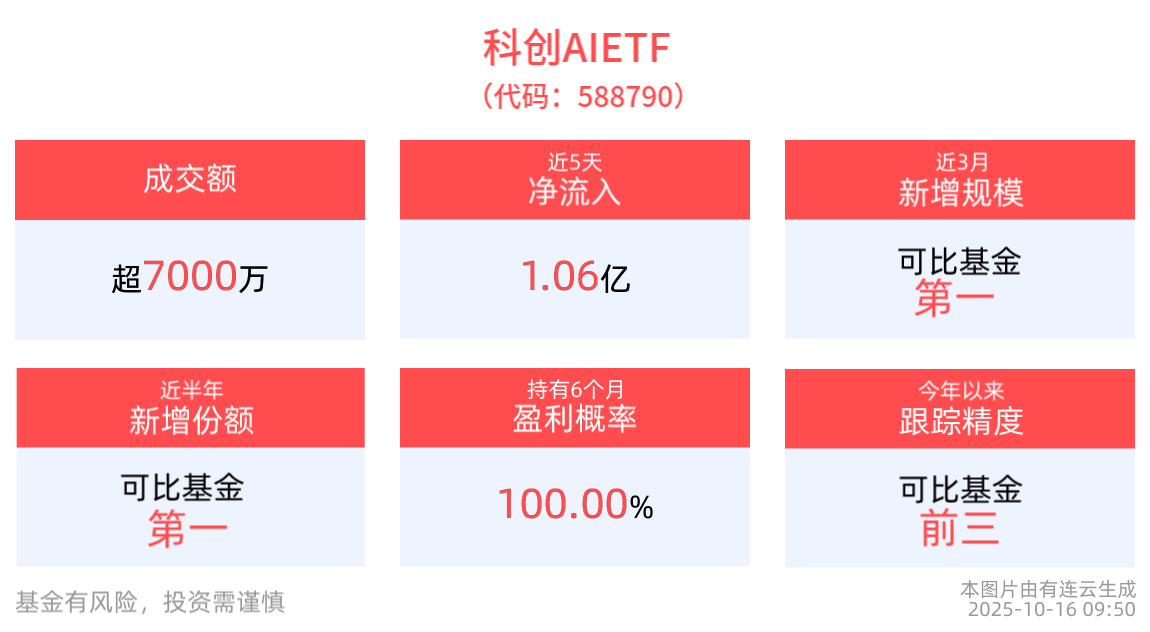
Core Insights - The Shanghai Stock Exchange's Sci-Tech Innovation Board Artificial Intelligence Index has shown a slight increase of 0.04% as of October 16, 2025, with notable gains from key stocks such as Cambricon (up 3.72%) and DaoTong Technology (up 2.80%) [3] - The Sci-Tech AI ETF (588790) has experienced a cumulative increase of 0.87% for the month up to October 15, 2025, indicating a stable performance amidst market fluctuations [3] - The ETF has seen a trading volume of 72.98 million yuan with a turnover rate of 1.09%, reflecting strong liquidity in the market [3] Market Trends - Recent adjustments in technology heavyweight stocks are indicative of a market consolidation phase, with expectations that small and mid-cap stocks may stabilize first as the market enters the latter part of this phase [6] - The overseas computing power industry remains robust, unaffected by recent trade tensions, suggesting a strong fundamental resonance within the related industry chain [6] - The domestic AI industry is expected to maintain high growth, driven by advancements in models and multi-modal technologies [6] Investment Opportunities - The Sci-Tech AI ETF is positioned as the largest product tracking the Sci-Tech Innovation Board Artificial Intelligence Index, with significant weight in stocks like Cambricon and Haiguang Information, which holds a 70% market share in domestic GPUs [7] - The ETF has seen a substantial growth of 1.98 billion yuan in scale over the past three months, ranking first among comparable funds [7] - The ETF's share count has increased by 3.783 billion shares in the last six months, indicating strong investor interest [7] Industry Developments - Oracle plans to deploy 50,000 AMD MI450 AI chips starting in the second half of 2026 to enhance its AI computing capabilities [8] - Walmart has partnered with OpenAI to introduce shopping features on ChatGPT, showcasing the integration of AI in retail [8] - The domestic usage of computing power chips is expected to surpass that of overseas chips soon, indicating a shift in the market landscape [8]

科创板首份三季报出炉!海光信息Q3营收、归母净利双双创新高
Zhong Guo Jin Rong Xin Xi Wang· 2025-10-15 13:53
Core Viewpoint - Haiguang Information has reported record high revenue and net profit for the third quarter of 2025, indicating strong performance in the context of surging domestic computing power demand [2][3]. Company Performance - Haiguang Information's Q3 revenue exceeded 4 billion, reaching approximately 40.26 billion, a year-on-year increase of 69.6% and a quarter-on-quarter increase of 31.38% [2]. - The net profit attributable to the parent company for Q3 was 7.6 billion, marking a historical high with a year-on-year growth of 13.04% and a quarter-on-quarter growth of 9.26% [2]. - For the first three quarters of the year, total revenue was 94.9 billion, up 54.65% year-on-year, while net profit reached 19.61 billion, reflecting a year-on-year increase of 28.56% [2]. Financial Health - The net cash flow from operating activities for the first three quarters was 22.55 billion, a significant increase of 465.64% year-on-year [3]. - As of the end of Q3, the total of prepaid expenses and inventory was 91.20 billion, with contract liabilities amounting to 28 billion, indicating a robust market environment for the domestic computing power industry [3]. Research and Development - Haiguang Information increased its R&D investment to 29.35 billion in the first three quarters, a year-on-year growth of 35.38% [3]. - The R&D investment ratio decreased by 4.4 percentage points compared to the same period last year, reflecting a larger revenue base [3]. Industry Trends - Multiple semiconductor companies have reported positive earnings forecasts, indicating a favorable trend in the semiconductor industry [5]. - Zhongke Shuguang reported a revenue of 88.04 billion for the first three quarters, a year-on-year increase of 9.49%, and a net profit of 9.55 billion, up 24.05% [5]. - The semiconductor industry is experiencing a recovery, with demand for AI computing, AIOT, and semiconductor equipment showing structural opportunities [7].
瑞银:中国算力加速发展推动AI进程 看好阿里巴巴 (09988)及百度(09888)
智通财经网· 2025-10-15 13:12
Core Viewpoint - China is accelerating investments in the artificial intelligence (AI) sector, with UBS highlighting that despite uncertainties in imported AI chips, domestic computing power is continuously developing due to national policy support and investments from major tech companies and local suppliers [1][2]. Group 1: Investment and Development - UBS is optimistic about Alibaba (09988) and Baidu (09888), believing that progress in self-developed chips will strengthen their positions in the AI value chain and that they will continue to invest in AI [1]. - Recent technological advantages include ongoing investments from Chinese internet companies in internal R&D and local GPU suppliers, which are rapidly improving despite existing gaps in chip performance [2]. Group 2: Hardware and Software Ecosystem - The performance of domestic cutting-edge GPUs has reached parity with NVIDIA's Ampere, with next-generation products targeting Hopper, although they still lag behind the Blackwell series [3]. - Some domestic chip manufacturers have established their own software stacks or added CUDA compatibility through translation tools, enhancing engineers' migration efficiency, though the fragmented ecosystem limits scalability [3]. Group 3: Supply Chain and Market Position - In addition to Alibaba and Baidu, UBS is optimistic about iFlytek (002230.SZ) due to its leading progress in integrating domestic hardware with large model development [3]. - The company also favors Horizon Robotics (09660), Northern Huachuang (002371.SZ), and Zhongwei Company (688012.SH) for their unique market positions [3].

国产算力需求爆发,海光信息Q3营收、归母净利双双创新高!| 财报见闻
Hua Er Jie Jian Wen· 2025-10-15 12:40
海光信息刚刚向市场交出了一份极为亮眼的成绩单:单季度营收同比猛增69.6%首次突破40亿大关,归 母净利润也创新历史新高。这一数字清晰地表明,在国产算力需求爆发的背景下,海光作为头部厂商正 在全力抢占市场版图。 海光信息周三公布最新财报。要点速览: 高增长背后的业务逻辑 海光信息2025年前三季度实现营业收入94.90亿元,同比增长54.65%,单三季度收入40.26亿元,同比大 增69.60%。 公司解释,主要得益于与整机厂商、生态伙伴在重点行业和领域的深化合作,加速了高端处理器产品的 市场导入,带动了销售规模的快速扩张。 归属于上市公司股东的净利润为19.61亿元,同比增长28.56%。 利润增速低于收入增速,反映出公司在 扩张阶段加大了研发和市场投入,利润端承压但仍保持较高增长。 扣非净利润为18.17亿元,同比增长23.18%。非经常性损益对利润的影响有限,主要为政府补助和资产 处置收益,整体盈利质量较高。 经营质量显著提升 研发投入:核心竞争力持续强化 前三季度研发投入29.35亿元,同比增长35.38%,占营收比30.92%。 营收:三季度营收达到40.26亿元创下历史新高,同比猛增69.6%;前 ...
A股算力芯片龙头,三季报公布
财联社· 2025-10-15 12:22
Core Viewpoint - Haiguang Information has achieved record high revenue and net profit in Q3, driven by deepened cooperation with key industry partners and significant market expansion of high-end processor products [2][3]. Financial Performance - Q3 revenue reached 4.026 billion yuan, a year-on-year increase of 69.6% and a quarter-on-quarter increase of 31.38% [2]. - Net profit attributable to shareholders for Q3 was 760 million yuan, up 13.04% year-on-year and 9.26% quarter-on-quarter; for the first three quarters, net profit totaled 1.961 billion yuan, a 28.56% increase year-on-year [3]. - Operating cash flow increased by 465.64% compared to the beginning of the year, attributed to rapid business growth and increased sales collections [3]. Research and Development - R&D investment for the first three quarters grew by 35.38% [4]. Incentive Plan - In September, Haiguang Information announced a draft for a restricted stock incentive plan aimed at boosting confidence in domestic computing power shipments, focusing on revenue from CPU and DCU products [5]. - The performance targets set in the plan include a revenue base of 9.162 billion yuan for 2024, with growth rates of no less than 55%, 125%, and 200% for the following years [6]. Ecosystem Development - Haiguang Information opened the CPU interconnect bus protocol (HSL) in September, which is expected to enhance collaboration across the industry, improve computational efficiency, and promote the establishment of unified standards [7]. - Analysts suggest that the HSL protocol positions Haiguang CPU to play a crucial role in the evolving landscape of heterogeneous computing, similar to NVIDIA's architecture [7]. Inventory and Market Strategy - As of the end of Q3, contract liabilities remained high at 2.8 billion yuan, with increased prepayments and inventory levels indicating a proactive approach to supply chain management [8]. - The company aims to deepen collaborations with existing clients while exploring new market opportunities to expand its market share [8]. Stock Performance - As of the latest close, Haiguang Information's stock rose by 5.91%, with a market capitalization exceeding 560 billion yuan [9].

科创、海外市场策略深度报告:科技龙头震荡蓄力,中小盘接力开启
ZHESHANG SECURITIES· 2025-10-15 08:54
Core Insights - The report indicates that since September, the small-cap sectors represented by the CSI 1000 and CSI 2000 have entered a period of consolidation, while technology-weighted stocks have seen strong gains. Recently, technology stocks have begun to adjust, which is viewed as a correction of strong stocks, characteristic of the later stage of market consolidation. As this period of fluctuation approaches its end, small-cap stocks are expected to stabilize first [1][3][4]. Trend Dimension - The current market is in a small-cap outperformance cycle, which began in 2022 with the rise of the AI industry. This cycle is expected to last 5-7 years, indicating a shift in market style driven by the transition between traditional and emerging industries [2][11]. Wave Dimension - From a wave perspective, small-cap stocks have significantly underperformed technology-weighted stocks since September. The CSI 2000 and CSI 1000 have lagged behind the STAR 50 and ChiNext 50 indices. As technology stocks enter a correction phase, small-cap stocks are anticipated to stabilize as the market moves towards the end of the consolidation period. Additionally, historical data suggests that small-cap stocks have a higher probability of outperforming the broader market in November, following the release of Q3 reports [3][15][23]. Industry Dimension - Potential directions for small-cap technology stocks during the October consolidation period include AI applications (both software and hardware), the expansion of domestic computing power, and the proliferation of innovative drugs. For AI applications, there are notable advancements in large models and vertical applications, while hardware applications are led by robotics and innovations such as autonomous driving and AI glasses. The report emphasizes the importance of monitoring technological advancements and new product developments in these areas [4][25][26]. - The report also highlights that leading companies in AI chips, wafer manufacturing, storage, and semiconductor equipment have already seen gains, suggesting that there are opportunities for small-cap stocks to benefit from ongoing technological and market developments. In the innovative drug sector, if the upward trend in market conditions continues, small-cap stocks are expected to follow suit [25][26].
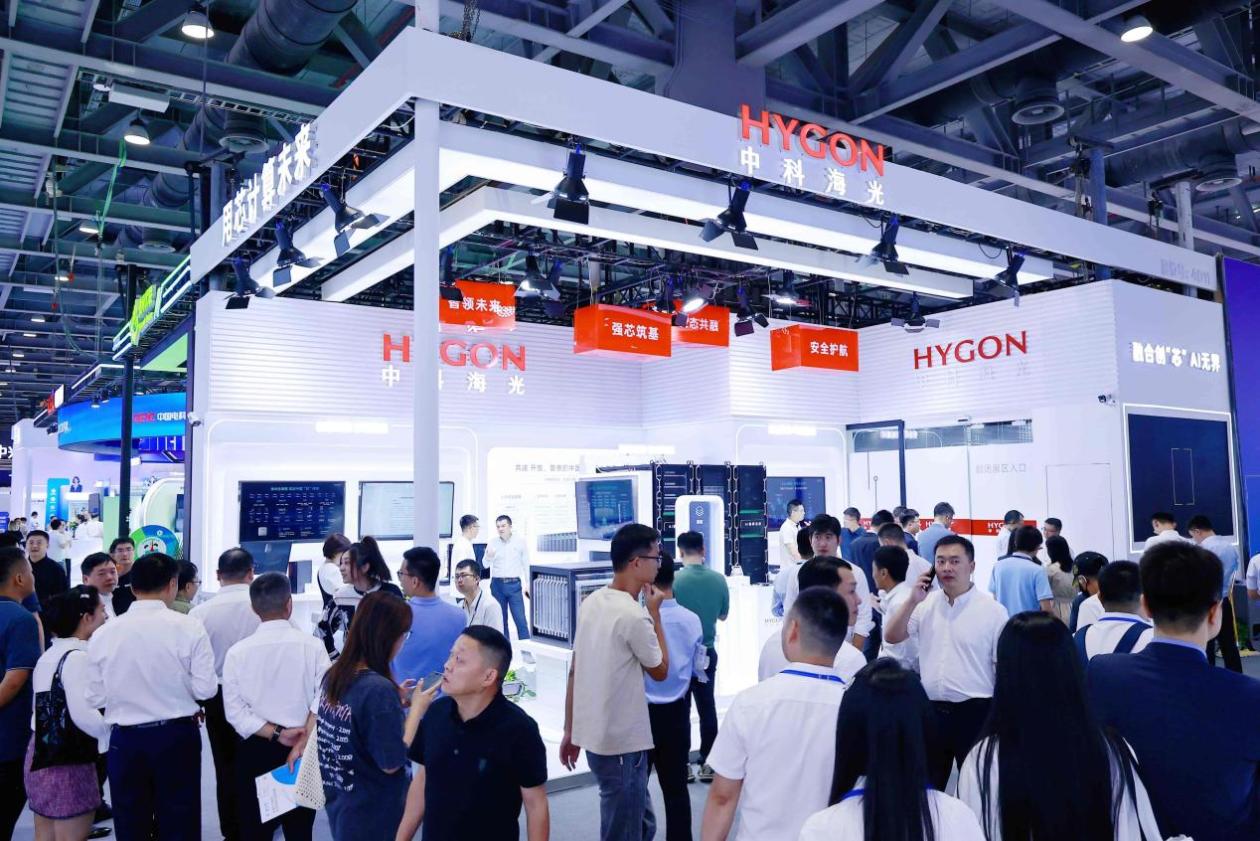
“双芯算力+开放生态”,2025中国移动合作伙伴大会海光展现国产算力硬实力
Huan Qiu Wang· 2025-10-15 08:44
Core Insights - The 2025 China Mobile Global Partner Conference showcased the latest achievements and future plans of AI technology empowering various industries, with a focus on domestic chip solutions from Haiguang Information [1][3] - Haiguang Information presented its CPU, DCU (AI accelerator), and AI cluster solutions, emphasizing deep collaboration with China Mobile to provide mature practices and advanced directions for domestic computing power [1][3] Group 1: Product Offerings and Applications - Haiguang's computing products, including CPUs and DCUs, serve as the foundation for numerous digital services such as online shopping, mobile payments, and real-time video processing [3] - The "Water Resources Big Model Integrated Machine," developed in collaboration with China Mobile, utilizes Haiguang's DCU for flood warning and disaster prevention, demonstrating practical applications in various sectors [3][4] - Haiguang has also launched multiple integrated machines in voice intelligence, robotics, and government writing, indicating the extensive application of its DCU in digital transformation across industries [4] Group 2: Technical Innovations - Haiguang's C86 architecture addresses compatibility challenges faced by traditional software based on x86 architecture, allowing seamless migration without performance loss [4][5] - The C86 architecture is fully compatible with the x86 ecosystem, enabling efficient adaptation across various operating systems and cloud platforms, thus supporting millions of mainstream software applications [4][5] - Haiguang's CPU includes an independent security module that supports national encryption algorithms and privacy computing, enhancing data security in communication scenarios [7] Group 3: Future Plans and Vision - Over the next three years, Haiguang plans to increase R&D investment to accelerate the iteration of CPU and DCU technologies while fostering an open ecosystem for deeper software-hardware integration [6][7] - The company aims to create a flexible computing network that supports various scenarios, from data center model inference to real-time edge computing [8] - Haiguang envisions a future where computing power is as accessible as utilities, facilitating the digital transformation of various industries through intelligent connectivity [8]