
营商环境

Search documents
中经评论:“促进南北方协调发展”别有深意
Jing Ji Ri Bao· 2025-11-07 00:31
Core Viewpoint - The "15th Five-Year Plan" emphasizes the need for coordinated development between northern and southern regions of China, addressing the increasing economic disparity and aiming for high-quality growth in the long term [1][3]. Economic Disparities - The economic weight is shifting from the north to the south, with southern provinces dominating in both number and scale, as evidenced by Guangdong and Jiangsu exceeding 10 trillion yuan in GDP, while northern provinces like Shandong and Henan lag behind [2]. - The pace of economic transformation is faster in the south, particularly in innovation hubs like the Guangdong-Hong Kong-Macau Greater Bay Area and the Yangtze River Delta, while northern provinces face challenges in transitioning from traditional industries [2]. - Population trends show an increase in the south, with Guangdong gaining 740,000 residents, while the northeastern region continues to experience significant population decline [2]. Strategic Importance of Northern Development - The disparity in economic development reflects various factors, including resource endowments and industrial structures, necessitating improved regional coordination mechanisms [3]. - The northern region is crucial for national food security and energy resources, contributing significantly to the country's grain production [3]. Recommendations for Northern Development - The primary task is to promote industrial transformation in the north, focusing on advanced manufacturing, modern agriculture, and energy sectors while fostering emerging industries [4]. - Enhancing the business environment in northern regions is essential, requiring reforms to reduce institutional barriers and costs [4]. - Expanding openness and integrating regional development with international standards are vital for enhancing the north's competitive edge [4]. Conclusion - The goal of promoting coordinated development is not to achieve uniform speed but to leverage each region's comparative advantages through reforms, innovation, and openness, ultimately fostering a high-quality development synergy between the north and south [5][6].
“促进南北方协调发展”别有深意
Jing Ji Ri Bao· 2025-11-06 22:07
Core Viewpoint - The article emphasizes the need for coordinated development between northern and southern regions of China, highlighting the increasing economic disparity and the importance of addressing this issue for long-term high-quality growth [1][3]. Economic Disparities - The economic weight is shifting from north to south, with southern provinces dominating in both number and scale, as evidenced by the fact that 8 out of 10 major economic provinces are in the south [2] - In the first three quarters of this year, Guangdong and Jiangsu both exceeded a GDP of 10 trillion yuan, while northern provinces like Shandong and Henan lagged behind with 7.7 trillion and 4.9 trillion yuan respectively [2] - By 2024, 27 cities in China are projected to have a GDP exceeding 1 trillion yuan, with 19 of these cities located in the south, accounting for over two-thirds of the total [2] Economic Transition and Population Movement - The south is experiencing faster economic transformation, particularly in innovation-driven areas like the Guangdong-Hong Kong-Macau Greater Bay Area and the Yangtze River Delta, while northern provinces face challenges in transitioning from traditional industries [2] - Population trends show an increase in the south, with Guangdong gaining 740,000 residents and Zhejiang 454,000, while the northeastern provinces continue to see population declines [2] Strategic Importance of Northern Development - The disparity in economic development reflects various factors, including resource endowments and industrial structures, necessitating improved regional coordination mechanisms [3] - The northern region is crucial for national food security and energy resources, contributing half of the country's total grain production [3] Recommendations for Northern Development - The primary task is to promote industrial transformation in the north, focusing on advanced manufacturing, modern agriculture, and energy sectors while also developing emerging industries [4] - Enhancing the business environment and reducing institutional transaction costs are essential for fostering a market-oriented economy in northern regions [4] - Expanding openness and integrating regional development with international standards are vital for enhancing competitiveness [4] Conclusion - Coordinated development should not aim for uniform speed but rather leverage comparative advantages through reforms, innovation, and openness, fostering a synergistic high-quality growth between the north and south [5]
副省级城市第三!截至9月底,成都市经营主体合计405.41万户,背后有这些“增长密码”
Sou Hu Cai Jing· 2025-11-06 11:55
Core Insights - Chengdu's business entities reached 4.0541 million by the end of September, ranking third among sub-provincial cities, indicating steady growth in the city's economic landscape [1] - Chengdu was recognized as an "Innovative City" in the "2024-2025 Urban Business Environment Innovation Report," highlighting its improvements in public service optimization and rights protection [1] - The city's continuous optimization of the business environment, improvement of industrial ecology, high-quality development of parks, and innovative talent policies are key factors driving its high-quality growth [1] Business Environment - The shift from "enterprises seeking government" to "government seeking enterprises" reflects a significant change in Chengdu's business environment, enhancing the ease of doing business [3] - Chengdu's government has actively supported companies, such as facilitating the first domestic import of umbilical cord blood stem cells and expediting the establishment of new enterprises [3] Policy and Service Enhancements - Chengdu has implemented a "one-code inspection" mechanism to streamline regulatory processes, reducing the burden on businesses and improving efficiency [6][7] - The city has integrated 800 inspection items and over 30,000 enforcement personnel into this system, achieving a satisfaction rate exceeding 99% among businesses [7] Talent Attraction and Support - Chengdu ranked fifth in the "Most Attractive Chinese Cities for Foreign Talent" report, showcasing its appeal to skilled professionals [8] - Recent talent policies focus on creating a comprehensive ecosystem for talent development, emphasizing platform optimization and ecological construction rather than just financial incentives [8]


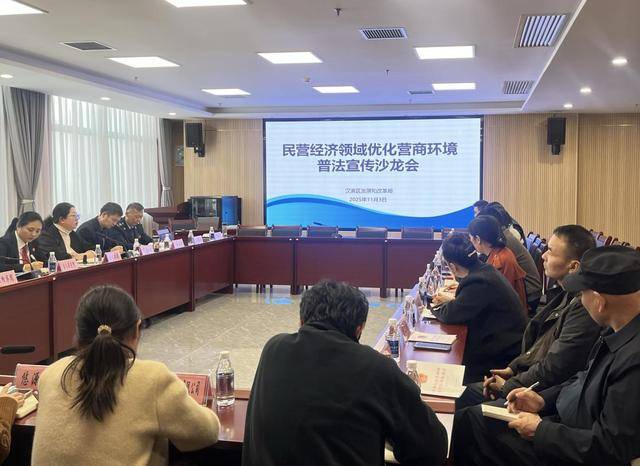
汉滨区举办民营经济领域普法沙龙 精准服务优化营商环境
Sou Hu Cai Jing· 2025-11-06 10:54
Group 1 - The event focused on optimizing the business environment for private enterprises, featuring a law promotion seminar tailored for their legal needs [3][4] - Various departments, including the judicial bureau and tax bureau, provided specialized lectures on topics such as legal services for enterprise development, contract risk prevention, and the latest tax incentives [3] - The interactive Q&A session allowed representatives from private companies to address practical issues, enhancing communication between government and enterprises [3] Group 2 - The activity is part of Hanbin District's efforts to improve the business environment and support market entities through precise legal education and face-to-face services [3] - The district aims to continuously innovate service methods and improve government-enterprise communication mechanisms to foster high-quality economic development [4]
鄂尔多斯市乌审旗:搭建政企“连心桥” 厚植营商“沃土”
Sou Hu Cai Jing· 2025-11-06 07:32
Core Insights - The private economy is identified as the "main force" in regional economic development, with the business environment serving as fertile ground for enterprise growth [1][2] Group 1: Mechanism Innovation - The establishment of the "Warm City, Warm Enterprise - U Business Heart" reception hall has created a comprehensive service platform for government-enterprise communication, integrating various functions such as legal mediation and democratic consultation [1] - Since 2025, six government-enterprise discussion meetings have been held, covering key sectors like energy, agriculture, and tourism, facilitating direct communication between local leaders and business representatives [1] Group 2: Targeted Support - A "Big Visit, Big Research" initiative was launched in 2025, involving a 15-member service team conducting one-on-one visits to 500 key private enterprises, successfully addressing 11 out of 14 reported issues [2] - The introduction of "targeted services" has improved policy delivery efficiency, transitioning from "enterprises seeking policies" to "policies seeking enterprises" [2] Group 3: Resource Aggregation - A three-dimensional empowerment system has been established, focusing on policy, legal, and financial support, with over 140 enterprises benefiting from tax and financing policy training [3] - The reception hall has facilitated cross-regional collaboration, leading to partnerships between local brands and businesses in cities like Xi'an and Shenzhen [3]

天津市北辰区市场监管局:推动准入准营再提速 服务食品生产经营企业发展
Zhong Guo Zhi Liang Xin Wen Wang· 2025-11-05 07:38
Core Insights - The article emphasizes the importance of food production and operation licensing as a critical aspect of food safety management, highlighting the challenges faced by companies due to policy misunderstandings and improper site layouts [1][2] - The Tianjin Beichen District Market Supervision Administration has transformed its approach from post-event inspections to proactive guidance, significantly speeding up the approval process for food production and operation enterprises [1][2] Group 1: Licensing and Approval Process - The Beichen District has served a total of 286 enterprises, reducing the average licensing approval time by over 50%, with on-site inspection first-pass approval rates increasing to over 95% [1] - The district has implemented a "certificate and license coordination" system, allowing for simultaneous processing of business licenses and operational permits, thus streamlining the approval process [1] Group 2: Support and Guidance for Enterprises - A "support + pre-review" model has been introduced, which simplifies complex regulations into easy-to-understand operational guidelines for new food production and operation enterprises [2] - The district has organized expert teams to provide tailored solutions for specific issues faced by enterprises, such as layout problems in school canteens, ensuring food safety [2] Group 3: Future Plans and Initiatives - The Beichen District Market Supervision Administration plans to further integrate party-building efforts with service delivery, creating a comprehensive service package for enterprises [2] - The establishment of an industry supply-demand matching platform is aimed at promoting resource sharing and collaborative growth among enterprises, contributing to a better business environment [2]
黑龙江省“十四五”期间招商引资签约项目7267个
Zhong Guo Xin Wen Wang· 2025-11-05 06:10
Core Insights - Heilongjiang Province has signed 7,267 investment projects and has 6,132 projects implemented since the start of the 14th Five-Year Plan, achieving an implementation rate of 84.4% [1] Group 1: Investment Attraction Efficiency - The efficiency of investment attraction in Heilongjiang Province has gradually improved, utilizing various platforms such as investment promotion conferences and forums to facilitate project signings [1] - The province has organized promotional activities in countries like Switzerland and Saudi Arabia, as well as in Hong Kong and Macau, leading to a number of signed cooperation projects [1] Group 2: Project Structure Optimization - The structure of investment projects has been continuously optimized, with 849 high-tech manufacturing and service projects signed and implemented, accounting for 13.8% of total implemented projects [1] - The province has attracted 435 projects from world and China’s top 500 enterprises, with a total investment of 605 billion yuan [1] - Focus has been placed on upgrading traditional industries and fostering modern industrial clusters through targeted investment in key sectors [1] Group 3: Improvement in Service Capabilities - The ability to serve investment enterprises and projects has significantly improved, with efforts made to resolve practical issues and create a favorable business environment [1] - Long-standing foreign enterprises such as Nestlé and Case New Holland have continued to expand their investments in Heilongjiang, indicating confidence in the province's business environment [1]
不宝金玉而宝信
Liao Ning Ri Bao· 2025-11-05 00:58
Core Insights - The essence of a favorable business environment lies in trust and credibility rather than short-term financial gains, emphasizing the importance of stable and reliable governance to attract investment and stimulate innovation [1][2] - Government credibility acts as a guiding star for the business environment, where businesses now prioritize trust over temporary benefits, focusing on policy stability, transparency, fairness, and commitment fulfillment [1] - A robust credit system enhances market efficiency, allowing businesses to simplify processes and consumers to engage confidently, ultimately leading to a more prosperous economic environment [2] Group 1 - Trust is a fundamental infrastructure in the business environment, akin to air, which is essential yet often overlooked [1] - Government must adhere to a credit baseline of "words must be followed by actions" to build trust with enterprises, ensuring timely policy implementation and legal protection of business rights [2] - The market's trust serves as a lubricant for a continuously improving business environment, where a lack of trust can increase transaction costs and suppress consumer willingness [2] Group 2 - The most valuable resource in the journey towards high-quality development is trust, which should be integrated into all aspects of governance, market, and society [2] - A well-established credit system allows for streamlined approval processes and quick access to loans for businesses, enhancing overall market efficiency [2] - Unlike short-term subsidies or resource inputs, a trust-based environment is more effective in retaining businesses and stimulating demand, acting as a powerful catalyst for economic growth [2]
成都民营经济持续向新向好 前三季度成都民营经济增加值同比增长6.4%
Sou Hu Cai Jing· 2025-11-04 17:17
Economic Performance - Chengdu's private economy achieved a value-added of 920.97 billion yuan in the first three quarters of this year, with a year-on-year growth of 6.4%, surpassing the provincial growth rate by 0.9 percentage points [1] - The primary industry contributed 38.35 billion yuan with a growth of 3.0%, the secondary industry contributed 269.24 billion yuan with a growth of 8.7%, and the tertiary industry contributed 613.38 billion yuan with a growth of 5.6% [1] Business Environment - Chengdu was awarded the title of "Annual Innovative City" in the "2024-2025 Urban Business Environment Innovation Report" [1] - The city emphasizes the "happiness index" of enterprises as a key measure of the business environment, implementing various effective measures to boost the confidence of private enterprises [1] Service Mechanism - Chengdu has initiated a "Daily Director Office Hours and Weekly Chain Leader Reception" service mechanism, focusing on key industrial chains with a comprehensive service model [5] - The "进解优促" initiative has evolved to enhance service mechanisms, achieving a visit to 78,900 enterprises and resolving over 15,800 issues with a completion rate exceeding 98% [5][6] Financing Support - Chengdu launched a dedicated loan product for private enterprises, "民营贷," with a total scale of no less than 50 billion yuan, facilitating easier access to credit [6] - The city established a comprehensive financial service platform, "蓉易贷," integrating resources from over a hundred financial institutions, offering 350 financial products and services [6] Innovation and Application - The city has supported over 3,000 enterprises in achieving production and sales connections through a cross-sector, full-cycle scene innovation mechanism, providing 704 scene supply and implementing 280 [7] - Companies like Dili Technology have benefited from local support in technology research and application, enhancing their operational capabilities in various public spaces [7]

环球时报社评:别让安世事件成为欧洲市场经济的污点
Bei Jing Ri Bao Ke Hu Duan· 2025-11-04 15:57
Core Viewpoint - The Dutch government's intervention in ASML's internal affairs and the court's decision to strip Chinese shareholders of their rights are seen as violations of Chinese companies' legitimate rights, leading to global supply chain disruptions and raising questions about Europe's institutional credibility [1][2]. Group 1: Impact on Investment Environment - The actions of the Dutch government undermine the foundation of property rights protection in the Netherlands and Europe, raising concerns about the motivations behind such behavior [2]. - The arbitrary alteration of equity structures and corporate governance by public authorities increases "institutional risk premiums," making long-term capital hesitant to invest in the region [2]. - The expectation of potential government takeovers will lead investors to reassess their positions in the Netherlands and Europe, creating a climate of uncertainty [2]. Group 2: Global Supply Chain Risks - The abrupt cessation of wafer supply to ASML (China) by the Dutch government amplifies systemic risks within the global supply chain, affecting various sectors such as automotive electronics and industrial control [2]. - Disruptions in a highly interdependent supply chain can lead to order delays, increased costs, and difficulties in finding alternatives, ultimately impacting the entire industry [2]. Group 3: Geopolitical Context - The U.S. has previously labeled Chinese-backed enterprises as risky, pressuring allies to intervene in normal business activities under the guise of national security, a tactic that has backfired in the context of the ASML incident [3]. - The Netherlands finds itself in a precarious position, having lost trust from Chinese enterprises and the global market due to its extreme measures, which did not yield substantial security benefits [3]. Group 4: Call for Constructive Solutions - The Chinese side advocates for a responsible approach from the Dutch government to stabilize bilateral economic relations and the global supply chain, urging an end to interference in corporate matters [4]. - The ASML situation could have been avoided if the Dutch government prioritized the broader economic relationship and the interests of workers and consumers [4].