对等关税

Search documents
白宫:特朗普已签署行政令 将对加拿大关税税率上调至35%
Yang Shi Xin Wen· 2025-07-31 23:16
(文章来源:央视新闻) 央视记者获悉,当地时间7月31日,白宫表示,美国总统特朗普已签署行政令,将对加拿大的关税税率 从25%上调至35%,新关税将于8月1日生效。 白宫方面还表示,特朗普认为有必要调整对部分国家的"对等关税"税率。行政令明确列及的国家将适用 其中规定的关税,未列入的国家则统一征收10%关税。 ...
对等关税命运难测:美上诉法院关键审判开启庭辩,法官质疑特朗普授权
Hua Er Jie Jian Wen· 2025-07-31 20:08
Core Viewpoint - The fate of the reciprocal tariffs remains uncertain as a court case questions the legal basis for President Trump's significant tariff actions [1] Group 1: Legal Proceedings - The U.S. Court of Appeals held oral arguments on the case "VOS Selections v. Trump," where judges questioned whether the International Emergency Economic Powers Act (IEEPA) allows the President to unilaterally alter the tariff schedule set by Congress [1][2] - The case centers on whether Trump exceeded presidential authority, infringing on Congress's constitutional power to set tariffs [1][3] - The Department of Justice defended Trump's global tariff system, but judges expressed skepticism towards their arguments [1][3] Group 2: Tariff Implications - A new round of reciprocal tariffs is set to take effect on August 1, impacting nearly 200 countries that failed to reach a trade agreement with the U.S. [1] - If the Trump administration loses the case, it could significantly undermine its overall tariff strategy and may require seeking Congressional authorization [1][5] Group 3: Judicial Concerns - Judges raised concerns about the scope of emergency powers, questioning why tariffs were not explicitly mentioned in the IEEPA and why Trump is the first president to invoke this law for tariffs [3][4] - The argument presented by the DOJ suggested that Congress intended to grant the President broad powers during emergencies, which could include imposing tariffs [4] Group 4: Market Impact - The Federal Circuit Court is not expected to make a ruling immediately, and the losing party is likely to seek a review from the Supreme Court [5] - A ruling in favor of Trump would grant him significant new powers to impose and relax tariffs on foreign entities, potentially setting a precedent for future presidents [5] - Conversely, a loss for the Trump administration could lead to a murky future for its tariff policies, with potential international disputes arising from countries seeking to revoke existing agreements [5][6]
美国“对等关税”8月1日重启,贸易谈判进展如何?
第一财经· 2025-07-31 14:26
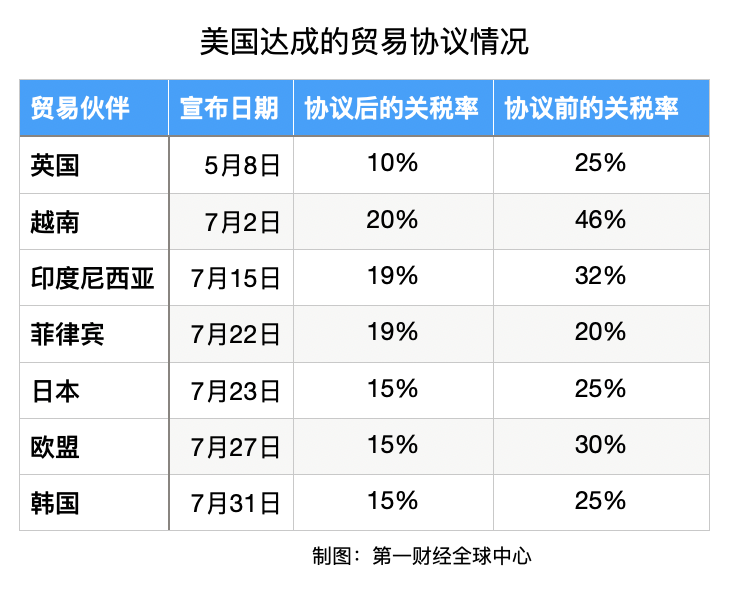
2025.07. 31 本文字数:2578,阅读时长大约4分钟 作者 | 第一财经 高雅 美国将在8月1日恢复征收所谓"对等关税",当前特朗普政府仍在与多个经济体进行最后时刻的谈 判。 | 贸易伙伴 | 宣布日期 | 协议后的关税率 | 协议前的关税率 | | --- | --- | --- | --- | | 英国 | 5月8日 | 10% | 25% | | 越南 | 7月2日 | 20% | 46% | | 印度尼西亚 | 7月15日 | 19% | 32% | | 菲律宾 | 7月22日 | 19% | 20% | | 日本 | 7月23日 | 15% | 25% | | 欧盟 | 7月27日 | 15% | 30% | | 韩国 | 7月31日 | 15% | 25% | 贸易谈判进展 在4月2日宣布实施所谓"对等关税"政策后,特朗普政府实施了为期90天的暂停期,原定于7月9日到 期。但为推进贸易协议谈判进程,特朗普本月再次延长了这一暂停期,将最后期限设定在8月1日。 据央视新闻,当地时间7月30日,美国总统特朗普表示,美国已与韩国达成"全面完整"的贸易协 议。美国将对韩国征收15%的关税。韩国将对 ...

美国“对等关税”8月1日重启 贸易谈判进展如何?
Di Yi Cai Jing· 2025-07-31 14:23
美国将在8月1日恢复征收所谓"对等关税",当前特朗普政府仍在与多个经济体进行最后时刻的谈判。 据央视新闻,当地时间7月30日,美国总统特朗普表示,美国已与韩国达成"全面完整"的贸易协议。美国 将对韩国征收15%的关税。韩国将对美全面开放贸易,接受包括汽车、卡车和农产品在内的美国产品。 同日,特朗普签署行政命令,对巴西加征40%关税,使总关税额达到50%。他还宣布印度将从8月1日起支 付25%的关税,并警告其他贸易伙伴,如果未能在最后期限前达成协议,将被实施广泛关税。 "8月1日的最后期限就是8月1日的最后期限——它依然有效,不会延期。对美国来说是一个重要的日 子!"特朗普在其社交平台上表示。 上海交通大学上海高级金融学院教授胡捷近期对第一财经记者表示,基于对美国总统特朗普政策目标和 谈判风格的综合判断,他更倾向于将关税税率维持在当前"喊价"的水平,并以此作为杠杆加大对其他国 家的谈判压力。 "这种策略并不意味着提高关税后谈判大门就会关闭。相反,谈判仍将持续进行。通过维持较高的关税威 胁,特朗普政府试图在后续谈判中占据更有利的地位,从而推动达成更符合美国利益的协议条款。"他分 析称。 | 贸易伙伴 | 宣布日期 ...
白宫官员:特朗普周四将签行政令 对未达成协议国家征更高关税
凤凰网财经· 2025-07-31 13:19
Core Viewpoint - The article discusses the impending implementation of higher tariffs by the Trump administration on various countries that fail to reach trade agreements by the August 1 deadline, highlighting the urgency and potential impact on major trade partners like Canada and Mexico [1][2]. Group 1: Tariff Implementation - Trump is set to sign an executive order on July 31 to impose higher tariffs on countries that do not reach trade agreements by August 1, affecting major trade partners including Canada and Mexico [1]. - Since the initial announcement in April, Trump has extended the deadline for tariff implementation twice, but the White House has now stated that the August 1 deadline will not be postponed again [1][2]. - The tariffs range from 10% to 50%, with specific rates announced for different countries, such as 35% on Canadian imports and 30% on Mexican imports [3][4]. Group 2: Trade Negotiations - Despite the impending tariffs, U.S. Commerce Secretary stated that negotiations would continue even after the tariffs take effect [2]. - Canadian officials are actively seeking favorable trade agreements with the Trump administration, emphasizing their commitment to negotiating terms [3]. - Mexican President expressed hope for reaching an agreement before the deadline, indicating a willingness to communicate with Trump if necessary [5].
美国“对等关税”8月1日重启,贸易谈判进展如何?
Di Yi Cai Jing· 2025-07-31 12:00
美国将在8月1日恢复征收所谓"对等关税",当前特朗普政府仍在与多个经济体进行最后时刻的谈判。 据央视新闻,当地时间7月30日,美国总统特朗普表示,美国已与韩国达成"全面完整"的贸易协议。美国 将对韩国征收15%的关税。韩国将对美全面开放贸易,接受包括汽车、卡车和农产品在内的美国产品。 目前,美国仅与英国、越南、菲律宾、印度尼西亚、日本、欧盟和韩国等经济体达成初步协议。 最初宣布暂停时,特朗普政府曾设定了"90天内达成90份协议"的目标,但这一预期未能实现。目前,美 国仅与英国、越南、菲律宾、印度尼西亚、日本、欧盟和韩国等经济体达成初步协议,且多数协议的细 节仍待敲定。 具体来说,5月,英国成为首个与美国达成贸易协议的国家。该协议设定了10%的基础关税,并针对汽 车、航空航天等关键行业制定了配额与豁免机制,但钢铝关税削减等核心问题至今仍未明确。7月2日, 美越协议宣布将越南输美商品的关税从46%降至20%,同时越南承诺"完全开放市场",但具体条款仍未披 露。随后,美国与印度尼西亚于7月15日达成协议,将印尼关税从32%下调至19%,作为交换,印尼同意 取消99%以上美国商品的关税壁垒。7月22日,美菲协议将菲律 ...
美欧二季度GDP均好于预期,美联储按兵不动
Hua Tai Qi Huo· 2025-07-31 05:09
Report Industry Investment Rating No relevant content provided. Core Viewpoints of the Report - The GDP of the US and Europe in the second quarter was better than expected, and the Fed kept its policy unchanged. The market should focus on domestic important meetings, the progress of "anti - involution", the impact of "reciprocal tariffs", and corresponding commodity sectors. For investment, it is recommended to allocate more industrial products on dips [1][2][3][5]. Summary by Related Catalogs Market Analysis - China's H1 GDP grew 5.3% year - on - year, higher than the annual target of 5%. Fiscal efforts and "rush to export" supported the economy, but policy urgency decreased. In June, exports were strong, while social retail sales growth slowed to 4.8%. Infrastructure and manufacturing investment declined, and real estate sales were weak. The Politburo meeting proposed more active fiscal and moderately loose monetary policies, and local governments will open applications for parenting subsidies in late August [1]. "Anti - Involution" Progress Tracking - Since July, relevant departments have emphasized governing low - price and disorderly competition. Policy expectations for "anti - involution" in industries such as steel, photovoltaic, and new energy vehicles have increased, and some commodity prices have recovered. Ten key industries' steady - growth work plans are to be introduced, and the petrochemical and chemical industries' old - device assessment is underway [2]. "Reciprocal Tariffs" Impact - After the "Big Beautiful" bill, Trump focused on external pressure to promote tariff negotiations. Tariffs are in a "stagnant" stage, dragging down commodities affected by external demand. The US Q2 GDP growth was 3%, and the Fed paused rate cuts. The eurozone's Q2 economic growth was better than expected, and the rate - cut expectation declined [3]. Corresponding Commodity Sectors - Domestically, the black and new - energy metal sectors are most sensitive to the supply - side. Overseas, energy and non - ferrous sectors benefit from inflation expectations. The black sector is dragged by downstream demand, and the supply of non - ferrous metals remains tight. The energy supply is expected to be loose in the medium - term. Some chemical products' "anti - involution" space is worth attention, and agricultural products have limited short - term fluctuations [4]. Strategy - For commodities and stock index futures, it is recommended to allocate more industrial products on dips [5]. Important News - The Politburo will hold the Fourth Plenary Session of the 20th Central Committee in October to discuss the 15th Five - Year Plan. Parenting subsidy applications will be open by August 31. The US and China will extend the suspension of part of reciprocal tariffs. Trump imposed tariffs on multiple countries, and the US economic data and Fed's policy were released [7][8].
油料日报:中美关税政策延续,油料震荡运行-20250731
Hua Tai Qi Huo· 2025-07-31 05:07
Group 1: Report Industry Investment Rating - The investment strategy for soybeans and peanuts is neutral [4][5] Group 2: Report's Core View - Under the continuation of Sino - US tariff policies, the oilseed market is oscillating. The soybean supply is expected to remain loose, and the peanut market is generally weak with low downstream consumption and cautious middlemen [1][3][4] Group 3: Summary by Related Contents Soybean Market - **Futures and Spot Prices**: The closing price of the soy - one 2509 contract was 4153.00 yuan/ton, up 9.00 yuan/ton (+0.22%) from the previous day. The edible soybean spot basis was A09 + 147, down 9 (-32.14%) from the previous day. On Tuesday, CBOT soybean futures fell for the third consecutive day, with the benchmark contract down 0.3%. Northeast soybean prices were stable, with remaining grain mostly consumed and limited trader inventories [1][2] - **Market Factors**: The Sino - US negotiation result maintained the previous "reciprocal tariff" rate, and the US soybean export expectation had no substantial change. The soybean crop in the Northeast was growing well, and the supply was expected to be loose [3] Peanut Market - **Futures and Spot Prices**: The closing price of the peanut 2510 contract was 8106.00 yuan/ton, up 4.00 yuan/ton (+0.05%) from the previous day. The average peanut spot price was 8580.00 yuan/ton, down 40.00 yuan/ton (-0.46%) month - on - month. The spot basis was PK10 + 94.00, down 4.00 (-4.08%) month - on - month. The domestic peanut market was oscillating slightly downward, with the average price of common peanuts at 4.29 yuan/jin [4] - **Market Factors**: The peanut market was generally weak, with a sluggish downstream consumption environment, light trading, increased operating difficulties for middlemen, and strong risk - aversion sentiment [4]
美国总统称将对印度商品征收25%关税
Huan Qiu Wang· 2025-07-31 02:52
【环球网财经综合报道】当地时间7月30日,美国总统在其社交平台"真实社交"(Truth Social)上宣布,自8月1日起,美国将对来自印度的商品征 收25%的关税,并声称将因印度的"不当行为"加收额外惩罚性费用。这一声明标志着美印之间的贸易摩擦急剧升温。 对于美国总统的最新关税威胁,印度官方截至目前尚未作出公开回应。此前,印度外交部曾表示,印度愿与美国进行"建设性对话",以寻求互利 共赢的解决方案,并反对任何单边主义和保护主义措施。 美国贸易代表办公室的代表格里尔(Katherine Tai)在7月28日也曾表示,美国需要更多时间与印度进行谈判,以评估印度向美国开放更多市场的 意愿。 此次关税威胁并非空穴来风。就在7月29日,美国总统在从英国返美的专机上曾向媒体透露,美国正考虑对印度输美产品征收20%至25%的关税。 他当时指责印度对美国产品征收的关税"几乎高于任何其他国家",并称"印度不能这么做"。 自今年4月特朗普公布所谓"对等关税"措施以来,美印双方已举行多轮会谈,但谈判始终陷入僵局。分歧主要集中在印度对农业和乳业的保护主义 立场上,双方在购买俄罗斯石油等议题上也存在分歧。有消息称,印度计划于8月中旬 ...