
指数化投资

Search documents
上半年公募基金发行升温,权益类占比超七成
Guo Ji Jin Rong Bao· 2025-07-03 15:52
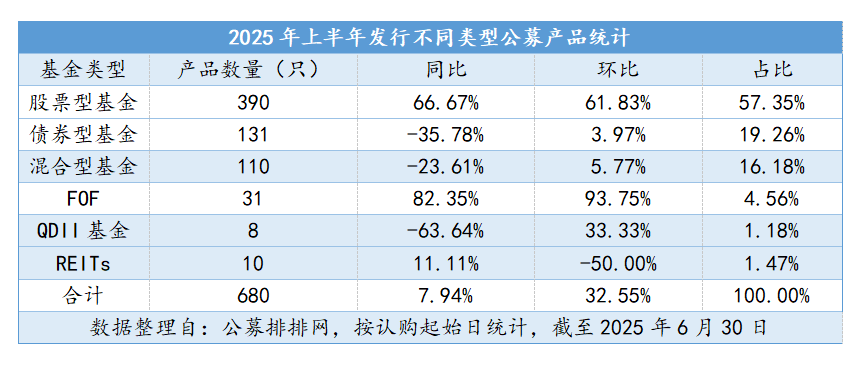
Core Insights - The public fund issuance market showed significant recovery in the first half of 2025, with a total of 680 new funds launched, representing a year-on-year increase of 7.94% and a quarter-on-quarter increase of 32.55% [1][2] Fund Type Analysis - Equity funds were the main contributors to the fundraising, with 390 equity funds launched, accounting for 57.35% of the total. Both year-on-year and quarter-on-quarter growth exceeded 60%, indicating a notable increase in equity fund issuance [1][2] - FOF (Fund of Funds) funds experienced a peak in issuance, with 31 funds launched, representing 4.56% of the total. The year-on-year and quarter-on-quarter growth rates were 82.35% and 93.75%, respectively [1][2] - Bond funds and mixed funds showed a recovery trend quarter-on-quarter, with 131 bond funds launched, making up 19.26% of the total, while mixed funds also exceeded 100 launches, accounting for 16.18% [1][2] Market Dynamics - The recovery in public fund issuance is attributed to two main factors: the restoration of market profitability, with over 80% of actively managed equity funds turning positive since April, and the release of policy benefits, such as the new "National Nine Articles" promoting long-term capital inflow into the market [3] - Looking ahead, the public fund issuance market is expected to continue a pattern of differentiation and innovation, with equity funds remaining dominant, comprising over 70% of upcoming funds. Index funds are becoming increasingly popular, with a focus on expanding ETF product lines into niche areas and accelerating coverage of emerging markets and US tech leaders [3] - "Fixed income plus" products and bond funds are anticipated to recover, with institutional interest in "fixed income plus" products due to their balanced return advantages. The potential of bond ETFs is expected to be released, supported by policies and funding [3]

宽德投资冯鑫:AI时代的指数化投资——量化投资与长期价值投资的融合
财联社· 2025-07-03 09:59
Core Viewpoint - The integration of AI-driven investment transformation, long-term policy orientation, and the responsibility of the domestic quantitative investment industry presents both challenges and opportunities for institutional managers committed to a long-term perspective [1][16]. Group 1: Era Background - The current era is characterized by a convergence of technological evolution and institutional transformation, with generative AI fundamentally altering various industries and providing new tools for long-term value investment [1]. - The development of AI is progressing from enhancing multi-step reasoning capabilities (L2) to achieving "perception-planning-execution" closed-loop capabilities (L3), marking 2025 as the "Year of AI Agents" [2]. Group 2: Policy and Market Dynamics - National policies are reinforcing a long-term orientation, with new regulations encouraging long-term capital market entry, advocating value investment, and standardizing algorithmic trading [4]. - The A-share market is undergoing positive structural changes, with improved information disclosure, regulatory enforcement, and investor composition, creating a foundation for sustainable long-term investment [5]. Group 3: Role of Quantitative Trading - Quantitative trading plays a crucial role in enhancing resource allocation efficiency and market stability, acting as both a "lubricant" and "stabilizer" in financial markets [6]. - Research indicates that quantitative trading can provide liquidity and price discovery, thereby improving overall market efficiency [6]. Group 4: Smart Beta Strategy - The Smart Beta strategy aims to serve long-term institutional capital by providing a reliable long-term allocation tool that combines long-termism with a tool-oriented approach [10]. - This strategy emphasizes a systematic modeling of fundamental factors, focusing on long-term value characterization while adhering to the principles of objectivity and discipline in quantitative investment [10][11]. Group 5: AI Exploration and Future Opportunities - The industry is increasingly embracing AI, with research categorized into interest-driven academic AI studies and more challenging industrial-grade AI development [12]. - Opportunities in the AI era can be divided into application-oriented real opportunities and foundational capability exploration, with the latter focusing on the potential of intelligent systems [13]. Group 6: Conclusion and Call to Action - The current environment presents a unique opportunity for active participation in shaping the future, emphasizing the importance of long-term commitment and practice over short-term certainty [16][17].

头部量化,最新发声!宽德投资冯鑫:不做伟大时代的旁观者!
券商中国· 2025-07-03 07:41
Core Viewpoint - The integration of AI-driven investment strategies, particularly the Smart Beta approach, is seen as a pivotal development in the investment landscape, aiming to balance long-term value investment with quantitative methods [1][5][15] Group 1: Technological and Policy Context - The current era is marked by a convergence of technological evolution and institutional transformation, with generative AI significantly impacting various industries and facilitating the implementation of long-term investment philosophies [3][8] - AI is evolving from enhancing multi-step reasoning capabilities to developing AI Agents capable of executing complex tasks autonomously, marking 2025 as the "Year of AI Agents" [8][10] - National policies are increasingly promoting long-term investment, with new regulations encouraging the entry of long-term capital into the market and advocating for value investing [10][11] Group 2: Role of Quantitative Trading - Quantitative trading serves as both a "lubricant" and "stabilizer" in the market, enhancing resource allocation efficiency and providing liquidity and price discovery mechanisms [4][12] - The evolution of the Chinese market structure, including improved information disclosure and regulatory enforcement, supports a fundamental-driven market mechanism conducive to long-term investment [10][11] Group 3: Smart Beta Strategy - The Smart Beta strategy is positioned as a reliable tool for long-term institutional investors, focusing on systematic modeling of fundamental factors to create transparent and replicable investment tools [15][16] - This strategy emphasizes low turnover, reasonable fees, and high capacity, aligning with the goal of achieving "universal access" for long-term investors [16][15] Group 4: AI Exploration and Future Opportunities - The industry is witnessing a surge in AI research, categorized into academic-driven studies and industrial-level AI development, which involves significant investment and long-term planning [17][18] - Opportunities arising from AI can be divided into application-oriented chances and foundational capability explorations, both of which are crucial for enhancing industry efficiency and addressing fundamental questions about AI's potential [18][19] Group 5: Conclusion and Vision - The current environment presents both uncertainties and structural challenges, yet it also opens up new avenues for development through technological breakthroughs and collaborative efforts [20] - The establishment of AI laboratories, such as WILL, reflects a commitment to exploring the societal value of AI and fostering a culture of responsible innovation within the investment sector [19][20]

A股6月新开户数超160万,证券ETF龙头(159993)盘中飘红
Xin Lang Cai Jing· 2025-07-03 05:42
Group 1 - The Guozheng Securities Leading Index (399437) increased by 0.52% as of July 3, 2025, with notable gains from major securities firms such as Everbright Securities (601788) up 3.00% and CITIC Securities (600030) up 0.88% [1] - In June 2025, the number of new individual A-share stock accounts opened was 1.638 million, representing a month-on-month increase of 89,600 accounts, or 5.79% [1] - The total number of new individual A-share stock accounts opened in the first six months of 2025 reached 12.5522 million, bringing the cumulative total to 381 million accounts as of June 30, 2025 [1] Group 2 - The top ten weighted stocks in the Guozheng Securities Leading Index (399437) as of June 30, 2025, include Dongfang Caifu (300059) and CITIC Securities (600030), with these stocks collectively accounting for 78.71% of the index [2]
★上交所:引导更多资金流向国家重点支持领域
Zheng Quan Shi Bao· 2025-07-03 01:56
Core Viewpoint - The meeting organized by the Shanghai Stock Exchange highlighted the rapid development of index-based investment in the Sci-Tech Innovation Board, with ETFs becoming a significant channel for investors to engage in "hard technology" enterprises [1][2]. Group 1: Development of Sci-Tech Innovation Board - The "Eight Measures for Deepening the Reform of the Sci-Tech Innovation Board" were released by the China Securities Regulatory Commission last June, leading to the introduction of 13 new indices over the past year, bringing the total to 29 [1]. - The indices include broad-based indices like the Sci-Tech 50, Sci-Tech 100, and thematic indices focused on sectors such as information technology, biomedicine, chips, and artificial intelligence [1]. Group 2: Growth of ETFs - Currently, there are 80 listed Sci-Tech Innovation Board ETFs with a total scale exceeding 250 billion yuan, representing a nearly 60% increase since the release of the "Eight Measures" [2]. - Since the announcement of the "Eight Measures," 51 new ETFs have been launched, nearly doubling the number prior to the measures, and 68 ETFs have been approved, also doubling the previous count [2]. - The Sci-Tech Innovation Board has become the highest proportion of index-based investment in A-shares, with index products accounting for 8.3% of the board's overall free-floating market value [2]. Group 3: Institutional Insights and Recommendations - Institutional representatives emphasized the convenience of Sci-Tech Innovation Board ETFs for investors and their role in facilitating long-term capital inflow from insurance and banking sectors [2]. - There are currently 27 fund companies involved in Sci-Tech Innovation Board ETFs, an increase of 13 since the "Eight Measures" were released [2]. - Recommendations were made to optimize the supporting mechanisms for Sci-Tech Innovation Board ETFs, with the Shanghai Stock Exchange indicating plans to enhance trading mechanisms and attract more social capital into key national support areas [2][3]. Group 4: Future Directions - The Shanghai Stock Exchange aims to deepen the reform of the Sci-Tech Innovation Board and strengthen communication with market participants to foster a more resilient and high-quality index investment ecosystem [3].
ETF产品加速涌现,中长期资金更青睐哪些方向?
Di Yi Cai Jing· 2025-07-02 14:03
Group 1: Core Insights - The Chinese ETF market is experiencing rapid development, with a significant increase in product offerings and a focus on long-term investment strategies [1][2] - The total scale of ETF products in China has reached 4 trillion yuan, with expectations to surpass 10 trillion yuan by 2024 [2] - Key drivers for the growth of the ETF market include policy support, the appeal of low fees and high transparency to individual investors, and the alignment of investment philosophies with index investing [2][6] Group 2: Product Design Considerations - ETF product design should consider future funding sources rather than immediate market trends, focusing on products suitable for long-term allocation [2][4] - The market is seeing a diversification of ETF products, including broad-based, thematic, and cross-border indices, with a strong emphasis on innovation [2][3] - Financial technology and data analytics are being leveraged to identify and respond to market trends, enabling timely index releases [3][6] Group 3: Investment Preferences of Long-term Funds - Long-term funds are increasingly favoring ETFs that track the CSI 300 index, dividend-focused strategies, and bond ETFs for risk diversification [6][7] - The insurance sector is a significant player in the ETF market, holding approximately 260 billion yuan in ETFs, primarily in equity and thematic products [6][7] - There is a growing interest in enhancing ETF offerings, including on-exchange products, index-enhanced ETFs, and QDII ETFs for overseas investments [7] Group 4: Future Outlook - The potential for growth in the Chinese ETF market is substantial, particularly in strategy-style ETFs, which are expected to see increased adoption as market maturity rises [7] - The introduction of new thematic indices, supported by policy and market demand, is anticipated to enrich the ETF landscape and provide diverse investment options [7]
首批科创债ETF获批,上半年债券ETF净流入1720亿元
Di Yi Cai Jing· 2025-07-02 12:55
Group 1 - The first batch of Sci-tech Bond ETFs has been approved, with six products from various fund companies listed on the Shanghai Stock Exchange [2] - The launch of Sci-tech Bond ETFs fills a gap in the public fund sector for "technology finance" bond funds, providing a focused investment theme to attract capital into key areas of technological innovation [2] - The ETFs are designed to lower financing costs and improve financing efficiency for sci-tech enterprises, aligning with policies to guide long-term capital into the market [2] Group 2 - The two indices tracked by the ETFs, the CSI AAA Sci-tech Innovation Corporate Bond Index and the SSE AAA Sci-tech Innovation Corporate Bond Index, have a 99% share of state-owned enterprise bonds and a low credit risk with AAA ratings [2] - In the first half of 2025, the total net inflow into the ETF market reached 297.4 billion yuan, with bond ETFs accounting for 172 billion yuan of this inflow [3] - The Shanghai Stock Exchange currently has 20 bond ETF products with a total scale exceeding 320 billion yuan, having doubled since the beginning of the year [4]
ETF市场快速扩容下如何防内卷,陆家嘴金融沙龙热议破局之道
Di Yi Cai Jing· 2025-07-02 12:42
中国ETF渗透率(ETF规模/上市公司总市值)较成熟市场仍有1~2倍提升空间,未来增长潜力显著。 近年来,我国ETF市场乘着政策支持的东风,伴着中长期资金的持续流入,随着产品种类的不断创新, 呈现出加速增长的态势。 ETF作为可交易的指数基金,规模在一年内接连突破2万亿元、3万亿元大关,目前已迈上4万亿元新台 阶。在业内看来,这不仅是资本市场的一个新的里程碑,也彰显了ETF正日益受到机构和个人投资者的 青睐。 "陆家嘴金融沙龙"在上海浦东举办,会聚了来自证券、基金、指数编制、保险资管以及金融信息服务等 相关领域的资深专家,围绕ETF的发展现状、产品创新、指数编制优化、中长期资金布局等维度展开了 深入而全面的探讨,为ETF市场从"规模增长"向"质量跃升"的转型发展提供了全新的思路与方向。 华泰柏瑞基金副总经理、指数投资部总监柳军认为,未来中国ETF市场需在产品创新、投资者教育、风 险管控等方面持续发力,真正实现"让ETF走进更多投资者视野,在资产配置中少走弯路"的目标。随着 市场有效性提升与投资者认知深化,ETF有望在普惠金融领域开辟新蓝海,成为居民财富保值增值 的"国民级"投资工具。 ETF市场快速扩张,指数 ...

首批十只科创债ETF获批!债券ETF半年净流入1720亿
Sou Hu Cai Jing· 2025-07-02 11:50
Group 1 - The first batch of 10 Science and Technology Innovation Bond ETFs (科创债ETF) has been approved after being submitted for approval on June 18, 2025, during the Lujiazui Forum [2][4] - The approval was announced by the Chairman of the China Securities Regulatory Commission (CSRC), indicating a strong push for the development of Science and Technology Innovation Bonds [2][4] - The ETFs are designed to meet the growing demand for stable investment products, with bond ETFs seeing significant inflows, totaling 1.72 trillion yuan in the first half of 2025 [4] Group 2 - Science and Technology Innovation Bonds are issued by financial institutions, technology companies, and equity investment institutions, with funds raised directed towards supporting technological innovation [5] - As of mid-June 2025, there are 1,273 Science and Technology Innovation Bonds in the market, with a total balance exceeding 1.3 trillion yuan [5] - The introduction of Science and Technology Innovation Bond ETFs is expected to provide investors with stable investment tools and attract social capital into key technological innovation sectors [6] Group 3 - The ETFs will track various indices, including the China Securities AAA Science and Technology Innovation Bond Index and the Shanghai Securities AAA Science and Technology Innovation Bond Index, among others [4] - The China Securities AAA Science and Technology Innovation Bond Index has 810 sample bonds, with an average credit rating of AAA for about 70% of the bonds [6] - The performance of the three indices over the past year shows a return of approximately 3.85% to 4.52%, with low annual volatility rates [6]
首批科创债ETF两周获批 填补公募基金在“科技金融”债基领域的空白
Zhong Guo Jing Ying Bao· 2025-07-02 11:47
Core Viewpoint - The approval of the first batch of Sci-Tech Bond ETFs marks a significant development in the public fund sector, filling a gap in the "technology finance" bond fund market and supporting the construction of a technology-driven economy [1][2]. Group 1: Introduction of Sci-Tech Bond ETFs - The first batch of Sci-Tech Bond ETFs was officially approved on July 2, with six products from companies including E Fund, Huaxia, and China Merchants listed on the Shanghai Stock Exchange [1]. - These ETFs track the China Securities AAA Sci-Tech Innovation Company Bond Index and the Shanghai Stock Exchange AAA Sci-Tech Innovation Company Bond Index, which were released in August 2023 [2]. Group 2: Strategic Significance - The introduction of Sci-Tech Bond ETFs is strategically important as it enhances the role of public funds in supporting national strategies and guiding market capital towards key technology sectors [1]. - The ETFs are designed to attract various funds to focus on key areas of technological innovation, thereby broadening financing sources for tech companies and improving financing efficiency [1]. Group 3: Market Trends and Future Outlook - The bond ETF market has seen significant growth, with a net inflow of 1.72 trillion yuan in the first half of 2025, indicating strong investor interest [2]. - The Shanghai Stock Exchange aims to continue enriching index and product offerings while optimizing the ETF market ecosystem to enhance investor satisfaction [2].