
绿色化

Search documents
工业企业利润加快恢复
Ren Min Ri Bao Hai Wai Ban· 2025-10-28 00:24
Core Insights - The profits of industrial enterprises above designated size increased by 3.2% year-on-year in the first three quarters, with a notable acceleration in September, where profits grew by 21.6% [1][2] Group 1: Profit Growth - The profit growth rate for industrial enterprises above designated size has continued to rebound, with manufacturing profits increasing by 9.9% and profits in the electricity, heat, gas, and water production and supply sector rising by 10.3% [2] - In terms of enterprise size, large, medium, and small enterprises saw profit increases of 2.5%, 5.3%, and 2.7% respectively [2] - Private enterprises and foreign-invested enterprises reported profit growth of 5.1% and 4.9%, respectively, indicating a recovery across different types of enterprises [2] Group 2: Revenue Growth - Revenue for industrial enterprises above designated size grew by 2.4% year-on-year in the first three quarters, with September showing a growth of 2.7% [3] - The profit margin for these enterprises improved, with a profit margin of 5.26% in the first three quarters, increasing to 5.49% in September [3] Group 3: Industrial Value Added - The industrial value added for enterprises above designated size increased by 6.2% year-on-year in the first three quarters, with manufacturing growing by 6.8% [4][5] - A significant majority of industries saw growth, with 37 out of 41 major industrial categories reporting an increase in value added [5] Group 4: High-tech and Green Manufacturing - High-tech manufacturing value added grew by 9.6%, contributing 24.7% to the overall industrial growth [6] - The production of green products, such as new energy vehicles and lithium-ion batteries, saw substantial increases, with production growth rates of 29.7% and 46.9%, respectively [7]
工业企业利润加快恢复(锐财经)
Ren Min Ri Bao· 2025-10-27 22:55
Core Viewpoint - The profit of industrial enterprises above designated size in China has shown a significant recovery in the first three quarters of the year, with a year-on-year growth of 3.2%, accelerating by 2.3 percentage points compared to the first eight months. In September alone, profits surged by 21.6%, indicating a strong recovery trend [1][2]. Group 1: Profit and Revenue Analysis - In the first nine months, the profit growth of industrial enterprises above designated size reached 3.2%, marking the highest cumulative growth rate since August of the previous year. The manufacturing sector saw a profit increase of 9.9%, while the electricity, heat, gas, and water production and supply sector grew by 10.3%. Conversely, the mining sector experienced a decline of 29.3%, although the decline has narrowed by 1.3 percentage points [2]. - Revenue for industrial enterprises above designated size increased by 2.4% year-on-year in the first nine months, with September's revenue growth reaching 2.7%, up by 0.8 percentage points from August. This consistent revenue growth over two months has created favorable conditions for ongoing profit recovery [3]. Group 2: Industrial Value Added - The industrial value added for enterprises above designated size grew by 6.2% year-on-year in the first three quarters. The manufacturing sector's growth rate was 6.8%, surpassing the overall industrial growth by 0.6 percentage points. The mining and electricity sectors grew by 5.8% and 2%, respectively [4]. - Among 41 major industrial categories, 37 reported year-on-year growth in value added, resulting in a growth coverage of 90.2%. In terms of products, 385 out of 623 major industrial products saw an increase in output, achieving a growth coverage of 61.8% [5]. Group 3: Trends in Manufacturing - The high-tech manufacturing sector's value added increased by 9.6% year-on-year, contributing 24.7% to the overall growth of industrial enterprises above designated size. Key industries such as integrated circuit manufacturing and biopharmaceuticals saw significant growth rates of 22.4% and 11.8%, respectively [6]. - The digital product manufacturing sector also experienced a value added growth of 9.7%, exceeding the overall industrial growth by 3.5 percentage points. Industries like smart device manufacturing reported a 12.2% increase [7]. Group 4: Green Manufacturing Initiatives - The production of green products has seen substantial growth, with output for new energy vehicles, lithium-ion batteries for vehicles, and charging piles increasing by 29.7%, 46.9%, and 22.2%, respectively. Additionally, green energy equipment such as wind turbines and solar cells also reported significant output increases [7].
万通液压20251027
2025-10-27 15:22
Summary of the Conference Call for Wantong Hydraulic Industry and Company Overview - The conference call pertains to Wantong Hydraulic, a company specializing in hydraulic cylinders, particularly in the medium and high-pressure segments, with applications in automotive, energy extraction, construction machinery, and military equipment [2][4]. Key Points and Arguments - **Financial Performance**: In 2025, despite a significant reduction in government subsidies, the company's non-GAAP net profit grew by 36%, indicating robust profitability. The net profit growth was 26.13%, with total revenue increasing by 14% year-on-year [3][2]. - **Product Development**: Wantong Hydraulic is focusing on high-end, intelligent, and green product iterations in the hydraulic cylinder sector. The company has seen growth in its three main products: dump truck cylinders, machinery cylinders, and gas springs, with all three experiencing year-on-year revenue growth for the first time in four accounting years [2][8][9]. - **Market Expansion**: The company has successfully issued a targeted convertible bond of 150 million yuan, attracting strategic investors like Pangu Intelligent and SAIC Group, which will help expand into new sectors such as wind power and new energy vehicles [2][6]. - **Order Growth**: The company reported a 50% year-on-year increase in orders on hand, with optimistic expectations for the fourth quarter due to strong demand across various business segments [31]. Additional Important Insights - **Product Revenue Breakdown**: In Q3, the revenue share of the three main products was 25% for dump truck cylinders, 53% for machinery cylinders, and 18% for gas springs, consistent with mid-year reports [11]. - **Oil Gas Spring Growth**: The oil gas spring segment saw over 30% growth in Q3, primarily driven by overseas market demand, with its revenue share approaching 20% [13]. - **Military Equipment Orders**: The military equipment business is performing well, with a faster order confirmation rate than initially expected [14]. - **Future Plans**: The company aims to maintain an annual growth rate of no less than 30% and is focusing on potential products in robotics, wind power, and passenger vehicles to enhance profitability [7]. - **Technological Advancements**: Wantong Hydraulic has made significant progress in developing oil gas suspension systems, which are being applied in advanced projects, including the global first KN95 autonomous driving fleet [17][16]. - **Market Penetration**: The penetration rate of oil gas springs in the wide-body dump truck sector is currently around 30%, with lower penetration in other logistics vehicles due to reliance on aftermarket modifications [20]. Conclusion Wantong Hydraulic is positioned for growth with a strong financial foundation, innovative product development, and strategic partnerships. The company is optimistic about future market opportunities, particularly in new energy and advanced automotive applications.
华鼎冷链科技获五星级冷链与4A级物流企业认证 开启冷链物流智能化新征程
Zheng Quan Ri Bao Wang· 2025-10-27 13:48
Core Insights - The 40th Logistics Industry High-Quality Development Conference was held in Shenzhen, focusing on "digital intelligence" and "green development" as key directions for the logistics industry's transformation [1] - Huading Cold Chain Technology Co., Ltd. received two certifications: "Five-Star Cold Chain Logistics Enterprise" and "4A Logistics Enterprise," reflecting its comprehensive competitiveness in the industry [1] - The cold chain logistics industry is transitioning from "extensive development" to "high-quality development," with leading companies accelerating nationwide network layouts [1] Group 1 - Huading Cold Chain Technology has established a three-tier warehouse network system consisting of Central Distribution Centers (CDC), Regional Distribution Centers (RDC), and Front Distribution Centers (FDC) to enhance logistics efficiency [1] - The Central Warehouse focuses on national goods allocation and bulk storage, ensuring stability at core supply chain nodes; the Regional Warehouse concentrates on distribution within large areas, while the Front Warehouse is close to end-consumer scenarios to ensure timely and flexible delivery [1][2] - This collaborative approach aims to achieve precise resource allocation and efficient goods flow, optimizing the overall supply chain response speed and operational costs [1] Group 2 - The company has built thousands of transportation routes, covering most prefecture-level cities and county-level areas in China, laying a hardware foundation for efficient "farm-to-table" connections [2] - Huading Cold Chain Technology is transitioning from a traditional "single logistics service provider" to an "integrated supply chain solution provider," extending services from basic warehousing and transportation to comprehensive supply chain planning, inventory management optimization, and delivery route design [2] - The company promotes resource sharing by opening its warehousing and transportation resources to industry partners, aiming to enhance the overall utilization efficiency of social cold chain resources [2] Group 3 - The "Huading Snow Leopard Digital Model" addresses three major challenges in cold chain logistics: full temperature control, timeliness assurance, and cost control [2][3] - In the warehousing segment, the system utilizes data analysis and algorithm optimization to improve order processing accuracy and warehouse layout [3] - In transportation, the system integrates real-time traffic, weather, and order information for vehicle routing and dynamic scheduling, aiming to reduce empty vehicle rates and optimize loading rates while continuously monitoring temperature and humidity of goods in transit [3]
富佳股份发布三季报,机器人、储能领域“双翼”蓄势待发
Zheng Quan Shi Bao Wang· 2025-10-27 13:16
Core Insights - The company reported a revenue of 2.291 billion yuan for the first three quarters of 2025, representing a year-on-year growth of 23.29%, while net profit decreased by 14.30% to 133 million yuan, indicating a narrowing decline compared to the first half of the year [1] - In the third quarter, the company achieved a profit of 46.4475 million yuan, marking a significant year-on-year increase of 40.85%, showcasing strong growth resilience [1] - The company's "One Body, Two Wings" strategic transformation is progressing, with significant developments in the robotics and energy storage sectors expected to generate substantial orders and initiate a second growth curve [1] Robotics Sector - The company is a well-known ODM supplier in the smart cleaning appliance sector, exporting products to over 30 countries and regions across five continents [2] - The launch of the world's first intelligent cluster grain robot in collaboration with partners marks the company's entry into the special robotics field, enhancing operational efficiency and aligning with national food security strategies [2] - The grain robot is expected to see order volumes in the tens of thousands annually starting in 2026, with the company being the sole manufacturer of the robot and its control systems, establishing a strong technological advantage [2] Energy Storage Sector - The company is building a comprehensive product system in the energy storage sector, transitioning from a component supplier to a system integrator, achieving a revenue of 245 million yuan in the first half of 2025 [3] - Recent favorable policies, including a plan to reach 180 million kilowatts of new energy storage capacity by 2027, are expected to significantly boost demand for energy storage solutions [3] - The combination of these policies is anticipated to increase profit margins for the company, as the energy storage market experiences heightened demand and supply pressures [3]

前三季度实际使用外资5737.5亿元 电子商务服务业增长亮眼
Zheng Quan Ri Bao Wang· 2025-10-27 10:35
Core Insights - The latest data from the Ministry of Commerce indicates that from January to September 2025, China attracted 573.75 billion RMB in foreign investment, with significant contributions from the manufacturing and service sectors [1] - High-tech industries received 170.84 billion RMB in foreign investment, with notable growth in e-commerce services (155.2%), aerospace manufacturing (38.7%), and medical equipment manufacturing (17%) [1] Group 1: Foreign Investment Trends - The service sector's attractiveness to foreign investment continues to rise, reflecting a shift towards digitalization, green initiatives, and specialized production services [2] - Local government policies have played a crucial role in driving growth in e-commerce services, with financial incentives for achieving sales targets [2] - Foreign investors are increasingly optimistic about the development of China's modern service industry and are leveraging their advantages to capitalize on growth opportunities [2] Group 2: Structural Optimization of Foreign Investment - The data highlights a continuous optimization in the structure of foreign investment, with the service sector's large market size and supportive policies enhancing its appeal [3] - The growth in foreign investment in high-tech manufacturing indicates confidence in the prospects of China's manufacturing upgrade, focusing more on quality and efficiency [3] - The month of September saw a year-on-year increase of 11.2% in actual foreign investment, with future growth dependent on the implementation of policies and expansion of market scenarios [3]
人工智能极可能成为驱动新一轮产业繁荣的关键力量
Jing Ji Guan Cha Bao· 2025-10-27 08:07
Core Points - The Fourth Plenary Session of the 20th Central Committee of the Communist Party of China emphasized the construction of a modern industrial system and the consolidation of the real economy as key to high-quality development [1][2] - The session highlighted the importance of high-quality development as a primary goal during the 14th Five-Year Plan period, reflecting a shift from rapid growth to quality enhancement [2][3] - The concept of "new quality productivity" was introduced, indicating a focus on technological innovation and the integration of various sectors to enhance overall productivity [7][10] Group 1: Modern Industrial System - The modern industrial system is a comprehensive concept that includes industrial structure, layout, total volume, technology, and innovation, serving as a key pathway for high-quality development [3][6] - The emphasis on building a manufacturing power, quality power, aerospace power, transportation power, and network power reflects China's strategic positioning in these critical sectors [6][10] Group 2: Technological Innovation and New Quality Productivity - New quality productivity is seen as a crucial development direction during the 14th Five-Year Plan, closely linked to technological innovation and the integration of traditional and advanced industries [7][11] - Key areas for investment and focus include artificial intelligence, quantum information, and controlled nuclear fusion, which are essential for enhancing core technologies and driving industrial upgrades [11][12] Group 3: Integration and Resource Efficiency - The integration of smart, green, and fusion development is necessary to improve resource allocation efficiency and create synergies across different sectors [4][5] - Current shortcomings in integration between industries, technologies, and research entities need to be addressed to fully realize the potential of these development directions [5][6]
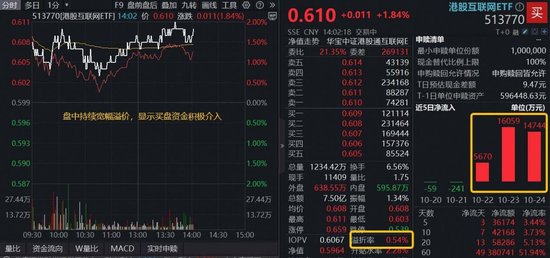
港股AI二度上攻!百亿港股互联网ETF(513770)溢价涨超2%,机构:政策与流动性双轮驱动互联网板块
Xin Lang Ji Jin· 2025-10-27 06:13
Core Viewpoint - The Hong Kong stock market is experiencing strong performance in the AI sector, particularly with the Hong Kong Internet ETF (513770) showing significant gains and attracting substantial capital inflows [1][3]. Group 1: Market Performance - The Hong Kong Internet ETF (513770) saw a price increase of over 2% during the afternoon session, currently up by 1.84%, indicating strong buying interest [1]. - Over the past three days, the Hong Kong Internet ETF has recorded a net capital inflow of 365 million CNY [1]. - The ETF's latest scale has surpassed 10 billion CNY, with an average daily trading volume exceeding 600 million CNY this year [8]. Group 2: Key Holdings and Sector Analysis - The top three holdings in the Hong Kong Internet ETF are Alibaba-W, Tencent Holdings, and Xiaomi Group-W, with weightings of 18.11%, 16.16%, and 11.067% respectively, collectively accounting for over 72% of the ETF [3]. - The China Securities Index for Hong Kong Internet stocks has shown a significant outperformance compared to the Hang Seng Technology Index, highlighting the sector's resilience [5]. - The current price-to-earnings (P/E) ratio for the Hong Kong Internet Index is 23.69, which is lower than both the historical average and the P/E ratio of the Hang Seng Technology Index [6]. Group 3: Future Outlook and Strategic Initiatives - Citigroup's recent report is optimistic about Kuaishou's performance during the Double Eleven shopping festival and its potential for AI monetization [3]. - The policy direction emphasizes technological self-reliance and the upgrading of industries, which is expected to benefit emerging sectors like the internet [3]. - Investors are advised to closely monitor upcoming U.S. policy changes and the financial results of Chinese tech companies to identify structural recovery opportunities [3].

中信建投:9月粗钢产量下降 钢厂盈利率持续下滑
智通财经网· 2025-10-27 05:34
Industry Overview - The steel industry is currently facing challenges due to a decline in demand, particularly in the real estate sector, which has seen a 5.5% decrease in new housing sales area from January to September [2] - The production of pig iron and crude steel has also decreased, with pig iron production at 64.586 million tons (down 1.1%) and crude steel production at 74.625 million tons (down 2.9%) for the same period [5] - The overall steel output has increased by 5.4%, indicating a mixed performance in the industry [5] Market Dynamics - The prices of major steel products such as rebar, hot-rolled, medium-thick plates, and cold-rolled sheets have shown slight fluctuations, with rebar prices remaining stable and hot-rolled prices increasing by 20 yuan/ton [6] - The profit margins for these products are under pressure, with rebar and medium-thick plates showing negative margins of -9 yuan/ton and -147 yuan/ton respectively [6] Investment Insights - The report suggests prioritizing investments in high-dividend and high-return companies, particularly in the downstream sectors, due to the uncertain recovery timeline in real estate [1] - The high-end special steel sector is expected to grow rapidly, supported by government policies and increasing demand from industries such as renewable energy, shipbuilding, and aerospace [1] Production and Consumption Trends - Fixed asset investment in infrastructure has decreased by 0.5%, while investments in third-sector infrastructure have increased by 1.1% [3] - The automotive sector has shown strong performance, with vehicle production and sales increasing by 17.1% and 14.9% respectively in September [4] Future Outlook - The steel industry is transitioning towards high-quality development, focusing on quality, technology, and green practices, moving away from the previous model of scale and price competition [5] - The government has set a target for the steel industry's value-added growth at around 4% annually, aiming to stabilize economic benefits and optimize industry structure [5]

中国改革现场丨好房子的新答案:两小时建成一间房
Yang Guang Wang· 2025-10-27 04:16
Group 1 - The core concept of the news is the advancement of modular construction methods in the housing industry, exemplified by a demonstration project in Guangzhou, which aims to enhance efficiency and quality in building homes [1] - The project in Huangpu District, Guangzhou, plans to construct a total of 282 houses, with 43 already completed and occupied, while the remaining units are nearing completion of exterior and municipal infrastructure work [1] - The modular construction approach is likened to automobile manufacturing, emphasizing a high level of automation and precision in the production process, with an 80% automation rate and a production efficiency increase of over four times compared to traditional methods [1] Group 2 - The intelligent production line in Shandong represents a significant technological advancement, capable of producing a wall panel in just twelve minutes and completing a modular house in under two hours [1] - The development direction of modular construction is identified as industrialization, digitalization, and greening, which collectively aim to enhance the quality of housing [2]