
食品安全

Search documents
市场监管总局专项抽检“双十一”网售食品3347批次
Yang Shi Wang· 2025-11-11 11:12
Core Insights - The market regulatory authority has conducted a special inspection of online food sales in conjunction with the "Double Eleven" shopping season, completing a total of 3,347 inspections to ensure consumer safety [1] Group 1: Inspection Details - The special inspection covered 11 major online platforms, including Douyin, Kuaishou, and Taobao (including Tmall), and involved 2,288 live-streaming rooms [1] - The inspection focused on 23 categories of food products, including convenience foods, alcoholic beverages, and pastries [1] Group 2: Findings - No non-compliant samples were found in categories such as grain processing products and biscuits [1] - Issues were identified with sweet potato vermicelli, which was found to be adulterated, and some weight-loss claims in candies, herbal teas, and solid beverages contained laxative components such as sennoside A and sennoside B [1] Group 3: Regulatory Actions - The market regulatory authority has urged local departments to investigate and address the non-compliant food products found during inspections, emphasizing the importance of controlling food safety risks and enforcing accountability [1] Group 4: Consumer Guidance - Consumers are advised to choose platforms and merchants with complete qualifications when purchasing food online and to carefully check production licenses and ingredient lists, avoiding exaggerated claims such as "extreme low prices" and "miraculous effects" [1]
山西省绛县市场监督管理局2025年食品安全监督抽检信息公告(第3期)
Zhong Guo Zhi Liang Xin Wen Wang· 2025-11-11 08:28
绛县市场监督管理局2025年食品安全监督抽检信息公告(第3期) 本期公布145批次监督抽检结果,分别为食用农产品、糕点、调味品、粮食加工品、肉制品、餐饮食品、方便食品、罐头、酒类、乳制品、食糖、糖果制 品、饼干、蛋制品、淀粉及淀粉制品、水果制品、豆制品、食用油、油脂及其制品、蔬菜制品、薯类和膨化食品、饮料、炒货食品及坚果制品22个食品大 类。根据食品安全国家标准检验和判定:全部合格,抽检明细见附件。 特此通告。 绛县市场监督管理局 2025年11月10日 | | | | 饭店 | 西 | 制) | | | 食品 | 县/ | | --- | --- | --- | --- | --- | --- | --- | --- | --- | --- | | | | | | | | | | | 县 | | | | | | | | | | | 抽 | | | | | 绛县南樊镇安根饭 | 山 | | | | | 绛 县/ | | XBJ25140826434520088 119 / | | / | | | 饸饹面(自制) | / | 2025/8/13 餐饮 | | | | | | | 店 | 西 | | | | 食品 ...


浙江省绍兴市市场监督管理局食品安全监督抽检信息公告(2025年第6期)
Zhong Guo Zhi Liang Xin Wen Wang· 2025-11-11 08:02
近期,绍兴市市场监督管理局组织抽检保健食品、餐饮食品、茶叶及相关制品、水产制品、炒货食品及坚果制品、淀粉及淀粉制品、饮料、方便食品、水果 制品、酒类、糕点、罐头、粮食加工品、食用油、油脂及其制品、调味品、豆制品、冷冻饮品、肉制品、乳制品、速冻食品、薯类和膨化食品、蔬菜制品、 食用农产品等23类食品319批次样品。根据食品安全国家标准检验和判定:抽样检验合格314批次、不合格5批次。不合格项目涉及农药残留量超标、质量指 标不合格、重金属污染。合格产品和不合格产品信息详见附件。具体情况公告如下: 一、农药残留量超标 (一)绍兴市柯桥区卫佳蔬菜批发部(个体工商户)销售的山药,咪鲜胺和咪鲜胺锰盐残留量超标。 (二)绍兴市越城区原意餐饮店销售的马铃薯,噻虫嗪残留量超标。 (三)浙江荣达生态农业开发有限公司销售的小葱,丙环唑残留量超标。 二、质量指标不合格 (四)绍兴柯桥区佳君土特产商行销售的椒盐香榧子,过氧化值(以脂肪计)不合格。 三、重金属污染 (五)诸暨市二成食品商行销售的蒋福康儿童榨菜丝,铅(以Pb计)超标。 对抽检中发现的不合格产品,我局已责成相关县级市场监管部门依法予以查处。要求越城区市场监督管理局、柯桥区市 ...

浙江省市场监管局10月和11月食品安全监督抽检结果显示 糕点不合格项目主要涉及3类问题
Zhong Guo Zhi Liang Xin Wen Wang· 2025-11-11 07:35
Core Viewpoint - The Zhejiang Provincial Market Supervision Administration has identified significant food safety issues in pastries through recent inspections, highlighting the need for stricter regulatory oversight and compliance from manufacturers [1][2][3]. Group 1: Inspection Results - In October and November, the Zhejiang Provincial Market Supervision Administration conducted four rounds of food safety inspections focused on pastries, revealing multiple non-compliance issues [1]. - A total of 502 batches of food were tested in the 36th round, with 16 batches failing, including two pastry samples for exceeding peroxide value and aluminum residue limits [2]. - In the 37th round, 369 batches were tested, with one pastry sample failing due to aluminum residue exceeding safety standards [2]. - The 38th round involved 682 batches, with one pastry sample failing for non-compliance with lemon yellow standards [3]. - The 39th round tested 763 batches, with two pastry samples failing due to microbial contamination [3]. Group 2: Non-compliance Issues - The primary non-compliance issues in pastries include exceeding peroxide values, excessive food additives like aluminum, and microbial contamination [1][4]. - The maximum allowable limit for aluminum residue in pastries is set at 100 mg/kg, and for peroxide value, it is 0.25 g/100 g [4][5]. - The presence of high levels of mold and bacteria indicates potential lapses in hygiene during production and storage processes [5].

“打假人”王海发文质疑抖音等平台存橄榄油参假乱象,平台回应
Xin Lang Ke Ji· 2025-11-11 06:42
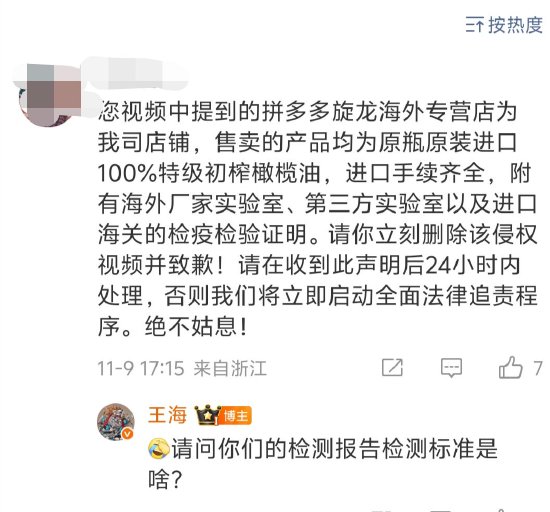
Core Points - A recent investigation by "professional whistleblower" Wang Hai revealed that all 12 samples of olive oil purchased from platforms like Pinduoduo and Douyin contained adulteration or mislabeling, with the lowest "extra virgin olive oil" content at only 18% and the highest at 53% [1] - Wang Hai criticized the sellers for marketing these products as "extra virgin" which constitutes false advertising and illegal production and sale of food that does not meet safety standards [1] - Pinduoduo's customer service responded by stating that there is a dedicated department for strict regulation of merchant products and that the issue has been escalated for further investigation [1] - Douyin's customer service emphasized their commitment to monitoring the authenticity of product promotions and stated that any confirmed false advertising would lead to severe penalties for the involved parties [1] - A representative from a store implicated in Wang Hai's video claimed that their products are 100% imported extra virgin olive oil with complete import documentation and threatened legal action if the video was not removed [1]

山东省临沂市市场监督管理局关于25批次食品不合格情况的通告2025年第8期
Zhong Guo Zhi Liang Xin Wen Wang· 2025-11-10 08:52
Core Points - The article reports on the results of food safety inspections conducted by the Linyi Municipal Market Supervision Administration, revealing that 25 out of 2172 food samples tested were found to be non-compliant with safety standards [1][2]. Group 1: Inspection Results - A total of 2172 food samples across 21 categories were inspected, including edible agricultural products, catering foods, and grain processing products [1]. - Among the inspected samples, 25 batches were identified as non-compliant, primarily due to pesticide residues, veterinary drug residues, and excessive food additives [1][2]. Group 2: Specific Non-Compliant Products - Specific non-compliant products included: - Chili with pesticide residue (0.21 mg/kg of imidacloprid, exceeding the standard of ≤0.05 mg/kg) [2]. - White fungus with sulfur dioxide residue (0.904 g/kg, where the standard is not to be used) [2]. - Peanut oil containing aflatoxin (106 μg/kg, exceeding the standard of ≤20 μg/kg) [2]. - Other products listed include various agricultural products and seasonings that failed to meet safety standards due to similar issues [3][4].
太原市市场监督管理局关于2025年第4期“你点我检 服务惠民生”食品安全专项监督抽检情况的通告
Zhong Guo Zhi Liang Xin Wen Wang· 2025-11-10 08:13
Core Points - The announcement details the results of the food safety supervision sampling conducted by the Taiyuan Market Supervision Administration, indicating that all 140 samples from seven categories of food passed inspection [2][3][4]. Group 1: Food Safety Supervision - The "You Point, I Check" initiative allows consumers to suggest food categories for inspection, reflecting a consumer-driven approach to food safety [2]. - The sampling covered seven categories: health foods, grain products, nut products, condiments, dairy products, meat products, and edible oils, totaling 140 samples [2][3]. - All tested samples were found to be compliant with safety standards, indicating a positive outcome for food safety in the region [2][4]. Group 2: Sample Details - The announcement includes a detailed list of sampled products, including their manufacturers, specifications, and production dates, ensuring transparency in the inspection process [3][4]. - Notable products sampled include various types of flour, dairy products, and condiments from well-known manufacturers such as Hebei Jingsha River Flour Group and Lee Kum Kee [3][4]. - The inspection results contribute to consumer confidence in food safety and quality in Taiyuan [2][3].
四川省内江市市场监督管理局关于145批次“你点我检”食品抽检情况的通告(2025-1024号)
Zhong Guo Zhi Liang Xin Wen Wang· 2025-11-10 06:52
Summary - The article discusses the recent food safety inspections conducted by the Neijiang Market Supervision Administration, which involved sampling 145 batches of various food products, resulting in one batch being found non-compliant due to excessive use of food additives [2]. Group 1: Inspection Results - A total of 145 food samples were tested, covering nine categories including grain products, edible oils, seasonings, and dairy products [2]. - Only one batch was found to be non-compliant, primarily due to the overuse of food additives [2]. Group 2: Actions Taken - The Neijiang Market Supervision Administration initiated immediate investigations and actions to address the non-compliant product, including product recalls and legal actions against violators [2]. - The results of the inspections and actions taken will be publicly disclosed to ensure transparency [2]. Group 3: Consumer Guidance - Consumers are encouraged to report any non-compliant products they encounter in the market by calling the food complaint hotline at 12315 [2].
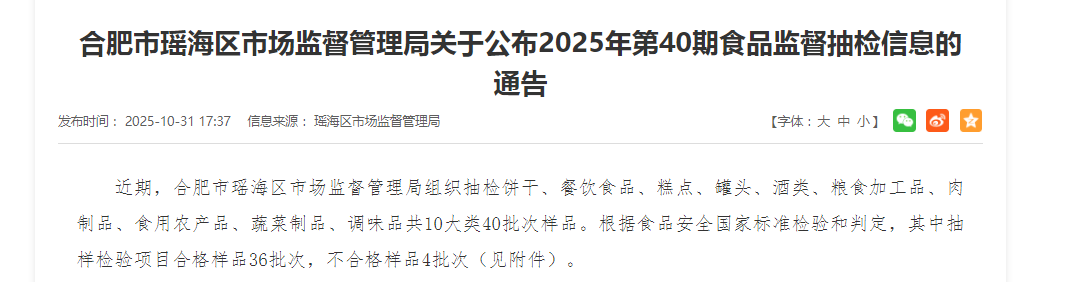
合肥市瑶海区市场监督管理局关于公布2025年第40期食品监督抽检信息的通告
Zhong Guo Zhi Liang Xin Wen Wang· 2025-11-10 04:46
Core Viewpoint - The Hefei Yao Hai District Market Supervision Administration conducted a food safety inspection, testing 40 samples across 10 categories, with 36 passing and 4 failing the safety standards [2][3]. Group 1: Inspection Results - A total of 40 samples were tested, with 36 samples meeting the food safety standards and 4 samples failing [2]. - The categories tested included biscuits, catering foods, pastries, canned goods, alcoholic beverages, grain products, meat products, edible agricultural products, vegetable products, and condiments [2]. Group 2: Follow-up Actions - The Yao Hai District Market Supervision Administration has initiated verification and disposal actions for the non-compliant food products identified during the inspection [3]. Group 3: Non-compliant Products - Specific non-compliant products included items with pesticide residues exceeding safety limits, such as a sample from a supermarket with a detected level of 1.55 mg/kg of dichlorvos, which exceeds the allowable limit of 0.05 mg/kg [7]. - Other non-compliant products were found to contain residues of various pesticides, including etofenprox and chlorfenapyr, with levels exceeding the permissible limits [7].
UNI-PRESIDENT CHINA(220.HK):3Q NET PROFIT GREW 8% YOY SLIGHTLY MISSED; 4Q SALES STILL UNDER PRESSURE; LT SALES GOAL(I.E. +6%-8% YOY)UNCHANGED
Ge Long Hui· 2025-11-07 19:47
Core Viewpoint - UPC's 3Q25 net profit reached RMB726 million, reflecting an 8% year-over-year increase, but slightly below expectations [1] - The company anticipates challenges in the beverage sector due to industry destocking, while maintaining long-term sales and profitability guidance [1][3] Financial Performance - 3Q25 net profit was RMB726 million, an increase of 8.4% year-over-year, with 9M25 net profit totaling RMB2,013 million, up 23.1% year-over-year [1] - Sales momentum softened in 3Q25, with food sales increasing at a low-single-digit to mid-single-digit percentage year-over-year, while beverage sales decreased at a low-single-digit to mid-single-digit percentage [2] Sales Outlook - Management maintains a long-term sales growth target of 6%-8% year-over-year, expecting gross profit margin to improve in 2025-26 due to product mix enhancement and sales leveraging [3] - The OEM business continues to show double-digit year-over-year growth, although overall sales are expected to weaken in October due to soft demand and competition [2] Strategic Initiatives - UPC's competitive advantage lies in its product matrix and continuous innovation, with stable point-of-sale coverage and a focus on structural optimization [3] - The total number of commercial refrigerators increased by 150,000 by 3Q25, indicating a commitment to maintaining this strategy [3] Valuation and Investment Perspective - The company revised down its top- and bottom-line forecasts for 2025-27 by 2%-5% and 3%-6% respectively, reflecting caution regarding beverage sales growth [4] - The forecasted EPS growth rate is now projected at a CAGR of 12.5% from 2024 to 2027, down from 14.8% [4] - The company maintains a BUY rating with a target price of HK$10.40, representing a P/E ratio of 18.9x for 2025 and 17.0x for 2026, alongside a dividend yield of 6%-7% [5]