
企业级AI

Search documents
汉得信息上半年扣非净利润同比增长31.56% AI业务收入突破亿元
Zheng Quan Shi Bao Wang· 2025-08-27 14:25
Core Insights - Han's Information reported a revenue of 1.575 billion yuan for the first half of 2025, representing a year-on-year growth of 3.54% [1] - The net profit attributable to shareholders reached 85.007 million yuan, up 1.90% year-on-year, while the net profit excluding non-recurring items was 81.313 million yuan, showing a significant increase of 31.56% [1] - The second quarter alone saw a revenue of 833 million yuan, a year-on-year increase of 5.64%, and a net profit of 49.75 million yuan, which is a remarkable growth of 50.88% [1] Financial Performance - The improvement in net profit is primarily attributed to the enhanced gross margin of the self-developed software business, including AI and PaaS platform new businesses, which has increased its share in overall revenue [1] - The gross margin for the overall business improved to 34.87%, driven by the growth in revenue from industrial digitalization and financial digitalization, which saw year-on-year increases of 13.75% and 4.98%, respectively [3] Business Strategy - The company focuses on providing comprehensive digitalization and intelligent solutions for medium and large enterprises, covering the entire lifecycle of enterprise management digitalization [1] - Under the guiding principle of "Digital Foundation, AI Potential," the company is enhancing its core competitiveness through a dual-wheel model of "products + services," improving the delivery quality and efficiency of traditional business segments [2] AI and PaaS Development - The company launched the "DeLing" AI application product/service series during the reporting period, aiming to build deep competitive advantages in AI [2] - The AI business revenue exceeded 100 million yuan in the first half of the year, achieving approximately 110 million yuan, while the enterprise-level PaaS platform business gained recognition from over 400 leading clients [3] Future Outlook - The company plans to continue enhancing its management and focus on high-quality development, aiming to improve profit margins and cash flow while expanding its enterprise-level AI and PaaS platform businesses [4]

模型、数据、场景,企业级 AI 落地三要素
Sou Hu Cai Jing· 2025-08-27 14:06
Core Insights - The next wave of AI will focus on selling returns rather than tools, emphasizing the importance of enterprise-level AI applications for maximizing profits [2][3] - Successful enterprise-level AI implementation requires three essential elements: models, data, and application scenarios [3][4] Models - The effectiveness of AI models is not solely determined by their size; businesses should select models based on specific scenarios [3] - As businesses mature in their AI journey, they will shift from paying for advanced models to paying for the commercial value generated by these models [3] Data - High-quality data is crucial for AI success; companies must ensure they have integrated and effective data to leverage AI capabilities [4] - Synthetic data can help address initial data shortages, allowing for quicker AI application deployment [4][7] Application Scenarios - The true value of AI models lies in their application scenarios, similar to how electricity's value is realized through its various uses [5] - Companies should prioritize identifying the most suitable business scenarios for AI transformation to achieve rapid deployment [5][8] Industry Developments - Major companies like Huawei and Alibaba Cloud are launching industrial AI solutions that significantly enhance operational efficiency [6][10] - The industrial sector is witnessing a shift towards AI integration, with government support for AI+ industrial software initiatives [8] Intelligent Agents - The industrial sector is characterized by four main types of intelligent agent applications: data governance, knowledge processing, process optimization, and decision support [11][12] - The current applications of intelligent agents are primarily in knowledge-intensive areas, where high-quality data is essential for further development [13]


模型、数据、场景,企业级AI落地三要素丨ToB产业观察
Tai Mei Ti A P P· 2025-08-27 03:45
Core Insights - The next wave of AI will focus on selling returns rather than tools, emphasizing the importance of enterprise-level AI applications for maximizing profits [2][3] Group 1: Key Elements for Enterprise AI Implementation - Successful enterprise-level AI requires three essential components: models, data, and application scenarios [3] - The effectiveness of AI models is not solely dependent on their size; businesses must select appropriate models based on specific scenarios [3] - High-quality data is crucial for AI success, and companies must ensure they have integrated their core data effectively [4] Group 2: Data as a Core Asset - Data is considered a core productivity factor for enterprise AI, and companies must focus on data compliance and quality [4] - Innovative companies are utilizing synthetic data to enhance model training and address initial data shortages [4][8] Group 3: Application Scenarios - The true value of AI models lies in their application scenarios, similar to how electricity's value is realized through its various uses [5][6] - Companies should prioritize identifying the most suitable business scenarios for AI transformation to achieve rapid application deployment [6] Group 4: Industrial AI Applications - Major companies like Huawei and Alibaba Cloud are launching industrial AI solutions that significantly enhance operational efficiency [7] - Specific examples include a 50% improvement in CAE simulation efficiency and a 22% increase in inventory turnover rates for automotive parts [7] Group 5: Government and Industry Support - The government is actively promoting AI integration in industrial software, with initiatives to support pilot projects and product development [9] - As of now, over 30,000 basic intelligent factories have been established in China, covering more than 80% of manufacturing sectors [9] Group 6: Emerging AI Solutions - Companies like Dingjie Zhizhi and Yilide are developing AI-enabled products to streamline design processes and enhance PDM workflows [10][11] - Traditional industries are also adopting AI, with examples like Foxconn's digital twin platform achieving millisecond-level synchronization [11] Group 7: Characteristics of Industrial AI Agents - Industrial AI applications are categorized into four main areas: data governance, knowledge processing, process optimization, and decision support [12] - The focus is on leveraging AI to enhance employee capabilities and streamline complex business processes [13][14]

企业级AI陷“落地焦虑”,联想SSG胡贯中:全栈AI是关键
2 1 Shi Ji Jing Ji Bao Dao· 2025-08-22 13:01
Core Insights - The application of AI in industrial scenarios is transitioning from "conceptual enthusiasm" to "implementation challenges" as companies seek structural growth opportunities driven by AI technology [1][2] - Lenovo's SSG Group reported a 19.8% year-on-year revenue increase to 16.3 billion yuan, achieving double-digit growth for 17 consecutive quarters, significantly outperforming the industry average [1][3] Investment Trends - Companies are increasingly investing in generative AI, moving from pilot projects to large-scale applications, driven by technological maturity and competitive pressures [3][4] - The evaluation of AI projects has become more pragmatic, with a focus on quantifiable business outcomes and ROI, rather than merely adopting AI for its own sake [4][5] Deployment Strategies - A hybrid deployment model combining local and cloud solutions is gaining traction, addressing data security concerns while allowing for flexibility and scalability [5][6] - Key industries such as manufacturing and supply chain are becoming primary areas for AI integration due to their complex processes and data-intensive nature [6][7] Market Evolution - The enterprise AI market is shifting from a focus on technological advancement to an emphasis on scenario adaptability and system collaboration [7][8] - Lenovo aims to provide end-to-end solutions that encompass data preparation, scenario handling, training, and management, facilitating rapid deployment and scalability [8][9] Future Directions - The future of enterprise AI is seen in the "inference market" and "intelligent agents," with a focus on applying trained models to generate measurable efficiency gains [9][10] - The integration of intelligent agents is viewed as a strategic pillar for enterprise AI, emphasizing the need for scenario-specific solutions rather than merely pursuing high-level technology [10]

速递|Anthropic仅收购Humanloop创始团队及工程师,曾融资790万美金,AI安全“特种部队”就位
Z Potentials· 2025-08-14 03:33
Core Insights - Anthropic has acquired the co-founders and most of the team from Humanloop, a platform focused on prompt management, LLM evaluation, and observability, to strengthen its enterprise strategy [2][3] - The acquisition follows a trend in the tech industry of talent acquisition through buyouts, emphasizing the importance of human capital in AI development [2][3] - Humanloop's team brings valuable experience in developing enterprise-level AI tools, which will enhance Anthropic's capabilities in AI safety and practical applications [3][6] Company Overview - Humanloop was founded in 2020 as a spin-off from University College London and has raised $7.91 million in seed funding through Y Combinator and Index Ventures [4] - The company is known for helping clients like Duolingo, Gusto, and Vanta develop, evaluate, and fine-tune robust AI applications [4] Recent Developments - Humanloop informed its clients last month about ceasing operations in preparation for the acquisition [5] - The timing of the acquisition coincides with Anthropic's launch of new features for enterprise clients, including longer context windows, aimed at enhancing model capabilities [6] - Anthropic has reached an agreement with the U.S. government's central procurement agency to offer its AI services at a significantly reduced price, which is a strategic move to compete with OpenAI [6] Strategic Alignment - The acquisition aligns with Anthropic's mission of prioritizing AI safety, as Humanloop's evaluation workflows are compatible with this goal [7] - Humanloop's commitment to developing tools for safe and efficient AI application aligns perfectly with Anthropic's vision for responsible AI development [7]

老百姓携手腾讯健康上线“老百姓小丸子AI”
Zheng Quan Ri Bao Wang· 2025-08-06 13:45
Core Insights - The collaboration between Lao Bai Xing and Tencent Health aims to enhance operational efficiency and precision in the pharmaceutical retail industry through the launch of the AI-powered assistant "Lao Bai Xing Xiao Wan Zi AI" [1][2][3] Group 1: Partnership and Technology - Lao Bai Xing has partnered with Tencent Health to develop an enterprise-level AI assistant tailored for the pharmaceutical retail sector [1] - The AI assistant is built on Tencent Cloud's intelligent agent development platform, utilizing high-performance computing clusters for enhanced data security and operational efficiency [1][3] Group 2: Features and Applications - The "Lao Bai Xing Xiao Wan Zi AI" integrates two major knowledge bases: industry policies and company regulations, covering key business scenarios such as medical insurance policies and store operations [2] - The AI can provide real-time, precise answers to employee inquiries regarding complex policies and operational issues, thereby improving internal collaboration and employee satisfaction [2][3] Group 3: Future Developments - Future plans include expanding the AI's capabilities from knowledge-based responses to comprehensive business decision-making and customer service, aiming to transform the smart health service ecosystem [3]


海通国际发布用友网络研报:Q2业绩显著改善,企业级AI落地正加速
Mei Ri Jing Ji Xin Wen· 2025-08-01 08:28
Group 1 - The core viewpoint of the report is that Yonyou Network (600588.SH) is rated as outperforming the market with a target price of 18.82 yuan [2] - Q2 revenue has returned to a growth trajectory, and the trend of contract signing is positive [2] - Profit and cash flow are continuously improving, indicating a shift towards high-quality development [2] - The launch of Yonyou ZhiYou 3.0 marks a new phase in intelligent management, with multi-agent collaboration becoming a new paradigm for enterprise AI applications [2]

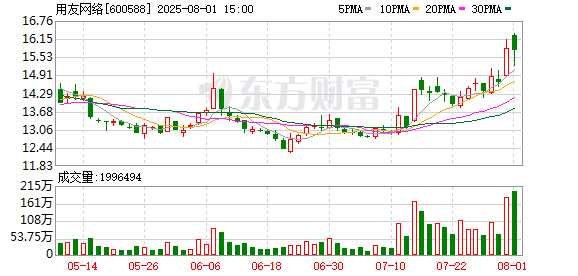
用友网络(600588):跟踪报告:Q2业绩显著改善,企业级AI落地正加速
Haitong Securities International· 2025-07-25 14:54
Investment Rating - The report maintains an "Outperform" rating for the company, with a target price of 18.82 RMB, representing a potential upside of 27% from the current price of 14.33 RMB [1][9]. Core Insights - The company's Q2 performance shows significant improvement, indicating a recovery in business momentum, with a notable increase in enterprise-level AI applications [1][9]. - Revenue for H1 2025 is projected to be between 3.56 billion RMB and 3.64 billion RMB, reflecting a year-over-year decline of 6.4% to 4.3%, while Q2 revenue is expected to be between 2.18 billion RMB and 2.26 billion RMB, showing a year-over-year growth of 6.1% to 10.0% [9]. - The company is transitioning to a subscription model and optimizing its organizational structure, which is expected to impact short-term operations but ultimately enhance revenue quality [9]. Financial Summary - Total revenue projections for 2025, 2026, and 2027 are 9.92 billion RMB, 10.92 billion RMB, and 12.26 billion RMB, respectively, with corresponding EPS estimates of -0.09 RMB, 0.07 RMB, and 0.18 RMB [3][9]. - The company anticipates a net loss attributable to shareholders in H1 2025 of 875 million to 975 million RMB, an improvement from a loss of 794 million RMB in the same period last year [9]. - Operating cash flow for Q2 is expected to show a net inflow, improving by approximately 320 million RMB year-over-year, contributing to a cumulative improvement of about 600 million RMB in H1 [9]. Business Development - The launch of Yonyou Zhiyou 3.0 marks a new phase in intelligent management, focusing on multi-agent collaboration to enhance AI application capabilities across various business scenarios [9]. - The platform supports the formation of specialized "digital intelligence teams" and enables seamless integration of data sources, breaking down data silos while ensuring security and compliance [9].
晚间公告丨7月23日这些公告有看头
第一财经· 2025-07-23 15:01
Core Viewpoint - Several companies have announced uncertainties regarding their potential involvement in the "Yarlung Tsangpo River downstream hydropower project," reflecting the cautious sentiment in the market about this project and its related opportunities [3][4][5][6]. Group 1: Company Announcements on Yarlung Tsangpo Project - Kailong Co., Ltd. has noted uncertainty about its participation in the Yarlung Tsangpo hydropower project, as it primarily operates in the civil explosives industry [3]. - *ST Zhengping has also expressed uncertainty regarding its potential involvement in the Yarlung Tsangpo hydropower project, leveraging its extensive experience in high-altitude construction management [4]. - Huaxin Cement has indicated that it has the capacity to provide construction materials for the Yarlung Tsangpo hydropower project but acknowledges uncertainty about the revenue and profit it may derive from this project [5]. - Dayu Water-saving has emphasized that it currently does not have any contracts related to the Yarlung Tsangpo project, despite its experience in water conservancy projects in Tibet [6]. - ST Xifa has clarified that its main business is beer production and does not involve any projects related to hydropower station construction [7]. Group 2: Financial Performance and Market Position - Rongzhi Rixin expects a significant increase in net profit for the first half of 2025, projecting a year-on-year growth of 2027.62% to 2.18 billion yuan, driven by the digital transformation across various industries [16]. - Weiguang Co., Ltd. reported a total revenue of 750 million yuan for the first half of 2025, reflecting a year-on-year growth of 10% [17]. Group 3: Major Contracts and Projects - Nantian Information plans to sign a procurement framework contract worth 58.27 million yuan with its controlling shareholder, which will span three years [18]. - China Communication Signal has won seven important projects in the rail transit market, with a total bid amount of approximately 1.431 billion yuan, accounting for 4.41% of its projected revenue for 2024 [19]. - Beixin Road and Bridge announced that its subsidiaries have won contracts totaling 1.629 billion yuan for highway projects, which is expected to positively impact future performance [20]. Group 4: Shareholding Changes - Tiancheng Zikong announced that Yunnan Trust plans to reduce its stake in the company by up to 1% [21]. - Baobian Electric has disclosed that the Equipment Finance Group intends to reduce its stake by up to 1% as well [22][23]. - Hongchang Technology's employee shareholding platform plans to reduce its stake by up to 2.56% [24].



钉钉陈航交出首个AI答卷
Hua Er Jie Jian Wen· 2025-07-09 03:28
Core Viewpoint - Alibaba is making significant investments in the enterprise-level AI sector, with DingTalk as a central focus, marking a substantial transition towards "intelligent" capabilities [1] Group 1: Product Development - DingTalk has launched the AI spreadsheet, which serves as an entry point for AI in every cell, allowing real-time data analysis and rapid business process construction [1] - The AI spreadsheet introduces the "spreadsheet as a document" feature, transforming each row into an independent document, thus creating a powerful business knowledge repository [1] - The launch of the AI spreadsheet is a critical step in Alibaba's AI to B strategy, indicating a tangible shift towards DingTalk's transformation into an "intelligent entity" [1] Group 2: Strategic Focus - Since the return of former key figure Chen Hang as CEO in March, DingTalk's strategic focus has shifted towards enhancing user experience and co-creating AI-native productivity tools [2] - Chen Hang emphasized two main objectives: optimizing product experience and returning to frontline operations to listen to user needs [2] Group 3: AI Integration and Efficiency - The AI spreadsheet allows for the extraction, classification, understanding, and matching of information, generating multi-modal content based on user requirements [2] - Users can create automated processes by setting "trigger conditions" and "execution actions," enabling immediate responses to data changes, thus addressing efficiency pain points in business processes [2] - The AI spreadsheet has become a vital tool for many enterprises, with applications in e-commerce operations, brand promotions, and market management [2] Group 4: Market Position and Challenges - For e-commerce brands, the AI spreadsheet significantly reduces the time required for data analysis, transforming a three-day task into a ten-minute process [3] - Despite having a strategic advantage, DingTalk faces challenges in establishing the AI spreadsheet as a leading product in the enterprise market, requiring rigorous testing in practical applications [4] - The competition in the collaborative office sector is intensifying, with ByteDance's Feishu and Tencent's enterprise services rapidly advancing their product capabilities and AI applications [3][4]