
可穿戴设备

Search documents
高通官宣转型
半导体芯闻· 2025-11-06 09:55
Core Insights - Qualcomm is transforming into a technology company covering a power range from 5W to 500W, diversifying its business from mobile to data centers, robotics, automotive, and wearable devices [2] - The company has launched two AI-focused system-on-chips (SoCs), AI200 and AI250, aimed at enterprises looking to run existing AI models efficiently rather than training new ones [2] - Qualcomm's CEO highlighted the competitive edge in the data center market with a focus on inference, building on the software ecosystem established since the launch of the Cloud AI 100 in 2020 [2] - The new AI200 and AI250 chips utilize a novel architecture with DDR memory and PCI Express interfaces to enhance energy efficiency and computational density [2] - Samsung is expected to use Snapdragon mobile SoCs 100% in the Galaxy S25, with a projected 75% usage in the Galaxy S26 [3] - The market for AI-enabled wearable devices, including smart glasses, smartwatches, and smart earbuds, is rapidly expanding, presenting a significant growth opportunity for Qualcomm [3]



Garmin(GRMN) - 2025 Q3 - Earnings Call Transcript
2025-10-29 15:32
Financial Data and Key Metrics Changes - Consolidated revenue increased 12% to nearly $1.8 billion, setting a new third-quarter record, despite a strong comparison from last year when revenue increased over 24% [4] - Gross margin was 59.1%, a 90 basis point decrease from the prior quarter, primarily due to higher product costs [15] - Operating income reached $457 million, up 4% year-over-year, with a pro forma EPS of $1.99 and GAAP EPS of $2.08 [4][15] Business Segment Data and Key Metrics Changes - **Fitness Segment**: Revenue increased 30% to $601 million, driven by strong demand for advanced wearables, with gross and operating margins at 60% and 32% respectively [6][7] - **Outdoor Segment**: Revenue decreased 5% to $498 million, impacted by the anniversary of the Diesel Series launch and the Phoenix 8 launch, with gross and operating margins at 66% and 34% respectively [8][10] - **Aviation Segment**: Revenue increased 18% to $240 million, with gross and operating margins at 75% and 25% respectively [11] - **Marine Segment**: Revenue increased 20% to $267 million, with gross and operating margins expanding to 56% and 19% respectively [12][13] - **Auto OEM Segment**: Revenue decreased 2% to $165 million, with a gross margin of 15% negatively impacted by increased warranty costs, resulting in an operating loss of $17 million [14] Market Data and Key Metrics Changes - By geography, double-digit growth was achieved in all three regions: 14% in APAC, 13% in EMEA, and 10% in the Americas [16] Company Strategy and Development Direction - The company is focused on maintaining a diversified business model and anticipates delivering another record year of double-digit growth in revenue, operating income, and EPS [4][6] - The launch of new products, such as the Blaze Equine Wellness System and the Phoenix 8 Pro, reflects the company's strategy to innovate and capture market share in various segments [9][12] Management's Comments on Operating Environment and Future Outlook - Management expressed confidence in achieving full-year revenue of $7.1 billion and raised full-year EPS guidance to $8.15, reflecting strong year-to-date performance [5][18] - The company is managing through tariff impacts and is focused on optimizing its supply chain structure [70] Other Important Information - The effective tax rate increased to 21.2% due to new U.S. tax legislation affecting R&D cost capitalization [17] - Free cash flow for the third quarter was $425 million, with full-year expectations of approximately $1.3 billion [17] Q&A Session Summary Question: Downward revision to outdoor guidance - Management noted that the Phoenix 8 Pro launched late in Q3, impacting expectations, and acknowledged that previous expectations may have been too high [20][21] Question: Drivers behind gross margin guide for Q4 - Management indicated that higher product costs, tariffs, and warranty accruals impacted gross margins, with Q4 being a more promotional period [22][23][24] Question: Cycle for fitness and outdoor segments - Management views the market as an ongoing opportunity for growth rather than a cyclical pattern, emphasizing strong product lines [28][29] Question: Channel inventory health - Management stated that channel inventory is healthy and lean, ready for Q4, with strong sell-out trends [36] Question: Growth in auto segment - Management anticipates revenue pressure in 2026 due to end-of-life programs but expects new programs to come online in the latter half of 2026 [41] Question: Drivers of growth in aviation segment - Both OEM and aftermarket segments are performing strongly, benefiting from a long backlog and resilient consumer behavior [42] Question: Accrued warranty costs in auto segment - Management clarified that accrued warranty costs were an isolated issue and that long-term margin targets remain unchanged [60][61] Question: Component supply environment - Management acknowledged impacts from the semiconductor market but believes it will benefit customers in the long term [62] Question: Marine segment guidance - Management noted that the end market is stabilizing, with positive consumer interest and market share gains [68]

泰凌微股东国家大基金拟减持不超2%股份
Ju Chao Zi Xun· 2025-10-22 12:47
Core Viewpoint - The National Integrated Circuit Industry Investment Fund (referred to as "National Fund") plans to reduce its stake in TaiLing Microelectronics (688591.SH) by up to 4.8149 million shares, representing no more than 2% of the company's total share capital, through centralized bidding and block trading [1][4]. Company Summary - TaiLing Microelectronics has a stable business operation, focusing on the research and sales of low-power wireless communication chips, which are widely used in smart home devices, wearable technology, and Internet of Things (IoT) terminals [4]. - The company intends to increase its research and development investment to strengthen technological innovation and market expansion, aiming to consolidate its competitive advantage in the low-power Bluetooth chip sector [4]. Industry Summary - The National Fund is a national-level investment platform for the semiconductor industry, primarily supporting the development of key areas such as integrated circuit design, manufacturing, packaging, testing, and materials [4]. - The recent reduction in stake by the National Fund is viewed as a routine asset management action and is not expected to adversely affect the company's control, governance structure, or ongoing operations [4]. - Industry experts believe that the growth potential of TaiLing Microelectronics in the wireless connectivity chip sector remains promising, driven by increasing demand in IoT, wearables, and smart hardware [4].


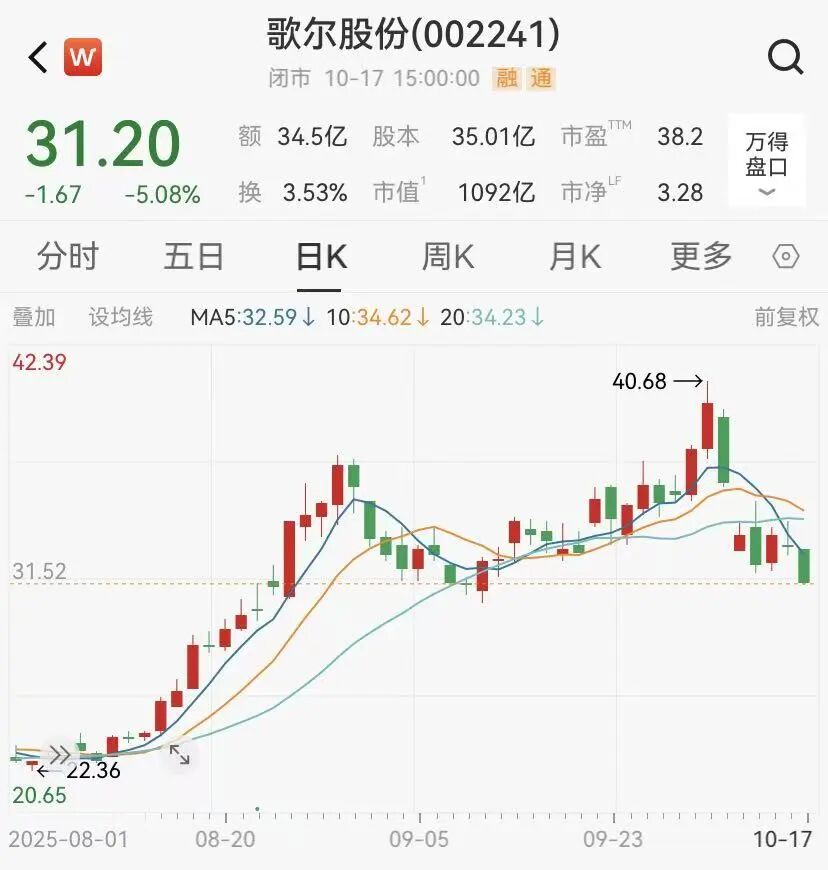
果链巨头歌尔股份百亿收购突然终止,高调筹划近3月
2 1 Shi Ji Jing Ji Bao Dao· 2025-10-19 04:17
Core Viewpoint - The acquisition plan by GoerTek, a major player in the Chinese acoustic industry, has been terminated after nearly three months of planning, with the company unable to reach an agreement on key terms with the seller [1][2]. Acquisition Details - GoerTek announced the termination of its plan to acquire 100% equity of Mega Precision Technology Limited and Channel Well Industrial Limited, both wholly-owned subsidiaries of Luen Fung Commercial Holdings Limited, for approximately HKD 10.4 billion (around RMB 9.5 billion) [2]. - The acquisition was initially disclosed on July 22, 2025, with the aim of enhancing GoerTek's competitiveness in the precision structural components sector and deepening vertical integration capabilities [2][3]. Market Context - The failed acquisition is viewed as a common industry consolidation driven by the "Apple supply chain" logic, where Apple encourages core suppliers to make strategic acquisitions to streamline supply chains and reduce costs [4]. - Mega Precision and Channel Well were key suppliers for Apple's mobile structure components and later became essential for Apple's watch metal frames [4]. Industry Trends - The trend towards lightweight wearable devices is increasing the demand for durable metal precision components, which enhances their value in Apple's product ecosystem [4]. - GoerTek has established a first-mover advantage in integrating components for wearable devices, supplying major companies like Huawei, Samsung, Xiaomi, Meta, and Amazon [4]. Future Strategy - Despite the termination of the acquisition, GoerTek remains committed to its long-term strategic goals, planning to pursue internal growth and diversified investment opportunities to enhance company value and shareholder returns [7]. - The company aims to transition from being a single component supplier to a subsystem integrator, similar to Luxshare Precision, thereby solidifying its position as a core supplier for Apple [6]. Financial Performance - In the first half of 2025, GoerTek reported revenues of RMB 37.549 billion and a net profit attributable to shareholders of RMB 1.417 billion [8]. - Following the announcement of the acquisition plan, GoerTek's stock price rose significantly, reaching a market capitalization of approximately RMB 109.2 billion, with a stock price increase of over 35% [8].


台湾销量预增40%,穿戴设备成华为海外破局先锋?
Guan Cha Zhe Wang· 2025-10-17 13:32
Core Insights - Huawei's wearable devices are performing well in overseas markets despite restrictions on its smartphones due to the Google ecosystem [1][3][8] - The company aims to leverage the high demand for smart wearables in Taiwan, expecting a 40% increase in sales volume and a 60% increase in revenue for its wearable products this year [1][3] Group 1: Market Performance - Huawei has maintained its position as the global leader in the wearable market, with a 20.2% market share and 990 million units shipped in Q2 2023, reflecting an 11.7% year-on-year growth [3][4] - In Taiwan, Huawei's wearable products are expected to see significant growth, with sales volume projected to increase by 40% and revenue by 60% following the introduction of the WATCH GT 6 series [1][3] Group 2: Competitive Landscape - Xiaomi has also shown strong performance in the wearable market, achieving an 18.9% market share with 9.5 million units shipped in Q2 2023, a 61% increase year-on-year [4][6] - Huawei's wearable devices are less dependent on the Google ecosystem compared to its smartphones, allowing for greater flexibility and market penetration [3][8] Group 3: Strategic Focus - Huawei is focusing on building a high-end brand image in overseas markets while enhancing product compatibility with both iOS and Android systems [2][3] - The company emphasizes the independent value of its wearable products, positioning them as essential health and fitness monitoring devices rather than mere accessories to smartphones [8] Group 4: Market Trends - The global wearable market is projected to reach a value of $36.6 billion in 2024, with expectations to surpass $40 billion by the end of 2025 [8] - The smart watch segment, while only accounting for 32% of total shipments, is expected to represent 69% of the market value, highlighting the importance of encouraging consumers to upgrade their devices [8]

“刚柔并济”人造肌肉举起四千倍自重物体
Ke Ji Ri Bao· 2025-10-15 23:26
Core Insights - A research team from Ulsan Institute of Science and Technology has developed a new type of artificial muscle that can switch between "soft and flexible" and "hard and strong" states, capable of lifting objects up to 4000 times its own weight, significantly outperforming human muscles [1] Group 1: Innovation and Technology - The new artificial muscle utilizes a dual-crosslinked polymer network structure, where chemical bonds provide structural strength, and thermal stimuli can form or break physical bonds to change stiffness under different conditions [1] - The micro artificial muscle weighs only 1.25 grams and can lift 5 kilograms in its rigid state, demonstrating a strain rate of 86.4%, which is more than double that of human muscles [1] - The unit volume power density of this artificial muscle reaches 1150 kJ/m³, which is 30 times greater than that of human muscles [1] Group 2: Applications and Future Prospects - The incorporation of surface-treated magnetic particles allows for precise movement control under external magnetic fields, enhancing the functionality of the material [1] - This composite material, combining both "soft" and "hard" characteristics, opens new avenues for the development of more flexible soft robots, wearable devices, and intuitive human-machine interaction systems [1]
专家点赞苹果(AAPL.US)战略转向AI眼镜 有望成为“类iPhone”爆款设备
Zhi Tong Cai Jing· 2025-10-13 03:29
Core Insights - Apple's decision to shift focus from the Vision Pro headset to AI glasses is seen as a correct move, indicating a strategic pivot away from niche markets towards more mainstream opportunities [1] - The Vision Pro headset may still have a future, with potential updates and a new design expected to be priced above $3000, but it is unlikely to be a mainstream hit [2] - Apple's strengths in design, chip efficiency, and ecosystem integration position it well to create a successful smart glasses product [3] Group 1 - The transition to smart glasses aligns with Apple's historical success in high-volume consumer products like the iPhone and iPad, rather than niche offerings [1] - The company is expected to leverage its expertise in expanding product lines once market appeal is established, similar to its approach with other successful devices [2] - Competitors like Samsung and Alphabet are also moving towards smart glasses, indicating a broader industry trend [2] Group 2 - Upcoming product launches in October are anticipated to include the M5 iPad Pro and an upgraded Vision Pro, with both products already in mass production [3] - The new product announcements will be conducted online rather than through a large-scale event at Apple's headquarters, reflecting a shift in marketing strategy [3] - The integration of smart glasses into Apple's existing ecosystem could provide a competitive edge over rivals [3]
康如飞远程居家康复平台:远程指导 居家康复不中断
Xin Hua Wang· 2025-10-11 08:12
Core Insights - The article highlights the increasing prevalence of chronic diseases and the challenges of home rehabilitation for stroke patients in China, emphasizing the need for effective solutions in this area [1] Group 1: Industry Context - The aging population in China is leading to a rise in chronic diseases, particularly stroke and cardiovascular diseases, which pose significant health risks and economic burdens [1] - Home rehabilitation is often more challenging than emergency treatment for stroke patients, creating a gap that needs to be addressed [1] Group 2: Company Overview - Kangru Fei has developed a remote home rehabilitation platform that aims to bridge the gap in home rehabilitation services, focusing on stroke patients during their recovery phase [1][2] - The platform offers a comprehensive digital rehabilitation video library with over 700 training videos, covering various stages of physical therapy [2] - Kangru Fei's platform enhances the accessibility of remote rehabilitation services, allowing patients to engage in daily rehabilitation exercises at home [2] Group 3: Value Proposition - The platform improves rehabilitation efficiency by enabling therapists to provide "one-to-many" services, addressing the shortage of therapists and accelerating patient recovery [2] - It reduces economic burdens by offering 24/7 online rehabilitation, minimizing the need for repeated hospital admissions and alleviating pressure on healthcare facilities [2] - The platform also aims to activate community rehabilitation resources, supporting the role of community healthcare providers in home rehabilitation [2] Group 4: Future Directions - Kangru Fei plans to innovate further by integrating advanced technologies such as artificial intelligence, wearable devices, and big data analytics into its rehabilitation services [3] - The company aims to establish a comprehensive rehabilitation service network that connects urban and rural areas, promoting a full-cycle rehabilitation approach [3] - The initiative aligns with national health strategies, contributing to the construction of a healthier China through enhanced community and home rehabilitation systems [3]
全球品牌大事记(2025年9月)
Sou Hu Cai Jing· 2025-10-09 08:17
Core Insights - The article summarizes significant global brand events that occurred in September 2025, highlighting the evolving landscape of brand management and strategic positioning across various industries. Group 1: National Brands - On September 3, China showcased its military capabilities during a grand parade, emphasizing its strategic confidence and modern defense systems, including advanced nuclear missiles, which reflect the nation's commitment to sovereignty and global standing [4]. - Albania appointed an AI system as a minister to reform its public procurement, positioning the country as an innovator in digital governance and attracting global attention [7]. - The completion of the world's highest bridge in Guizhou, China, demonstrates the country's engineering prowess and infrastructure capabilities, reinforcing its image as a leader in construction and innovation [14]. Group 2: Fashion Brands - The passing of fashion icon Giorgio Armani raises questions about brand management and succession, as the company must balance tradition with innovation to maintain its unique aesthetic [5]. Group 3: Internet Brands - TikTok's U.S. operations are set to be acquired by a consortium, reducing its parent company's stake below 20%, which aims to comply with U.S. national security regulations and reshape its operational model in the U.S. market [6]. Group 4: Technology Brands - Meta launched its first consumer-grade smart glasses, aiming to revolutionize human-computer interaction, although concerns about technical stability and pricing may affect market acceptance [8]. - Neuralink received FDA approval for clinical trials of its brain-machine interface, aiming to bridge medical and consumer markets, thus redefining human-computer interaction paradigms [9][10]. - OpenAI announced a partnership with major tech firms to develop new data centers, significantly advancing its AI infrastructure and altering the competitive landscape of the AI industry [11]. - NVIDIA's investment in OpenAI marks a shift towards a capital-intensive AI industry, emphasizing the importance of computational power as a strategic resource [12]. Group 5: Automotive Brands - The launch of the Yangwang U9 Xtreme, which set a new speed record for electric vehicles, signifies China's emergence as a leader in the high-performance automotive sector, challenging traditional fuel-powered vehicles [13].



芯原股份(688521):2025年Q3业绩预告点评:25Q3订单亮眼之余 营收亦创历史新高
Xin Lang Cai Jing· 2025-10-09 00:28
Group 1 - The company expects a significant increase in Q3 2025 revenue, projecting 1.284 billion yuan, a 119.74% increase quarter-on-quarter and a 78.77% increase year-on-year [1] - New orders for Q3 2025 are expected to reach 1.593 billion yuan, a year-on-year increase of 145.80%, with approximately 65% of these orders related to AI computing power [1] - The company has maintained a high level of backlog orders for eight consecutive quarters, with an expected backlog of 3.286 billion yuan by the end of Q3 2025, setting a new historical high [1] Group 2 - The company has deep expertise in semiconductor IP, with over 20 years of R&D investment, covering various types of processor IP and providing one-stop design services for numerous clients [1] - The company has developed a series of platform solutions in five key areas: AIGC, automotive electronics, wearable devices, data centers, and IoT, achieving strong performance and market position [1] - The company has been focusing on Chiplet technology for five years, aiming to lead in the AIGC and smart driving systems sectors, with ongoing projects in Chiplet architecture and advanced packaging technology [2] Group 3 - The company has adjusted its revenue forecasts for 2025-2027 to 3.8 billion, 5.3 billion, and 7 billion yuan respectively, and has revised its net profit expectations to -80 million, 270 million, and 560 million yuan for the same period [2] - The company is recognized as a top ASIC company in China, benefiting from significant technological accumulation, customer resources, and product implementation advantages [2] - The company maintains a "buy" rating based on its strong market position and growth potential [3]
