
基建投资

Search documents
中国经济进入内需攻坚之年
Jin Rong Shi Bao· 2026-01-05 03:32
Group 1 - In the first half of 2025, China's economy achieved a growth rate of 5.3% due to proactive fiscal measures, effective trade-in policies, and strong export resilience. However, growth momentum slowed in the second half of the year as the effects of stimulus policies diminished and high base effects emerged [1] - The 2026 economic work is under close scrutiny as it marks the beginning of the 14th Five-Year Plan, with a focus on maintaining economic growth as a priority. The Central Economic Work Conference in December 2025 emphasized the need for policies that are not only active but also effective [1] - The 2026 macroeconomic policy will continue to adopt a "more proactive" stance while focusing on enhancing effectiveness, integrating existing and new policies, and increasing counter-cyclical and cross-cyclical adjustments [1] Group 2 - China's export performance in 2026 is expected to exceed market expectations, supported by market diversification and product structure upgrades. From January to November 2025, China's export value increased by 5.4% year-on-year, surpassing the levels of the same period in 2024 [2] - Despite a nearly 20% decline in exports to the United States, exports to emerging markets such as Africa (26.3%), ASEAN (13.7%), and India (11.9%) showed significant growth. The share of exports to Latin America, Africa, and India combined reached 17.5%, matching that of ASEAN [2] - The strong resilience in exports is attributed to stable global economic growth, ongoing fiscal expansion in the US and Europe, and the stabilization of US-China trade relations. Additionally, technological advancements driven by artificial intelligence are expected to support exports [3] Group 3 - Infrastructure investment is projected to rebound in 2026, driven by the commencement of major projects and financial support. From January to October 2025, broad infrastructure investment grew by 1.5% year-on-year, with new policy financial tools and local government debt limits set to enhance project funding [3] - The 14th Five-Year Plan emphasizes the importance of technology innovation and industrial upgrading in driving manufacturing investment. Manufacturing investment grew by 2.7% year-on-year from January to October 2025, with a focus on advanced manufacturing and strategic emerging industries [4][5] Group 4 - The Chinese consumer market is showing strong resilience, with retail sales of consumer goods increasing by 5.0% year-on-year in the first half of 2025, supported by policies promoting trade-in programs. However, growth slowed in the second half due to diminishing effects of these policies [6] - The "14th Five-Year Plan" highlights the importance of enhancing the consumption rate and the role of domestic demand in driving economic growth. There is a focus on whether policies to stimulate consumption will be strengthened in 2026 [6] - The balance between short-term growth stabilization and long-term development tasks is crucial for policy formulation in 2026, with an emphasis on stabilizing the real estate market and improving social security systems [7]


中金:预计2026年基建投资增速为4.5%
Xin Lang Cai Jing· 2025-12-25 00:26
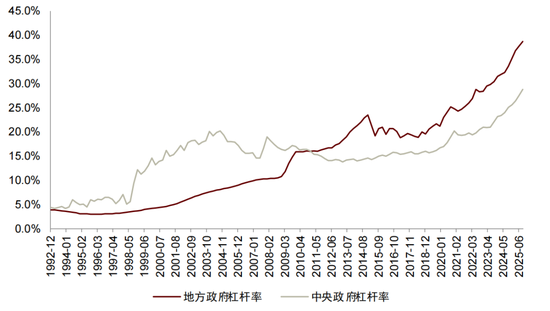
Core Viewpoint - The central economic work conference in December 2025 emphasizes the need to "promote investment stabilization" in 2026, leading to an optimistic outlook on fiscal policy for the upcoming year, particularly in infrastructure investment, which is expected to grow by 4.5% in 2026 [1][3][18]. Fiscal Policy Outlook - The fiscal measures for 2026 are anticipated to be more proactive, with a focus on stabilizing investment and stimulating private sector investment [3][4]. - The trend of "central government increasing leverage while local governments reduce leverage" is expected to continue, with the central government taking a more significant role in driving investment due to limited local government borrowing capacity [4][18]. Infrastructure Investment - Infrastructure investment is projected to be a crucial growth stabilizer in 2026, with a forecasted growth rate of 4.5% [18]. - The central government is expected to play a vital role in supporting infrastructure investment, particularly in the western regions, where there is significant potential for growth [18][32]. Construction Sector Insights - The construction state-owned enterprises (SOEs) are expected to benefit from debt reduction initiatives, leading to improved asset quality and valuation recovery [2][22]. - The share of receivables in total assets for major construction SOEs has been rising, indicating a need for financial improvement and valuation recovery as local government funding stabilizes [22][26]. Regional Investment Opportunities - The western provinces, particularly Sichuan, are highlighted as having high potential for infrastructure investment due to favorable central government funding and strategic positioning [32][39]. - The central transfer payment to western provinces is projected to be 4 trillion yuan, accounting for 42.2% of total central transfer payments, indicating strong financial support for infrastructure projects [32][36]. Manufacturing Sector Outlook - Manufacturing investment is expected to stabilize with a growth rate of around 5% in 2026, driven by a recovery in semiconductor capital expenditures [14][46]. - The cleanroom engineering sector is anticipated to benefit significantly from the upturn in semiconductor investments [46]. International Market Growth - The overseas market is projected to become a second growth curve for construction companies, with expectations of continued growth in new contracts and revenue from international projects [2][18].





中金公司:建筑存量出清与增量转型
Di Yi Cai Jing· 2025-12-25 00:13
Core Viewpoint - The report from CICC indicates a relatively optimistic outlook for fiscal policy in 2026, with a focus on stabilizing investment and supporting growth through infrastructure investment, particularly in the context of the real estate sector bottoming out [1] Group 1: Infrastructure Investment - Infrastructure investment is expected to be a key method for stabilizing growth, with a projected growth rate of 4.5% in 2026 [1] - There is a strong regional investment opportunity in western infrastructure, especially in Sichuan Province, which is anticipated to have high investment activity [1] Group 2: State-Owned Enterprises and Debt Management - The report highlights the potential for valuation recovery among construction state-owned enterprises due to debt management and state-owned enterprise reforms [1] Group 3: Manufacturing Sector - Manufacturing investment is expected to stabilize and recover, with a focus on cleanroom engineering benefiting from the upturn in semiconductor capital expenditures [1] Group 4: Overseas Market Opportunities - The overseas market is seen as a potential second growth curve, with an emphasis on the accelerated realization of construction companies' overseas expansion strategies [1]

中金2026年展望 | 建筑:存量出清与增量转型
中金点睛· 2025-12-24 23:37
Core Viewpoint - The article emphasizes optimism regarding fiscal policy in 2026, particularly in infrastructure investment as a means to stabilize economic growth amid a challenging real estate market [2][4][5]. Fiscal Policy Outlook - The 2026 fiscal policy is expected to be more proactive, with a focus on stabilizing investment and stimulating private sector activity [4][5]. - Central government investment is anticipated to increase, while local governments will continue to reduce leverage due to rising debt risks [5]. Infrastructure Investment - Infrastructure investment is projected to grow at a rate of 4.5% in 2026, driven by ongoing support from central fiscal measures [2][15]. - The central government is expected to play a significant role in funding infrastructure projects, particularly in the western regions of China [27][28]. Regional Investment Opportunities - The western provinces, especially Sichuan, are highlighted as having high potential for infrastructure investment due to favorable central government support and strategic positioning [3][27][34]. - Sichuan's transportation investment is leading nationally, with a compound annual growth rate of 4.9% from 2020 to 2024, indicating strong growth prospects [32]. Manufacturing Sector Insights - Manufacturing investment is expected to stabilize with a growth rate of around 5% in 2026, benefiting from a potential recovery in semiconductor capital expenditures [3][12]. - The cleanroom engineering sector is identified as a key beneficiary of increased capital spending in high-end manufacturing [3]. International Engineering Opportunities - The overseas market is anticipated to become a second growth curve for construction companies, with significant growth in new contracts and revenue from foreign projects since 2025 [3][12]. Debt Management and Corporate Valuation - The ongoing debt management efforts are expected to improve the asset quality and valuation of state-owned construction enterprises, which have seen a decline in price-to-book ratios due to rising receivables [2][16]. - The average funding cost for major construction enterprises is around 4%, with some companies achieving lower rates through bond issuance [22][23]. Construction Sector Dynamics - The construction sector is experiencing a shift towards higher market concentration, with leading companies increasing their market share significantly in recent years [22][23]. - The article notes that the average market share of major construction enterprises has risen to 22.9% in revenue terms and 48.9% in order terms [22][23].



申万宏源:首予中国中铁“增持”评级 报表优化 资源板块发力推动估值修复
Zhi Tong Cai Jing· 2025-12-24 01:28
Group 1 - The core viewpoint of the report is that China Railway (00390) is rated as "Buy" with expectations of stable infrastructure investment in 2026, supported by local government debt reduction and central government projects [1][2] - The new signed orders show marginal improvement, with a year-on-year growth of 3.7% in the first three quarters of 2025, indicating a robust order backlog that ensures long-term stable growth [1][3] - The resource sector continues to perform well, with mineral resource business revenue reaching 6.223 billion in the first half of 2025, reflecting an 8.04% year-on-year increase, enhancing profitability and cyclical resilience [1][4] Group 2 - The fixed asset investment growth has slowed down this year, but the outlook for 2026 suggests stabilization due to orderly local government debt reduction and the implementation of central government projects [2] - The company has a substantial order backlog of 75.4 billion, which is expected to support long-term growth, despite some pressure on traditional infrastructure due to industry impacts [3] - The company’s resource utilization business is primarily focused on mining operations, with leading reserves of copper, cobalt, and molybdenum among domestic peers, contributing to its profitability [4] Group 3 - The company has implemented a "Valuation Enhancement Plan" to improve quality and increase investor returns, with H-shares trading at a significant discount compared to A-shares [5] - The dividend distribution from 2021 to 2024 shows a consistent payout, with the H-share dividend yield at 5.1%, making it attractive for investors [5]
中国中铁(00390):报表优化,资源板块发力推动估值修复
Shenwan Hongyuan Securities· 2025-12-23 15:23
Investment Rating - The report initiates coverage with an "Outperform" rating for China Railway Group Limited (00390) [1][7] Core Insights - The report highlights that the company's valuation is expected to recover due to the optimization of financial statements and the performance of its resource segment [6][18] - It emphasizes the improvement in new contract signings and the robust backlog of orders, ensuring stable long-term growth [6][16] - The resource segment is noted for enhancing profitability and cyclicality resistance, with significant reserves of copper, cobalt, and molybdenum [6][25] - The report points out the attractive dividend yield of H-shares compared to A-shares, indicating a clear discount in valuation [6][33] Financial Data and Profit Forecast - Revenue projections for 2023 to 2027 are as follows: - 2023: 1,263.41 billion RMB - 2024: 1,160.31 billion RMB - 2025E: 1,156.73 billion RMB - 2026E: 1,164.20 billion RMB - 2027E: 1,179.18 billion RMB - The expected growth rates are: - 2023: +9.45% - 2024: -8.16% - 2025E: -0.31% - 2026E: +0.65% - 2027E: +1.29% [5][36] - Net profit attributable to ordinary shareholders is forecasted as follows: - 2023: 33.48 billion RMB - 2024: 27.89 billion RMB - 2025E: 25.16 billion RMB - 2026E: 24.95 billion RMB - 2027E: 25.85 billion RMB [5][36] Order and Contract Insights - The company has signed new contracts amounting to 2.73 trillion RMB in 2021, 3.03 trillion RMB in 2022, 3.10 trillion RMB in 2023, 2.72 trillion RMB in 2024, and 1.58 trillion RMB in 2025 (Q1-Q3), with a year-on-year growth of +4.7%, +11.1%, +2.2%, -12.4%, and +3.7% respectively [6][16] - As of Q3 2025, the company has a backlog of contracts worth 7.54 trillion RMB, ensuring stable revenue for the upcoming years [6][16] Resource Segment Performance - The resource utilization segment's revenue from 2021 to 2025 (Q1-Q3) is as follows: - 2021: 5.96 billion RMB - 2022: 7.50 billion RMB - 2023: 8.37 billion RMB - 2024: 8.16 billion RMB - 2025 (Q1-Q3): 6.22 billion RMB - The segment's gross margin is reported at 59.45% for 2025 (Q1-Q3) [6][25] Valuation and Market Comparison - The report suggests a target market capitalization of 999 billion RMB for 2026, translating to 1,102 billion HKD, indicating a potential upside of 16.6% from the current market cap of 945 billion HKD [6][41] - The report compares the company's valuation with peers, noting that the average PE for comparable companies is 4.2X for 2025 and 4.0X for 2026 [6][41]

钢材周报:终端延续弱势,期价震荡走势-20251222
Tong Guan Jin Yuan Qi Huo· 2025-12-22 02:18
1. Report Industry Investment Rating - Not provided in the given content 2. Core Viewpoints of the Report - Terminal demand continues to be weak, with real estate investment declining, and new construction and construction data undergoing significant adjustments. Infrastructure investment also shows a weakening trend on a month - on - month basis. The fundamentals of the industry are average, with minor adjustments in the production and apparent demand of the five major steel products, and inventory continuing to decline. The de - stocking trend of rebar is good, while hot - rolled coils face greater inventory pressure due to adjusted apparent demand. Affected by policies, coal and coke futures have rebounded significantly, driving up the black - metal sector. Steel prices will follow the short - term rebound but remain in a volatile pattern [1][4][5] 3. Summary According to Relevant Catalogs Trading Data | Contract | Closing Price | Change | Change Percentage | Total Trading Volume (lots) | Total Open Interest (lots) | Price Unit | | --- | --- | --- | --- | --- | --- | --- | | SHFE Rebar | 3125 | 41 | 1.33% | 838111 | 2374085 | Yuan/ton | | SHFE Hot - Rolled Coil | 3277 | 32 | 0.99% | 279994 | 1191178 | Yuan/ton | | DCE Iron Ore | 777.5 | 9.5 | 1.24% | 187722 | 534905 | Yuan/ton | | DCE Coking Coal | 1126.5 | 64.5 | 6.07% | 1379629 | 697473 | Yuan/ton | | DCE Coke | 1603.5 | 73.0 | 4.77% | 23737 | 36859 | Yuan/ton | [2] Market Review - Last week, steel futures oscillated and rebounded. Steel inventory continued to decline, and there was cost support. However, the terminal market remained weak, and there was significant upward pressure. In the spot market, the price of Tangshan billet was 2950 (+10) yuan/ton, Shanghai rebar was quoted at 3300 (+30) yuan/ton, and Shanghai hot - rolled coil was 3270 (+30) yuan/ton [4] - From January to November, the national real estate development investment was 785.91 billion yuan, a year - on - year decrease of 15.9%. The floor area under construction of real estate development enterprises was 6.56066 billion square meters, a year - on - year decrease of 9.6%. The newly started floor area was 534.57 million square meters, a decrease of 20.5%. The completed floor area was 394.54 million square meters, a decrease of 18.0%. The sales area of newly built commercial housing was 787.02 million square meters, a year - on - year decrease of 7.8%. Infrastructure investment (excluding electricity, heat, gas, and water production and supply industries) decreased by 1.1% year - on - year. Among them, investment in pipeline transportation increased by 16.8%, investment in water transportation increased by 8.9%, and investment in railway transportation increased by 2.7% [4] - In terms of the industry, last week, rebar production was 1.82 million tons, a month - on - month increase of 30,000 tons; apparent demand was 2.09 million tons, an increase of 60,000 tons; factory inventory was 1.4 million tons, a decrease of 10,000 tons; social inventory was 3.13 million tons, a decrease of 260,000 tons; and total inventory was 4.53 million tons, a decrease of 270,000 tons. Hot - rolled coil production was 2.92 million tons, a decrease of 170,000 tons; factory inventory was 830,000 tons, a decrease of 6,000 tons; social inventory was 3.07 million tons, a decrease of 60,000 tons; total inventory was 3.91 million tons, a decrease of 60,000 tons; and apparent demand was 2.98 million tons, a decrease of 140,000 tons [5] Industry News - Recently, multiple departments such as the National Development and Reform Commission, the Ministry of Finance, the Ministry of Commerce, the People's Bank of China, and the State - owned Assets Supervision and Administration Commission of the State Council have intensively carried out deployments to implement the spirit of the Central Economic Work Conference and list key tasks for 2026. More incremental policies will be introduced according to the situation to boost consumption, stabilize investment, and cultivate new growth drivers. The scale of central budgetary investment will be appropriately increased, and major projects of the 15th Five - Year Plan will be implemented in advance. At the same time, risks in key areas will be actively and steadily resolved, "involution - style" competition will be rectified, and market order will be regulated [6] - The magazine Qiushi published an important article by General Secretary Xi Jinping, "Expanding Domestic Demand is a Strategic Move," emphasizing that expanding domestic demand is related to both economic stability and security and is a long - term strategic measure [6] - On December 17, Ministry of Finance data showed that from January to November, the national general public budget revenue was 2.00516 trillion yuan, a year - on - year increase of 0.8%. Among them, national tax revenue was 1.64814 trillion yuan, a year - on - year increase of 1.8%; non - tax revenue was 357.02 billion yuan, a year - on - year decrease of 3.7%. In terms of central and local levels, central general public budget revenue was 884.64 billion yuan, a year - on - year decrease of 1%; local general public budget revenue at the provincial - level was 1.12052 trillion yuan, a year - on - year increase of 2.2% [6] - The Ministry of Commerce responded to China's re - implementation of export license management for steel, stating that the main purpose is to strengthen the monitoring, statistical analysis of steel product exports, and track product quality. The management complies with WTO rules and does not involve restrictions on export volume or business qualifications of enterprises [6] - From January to November, the national real estate development investment was 785.91 billion yuan, a year - on - year decrease of 15.9%. The floor area under construction of real estate development enterprises was 6.56066 billion square meters, a year - on - year decrease of 9.6%. The newly started floor area was 534.57 million square meters, a decrease of 20.5%. The completed floor area was 394.54 million square meters, a decrease of 18.0%. The sales area of newly built commercial housing was 787.02 million square meters, a year - on - year decrease of 7.8% [6] - From January to November 2025, the national fixed - asset investment (excluding rural households) was 4.44035 trillion yuan, a year - on - year decrease of 2.6%. In the secondary industry, industrial investment increased by 4.0% year - on - year. Among them, investment in mining increased by 4.0%, investment in manufacturing increased by 1.9%, and investment in electricity, heat, gas, and water production and supply industries increased by 10.7%. In the tertiary industry, infrastructure investment (excluding electricity, heat, gas, and water production and supply industries) decreased by 1.1% year - on - year. Among them, investment in pipeline transportation increased by 16.8%, investment in water transportation increased by 8.9%, and investment in railway transportation increased by 2.7% [6] Relevant Charts - The report provides multiple charts, including the trend of rebar futures and monthly spreads, the trend of hot - rolled coil futures and monthly spreads, the trend of rebar basis, the trend of hot - rolled coil basis, the regional price difference trend of rebar and hot - rolled coil spot, the smelting profit of long - process steel mills, the production of rebar and hot - rolled coil, the daily average pig iron output of 247 steel mills, the blast furnace operating rate of 247 steel mills nationwide, the social inventory, factory inventory, and total inventory of rebar and hot - rolled coil, and the apparent consumption of rebar and hot - rolled coil [9][10][11][13][14][15][16][18][21][25][26][28][31][34][35][36]
这个行业“爆单”,上月销量同比增178%!两班倒也供不应求,客户进厂催单,销售负责人:“10年难遇”
Mei Ri Jing Ji Xin Wen· 2025-12-21 14:37
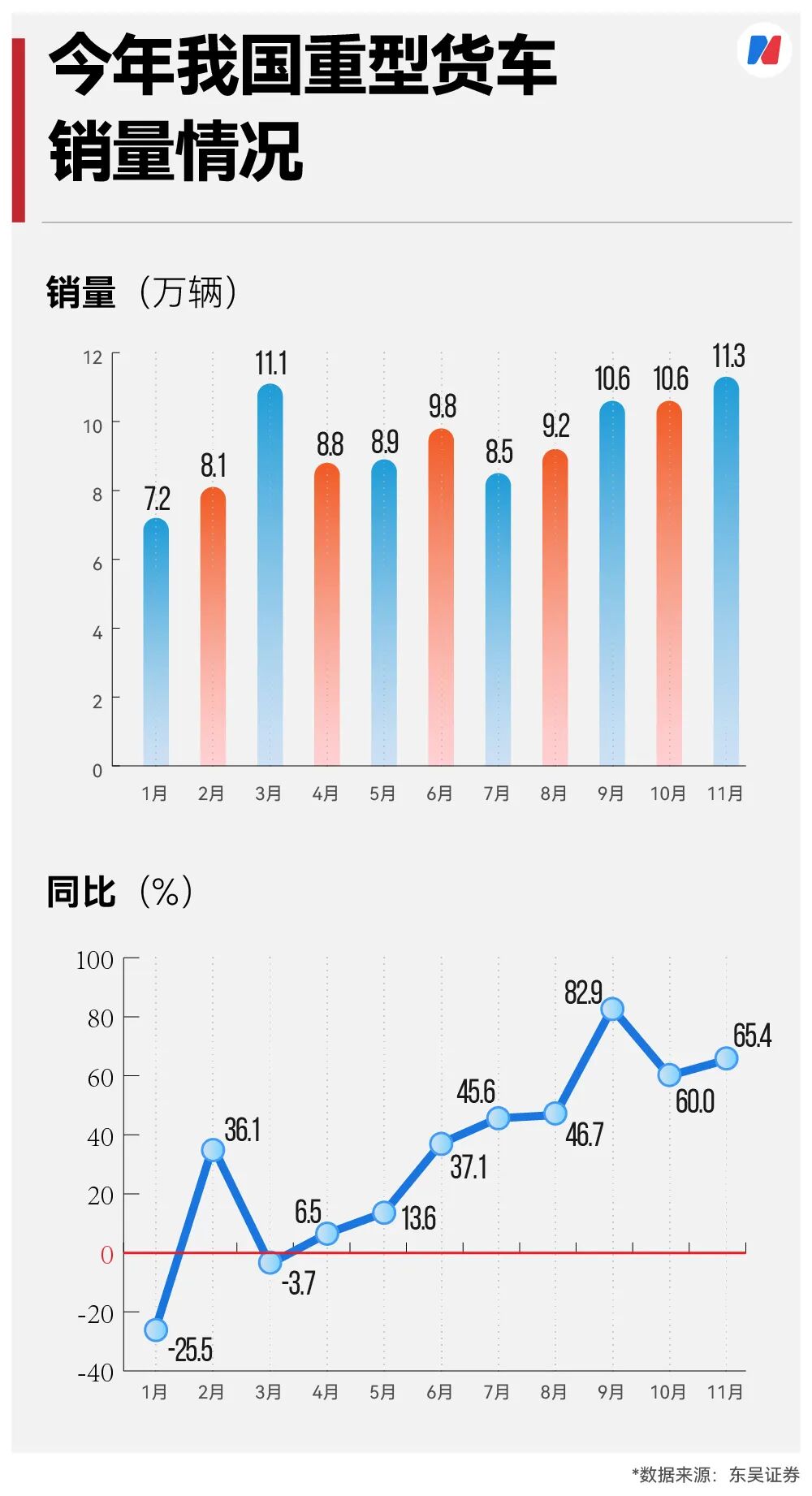
每经记者|周逸斐 段思瑶 每经编辑|金冥羽 陈星 "现在订单供不应求,客人直接到工厂催单,这在以往难得一见。"谈及今年的销量,中国重汽的一位销售负责人陈珂(化名)喜形于色。 数据也证实了这一点。中汽协最新数据显示,11月我国重型货车销量11.3万辆,同比增长65.4%,实现八连涨。 在本次销售热潮中,新能源重卡成为新引擎。 公开数据显示,11月份,国内新能源重卡市场共计销售2.8万辆,同比增长178%,前三季度销量同比增长184%。 "订单太多,但产能供不上,我们只能优先保障核心客户的需求。"陈珂清楚地记得,这场重卡市场的变局始于去年。 他告诉每经记者:"从2024年10月到现在,我们就没闲过。原先的一班制生产满足不了需求,部分地区生产车间已经改成两班制。" 中国重汽旗下的一家齿轮公司上演着同样的景象。在大月生产压力下,该公司提高产能,变速箱总成装机量同比增长66%,总成单班产量超610台。 为何重卡销量上涨如此明显?本轮行情的"主角"为什么是新能源重卡?围绕这些问题,《每日经济新闻》记者(以下简称每经记者)进行了深入调查。 1 订单太多、产能不足,客户直接去厂里催单 车间的热火朝天也直接反映在企业销量上。第 ...
11月狭义基建投资环比改善,2026年财政、投资定调积极
Guotou Securities· 2025-12-21 09:34
Investment Rating - The industry investment rating is "Leading the Market - A" [6] Core Insights - The report indicates that infrastructure investment in November showed a month-on-month improvement, with a positive fiscal and investment outlook for 2026 [3][17] - The report emphasizes the importance of expanding effective investment as a key task for building a strong domestic market and accelerating the construction of a new development pattern [2][18] - The construction industry is expected to see marginal improvements driven by policy and fundamental improvements, particularly in the context of new and old kinetic energy conversion in investment [3][19] Summary by Sections Industry Dynamics - From January to November, national fixed asset investment (excluding rural households) reached 44.40 trillion yuan, a year-on-year decrease of 2.6%. Excluding real estate development investment, project investment grew by 0.8%. In November, fixed asset investment (excluding rural households) fell by 1.03%. The narrow and broad infrastructure investment completion amounts from January to November showed year-on-year increases of 1.10% and 0.13%, respectively, with a month-on-month improvement in November [17][30] - In the three major infrastructure subcategories, investment in electricity, heat, gas, and water maintained double-digit growth, with a year-on-year increase of 10.70%. Investment in transportation, warehousing, and postal services slightly decreased by 0.10%, while investment in water conservancy, environment, and public facilities management fell by 6.30% [17][30] Market Performance - The construction industry experienced a slight decline of 0.10%, underperforming the Shanghai Composite Index, but the international engineering sector performed well with a 5.99% increase [20][21] - The report highlights that 57.93% of companies in the construction sector recorded gains, with notable performers including *ST Kexin and Zhongtian Precision [21][22] Key Investment Targets - Recommended stocks include low-valuation central enterprises in infrastructure such as China State Construction and China Communications Construction, which are expected to benefit from improved operational quality and increased dividends [12][13] - The report also suggests focusing on companies in the cleanroom engineering sector, such as Yaxiang Integration and Shenghui Integration, which are expected to benefit from the growing demand in the semiconductor and cloud service industries [12][13]
以专业锚定价值,探秘公募大厂的REITs实践
Zhong Guo Ji Jin Bao· 2025-12-19 08:13
Core Insights - Public REITs have emerged as a new growth point for the public fund industry, with a total market value exceeding 200 billion yuan in just four years since their launch in 2021, serving as a vital link between capital markets and infrastructure construction [1][2] Group 1: Public REITs Overview - Public REITs, or publicly offered infrastructure securities investment funds, allow ordinary investors to participate in infrastructure investments by breaking down large projects like highways and wind farms into smaller shares, thus enabling low-threshold investment opportunities [2] - The value of public REITs lies in their ability to "activate" dormant infrastructure assets and connect capital with new projects, creating a virtuous cycle of investment, operation, exit, and reinvestment [2] Group 2: Operational Structure - Public REITs utilize a dual-layer structure of "public fund + asset-backed securities," focusing on underlying infrastructure assets, with returns derived from stable cash flows and potential appreciation in the secondary market [3] - The management of public REITs involves a clear division of responsibilities, with fund managers overseeing the overall strategy while external operators manage daily operations, ensuring asset quality and stable returns for investors [3] Group 3: Investment Strategy - High-quality underlying assets are fundamental to the success of public REITs, with ICBC Credit Suisse's REITs focusing on core values in transportation infrastructure and green energy [4] - The G18 Rongwu Expressway, part of the national highway network, serves as a key asset for the Hebei Expressway REIT, projected to achieve a cash distribution rate of 9.48% in 2024, indicating strong revenue potential [4] - The ICBC Mongolian Clean Energy REIT targets green investments through an inland wind power project, contributing to ecological protection while providing returns to investors [4] - The company is also diversifying its REIT product matrix by actively reserving various asset types such as parking lots, affordable rental housing, and industrial parks to meet different investor needs [4]