新能源汽车发展

Search documents
东风汽车集团1-10月销售新能源汽车42.14万辆,同比增长37.1%
Ju Chao Zi Xun· 2025-11-07 03:06
Core Insights - Dongfeng Motor Group Co., Ltd. reported a total vehicle sales of 1,501,025 units from January to October 2023, representing a year-on-year decline of approximately 1.6% [2][4] - The company's performance in the new energy vehicle (NEV) segment was strong, with cumulative sales of 421,355 units, marking a year-on-year increase of 37.1% [2][4] Production and Sales Data - Total production from January to October was 1,497,404 units, showing a slight decrease of 0.1% year-on-year [3][4] - Passenger vehicle sales totaled 1,199,736 units, down 3.2% year-on-year, with specific segments showing varied performance: - Basic passenger vehicles saw a decline of 10.0% to 576,765 units - Sports Utility Vehicles (SUVs) increased by 2.1% to 539,484 units - Multi-Purpose Vehicles (MPVs) grew by 19.0% to 83,487 units [3][4] Commercial Vehicle Performance - Commercial vehicle sales reached 301,289 units, reflecting a year-on-year growth of 5.7% [4] - Notable performance in the truck segment: - Total sales of cargo vehicles were 293,163 units, up 8.3% - Heavy-duty trucks increased by 24.4% to 146,340 units - Medium-duty trucks surged by 43.9% to 10,353 units - Bus sales, however, dropped significantly by 43.9% to 8,126 units [4] New Energy Vehicle Segment - The NEV sector continued to be a key growth driver, with production reaching 433,970 units, a year-on-year increase of 43.2% [4] - NEV sales comprised 421,355 units, up 37.1% year-on-year, with: - NEV passenger vehicles totaling 387,689 units, a growth of 39.1% - NEV commercial vehicles reaching 33,666 units, an increase of 17.6% [4] Subsidiary Performance - Various subsidiaries exhibited differentiated growth: - Yipai Technology reported sales of 221,355 units, up 35.1% - Lantu Motors saw a significant increase of 90.7% to 112,627 units - Mengshi Technology experienced a remarkable growth of 196.5% to 5,215 units - Dongfeng Nissan (including Dongfeng Infiniti and Qichen) reported a decline of 7.5% to 479,977 units - Dongfeng Motor Co., Ltd. (A-share code 600006) saw a decrease of 21.4% to 99,482 units [5]


行业聚焦:全球OBC+DC/DC 二合一车载充电机行业Top 5生产商市场份额及排名调查
QYResearch· 2025-11-05 02:11
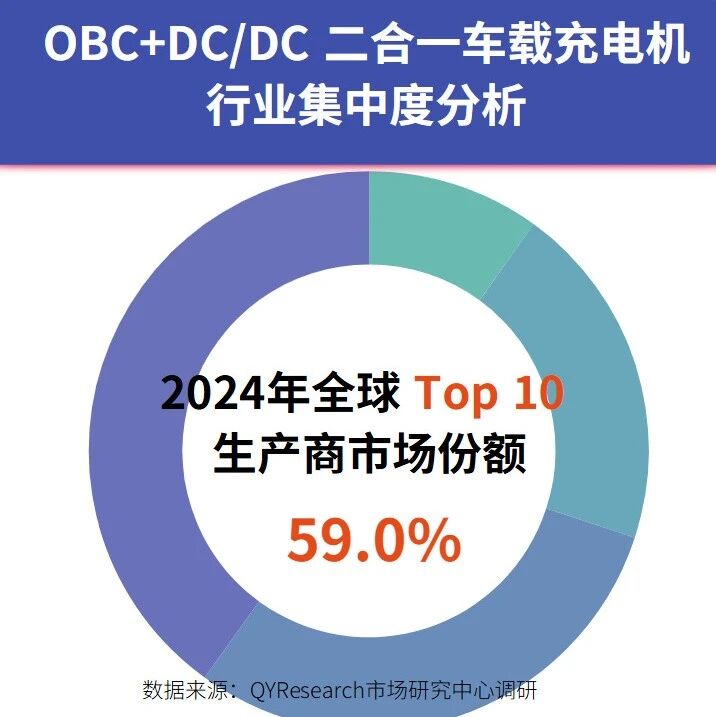
Core Viewpoint - The OBC+DC/DC integrated on-board charger is a crucial component in electric vehicles, converting AC to high-voltage DC and further supplying low-voltage DC to auxiliary systems, thereby optimizing space, reducing costs, and enhancing system integration [1][10]. Market Overview - The global market for OBC+DC/DC integrated on-board chargers is projected to reach $2.83 billion by 2030, with a compound annual growth rate (CAGR) of 7.4% in the coming years [2]. - The top ten manufacturers are expected to hold approximately 59.0% of the market share by 2024 [3]. Product Segmentation - The most significant product type currently is the 3.3KW rated power charger, which accounts for about 63.5% of the market share [5]. - In terms of application, passenger vehicles represent the largest downstream market, holding a 74.2% share [7]. Leading Companies - Key manufacturers in the global OBC+DC/DC integrated on-board charger market include Valeo, Bosch, Fudi Power, Tesla, Huawei, Weimais, Inbol, Zhejiang Fute Technology, Huichuan Technology, and Shenzhen Xinrui Technology [3][10]. Industry Drivers and Challenges - Major drivers for the OBC+DC/DC integrated on-board charger market include the rapid growth of new energy vehicle ownership, the demand for vehicle lightweighting and high power density, increased requirements for charging and energy conversion efficiency, and the trend towards integration that offers cost and space optimization advantages [10]. - Challenges include increased design complexity due to high integration, high costs of SiC power devices, long verification cycles for system reliability and safety, and the lack of standardization across different vehicle platforms [10]. Future Opportunities - The maturation of new power devices like SiC and GaN is expected to enhance power density and efficiency further. Additionally, bidirectional OBC technology will create new scenarios for vehicle-grid interconnection, while policy support and unified charging standards will accelerate the penetration of integrated chargers in both passenger and commercial vehicle sectors [11].
国产燃油车卖得怎么样?5位销售一起聊聊实际情况
车fans· 2025-11-05 00:30
Core Viewpoint - The rapid development of domestic new energy vehicles (NEVs) is notable, but there remains a significant demand for domestic fuel vehicles, indicating a complex market landscape [1]. Sales Performance - The best-selling fuel vehicle is the Xingrui, accounting for one-third of monthly sales, followed by Boyue L and Emgrand [3]. - The overall sales of fuel vehicles have remained stable compared to last year, but there is increased pressure from the growing interest in NEVs [4]. - The most popular fuel vehicles in the store include the M8, GS8, M6 series, and the Ying Su series, with Ying Su selling around 18-20 units monthly [6]. - The top-selling fuel cars are the fourth-generation CS75PLUS, CS55PLUS, and Yidong PLUS, collectively selling about 35 units monthly, representing over 65% of total sales [9]. Customer Demographics - Fuel vehicle buyers are predominantly middle-aged, with a mix of professions including factory workers, nurses, and teachers, often requiring vehicles for long-distance travel [3]. - The customer base for the Ying Su is diverse, including first-time buyers and retirees, with a general preference for the reliability of fuel vehicles over NEVs [6]. - Younger customers, often purchasing their first car, primarily consider fuel vehicles, with some interest in plug-in hybrids [10]. Market Trends - There is a noticeable decline in overall sales compared to last year, with profit margins also decreasing, leading to a push for additional services [7]. - The acceptance of NEVs is increasing, with customers recognizing the advantages in product configuration and overall purchase experience [7]. - The market for fuel vehicles is expected to improve slightly next year due to potential changes in tax policies and the reduction of subsidies for NEVs [13][15]. Competitive Landscape - Competing fuel vehicles include popular models like the Langyi and Suteng, with domestic brands such as Chery, GAC, and Changan being compared within similar price ranges [3]. - The lack of competitive pricing and product offerings in the NEV segment is noted, particularly in the 150,000 yuan price range, which is currently underserved [7]. - The best-selling fuel vehicles in the store include the Aiyue 5 and Aiyue 8, appealing to younger consumers due to their affordability and design [12].
“卖爆了”!新能源车数据来了
Zhong Guo Ji Jin Bao· 2025-11-02 03:05
Core Insights - The new energy vehicle (NEV) market in China is experiencing significant growth, with major players reporting increased delivery volumes in October compared to September, despite some companies facing year-on-year declines [2][6]. Company Performance - BYD achieved a record monthly sales of 441,706 units in October 2025, marking an 11.47% increase from September, but a 12.13% decrease year-on-year [3][6]. - Geely's NEV sales reached 177,882 units in October, a 63.61% increase year-on-year and a 7.68% increase month-on-month, setting a historical high [8]. - Chery's NEV sales surpassed 110,000 units for the first time, totaling 110,346 units in October, reflecting a 54.70% year-on-year increase and a 20.48% month-on-month increase [10]. - Leap Motor reported a record monthly delivery of 70,289 units, marking an 84.11% year-on-year increase [11]. - NIO's delivery volume reached 40,397 units in October, a 92.59% year-on-year increase and a 16.25% month-on-month increase [14]. - Ideal Auto's delivery volume fell to 31,767 units, representing a 38.25% year-on-year decline and a 6.43% month-on-month decline [23]. Market Trends - The competition among NEV manufacturers is intensifying, with no clear leader emerging as companies like Leap Motor, Xpeng, and NIO continue to innovate and expand their offerings [2][12]. - State-owned enterprises in the NEV sector, such as BAIC and Lantu, are also showing strong performance, with BAIC's sales increasing by 112.02% year-on-year [16][20]. - Lantu aims to establish itself as the leading high-end NEV brand among state-owned enterprises, achieving nine consecutive months of sales growth [20]. Future Outlook - Leap Motor is optimistic about achieving a total delivery of at least 500,000 units for the year, having already delivered 465,800 units in the first ten months [10]. - Ideal Auto is focusing on expanding its market presence in Central Asia, the Middle East, Europe, and the Asia-Pacific region, while also addressing production capacity issues [23][25].





王俊履新东风汽车副总经理 东风领导班子再迎调整
Xi Niu Cai Jing· 2025-10-31 11:47
Group 1 - Dongfeng Motor Group Co., Ltd. appointed Wang Jun as the new Deputy General Manager and a member of the Party Committee, following a recent leadership meeting [2] - Wang Jun has a rich background in the automotive industry, having worked for 30 years at Changan Automobile in various key roles, including Vice Director of the Technical Center and General Manager of the Sales Company [4] - The recent personnel changes at Dongfeng include the promotion of Zhou Feng to Deputy General Manager in July and the appointment of former Chief Accountant Feng Changjun as Director and General Manager in October, leaving only one Deputy General Manager position vacant [5] Group 2 - Dongfeng Motor, as one of the three major state-owned automobile manufacturers in China, is accelerating its development in the new energy sector, with total sales reaching 1.3168 million units from January to September 2025, a year-on-year decline of 3.6% [5] - The sales of new energy vehicles reached 361,900 units during the same period, marking a significant year-on-year increase of 35.6%, with notable growth in its self-owned brands such as Yipai Technology, Lantu Automobile, and Mengshi Technology [5] - The impact of Wang Jun's appointment on Dongfeng Motor's future operations and strategy will be closely monitored by industry analysts [5]

安徽登顶汽车产量第一省
Di Yi Cai Jing· 2025-10-27 14:49
Core Insights - Anhui province has emerged as the leading automobile production province in China, surpassing Guangdong with a production of 2.4044 million vehicles in the first three quarters of this year, a significant increase from 1.8265 million vehicles in the same period last year, representing a year-on-year growth of 31.64% [2][4]. Production Rankings - The top ten provinces for automobile production in 2024 are Guangdong, Anhui, Chongqing, Jiangsu, Shandong, Shanghai, Shaanxi, Zhejiang, Jilin, and Hubei, with respective productions of 5.7074 million, 2.6203 million, 2.5401 million, 2.25 million, 1.8381 million, 1.8075 million, 1.7535 million, 1.6922 million, 1.507 million, and 1.3891 million vehicles [3]. Statistical Changes - The shift in automobile production statistics from "enterprise legal person location" to "production location" starting in 2025 will significantly impact how production is reported, allowing for a more accurate representation of production in provinces like Anhui [3][4]. Industry Growth - Anhui's rapid growth in the automotive sector is attributed to the establishment of major manufacturers such as BYD, NIO, Chery, and Volkswagen, along with a comprehensive supply chain of 2,800 parts manufacturers [4]. New Energy Vehicles - In the first three quarters, Anhui produced 1.2163 million new energy vehicles, leading the nation, while Guangdong's production of new energy vehicles fell to 730,200, a year-on-year decline of 67.97% [4]. Expansion of Production Clubs - This year, 15 provinces are expected to exceed one million vehicles in production, expanding the "million vehicle production club," with notable increases in provinces like Sichuan and Guangxi, which are projected to surpass one million vehicles for the first time [5][6]. Historical Context - The number of provinces producing over one million vehicles has increased from 10 in 2022 to 12 in 2024, indicating a shift in the automotive industry landscape, with traditional automotive hubs experiencing declines while emerging regions gain prominence [7].
安徽登顶汽车产量第一省
第一财经· 2025-10-27 13:12
Core Viewpoint - The article highlights the significant rise of Anhui province in automobile production, projecting it to surpass Guangdong as the leading province in China for automobile manufacturing in 2025, driven by both statistical reforms and rapid industry growth [3][6]. Summary by Sections Automobile Production Rankings - In 2024, the top ten provinces for automobile production are Guangdong, Anhui, Chongqing, Jiangsu, Shandong, Shanghai, Shaanxi, Zhejiang, Jilin, and Hubei, with production figures of 5.71 million, 2.62 million, 2.54 million, 2.25 million, 1.84 million, 1.81 million, 1.75 million, 1.69 million, 1.51 million, and 1.39 million vehicles respectively [5]. Changes in Production Statistics - The shift in automobile production statistics from "enterprise location" to "production location" by the National Bureau of Statistics has significantly impacted the rankings, allowing vehicles produced in Anhui by companies headquartered elsewhere to be counted towards Anhui's total [6]. Growth in Anhui's Automobile Industry - Anhui's automobile production has seen substantial growth, with figures rising from 1.75 million in 2022 to 2.62 million in 2024, marking its ascent from seventh to second place nationally [6]. Current Production Data - In the first three quarters of this year, Anhui produced 2.40 million vehicles, a 31.64% increase from 1.83 million in the same period last year, accounting for 10% of the national total [7]. Electric Vehicle Production - A key driver of Anhui's growth is the surge in electric vehicle production, with 1.22 million units produced in the first three quarters, up from 0.48 million last year, while Guangdong's production has declined significantly [7]. Emerging Provinces - Other provinces like Shaanxi, Shandong, Jiangsu, and Zhejiang are also experiencing rapid growth, with Shaanxi's production surpassing 1 million vehicles earlier than expected, indicating a broader trend of rising automobile production across multiple provinces [9]. Expansion of the "Million Vehicle Club" - This year, 15 provinces are expected to exceed 1 million vehicles in production, expanding the "Million Vehicle Club" to include new entrants like Sichuan, Hunan, and Henan [10]. Historical Context of Production Growth - The membership of the "Million Vehicle Club" has grown from 10 provinces in 2022 to 12 in 2024, reflecting a shift in the automotive industry landscape, with traditional powerhouses losing ground to emerging regions [11].
国海证券:维持零跑汽车(09863)“增持”评级 管理层增持彰显发展信心
智通财经网· 2025-10-24 05:58
Core Viewpoint - Guohai Securities expresses optimism about Leap Motor's future development, maintaining a "Buy" rating for the company [1] Financial Projections - The company is expected to achieve operating revenues of 64.19 billion, 100.26 billion, and 128.13 billion yuan for the years 2025 to 2027, with year-on-year growth rates of 100%, 56%, and 28% respectively [1] - The projected net profit attributable to shareholders is 0.94 billion, 4.42 billion, and 6.41 billion yuan for the same period, indicating a turnaround and growth rates of +371% and +45% [1] - Earnings per share (EPS) are forecasted to be 0.66, 3.11, and 4.51 yuan for 2025, 2026, and 2027 respectively [1] Recent Developments - On October 16, Leap Motor unveiled its flagship D platform and the D19 flagship model [1] - On October 20, the company announced that its chairman and CEO, Zhu Jiangming, along with shareholder Fu Liqian, purchased a total of 3.2435 million shares of the company's H shares at an average price of approximately 63.19 HKD per share, reflecting strong confidence in the company's future [1] - The management's share purchase is seen as a strong signal of confidence in the company's long-term development [1]

自驾川藏线 充电更便捷
Ren Min Ri Bao· 2025-10-23 05:47
Core Insights - The development of electric vehicles (EVs) is essential for China to transition from a major automotive country to a strong automotive power [3] - The growth of China's EV industry has been significant, with sales reaching 3.521 million units in 2021 and projected to exceed 12 million units by 2024, maintaining the world's leading position [3] Industry Developments - The Sichuan-Tibet Highway, known for its scenic beauty, is increasingly seeing the presence of domestic EVs, which were previously dominated by traditional fuel vehicles [2] - The charging infrastructure along the Sichuan-Tibet Highway has improved significantly, transitioning from slow chargers with power ratings of 7 kW or 60 kW to the latest 600 kW super fast charging technology [3] - The charging efficiency has drastically increased, allowing for quicker charging times, which enhances the feasibility of long-distance travel in EVs [3] Consumer Experience - Tourists like Chen Bo are now able to enjoy road trips in EVs with confidence due to the expanding network of charging stations [2][3] - The experience of traveling in EVs has become more convenient, with charging times reduced to the duration of a meal or a coffee break [3]
电动车充电设施建设将提速
Jing Ji Ri Bao· 2025-10-22 22:21
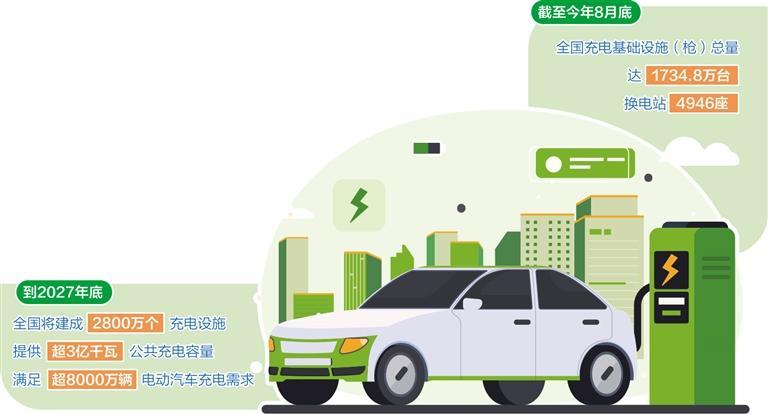
Group 1 - The National Development and Reform Commission and the National Energy Administration, along with six other departments, have issued a three-year action plan to double the service capacity of electric vehicle charging facilities by 2027, aiming to establish 28 million charging facilities and provide over 300 million kilowatts of public charging capacity to meet the needs of over 80 million electric vehicles [2][3] - The charging infrastructure industry is transitioning from quantity-focused growth to quality enhancement, with the action plan emphasizing five key areas: improving public charging facilities, optimizing residential charging conditions, promoting vehicle-grid interaction, enhancing power supply capabilities, and improving operational services [3][4] - The industry is expected to shift from price competition to service competition, focusing on improving service quality and customer experience as electric vehicle adoption continues to rise [4] Group 2 - The action plan includes a commitment to expand charging networks into rural areas, with plans to add at least 14,000 direct current charging guns in townships that currently lack public charging stations, ensuring comprehensive coverage of charging facilities [5] - Companies like BYD are actively innovating in the charging infrastructure space, with plans to commercialize advanced charging solutions, including a megawatt fast-charging platform and integrated solar-storage-charging stations by 2026 [3][4] - The industry is witnessing a diversification of participants, with more local governments and enterprises engaging in the charging infrastructure supply chain, driving high-quality development [3][4]