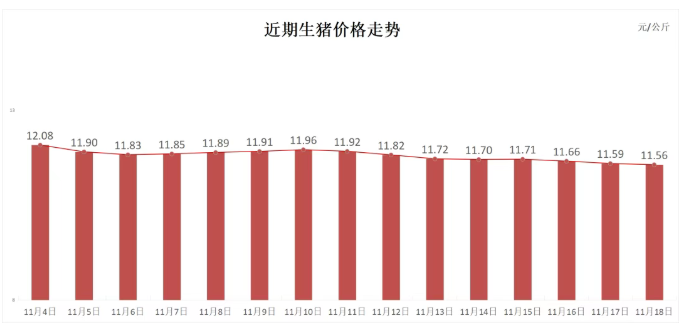
猪价走势

Search documents
官方最新监测预警:25个省份猪肉价格下跌,消费或难以支撑猪价?
Sou Hu Cai Jing· 2025-12-03 04:14
Core Insights - The average price of pork in China has decreased to 22.86 yuan/kg as of the fourth week of November, marking a 0.7% decline from the previous week and a 19.3% drop year-on-year, indicating a "旺季不旺" (peak season not prosperous) scenario in the market [1] - As of December 3, the average price of external three-yuan live pigs is 11.54 yuan/kg, showing a slight increase of 0.01 yuan/kg, but the upward momentum is weak, with the number of provinces experiencing price increases dropping from 25 to 16 [3][4] - The supply of pigs has reached historical highs, with slaughter volumes from January to October 2025 reaching 32.289 million heads, significantly higher than previous years, which is contributing to the current price trends [6] Price Trends - The average pork price in China is currently 22.86 yuan/kg, down 0.7% week-on-week and 19.3% year-on-year [1] - On December 3, the average price of external three-yuan live pigs was 11.54 yuan/kg, with a recent trend of three consecutive days of price increases, although the daily increase has diminished [3] - The number of provinces with rising prices has decreased, indicating a broader decline in pork prices across the country [3] Supply and Demand Dynamics - The increase in slaughter volume is a significant factor in the current pork price situation, with slaughter numbers for 2025 showing a substantial increase compared to previous years [6] - The concentration of production in the industry is also rising, with more large-scale slaughter enterprises contributing to the supply [6] - The current high supply levels may limit the potential for significant price increases in the near term, leading to a volatile price environment [6]

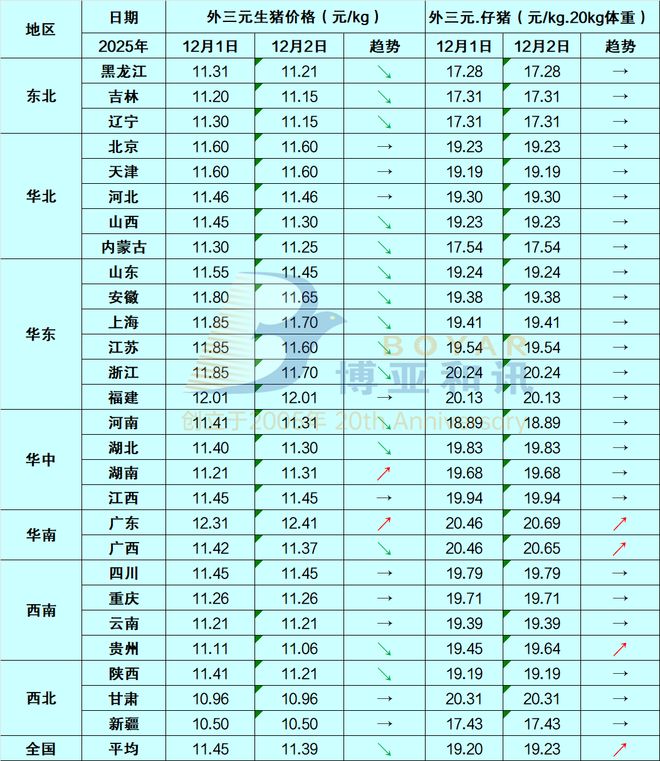
【BOYAR监测】生猪市场每日简评【12.2】
Xin Lang Cai Jing· 2025-12-02 10:09
Group 1 - The average price of external three-yuan live pigs in China on December 2, 2025, is 11.39 yuan/kg, a decrease of 0.06 yuan/kg from the previous day [1] - The average price of piglets is 19.23 yuan/kg, an increase of 0.02 yuan/kg from the previous day [1] - The average price of white strip meat is 15.25 yuan/kg, a decrease of 0.07 yuan/kg from the previous day [1] Group 2 - The market sentiment is weak, particularly in the northern regions, leading to a decline in pig prices [2] - Despite attempts to raise prices at the beginning of the month, the market response has been limited, resulting in a lack of upward momentum in pig prices [2] - The supply side is experiencing a strong release, while demand remains weak, leading to a short-term market outlook of strong supply and weak demand [2][3] Group 3 - The price gap between northern and southern regions is widening, which may increase the volume of pig source transfers from the north [3] - The market sentiment is mixed, with expectations of a stable yet weak adjustment in pig prices in the coming days [3]
【BOYAR监测】生猪市场每日简评【12.1】
Xin Lang Cai Jing· 2025-12-01 10:18
Core Insights - The average price of external three yuan pigs in China increased to 11.45 yuan/kg as of December 1, 2025, reflecting a rise of 0.26 yuan/kg from the previous week [1] - The average price of piglets rose to 19.20 yuan/kg, up by 0.02 yuan/kg from last week [1] - The average price of white strip meat reached 15.32 yuan/kg, an increase of 0.17 yuan/kg compared to last week [1] Price Trends - The pig feed ratio is currently at 3.45:1, which is an increase of 0.08 from last week [1] - The southern region experienced a more significant price increase, contributing to the overall national average rise [1] - Market sentiment improved due to a combination of factors, including reduced supply from large-scale farms and seasonal temperature drops in the northern region, which are favorable for the cured meat market [1] Market Outlook - Short-term expectations indicate a gradual recovery in consumer demand as temperatures drop, although the supply from large-scale farms is beginning to increase [1] - Current temperature conditions are not sufficient to support a peak in cured meat demand, leading to limited upward movement in white strip meat prices [1] - The price difference between live pigs and white strip meat remains below 4 yuan/kg, indicating limited order growth from slaughter enterprises [1] - Market sentiment is mixed, with expectations of weak adjustments in pig prices in the coming days, influenced by the outflow rhythm from large-scale farms and the sales situation of white strip meat [1]
10月生猪数据揭秘:出栏量增体重降,母猪去化加速,26年猪价可期
Zhi Tong Cai Jing· 2025-11-30 00:22
Group 1 - The supply of live pigs remains relatively loose, and due to policy guidance from the National Development and Reform Commission, large pig enterprises are reducing the weight of their marketings, which increases short-term supply pressure and leads to a significant decline in pork prices during the month [1][2] - The industry is experiencing expanded losses, with the number of breeding sows in the country entering a de-stocking phase since July, and the de-stocking trend accelerating in October, which may further elevate the price center for pigs in 2026 [1][2] - The cash flow of "low-cost+" pig enterprises is expected to improve significantly, continuously enhancing their intrinsic value [1][2] Group 2 - In October 2025, the total number of live pigs marketed by 15 listed pig enterprises reached 17.52 million heads, representing a year-on-year increase of 30% and a month-on-month increase of 23%, primarily due to the release of capacity by leading pig enterprises [3] - The average marketing weight of pigs from nine listed enterprises decreased to 121 kg, showing a year-on-year decline of 1.9% and a month-on-month decline of 1.5% [3] - The number of piglets marketed in October 2025 was 1.44 million heads, a year-on-year increase of 144%, with the proportion of piglets in total marketings rising by 0.4 percentage points to 20% [3]


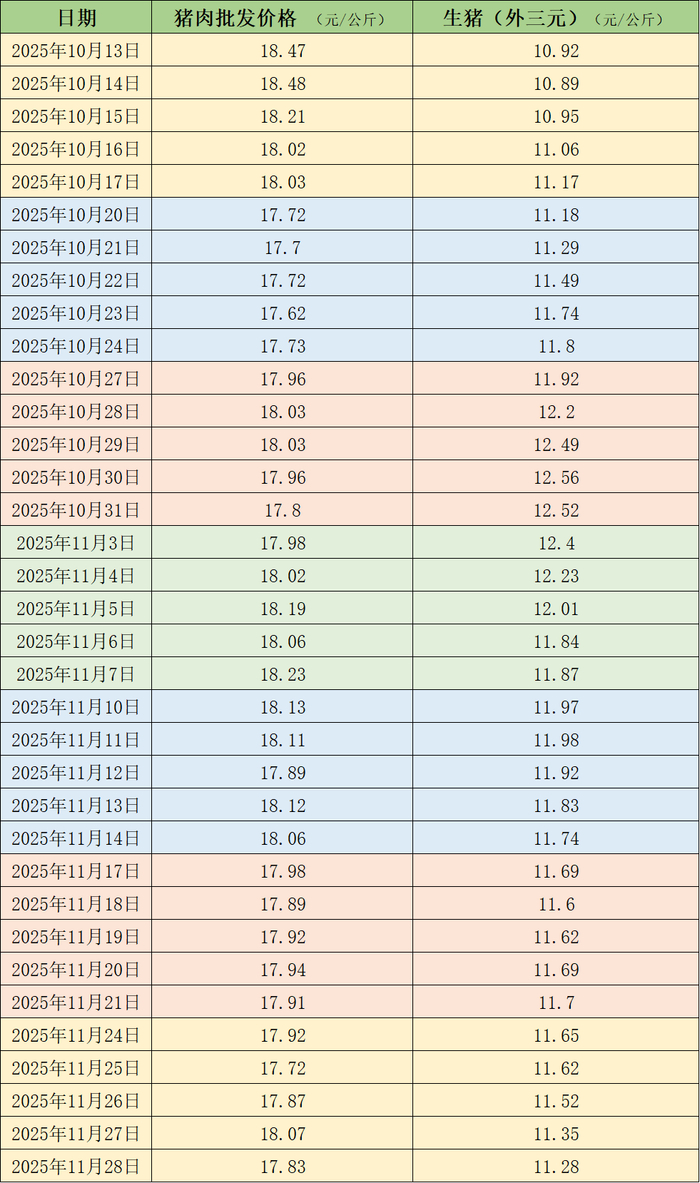
价格周报|本周猪价继续下探,机构称12月整体供应量级续增是大概率事件
Xin Lang Cai Jing· 2025-11-29 09:01
Core Insights - The average wholesale price of pork in China has decreased to 17.83 yuan/kg as of November 28, down 0.4% from 17.91 yuan/kg on November 21 [1] - The average price of live pigs (external three yuan) has also declined to 11.28 yuan/kg, a 3.6% drop from 11.7 yuan/kg on November 21 [1] Price Trends - The average price of pork this week is 17.88 yuan/kg, down 0.3% from last week's average of 17.93 yuan/kg [1] - The weekly average price of live pigs is 11.48 yuan/kg, a decrease of 1.5% from the previous week's average of 11.66 yuan/kg [1] Market Dynamics - The average trading weight of live pigs has slightly decreased to 124.62 kg, down 0.1% week-on-week [3] - There is an increase in the supply of live pigs as farmers accelerate the outflow of heavier pigs, while slaughterhouses are increasing their procurement of pigs from smallholders [3] Supply and Demand Outlook - The supply of live pigs is expected to increase in December, with a potential for short-term price increases due to reduced outflow plans from some farming groups [5] - However, overall supply remains abundant, which may lead to downward pressure on prices despite a slight increase in slaughter volumes [5] Long-term Projections - The industry anticipates that the supply of live pigs will remain high in the first half of next year, with production performance improvements and stable epidemic conditions [4] - Price pressures are expected to continue into the off-season, with potential recovery in the second half of next year as production capacity decreases [4]
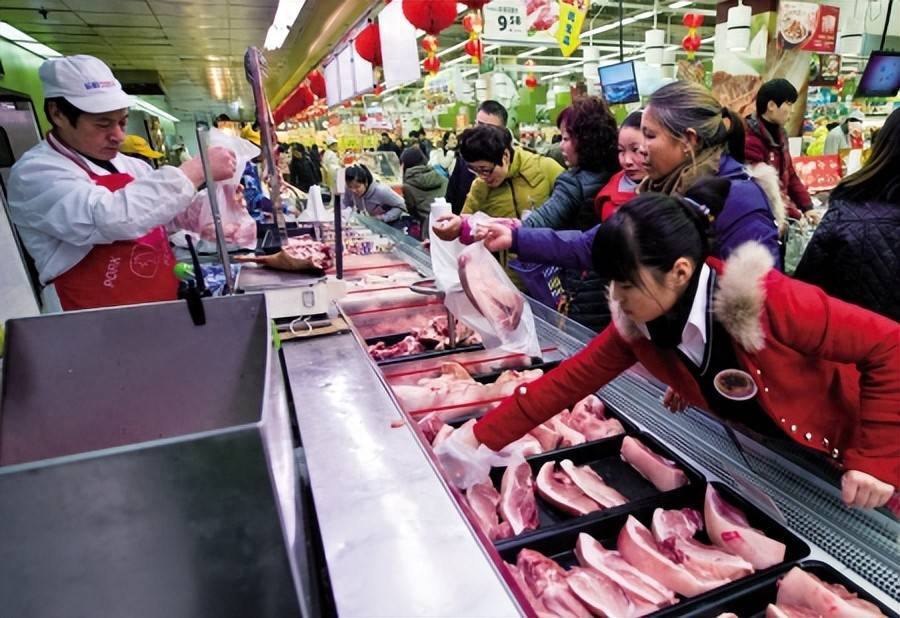
供应增幅更为明显 生猪期货预计仍承压运行为主
Jin Tou Wang· 2025-11-26 05:43
News Summary Core Viewpoint - The national pig price has decreased, while corn prices have increased, leading to a decline in the pig-to-feed price ratio, indicating potential challenges for the pig farming industry in the near future [1][2][3]. Group 1: Market Data - As of November 19, the national pig price is 12.24 yuan/kg, down 1.61% from November 12 [1]. - The wholesale corn price is 2.28 yuan/kg, up 0.88% from November 12 [1]. - The pig-to-feed price ratio is 5.37, down 2.36% from November 12 [1]. - The average loss per pig in the current breeding model is estimated at 232.66 yuan [1]. Group 2: Company Insights - Shennong Group aims to achieve a pig output target of approximately 3 million heads, with a complete cost of 12.2 yuan/kg in October [1]. Group 3: Institutional Perspectives - Zhengxin Futures predicts that pig prices may continue to face pressure over the next three months, recommending a short position on March contracts while suggesting a wait-and-see approach for short-term trading [2]. - Yide Futures notes that while demand for pigs is stable or increasing, the supply is also rising significantly, leading to continued pressure on pig prices in the short term [3]. - The acceleration in the elimination of breeding sows may provide some downward space, but the market bottom may take time to develop, with near-term futures expected to remain under pressure [3].

大越期货生猪期货早报-20251124
Da Yue Qi Huo· 2025-11-24 02:40
Report Industry Investment Rating No relevant content provided. Core Viewpoints of the Report - The domestic pig market is in the off - season after the Mid - Autumn Festival and National Day. Supply is expected to decrease this week as large farms reduce their slaughter. Demand is also weak as consumer willingness declines after the long holiday. The market may see a double - decline in supply and demand, with short - term pig prices oscillating downward and medium - term prices maintaining a range - bound pattern. The report suggests paying attention to the monthly group farm slaughter rhythm and the dynamics of the secondary fattening market [10]. - The basis shows that the spot price is at a premium to the futures price, which is a bullish signal. However, inventory, market trends, and main positions all indicate a bearish outlook. Overall, it is expected that pig prices will bottom out and return to an oscillatory pattern this week, with the LH2601 contract oscillating between 11,200 and 11,600 [10]. Summary by Directory 1. Daily Hints - The supply of pigs and pork is expected to decrease this week. The market may experience a double - decline in supply and demand, with short - term pig prices oscillating downward and medium - term prices maintaining a range - bound pattern. Attention should be paid to the monthly group farm slaughter rhythm and the dynamics of the secondary fattening market [10]. 2. Recent News - The domestic pig consumption market is affected by the off - season. After the Mid - Autumn Festival and National Day, the slaughter of large pigs has decreased, resulting in a double - decline in supply and demand. Spot prices are short - term weak but may bottom out and rebound, with medium - term prices maintaining a range - bound pattern [12]. - Pig farming profits have recently expanded their losses, reducing the short - term enthusiasm for large pig slaughter. The double - decline in supply and demand supports short - term pig futures and spot price expectations [12]. 3. Bullish and Bearish Factors - **Bullish Factors**: The domestic pig supply is in the off - season after the long holiday, and there may be limited room for further decline in domestic pig spot prices [13]. - **Bearish Factors**: The domestic macro - environment is expected to improve due to the preliminary Sino - US trade agreement, and the year - on - year increase in domestic pig inventory [13]. - **Main Logic**: The market focuses on pig slaughter and fresh meat demand [13]. 4. Fundamental Data - **Supply - side Indicators**: - As of September 30, the pig inventory was 436.8 million heads, a month - on - month increase of 0.2% and a year - on - year increase of 2.3%. As of the end of September, the inventory of breeding sows was 40.35 million heads, a month - on - month increase of 0.01% and a year - on - year decrease of 0.66% [10]. - As of March 31, the pig inventory was 408.5 million heads, a month - on - month decrease of 5.9% and a year - on - year decrease of 5.2%. As of the end of May 2024, the inventory of breeding sows was 39.96 million heads, a month - on - month increase of 0.2% and a year - on - year decrease of 6.2% [28]. - **Demand - side Indicators**: The report mentions that after the long holiday, consumer willingness has declined, suppressing short - term fresh pork consumption [10]. 5. Position Data - The main positions are net short, and short positions are increasing, which is a bearish signal [10].
大越期货生猪期货早报-20251120
Da Yue Qi Huo· 2025-11-20 03:04
1. Report Industry Investment Rating No relevant content provided. 2. Core Viewpoints of the Report - The domestic pig market has entered the off - season of supply and demand after the Mid - Autumn Festival and National Day. Large - scale farms have reduced their slaughter, supporting short - term pig prices. It is expected that both pig and pork supply will decrease this week. The overall consumer willingness of residents has weakened, suppressing short - term fresh pork consumption. The market may see a decrease in both supply and demand this week, with short - term pig prices oscillating downward and mid - term prices maintaining a range - bound pattern. Attention should be paid to the changes in the slaughter rhythm of group farms in the middle of the month and the dynamic changes in the secondary fattening market [8]. - The basis of the 2601 contract is 20 yuan/ton, with the spot price at a discount to the futures price, showing a neutral situation [8]. - As of June 30, the pig inventory was 424.47 million heads, a month - on - month increase of 0.4% and a year - on - year increase of 2.2%. As of the end of June, the inventory of breeding sows was 40.42 million heads, a month - on - month increase of 0.02% and a year - on - year increase of 4.2%, presenting a bearish situation [8]. - The price is below the 20 - day moving average and moving downward, which is bearish [8]. - The net position of the main players is short, and the short positions are decreasing, also indicating a bearish situation [8]. - Recently, both supply and demand of pigs have started to decrease. It is expected that pig prices will bottom out and return to a volatile pattern this week. The LH2601 contract of pigs is expected to oscillate in the range of 11,400 - 11,800 [8]. 3. Summary According to the Table of Contents 3.1 Daily Hints No relevant content provided. 3.2 Recent News - Affected by the arrival of the off - season, after the Mid - Autumn Festival and National Day, the slaughter of large pigs has decreased, resulting in a decrease in both supply and demand of pigs. The spot price is weak in the short term and will maintain a range - bound pattern in the medium term [10]. - After the festivals, the demand for pork has weakened in the short term, but the supply has also decreased, so the room for further decline in the spot price may be limited, and it may show a trend of bottoming out and rebounding [10]. - The loss of domestic pig farming profits has recently expanded, and the enthusiasm for slaughtering large pigs has weakened in the short term. The decrease in both supply and demand supports the short - term expectations of pig futures and spot prices [10]. - After the National Day, the spot price of pigs has bottomed out and rebounded, and the futures will generally maintain a range - bound pattern in the medium term. Further observation of supply and demand growth is needed [10]. 3.3 Bullish and Bearish Factors - **Bullish factors**: The domestic pig supply has entered the off - season after the long holiday, and the room for further decline in the domestic pig spot price may be limited [11]. - **Bearish factors**: The domestic macro - environment is expected to improve due to the preliminary Sino - US trade agreement, and the domestic pig inventory has increased year - on - year [11]. - **Main logic**: The market focuses on pig slaughter and fresh meat demand [11]. 3.4 Fundamental Data - **Inventory data**: As of March 31, the pig inventory was 408.5 million heads, a month - on - month decrease of 5.9% and a year - on - year decrease of 5.2%. As of the end of May 2024, the inventory of breeding sows was 39.96 million heads, a month - on - month increase of 0.2% and a year - on - year decrease of 6.2%. As of June 30, the pig inventory was 424.47 million heads, a month - on - month increase of 0.4% and a year - on - year increase of 2.2%. As of the end of June, the inventory of breeding sows was 40.42 million heads, a month - on - month increase of 0.02% and a year - on - year increase of 4.2% [8][25][26]. - **Price data**: From November 12 to 19, the prices of the main 2601 and far - month 2603 pig futures contracts fluctuated, and the number of pig futures warehouse receipts remained at 90. The spot prices of outer - ternary pigs in different regions also showed certain fluctuations [12]. 3.5 Position Data No relevant content provided other than the fact that the main players' net position is short and the short positions are decreasing [8].
国家级生猪大数据中心:11月19日全国生猪均价11.61元/公斤 环比上涨0.05元
Xin Hua Cai Jing· 2025-11-19 13:43
Price Trends - The national average price of live pigs on November 19 was 11.61 yuan/kg, an increase of 0.05 yuan/kg from the previous day [1] - The price monitoring indicates that 31 provinces showed 13 price increases, 0 decreases, and 18 stable prices, reflecting a steady upward trend [1] Supply and Demand Dynamics - The supply index for meat in Chongqing increased by 4.63% compared to the previous day [1] - The wholesale trading volume of pork in Beijing was 590,500 kg, a decrease of 0.12% from the previous day [1] - There is a prevailing sentiment among some farmers to hold back on selling, leading to a temporary tightening of pig circulation [3] Regional Insights - In southern regions, there is a slight recovery in local demand due to early preparations for the curing season [3] - Overall downstream demand remains acceptable, with expectations for continued price increases in the coming days [3]
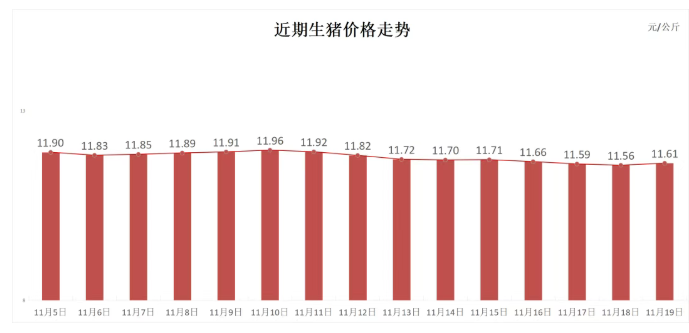
国家级生猪大数据中心:11月18日猪价稳中下跌 全国生猪均价为11.56元/公斤
Xin Hua Cai Jing· 2025-11-18 15:07
新华财经北京11月18日电据国家级生猪大数据中心18日发布,监测显示,今日(2025年11月18日),31 个省(自治区、直辖市)外三元生猪价格1涨10跌20平,呈稳中下跌趋势。 分析来看,今日养殖端出栏积极性一般,气温下降后需求没有明显好转,屠企多压价按需采购,部分集 团场降价出栏,采购基本无难度,但仍有部分养殖端挺价惜售,预计明日价格上涨。 (文章来源:新华财经) 具体价格监测情况显示,18日全国生猪均价为11.56元/公斤,较前一日下跌0.03元/公斤。重庆市肉品 供给指数显示,今日肉品供给比昨日上涨3.43%。北京市白条猪批发交易量为59.12万公斤,较昨日下跌 0.29%。 外三元生猪价差监测显示,今日全国21组大区间平均价差约0.47元/公斤,较昨日下跌0.01元/公斤, 低于平均调运成本0.58元/公斤。 ...