
美联储宽松周期

Search documents
FICC日报:关注中国8月通胀数据和美国8月PPI数据-20250910
Hua Tai Qi Huo· 2025-09-10 07:35
Report Industry Investment Rating No relevant information provided. Core Viewpoints - Global inflation showed initial signs of rising in August. China's economic data in July still had resilience, but domestic monthly economic data faced pressure. The government emphasized measures to stabilize the real - estate market, expand consumption, and increase investment. China's August exports and imports had different trends, and September exports might improve due to a low base. The A - share market on September 9 was in an adjustment state. In the US, the manufacturing index contracted, and employment data was worse than expected. The Fed is expected to restart the easing cycle, and there are concerns about its credibility crisis. In Japan, policy uncertainty increased, leading to a sell - off of long - term government bonds. For commodities, different sectors have different outlooks, and it is recommended to go long on industrial products and precious metals at low prices [2][3][4][5]. Summary by Related Catalogs Market Analysis - In August, global inflation began to rise. China's July exports increased year - on - year, supported by a low base and the "rush - to - export" effect. Financial data showed excessive money supply but weak financing and loan data. Investment data faced pressure. In August, China's exports grew by 4.4% year - on - year, a 2.8 - percentage - point decrease from July, mainly affected by a high base and tariffs. Exports to the US weakened, while those to emerging economies remained strong. Imports grew by 1.3% year - on - year, a 2.8 - percentage - point slowdown, dragged down by commodity imports. On September 9, the A - share market adjusted, with the ChiNext Index falling more than 3% in the afternoon. In the US, the August ISM manufacturing index contracted for the sixth consecutive month, and employment data was worse than expected [2]. Fed Policy - Powell's speech at the global central bank meeting on August 22 turned dovish, indicating a possible policy adjustment. The Fed is expected to restart the easing cycle as August's employment data was disappointing. There is a growing credibility crisis at the Fed, with criticism from Trump and the US Treasury Secretary. Trump has announced potential candidates for the next Fed chair, and the nomination of Milan is to be voted on [3]. Commodity Analysis - Domestically, the black and new - energy metal sectors are most sensitive to the supply side. Overseas inflation expectations can focus on precious metals and agricultural products. The black sector is still affected by downstream demand expectations, and the supply constraint in the non - ferrous sector persists. The energy supply is expected to be relatively loose in the medium term. In the chemical sector, there is "anti - involution" space for some products. Agricultural products are driven by tariffs and inflation expectations but need fundamental support. Precious metals are a good long - term investment opportunity as the Fed is about to restart the interest - rate cut cycle [4]. Strategy - For commodities and stock index futures, it is recommended to go long on industrial products and precious metals at low prices [5]. Key News - On September 9, the A - share market adjusted, with the ChiNext Index falling. Gold, real - estate, and bank stocks performed well, while semiconductor and innovation - drug stocks declined. An explosion in Doha, Qatar, led to a short - term rise in international oil prices. The US 2025 non - farm employment benchmark change was worse than expected. The Senate will vote on Milan's nomination as a Fed governor, and the FOMC is expected to cut interest rates in September [7].
FPG财盛国际:黄金突然“大变脸”的原因在这!接下来如何交易
Sou Hu Cai Jing· 2025-08-08 02:01
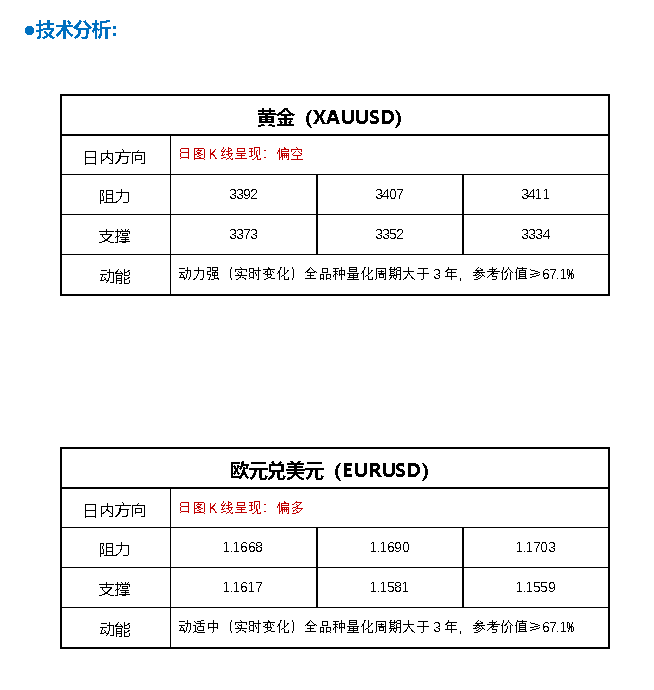
Group 1 - The latest employment data from the US indicates a weakening labor market, leading to a strong increase in gold prices as investors increase dovish bets ahead of the Federal Reserve's expected easing cycle in September [1] - The US Department of Labor reported that the number of continuing unemployment claims rose by 38,000 to 1.97 million, indicating increased difficulty for unemployed individuals to find new jobs. Initial jobless claims also rose to 226,000, exceeding economists' expectations [1] - According to Prime Market Terminal data, traders anticipate a 95% probability of a 25 basis point rate cut at the Federal Reserve's September meeting [1] Group 2 - On August 1, gold prices surged by 2%, rising from approximately $3,281 per ounce to $3,363 per ounce, and have since fluctuated between $3,350 and $3,397 per ounce, with buyers struggling to break through the $3,400 per ounce level [2] - To maintain a bullish outlook, buyers need to rise above $3,400 per ounce, which would clear the path for gold to challenge the June 16 high of $3,452 per ounce, followed by the historical high of $3,500 per ounce. Conversely, if gold prices fall below the convergence area of the 50-day and 20-day simple moving averages (around $3,350 to $3,346 per ounce), a decline towards the 100-day moving average of $3,275 per ounce is expected [3] Group 3 - Current resistance levels for gold are at $3,392, $3,407, and $3,447, while support levels are at $3,373, $3,352, and $3,334. The momentum is strong, with a reference value greater than 67.1% [4]

高盛资产管理公司的Ashish Shah:未来两个月的数据将至关重要。如果关税引发的通胀比预期温和,或者劳动力市场出现走弱迹象
Sou Hu Cai Jing· 2025-07-30 22:22
Core Viewpoint - The upcoming data over the next two months will be crucial for economic outlook, particularly regarding inflation and labor market trends, which may influence the Federal Reserve's monetary policy decisions [1] Group 1 - Ashish Shah from Goldman Sachs Asset Management suggests that if inflation caused by tariffs is milder than expected, or if there are signs of a weakening labor market, the Federal Reserve may resume its easing cycle in the fall [1]

高盛资产管理公司的Ashish Shah:未来两个月的数据将至关重要。如果关税引发的通胀比预期温和,或者劳动力市场出现走弱迹象,我们认为美联储将在秋季恢复宽松周期。
news flash· 2025-07-30 21:19
Core Viewpoint - The upcoming data over the next two months will be crucial for economic outlook and Federal Reserve policy decisions [1] Group 1 - If inflation caused by tariffs is milder than expected, or if there are signs of a weakening labor market, the Federal Reserve is likely to resume easing measures in the fall [1]
花旗看好新兴市场主权债券 押注利率下行及美元走弱
news flash· 2025-07-18 07:13
Core Viewpoint - Citigroup has upgraded its rating on emerging market local currency sovereign bonds to "overweight," betting on declining interest rates and a weakening dollar [1] Group 1: Economic Indicators - Analysts Dirk Willer and Adam Pickett noted early signs of tariff transmission effects in the U.S. June inflation data, but a slowdown in service prices may keep inflation under control [1] - The potential for the Federal Reserve to restart a loosening cycle in the second half of 2025 is highlighted, which typically benefits emerging markets [1]

分析师:亚洲货币剧烈波动成金价反弹主要推手
news flash· 2025-05-06 10:16
Core Viewpoint - The recent rebound in gold prices is primarily driven by significant fluctuations in Asian currencies, which aligns with risk-averse behavior in the market [1] Group 1: Market Dynamics - Analyst Giuseppe Dellamotta notes that gold has recovered its losses from the previous week, although the exact catalysts remain unclear [1] - The volatility in Asian currencies provides a plausible explanation for the timing of gold's rebound and fits the logic of seeking safe-haven assets [1] Group 2: Future Outlook - As authorities begin to intervene in the currency markets, the demand for safe-haven assets may gradually decrease [1] - The upcoming Federal Open Market Committee (FOMC) decision from the Federal Reserve poses a risk for gold bulls, as the market has aggressively bet on a dovish shift [1] - There is a possibility that the Federal Reserve may issue hawkish signals to correct market expectations, which could impact gold prices [1] Group 3: Long-term vs Short-term Trends - In the medium to long term, the upward trend for gold remains intact, with expectations of continued low real yields during the Federal Reserve's easing cycle [1] - Short-term risks are present; positive developments in trade tensions or a hawkish stance from the Federal Reserve could lead to a market re-evaluation and further pullback in gold prices [1]