
脱钩

Search documents
观点 | 纪文华:多边规则如何守护全球供应链韧性?隐忧与对策
Sou Hu Cai Jing· 2025-08-22 04:08
Core Viewpoint - The discussion emphasizes the increasing complexity and politicization of global supply chains, driven by geopolitical tensions, technological changes, and other challenges, necessitating a focus on supply chain resilience and stability [4][7]. Group 1: Current Situation - The structure of global industries and supply chains has become more complex and politicized due to factors such as great power strategic competition, geopolitical conflicts, technological changes, global pandemics, and climate change [4]. - Countries have implemented various national policies and trade measures aimed at enhancing the resilience and security of their supply chains [4]. Group 2: Types of Measures - **Unilateral and inward-looking measures**: Some countries impose trade and investment restrictions on specific foreign goods, provide subsidies to domestic industries, and conduct security reviews of their supply chains, which often violate multilateral rules and increase economic costs [5]. - **Regional and "small multilateral" arrangements**: Countries establish closer ties with a limited number of partners through bilateral or multilateral mechanisms, which can create new barriers for non-participants and lack clear rules [6]. - **Multilateral mechanisms for rule coordination**: Some nations attempt to use platforms like the WTO and G20 to promote trade openness and cooperation in supply chain resilience, although these initiatives often remain conceptual without binding agreements [6]. Group 3: Importance of Multilateralism - The need for responsible nations to engage in multilateral discussions is highlighted, as unilateral measures can lead to a cycle of trade distortions and further disruptions in global supply chains [7]. - Strengthening multilateral mechanisms and promoting rule-based arrangements for supply chain security and stability is seen as a constructive way forward [7]. Group 4: Suggestions for Moving Forward - A call for like-minded WTO members to take a proactive role in initiating informal working groups or "small multilateral" initiatives to enhance focus on supply chain issues [8]. - Suggested elements for a global arrangement include reforming WTO rules, opposing decoupling measures, clarifying conditions for supply chain stability measures, and establishing supply assurance obligations for dominant countries in key supply chains [9][10].

新华社快讯:商务部谈中美经贸关系:人为“脱钩”是脱不掉的
Xin Hua Wang· 2025-08-12 06:36
Core Viewpoint - The China-U.S. economic and trade relationship remains significant despite challenges, with both countries being important trade partners for each other [1] Group 1: Economic Relations - Since 2018, unilateralism and protectionism from the U.S. have led to increased trade frictions, disrupting normal economic cooperation between China and the U.S. [1] - Although the share of China-U.S. trade in each country's total trade has decreased, the overall bilateral trade has remained stable [1] Group 2: Trade Projections - In 2024, the projected trade volume for goods between China and the U.S. is expected to reach $688.3 billion, while the service trade scale is anticipated to be $155.8 billion, representing increases of 18% and 34.7% respectively compared to 2017 [1] - The economic and public support for China-U.S. economic cooperation is solid, indicating that a forced "decoupling" is not feasible [1]
美中贸易全国委员会前高管:美企持续参与中国市场意愿强烈
news flash· 2025-07-31 02:59
Group 1 - The core viewpoint is that American businesses have a strong willingness to engage in the Chinese market despite ongoing discussions about "decoupling" between the US and China, with minimal actual progress in this area [1] - The US-China economic ties remain close, indicating a resilient relationship between the two economies [1] - A high-level business delegation from the US is visiting China this week, organized by the US-China Business Council, highlighting ongoing interest in collaboration [1]
当着冯德莱恩的面,中方把话说得很清楚,美国想收手?有点晚了
Sou Hu Cai Jing· 2025-07-26 00:02
Group 1: Global Trade Dynamics - The ongoing trade war, primarily driven by the U.S. under President Trump, is creating significant global economic implications, with the EU seeking to navigate its interests amidst U.S.-China tensions [1] - Trump's tiered tariff strategy, which includes a baseline 15% tariff, disproportionately impacts specific industries, such as a potential €26 billion loss for the German automotive sector and pressures on French brandy producers from Chinese anti-dumping investigations [3] - The EU's recent negotiations with China faced strong resistance, particularly regarding requests to lift rare earth export controls and halt energy trade with Russia, highlighting the complexities of international trade relations [4] Group 2: Economic Cooperation Amidst Tensions - Despite the political tensions, there are signs of pragmatic economic cooperation, such as the resumption of negotiations on electric vehicle anti-subsidy agreements and commitments from China to facilitate compliance applications for rare earth exports [6] - The logistics sector is feeling the strain from tariffs, with UPS announcing a workforce reduction of 20,000 and shipping costs rising by 20%, indicating the broader impact of trade policies on operational costs [8] - The deep interconnections in the global economy are evident, with significant trade flows continuing between the EU and China, including a notable increase in Chinese investments in the Eurozone despite rising tensions [8]
X @外汇交易员
外汇交易员· 2025-07-18 03:03
Sino-US Trade Relations - The Ministry of Commerce of China states that despite challenges, China and the US remain important trade partners [1] - The Ministry of Commerce of China suggests that Sino-US economic and trade cooperation has a solid economic and public foundation, and artificial "decoupling" is not feasible [1]
美国的真实目的,中方早已识破,拿不到稀土后,特朗普彻底急了
Sou Hu Cai Jing· 2025-06-08 13:52
Core Viewpoint - The ongoing tensions in US-China economic relations are exacerbated by the US's frequent provocations, particularly regarding the rare earth supply chain, which China has recognized and is strategically responding to [1][4][9]. Group 1: US-China Economic Talks - The high-level economic talks in Geneva resulted in a joint statement, with China demonstrating goodwill by suspending certain tariffs and non-tariff measures against the US [1][3]. - In contrast, the US quickly issued guidelines for AI chip export controls and cut off sales of semiconductor design software to China, undermining the outcomes of the Geneva talks [3][6]. Group 2: Rare Earth Supply Chain - China controls over 90% of the global rare earth magnet production and has implemented export restrictions, impacting not only the US but also other countries [4][7]. - The US has expressed concerns over China's rare earth export policies while ignoring the fact that these restrictions were not specifically targeting the US [4][6]. Group 3: Strategic Dilemmas - The US faces a strategic dilemma as its automotive industry warns of production disruptions due to potential rare earth supply shortages, while its policies towards China appear chaotic and ineffective [6][9]. - There is a growing recognition that the US underestimates China's bargaining power and resolve to exit negotiations, which could lead to broader economic implications [6][9]. Group 4: Negotiation Dynamics - The negotiation dynamics reveal a fundamental conflict in logic, with China advocating for mutual respect and equal consultation, while the US employs a zero-sum game mentality [7][9]. - The US's strategy of "talking while fighting" has not succeeded in forcing concessions from China and has instead increased uncertainty in global supply chains [9].
扛不住了,美国拨通中方电话,马斯克察觉不对,中国实力无法估算
Sou Hu Cai Jing· 2025-05-31 15:51
Group 1 - The recent phone call between Chinese Vice Foreign Minister Ma Zhaoxu and US Deputy Secretary of State Wendy Sherman reflects underlying tensions in trade, technology competition, and strategic perceptions between the two nations [1][3] - The US is facing dual pressures internally and externally, as indicated by the contrasting tones in the official statements from both sides during the call [3] - The US-China trade dynamics have shifted, with China's industrial products gaining competitiveness in the US market, impacting traditional allies and other trade economies [3] Group 2 - The US is pivoting its strategic focus towards technology, with significant attention on AI and semiconductor industries, as highlighted by comments from CIA and Pentagon officials [4] - Business leaders in the US, including Tesla's CEO Elon Musk, have raised concerns about China's energy and talent advantages in the tech sector, suggesting a potential shift in competitive dynamics [4][7] - The ongoing technology competition is exacerbated by US export controls on AI, which may hinder the global AI ecosystem and limit US companies' access to the Chinese market [4][7] Group 3 - The communication between the two nations, despite existing differences, signals a willingness to maintain dialogue, which is crucial in the context of global interdependence [9] - The need for a pragmatic approach to US-China relations is emphasized, particularly in addressing global challenges like AI and climate change, rather than engaging in zero-sum games [9]

加税“非美产”苹果,特朗普开始做一种最坏的打算
Hu Xiu· 2025-05-24 06:25
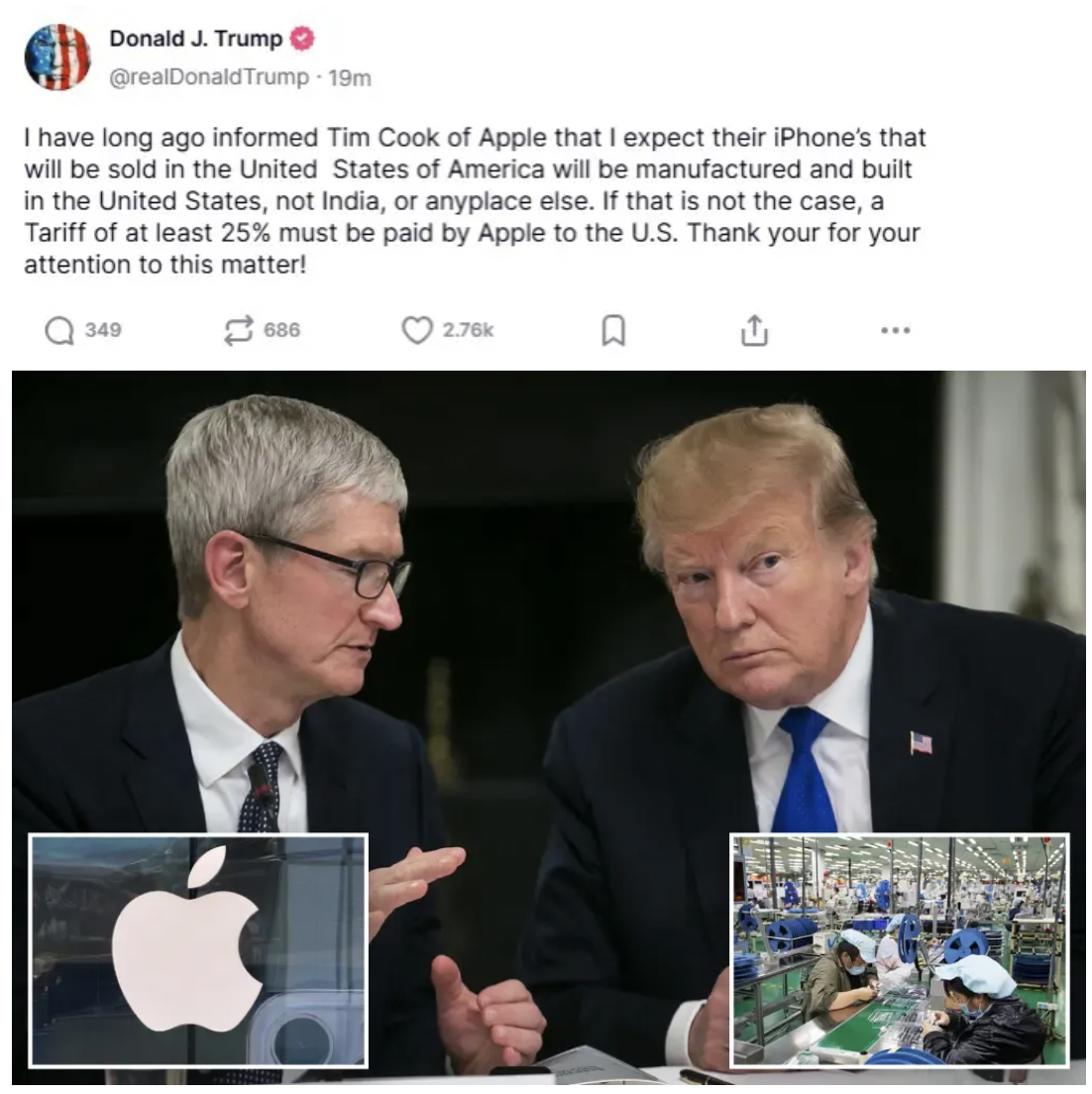
Group 1: Trump's Trade War Strategy - Trump's trade war is characterized by a belief that the U.S. is being exploited by other countries, with a focus on "fair trade" and "decoupling" from global trade systems [4][5] - The trade war's theoretical framework has evolved, with economists like Milan proposing a "optimal tariff" strategy to minimize domestic harm while applying tariffs [7][10] - The initial trade war strategies by Navarro and Lighthizer have faced academic criticism for their simplistic assumptions about trade dynamics [8][10] Group 2: Economic Impacts of the Trade War - The trade war has led to significant economic turmoil, with U.S. stock markets and bond yields experiencing volatility, indicating a failure of Trump's initial expectations [15][16] - Inflation and various economic indicators have worsened, leading to increased tensions between the White House and the Federal Reserve [14][16] - The trade war has resulted in rising costs for American consumers, with major retailers like Walmart and Amazon facing pressure to raise prices due to increased tariffs [20] Group 3: Political Ramifications - The trade war has caused divisions within Trump's MAGA base, with key figures expressing dissent over the handling of the tariffs and their economic consequences [17][18] - Trump's attempts to shift blame for economic issues onto the Democratic Party have been met with skepticism, as his administration's actions have led to significant economic challenges [19][20] - The internal conflicts within the Republican Party may jeopardize their prospects in the upcoming 2026 midterm elections, as the trade war's fallout continues to affect voter sentiment [18][20] Group 4: International Relations and Global Trade Dynamics - The trade war has accelerated changes in international relations, with traditional allies like Canada and Japan responding with retaliatory tariffs and a reluctance to make concessions [22][23] - Countries like India and Vietnam are attempting to capitalize on the trade war by attracting businesses looking to relocate from China, although skepticism remains about their capabilities [26] - The trade war has inadvertently strengthened China's position in global trade, as it contrasts its policies with the U.S. approach, fostering deeper ties with developing nations [26]
罕见,25年来第一次,中国退居全球第三,背后信号很不寻常
3 6 Ke· 2025-05-22 00:55
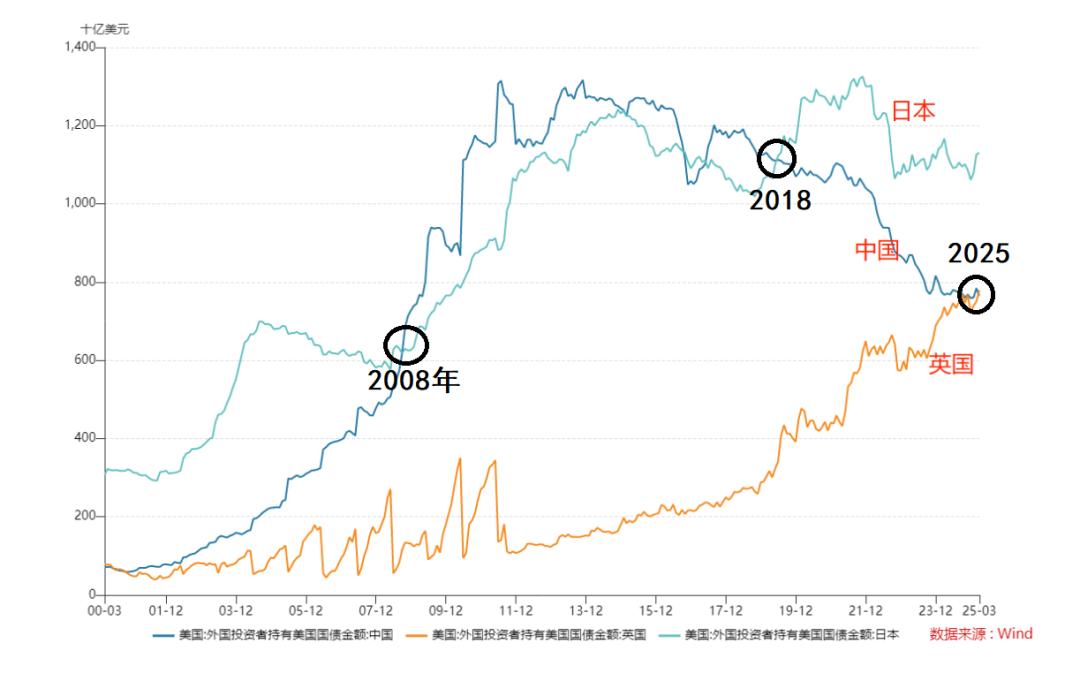
Core Viewpoint - China has significantly reduced its holdings of US Treasury bonds, selling $18.9 billion in March and falling to $765.4 billion, now ranking third globally behind the UK [1][2][4]. Group 1: Historical Context - This marks the first time in 25 years that China has dropped to third place in US Treasury bond holdings since becoming one of the top two holders in 2000 [2]. - China's peak holdings exceeded $1.3 trillion in 2015, accounting for 23.2% of total foreign holdings [2]. - The reduction in holdings began during the trade war initiated by Trump, with China relinquishing its top position back to Japan [4]. Group 2: Current Trends - As of now, China's share of US Treasury bonds has shrunk to approximately 2.1%, indicating a significant "decoupling" from US financial assets [5]. - In March, while China sold off bonds, overseas investments in US Treasury bonds saw a net inflow of $161.8 billion, highlighting China's unique position [6]. - The yield on 10-year US Treasury bonds has risen sharply, reaching 4.48%, which has put pressure on the US financial markets [6][7]. Group 3: Implications for US Debt - The upcoming maturity of $6.5 trillion in US Treasury bonds in June poses a significant challenge, as it represents 70% of the year's total maturities [8]. - Rising interest rates could lead to increased debt servicing costs, potentially exceeding $200 billion [9]. - Moody's downgraded the US sovereign credit rating for the first time in history, reflecting growing concerns about US debt sustainability [10]. Group 4: China's Strategy - China has been gradually reducing its US Treasury holdings while increasing its gold reserves, indicating a shift towards risk diversification [15][19]. - As of April, China's gold reserves reached 73.77 million ounces, marking a continuous increase over six months [19]. - The geopolitical landscape, including tensions over trade and territorial issues, has influenced China's strategy towards US debt [19][20]. Group 5: Global Context - The situation mirrors the financial weaponization seen in the case of Russia, which drastically reduced its US Treasury holdings following sanctions [21]. - The total US debt is approaching $37 trillion, raising concerns about the sustainability of the US credit system [21][22]. - China's remaining holdings of US Treasury bonds serve as a strategic asset in negotiations, reflecting the ongoing complexities in US-China relations [22].
【财经分析】关税缓冲期促前置出货热潮 新加坡出口复苏仍存挑战
Xin Hua Cai Jing· 2025-05-17 11:43
Core Viewpoint - Singapore's Non-oil Domestic Exports (NODX) saw a significant year-on-year increase of 12.4% in April 2025, marking the largest monthly rise in nearly nine months, although this growth is influenced by short-term factors and may face downward pressure in the coming months [1][2][4] Group 1: Export Performance - NODX growth in April was driven by a remarkable 23.5% increase in electronic products, with personal computer exports surging by 124.3%, and integrated circuits and magnetic disk media products growing by 23.3% and 33.0% respectively [1] - Non-electronic products also experienced growth, with an overall increase of 9.3%, particularly highlighted by a substantial 80.4% rise in non-monetary gold exports [1][2] - The NODX to Indonesia increased by 111.2%, while exports to Taiwan and South Korea rose by 47.4% and 38.1% respectively, indicating strong demand for ships, gold, and computers [2] Group 2: Economic Outlook and Risks - The Chief Economist of OCBC noted that the April NODX growth was primarily due to front-loading of electronic product shipments ahead of a tariff exemption announcement, suggesting potential risks of a decline in exports if a long-term agreement is not reached between the US and China [2][3] - UOB's research report indicated that the April export rebound exhibited typical policy-driven characteristics, with a 58.9% year-on-year surge in non-oil re-exports, reflecting supply chain adjustments in anticipation of policy changes [3] - The World Trade Organization (WTO) has significantly downgraded its global trade growth forecast for 2025 from 3.0% to 0.2%, citing renewed trade tensions between the US and China as a key factor [3][4] Group 3: Manufacturing and Economic Growth - Singapore's manufacturing Purchasing Managers' Index (PMI) has shown weakness, with some sub-indices falling below the neutral line, indicating underlying fragility in the manufacturing sector [5] - The Ministry of Trade and Industry revised its economic growth forecast for the year down from 1% to 3% to a range of 0% to 2%, reflecting concerns over future export performance and economic activity [6]