财富管理转型

Search documents
市场大幅缩量,热门概念题材普遍回调,尾盘宽基ETF持续放量 | 华宝3A日报(2026.1.15)
Xin Lang Cai Jing· 2026-01-15 11:20
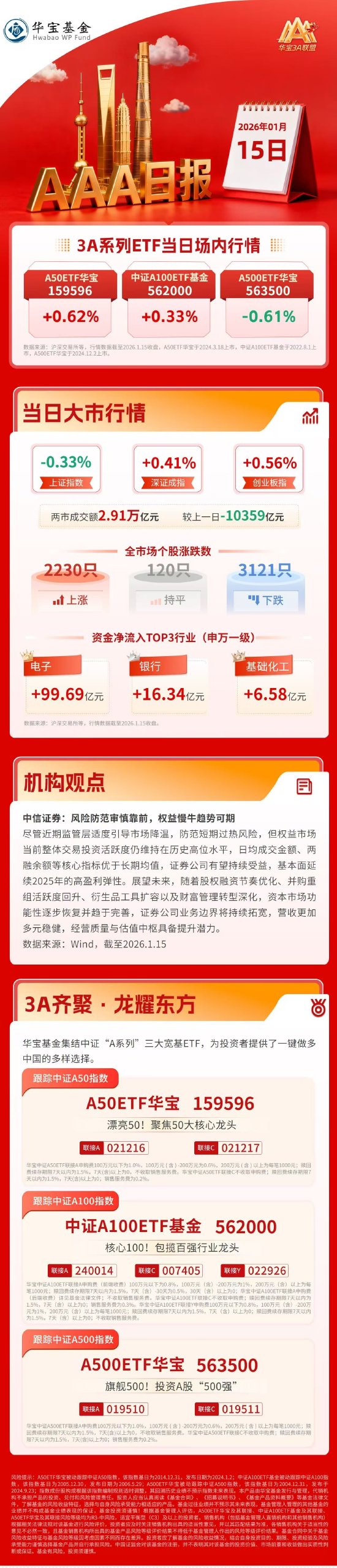
Group 1 - The overall trading activity in the equity market remains at historically high levels, with daily transaction amounts and margin balances exceeding long-term averages, indicating a positive outlook for securities firms [2][6] - The market is currently experiencing a cautious approach to risk management, with regulatory bodies guiding a cooling of the market to prevent overheating [2][6] - Future prospects for the capital market include optimized equity financing, increased merger and acquisition activity, expansion of derivative tools, and deepening of wealth management transformations, which will broaden the business scope of securities firms and enhance revenue diversity and stability [2][6] Group 2 - The A50 ETF, A100 ETF, and A500 ETF are part of the "A series" ETFs launched by Huabao Fund, providing investors with diverse options to invest in China [2] - The A50 ETF tracks the A50 index, focusing on 50 leading companies, while the A100 ETF encompasses the top 100 industry leaders [2] - The market capitalization and performance of these ETFs are highlighted, with specific details on their listing dates and fee structures for investors [2][6]

中信证券(600030)2025年业绩快报点评:券业首份业绩快报 净利润增长38%
Xin Lang Cai Jing· 2026-01-15 00:26
Core Insights - The company reported a significant increase in revenue and net profit for 2025, with operating income reaching 74.83 billion yuan, a year-on-year growth of 29%, and net profit attributable to shareholders at 30.05 billion yuan, up 38% [1] - The company maintained a leading position in equity underwriting, achieving the highest issuance numbers and scale in the market despite a general decline in IPO activity [2] - The internationalization strategy has become a crucial growth driver, with substantial revenue growth from overseas operations, enhancing the company's ability to withstand market fluctuations [2] Financial Performance - In Q4 2025, the company achieved operating income of 19.02 billion yuan, an 18% year-on-year increase, but a 17% quarter-on-quarter decline; net profit for the same period was 6.89 billion yuan, up 41% year-on-year, but down 27% quarter-on-quarter [1] - The average daily trading volume in the A-share market was 1.98 trillion yuan, a 67% increase year-on-year, contributing to the company's brokerage business revenue [1] - The company's asset management scale reached 4.7 trillion yuan, with client asset custody at 15 trillion yuan, indicating a robust wealth management transformation [1] Equity Financing - In 2025, the company led the market in equity financing, with 17 IPOs raising 24.7 billion yuan, an 86% increase year-on-year, and 41 refinancing deals raising 229 billion yuan, a 230% increase [2] International Operations - The company's international subsidiary reported operating income of 1.492 billion USD in the first half of 2025, a 52.87% year-on-year increase, and net profit of 387 million USD, up 65.38% [2] Profit Forecast - The company has revised its profit forecasts for 2026 and 2027, expecting net profits of 30.1 billion yuan, 31.8 billion yuan, and 33.4 billion yuan for 2025, 2026, and 2027 respectively, reflecting a year-on-year growth of 38%, 6%, and 5% [3] - The company is expected to maintain a price-to-book ratio of 1.36, 1.28, and 1.20 for 2025-2027, indicating a solid market position and potential for valuation premium [3]

2%股权的关键一跃!华安证券拟增资控股华富基金
Sou Hu Cai Jing· 2026-01-14 04:31
Core Viewpoint - Huazhong Securities plans to increase its stake in Huafu Fund Management Co., Ltd. by 2%, which will enhance its control over the fund and align its strategic planning with the overall asset management layout of the group [2][8]. Group 1: Stake Acquisition and Governance - The company intends to invest 26.46 million yuan to acquire an additional 2% stake in Huafu Fund, raising its total ownership to 51% [2]. - This acquisition will allow Huazhong Securities to lead the strategic planning and operational decisions of Huafu Fund through its governance structures [8]. - The appointment of Zhang Jun, General Manager of Anhui Jiaokong Capital, as a director will strengthen the synergy among shareholders and enhance resource integration capabilities [2]. Group 2: Fund Management and Product Structure - Huafu Fund, established in 2004, has a registered capital of 250 million yuan and manages 87 public funds with a total scale exceeding 100 billion yuan [3]. - The fund's product structure is primarily focused on fixed-income products, with money market and bond funds accounting for nearly 80% of its total management scale [3][4]. - The fund's management scale includes 38 bond funds, 18 equity funds, and 25 mixed funds, among others [4]. Group 3: Asset Management Strategy - Huazhong Securities' asset management subsidiary, Huazhong Asset Management, focuses on private small-collection businesses and has a management scale exceeding 40 billion yuan [5]. - The company aims to leverage Huafu Fund's public fund license to enhance its wealth management capabilities and respond to regulatory demands for high-quality industry development [8]. - The increase in stake allows for better integration of research resources, such as macro strategies and credit ratings, enhancing the overall asset management strategy [8]. Group 4: Financial Performance and Market Context - In the first half of 2025, Huazhong Securities' total sales of financial products reached 6.217 billion yuan, with a year-on-year growth of 13.80% [6]. - The private fund sales contributed over 60% of the total sales revenue, while public fund sales saw a significant increase of 333.52%, although they still accounted for less than a quarter of total sales [6][7]. - The acquisition of control over Huafu Fund comes at a time when many firms are withdrawing their applications for public fund licenses, positioning Huazhong Securities advantageously in a challenging market environment [9].


70后财富管理一姐转身创业
21世纪经济报道· 2026-01-12 02:00
Core Viewpoint - Xu Haining, a prominent figure in wealth management, has transitioned from her role at Dongfang Securities to establish Shanghai Zhihui Technology Co., focusing on wealth management integrated with technology and industry-finance collaboration [1][3]. Company Overview - Shanghai Zhihui Technology Co., founded on January 8, 2026, has a registered capital of 100 million yuan and is located in Hongkou District, Shanghai. Xu Haining serves as the legal representative [1][3]. - The company aims to address core industry transformation needs through three main business directions: developing intelligent advisory systems, creating a professional training system for investment advisors, and providing customized consulting services for financial institutions [3][4]. Background of Xu Haining - Xu Haining has over ten years of experience in the wealth management sector, previously serving as the Vice President and head of wealth management at Dongfang Securities. She resigned on November 20, 2024, for personal career development reasons [3][9]. - Her career began outside the financial industry, with significant roles in real estate and securities investment before joining Dongfang Securities in 2012, where she played a crucial role in transforming the company's wealth management business [7][8]. Business Strategy and Focus - Shanghai Zhihui Technology's core positioning is "wealth management + technology + industry-finance collaboration," focusing on the integration of technology in wealth management practices [3][4]. - The company plans to enhance the professional capabilities of investment advisors and improve the overall service quality in the wealth management sector [3][4]. Partnerships and Capital - The company is co-founded by Xu Haining and Zhonglian Heavy Industry Capital, which is a wholly-owned subsidiary of Zhonglian Heavy Industry, indicating strong financial backing [4]. - Xu Haining holds a 3% stake in the company, while her partner Li Zhiqian holds 97%, suggesting a strategic partnership that leverages industry resources [5][4].


关键时刻,中信证券惊现14.5亿资金神秘压单!发生了什么?
Xin Lang Cai Jing· 2026-01-07 08:44
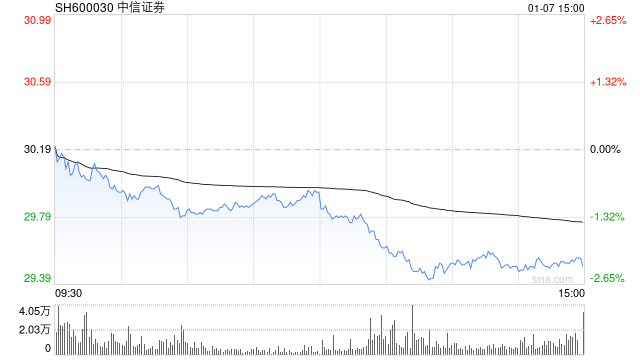
Group 1 - The A-share market continues its longest winning streak, with the Shanghai Composite Index reaching a 10-year high of 4085.77 points, marking 14 consecutive days of gains and nearing the 4100-point mark [1][7] - A significant sell order of 492,200 lots from CITIC Securities, valued at approximately 1.45 billion yuan, was observed near the market close, indicating potential selling pressure [1][7] - Previous instances of large sell orders from CITIC Securities were noted, with over 3 billion yuan and 1 billion yuan in sell orders recorded on September 17 and October 24, 2025, respectively [1][7] Group 2 - The brokerage sector experienced a notable surge, with a total inflow of 14.549 billion yuan, leading all secondary industries in the Shenwan classification [4][8] - Major brokerages, including CITIC Securities, received over 1 billion yuan in inflows, with Oriental Fortune seeing a net financing buy of 955 million yuan, the highest in over three months [4][8] - The market outlook remains positive, driven by government policies aimed at stabilizing growth and boosting the capital market, alongside a favorable liquidity environment and improved investor confidence [9]
东海证券晨会纪要-20260107
Donghai Securities· 2026-01-07 06:05
Group 1: Public Fund Fee Reform - The comprehensive implementation of the public fund fee reform marks a significant shift in the industry, with the new regulations effective from January 1, 2026, aimed at optimizing the industry ecosystem through differentiated arrangements [5][6]. - The new rules introduce a more detailed classification of subscription fees, with the maximum subscription fee for index funds set at 0.3%, aligning it with bond funds, while actively managed equity funds maintain a maximum of 0.8% [6][7]. - The redemption fee rules have been made more flexible, allowing for specific agreements on redemption fees for certain types of funds held for specified durations, addressing previous market concerns about liquidity [6][7]. - The new regulations are expected to reduce investment costs significantly for investors, with an estimated annual benefit exceeding 50 billion yuan, enhancing the long-term investment orientation [7][10]. - Fund sales institutions may face profitability pressures due to reduced fees, prompting a shift towards service-oriented business models rather than purely sales-driven approaches [8][10]. Group 2: China Merchants Bank (招商银行) - China Merchants Bank is navigating an industry downturn, with pressure on net interest margins and personal loan risks, yet it maintains a leading position in key operational metrics [12][13]. - The bank's growth strategy is shifting towards high-quality development, focusing on government bonds and new economic sectors, while optimizing its retail and corporate financing mix [12][13]. - The bank's net interest margin remains robust due to its strong low-cost funding capabilities, despite facing downward pressure from interest rate cuts [13]. - Asset quality management is a priority, with the bank effectively managing risks associated with real estate and retail loans, supported by a high provision coverage ratio [13][14]. - The bank's wealth management business is expected to recover, contributing significantly to its revenue as market conditions improve [14][15]. - The bank's dividend policy remains strong, with a high payout ratio supported by solid capital management, positioning it favorably for investors seeking both income and value [14][15].
基金早班车丨风险资产预期领跑,2026年多元配置应对分化
Sou Hu Cai Jing· 2026-01-07 00:31
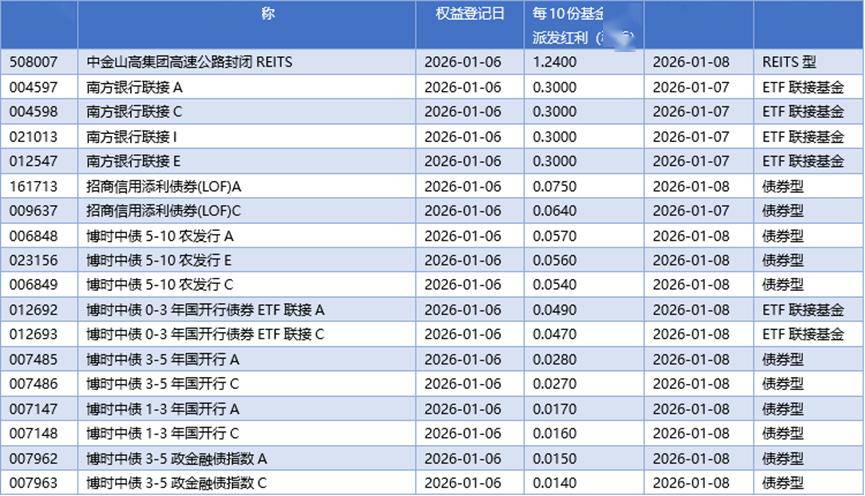
Group 1 - Standard Chartered Bank's latest outlook indicates that after a rare global rally in 2025, asset performance will significantly diverge in 2026 due to an increased probability of a "soft landing" for the US economy, easing trade tensions, and AI-driven productivity improvements, which together provide opportunities for risk assets to outperform [1] - The bank recommends a diversified allocation strategy across regions, industries, and multiple strategies to hedge against uncertainties and capture structural opportunities [1] Group 2 - On January 5, major stock indices opened high, with the Shanghai Composite Index reaching a ten-year high, closing up 1.5% at 4083.67 points, marking a 13-day winning streak, while the Shenzhen Component Index rose 1.4% to 14022.55 points, and the ChiNext Index increased by 0.75% to 3319.29 points [1] - The total trading volume in the Shanghai and Shenzhen markets was 28,065.75 billion yuan, an increase of 2,602 billion yuan compared to the previous trading day, with over 4,100 stocks rising, including 143 stocks hitting the daily limit [1] Group 3 - In the first week of January 2026, two new funds were launched, primarily bond funds, while 18 funds distributed dividends, mostly bond funds, with the highest dividend payout from the CICC Highway Closed-End Infrastructure Securities Investment Fund at 1.2400 yuan per 10 fund shares [2] - The brokerage index showed significant gains, with several sell-side strategies optimistic about the sector's valuation recovery, as leading brokerages' price-to-book ratios remain below historical averages, suggesting potential for profit growth [2] - The asset management business of brokerages has shown steady development, with private asset management scale reaching 5.8 trillion yuan by the end of November 2025, and a focus on differentiated research capabilities becoming a new competitive edge [2]
146亿元资金净流入,券商板块机会如何?丨每日研选
Shang Hai Zheng Quan Bao· 2026-01-07 00:30
Core Viewpoint - The influx of approximately 14.6 billion yuan into the brokerage sector on January 6 indicates a strong market interest, driven by favorable policy cycles, valuation recovery, and fund reallocation, suggesting potential growth opportunities for brokerages and financial IT sectors in 2026 [1][2] Policy Environment - Key reforms, including the release of regulations on public fund sales fees and commercial real estate REITs, are expected to inject new momentum into the industry, shifting focus from short-term scale to long-term value [2] - The expansion of REITs is anticipated to create incremental opportunities for brokerage investment banking and asset management businesses, with three core favorable logics yet to be fully priced in by the market [2] Market Dynamics - The divergence in performance, where the A-share major indices rose significantly while the brokerage index fell, indicates a disconnection between valuation and profitability, creating a potential for valuation recovery [2] - The brokerage sector is currently underweight in active equity funds, and with regulatory guidance for public funds to optimize assessments, there is a likelihood of increased allocation to brokerages due to their stable growth and significant index weight [2] Investment Logic - The industry is evolving along differentiated paths, with three main investment themes suggested: - **Mergers and Acquisitions**: Anticipated steady progress in M&A within the brokerage sector, enhancing leverage and capital efficiency, with a focus on companies like CICC, Shougang Securities, and China Galaxy Securities [3] - **Comprehensive Leaders**: Strong, well-capitalized brokerages with balanced business structures are positioned to capitalize on industry trends, with recommendations for Guotai Junan Securities, GF Securities, and CITIC Securities [3] - **Financial Technology**: Increased market activity and digital finance trends favor financial IT and internet wealth management platforms, with attention on companies like Tonghuashun, Jiufang Zhitu, and Wealth Trend, as well as internet finance platforms like Dongfang Caifu and Zhinan Zhen [3]
2025年证券从业者跌破33万大关!互联网券商逆势扩招 保代8年来首现年度减员
Mei Ri Jing Ji Xin Wen· 2026-01-06 12:34
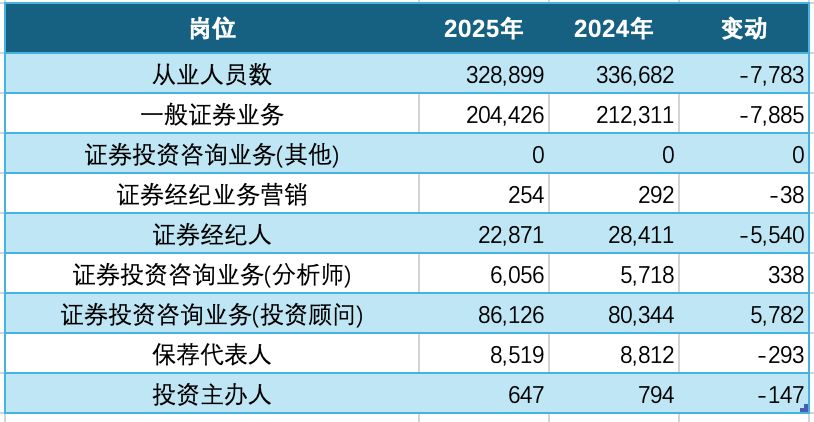
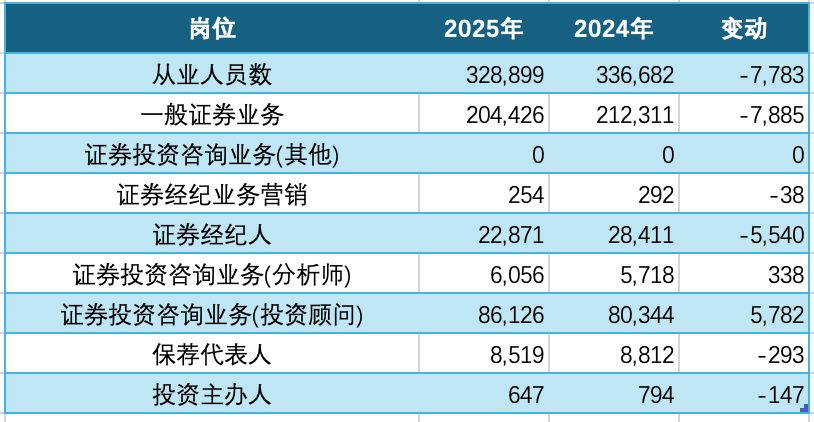
Core Insights - The total number of employees in the securities industry is projected to decline to 328,899 by the end of 2025, a decrease of nearly 7,800 from the end of 2024, marking a significant shift in the talent landscape within the industry [1][2] Group 1: Industry Employment Trends - The overall reduction in industry personnel contrasts with the growth of internet-based brokerages, which are actively hiring talent despite the overall decline [3][4] - Major brokerages such as Guotai Junan, CITIC Securities, and others continue to dominate the workforce, with five firms employing over 10,000 people, accounting for nearly 20% of the total industry workforce [3] - Conversely, traditional brokerages are experiencing significant layoffs, with firms like Guotai Junan and Minsheng Securities reducing their workforce by over 500 employees [3] Group 2: Investment Banking Dynamics - The number of sponsor representatives, a highly regarded group in investment banking, has decreased for the first time in eight years, falling to 8,519 by the end of 2025, down 293 from 2024 [5][6] - This decline is attributed to a slowdown in equity financing and a stricter regulatory environment, leading to fewer projects and increased pressure on professionals in this field [5][6] Group 3: Wealth Management Evolution - The number of securities brokers has significantly decreased to a historical low of 22,871 by the end of 2025, down 5,540 from the previous year, indicating a shift away from traditional brokerage roles [7] - In contrast, the number of investment advisors has reached a record high of 86,126, reflecting a strategic shift towards high-quality client service and professional wealth management [7][8] Group 4: Research Analyst Growth - The number of securities analysts has surpassed 6,056, marking a growth of 338 from 2024, indicating a rising demand for research capabilities within the industry [9][10] - Notable movements among prominent analysts have been observed, with several high-profile analysts changing firms, highlighting the competitive nature of the research sector [9]
2025年证券从业者跌破33万大关 互联网券商逆势扩招,保代8年来首现年度减员
Mei Ri Jing Ji Xin Wen· 2026-01-06 12:28
Core Insights - The total number of employees in the securities industry is projected to decline to 328,990 by the end of 2025, a decrease of nearly 7,800 from the end of 2024. This marks a historical fluctuation between 320,000 and 360,000 since 2017, with a peak of 354,500 in 2022 [1][2] Group 1: Industry Employment Trends - The overall reduction in industry personnel contrasts with the talent acquisition by internet-based brokerages such as Dongfang Caifu, Guojin Securities, and Maikao Securities, which are experiencing growth in employee numbers [3][4] - Five major brokerages have over 10,000 employees each, accounting for nearly 20% of the total workforce in the industry. These include Guotai Junan (17,800), CITIC Securities (14,200), and others [3] - Some mid-sized brokerages have also seen reductions in personnel, with firms like Guotai Junan and Minsheng Securities losing over 500 employees [3] Group 2: Investment Banking Trends - The number of sponsor representatives, considered the "gold collar" group in investment banking, has decreased for the first time in eight years, falling to 8,519 by the end of 2025, down 293 from 2024 [5][6] - The decline in sponsor representatives is attributed to a slowdown in equity financing and stricter regulatory environments, leading to fewer projects available for these professionals [5][6] Group 3: Wealth Management Dynamics - The number of securities brokers has significantly decreased to a historical low of 22,900 by the end of 2025, down 5,540 from 2024, indicating a shift away from traditional brokerage roles [7] - Conversely, the number of investment advisors has reached a record high of 86,126, reflecting a strategic shift in the industry towards high-quality client services rather than sheer volume [7][8] Group 4: Research Analyst Growth - The number of securities analysts has surpassed 6,056, marking an increase of 338 from 2024, indicating a growing demand for research capabilities within the industry [9][10] - Notable movements among prominent analysts have been observed, with several high-profile analysts changing firms, highlighting the competitive nature of the research sector [9]