
贸易便利化

Search documents
与世界各国共享机遇、共同发展
Ren Min Ri Bao· 2025-11-30 22:01
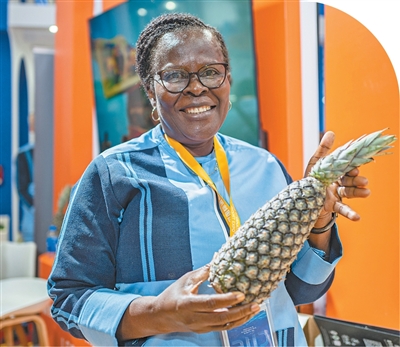
Core Viewpoint - China emphasizes the importance of promoting common development through international cooperation, aiming to share opportunities and benefits with countries worldwide, thereby injecting new momentum into global economic growth [1] Group 1: Trade Opportunities - The opening of the Chinese market has led to significant growth in exports from developing countries, such as Pakistan's pine nuts, which saw an export value of over $18 million in 2024, a 14% increase year-on-year [3] - South Africa's macadamia nuts are projected to have exports to China reach approximately 48% of their total production in 2024, highlighting China's role as a key partner in the macadamia industry [4] - The eighth China International Import Expo has facilitated the entry of products from least developed countries, with a 23.5% increase in participation from these nations, resulting in a cumulative intended transaction amount of $4.18 billion over seven years [5] Group 2: Economic Cooperation - China is actively enhancing trade facilitation measures, such as zero-tariff policies and streamlined customs processes, which significantly lower trade costs and barriers for developing countries [7] - The establishment of cross-border e-commerce platforms and improved logistics has created new opportunities for small and medium-sized enterprises from developing nations to access the Chinese market [7] - China's commitment to multilateralism and its role as a major trading partner for developing countries are recognized as crucial for global economic stability and growth [7]

中亚国家拟将区域贸易额提升至200亿美元
Shang Wu Bu Wang Zhan· 2025-11-25 16:43
Group 1 - The first Central Asian Trade and Investment Ministers' meeting was held in Tashkent, with Azerbaijan invited to participate, aiming to expand trade among Central Asian countries to $20 billion and establish a "Made in Central Asia" brand [1] - Uzbekistan's Minister of Investment, Industry and Trade, Kudratov, emphasized the high complementarity of Central Asian economies and proposed a joint action plan to facilitate trade through measures like coordinated customs procedures and electronic document flow [1] - A proposal was made to hold a "Central Asia-Azerbaijan Investment Forum" in Samarkand in 2026 to showcase the "Made in Central Asia" brand, which is expected to enhance the export competitiveness and international recognition of Central Asian products [1] Group 2 - Kazakhstan's Minister of Trade and Integration, Shakkaliyev, called for a shift from a "buy-sell" model to an "investment-production-sales" integrated cooperation, planning to sign an industrial cooperation development plan with Uzbekistan [2] - Tajikistan's Minister of Economic Development and Trade, Zafkizoda, highlighted the importance of digitalization, presenting successful cases of AI company Zypl.ai and fintech company Alif [2] - The meeting concluded with a joint communiqué confirming the commitment of all parties to deepen economic cooperation, develop industrial collaboration, and enhance investment mechanisms [2]
多边贸易体系面临更大重塑压力
Sou Hu Cai Jing· 2025-11-21 23:27
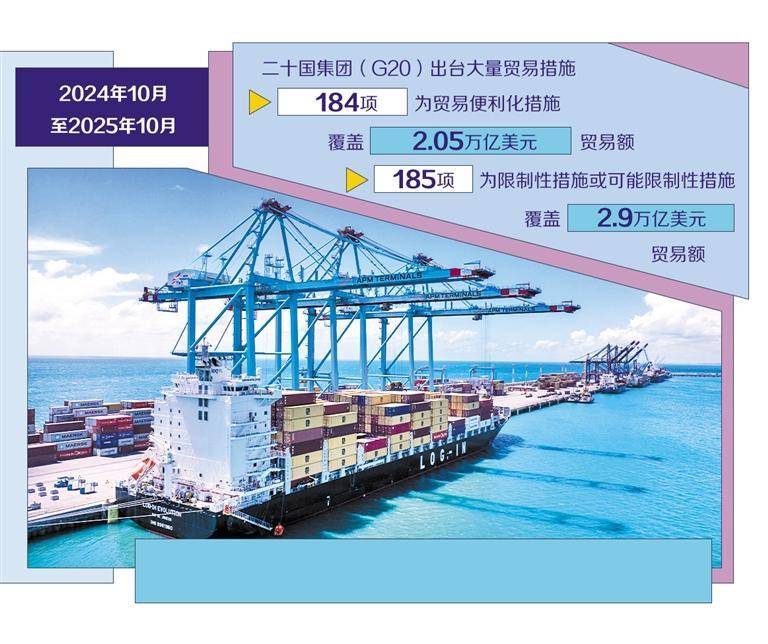
Core Insights - The World Trade Organization's report indicates a significant shift in G20 trade policies, with restrictive measures now covering more trade volume than facilitative measures for the first time since the monitoring mechanism was established in 2009, highlighting a rise in global protectionism [2][6] Group 1: Trade Facilitation Measures - The G20 implemented 184 trade facilitation measures, the second highest in the last decade, covering a trade volume of $2.05 trillion, nearly doubling from the previous period's $1.07 trillion [3] - Of these measures, 129 were related to import facilitation, accounting for 70% and covering $1.90 trillion, which is 10.5% of the G20's total imports [3] - These measures included lowering or eliminating import and export tariffs, simplifying customs procedures, and easing export quantity restrictions, which helped alleviate supply chain pressures and reduce production costs [3] Group 2: Trade Restrictive Measures - The report recorded 185 trade restrictive or potentially restrictive measures, the highest since monitoring began in 2009, covering a trade volume of $2.90 trillion, significantly up from $829 billion in the previous period [4] - Import-restricted trade volume reached $2.60 trillion, more than four times the previous period's $598 billion, with $2.35 trillion directly related to U.S. trade policies since early 2025 [4][5] - Types of restrictive measures included increased import tariffs, complex customs procedures, and setting limits on import and export quantities, with the U.S. being a key driver of these measures [5] Group 3: Long-term Structural Adjustments in Global Trade Policy - The increase in restrictive measures over facilitative ones reflects a systemic spillover effect rather than isolated actions by individual countries, indicating a gradual rise in protectionist policies [6] - The surge in restrictive trade policies and the spread of protectionism are contributing to greater uncertainty in global trade, with potential risks including supply chain reconfiguration and increased regionalism [6] - The growing number of restrictive measures is prompting countries to strengthen regional trade arrangements and bilateral agreements, which may further undermine the relative position of multilateralism in global trade [6]
世贸组织报告显示——多边贸易体系面临更大重塑压力
Jing Ji Ri Bao· 2025-11-21 22:45
贸易限制性措施加剧贸易环境不确定性。报告共记录了185项贸易限制性或可能限制性的措施,创下了 贸易监测措施自2009年启动以来的最高纪录,覆盖贸易额高达2.90万亿美元,较上一期8290亿美元规模 大幅增加。其中进口受限贸易额高达2.60万亿美元,为上一期5980亿美元的4倍多。报告还指出,高达 2.35万亿美元的贸易受限额与2025年年初以来的美国贸易政策直接相关。限制性措施在类型上包括加征 进口关税、海关程序复杂化、设定进出口数量限制等。报告称,美国是推动限制性贸易措施的核心驱动 力,其采取的措施包括但不限于对加拿大、印度、巴西等多国实施25%至50%的额外进口关税,停止所 有国家的低价值免税进口豁免,对铜、木材、家具等产品实施新关税,以及与部分国家签署框架协议。 报告指出,限制性措施对二十国集团进口的影响迅速扩大,进口受限比例在1年之内从12.9%大幅跳升 至22%,反映关税链式反应正在累积。 全球贸易政策方向迎来长期性结构性调整。报告指出,贸易限制性措施在覆盖贸易额上首次盖过便利化 措施,反映的是"系统性外溢影响"而非某一国家的孤立行动,表明保护主义政策正逐渐抬头,而不是短 期震荡。限制性贸易政策加剧 ...
海南自贸港首票B类快件税款担保电子化业务落地
Zhong Guo Xin Wen Wang· 2025-11-21 13:29
海南自贸港首票B类快件税款担保电子化业务落地 中新网海口11月21日电 (蔡珺博 孟桓宇)据海口海关21日消息,海南自贸港首票B类快件税款担保电子化 改革日前在成功落地实施。电子化上线后,企业通过中国国际贸易"单一窗口"即可在线完成担保备案、 审批等全流程操作,实现担保额度"秒级"生效,通关环节即时应用。 B类快件通常指快件运营人以向客户承诺的快速商业运作方式承揽、承运的自用、合理数量范围内的个 人物品,具有批次多、单票货值低、时效要求高等特点。 广告等商务合作,请点击这里 本文为转载内容,授权事宜请联系原著作权人 随着国内居民对海外奶粉、保健品等商品需求日益旺盛,网购等消费渠道日趋多元,进口B类快件业务 迎来快速增长期。今年以来,海口美兰机场海关监管B类快件报关单26.24万件(票),货值7571.58万元。 税款担保的电子化改革,精准契合了快件行业发展的实际需求,实现了从"纸间"到"指间"的跨越。 中新经纬版权所有,未经书面授权,任何单位及个人不得转载、摘编或以其它方式使用。 关注中新经纬微信公众号(微信搜索"中新经纬"或"jwview"),看更多精彩财经资讯。 税款担保电子化是海南自贸港打造贸易无纸化、 ...
市场监管总局局长罗文会见柬埔寨工业和科技创新部大臣韩万迪
Zheng Quan Shi Bao Wang· 2025-11-18 10:53
人民财讯11月18日电,11月17日,国家市场监督管理总局局长罗文会见来访的柬埔寨工业和科技创新部 大臣韩万迪。双方同意在食品安全监管、计量、标准化和合格评定等领域深化合作,促进贸易便利化。 ...
中国贸易“暖风”吹向最不发达国家
Zhong Guo Xin Wen Wang· 2025-11-16 09:38
Core Insights - China's trade policies are increasingly benefiting the least developed countries (LDCs), providing them with opportunities to access the Chinese market and integrate into global trade [2][3]. Trade Policy and Initiatives - Starting December 1, 2024, China will implement a 100% zero-tariff policy for products from 33 LDCs, significantly lowering the barriers for these countries to enter the Chinese market [2]. - In addition to zero tariffs, China is enhancing trade facilitation and providing support for cross-border e-commerce, which is crucial for LDCs with weak infrastructure [2][3]. Trade Events and Platforms - The recent China International Import Expo (CIIE) established a dedicated section for products from LDCs, with 163 companies participating, marking a 23.5% increase from the previous year [3]. - The CIIE has become a vital platform for LDCs to access the Chinese market and integrate into global value chains, facilitating the export of products like honey from Zambia and peanuts from Nigeria [3]. Economic Impact - The stable export income generated from these trade opportunities allows LDCs to invest in education, healthcare, and infrastructure, fostering their economic development [3]. - China's market demand is encouraging LDCs to shift from mere exportation to developing specialized manufacturing and enhancing product value [3]. Open Trade Environment - China's openness index has increased from 0.5891 in 1990 to 0.7634 in 2024, reflecting a nearly 30% rise over 30 years, positioning China as a leader in global trade openness [4]. - The recent policy recommendations from the 20th Central Committee emphasize expanding high-level openness and promoting win-win cooperation, aiming to create a more inclusive and dynamic market [4].
G20国家受关税影响贸易额创WTO观测史上最大增幅,后续会怎样?
第一财经· 2025-11-14 14:17
Core Insights - The WTO reported that the trade volume affected by tariffs among G20 countries increased approximately fourfold from the previous reporting period, marking the largest increase in WTO trade monitoring history [3][8] - Despite the rise in tariffs, G20 countries implemented a significant number of trade facilitation measures, doubling the value of such measures compared to the previous report [4][9] Group 1: Tariff Impact - From mid-October 2024 to mid-October 2025, 14.3% of imported goods in G20 countries (approximately $25.99 trillion) were affected by tariffs and other measures, a significant increase from the previous $5.99 trillion [8] - The average actual tariff rate faced by U.S. consumers reached 18.0%, the highest level in over 90 years, indicating ongoing concerns about tariffs [4][12] Group 2: Trade Facilitation Measures - G20 countries introduced 184 new trade facilitation measures covering approximately $2.055 trillion in trade, nearly double the previous report's $1.07 trillion [9] - In the service trade sector, 52 new measures were introduced, with over two-thirds aimed at promoting trade [9] Group 3: Trade Growth Projections - The WTO forecasts a global goods trade growth rate of 2.4% for 2025, but this is expected to drop significantly to 0.5% in 2026 [11] - Oxford Economics predicts a slowdown in global trade growth from 4% in 2025 to 1% in 2026, highlighting the negative impact of rising tariffs [12] Group 4: Trade Policy Uncertainty - Trade policy uncertainty remains a critical factor affecting investment, with the U.S. experiencing over 40 modifications to tariff-related regulations within a year [13] - The fluctuation in U.S. trade policies, including recent increases in heavy truck tariffs and ongoing legal uncertainties regarding tariff legality, contribute to this uncertainty [12]
G20国家受关税影响贸易额创WTO观测史上最大增幅,后续会怎样?|全球贸易观察
Di Yi Cai Jing· 2025-11-14 10:35
Group 1 - The trade volume affected by tariffs among G20 countries has increased approximately fourfold compared to the previous reporting period, marking the largest increase in WTO trade monitoring history [1][4] - During the period from mid-October 2024 to mid-October 2025, 14.3% of imported goods in G20 countries (approximately $2.599 trillion) are impacted by tariffs and other measures, which is more than four times the previous record of $599 billion [4] - The WTO reported that a total of 185 measures are affecting trade valued at approximately $2.9 trillion, compared to $829 billion in the previous G20 report [4] Group 2 - G20 countries have implemented 184 new trade facilitation measures covering about $2.055 trillion in trade, nearly double the previous report's $1.07 trillion [5] - In the services trade sector, G20 countries introduced 52 new measures, with over two-thirds aimed at promoting trade [5] - The WTO noted that despite rising trade barriers, there is a continued dialogue among members rather than retaliatory actions [5] Group 3 - The WTO economists predict a global goods trade growth rate of 2.4% for 2025, but this forecast has been significantly downgraded to 0.5% for 2026 [6] - Oxford Economics reported a slowdown in global trade growth from 4% in 2025 to 1% in 2026, with U.S. tariffs impacting trade performance differently across countries [7] - The uncertainty surrounding trade policies is expected to have a negative impact on investment, with trade policy uncertainty remaining above long-term averages [7][8]
进博会圆满落幕,南京交易分团意向成交9.98亿美元
Nan Jing Ri Bao· 2025-11-14 02:50
Core Insights - The 8th China International Import Expo (CIIE) concluded successfully in Shanghai, serving as a showcase for China's high-level opening-up and a powerful engine for global resource connectivity and development expansion [1] Group 1: International Cooperation and Cultural Exchange - Nanjing showcased seven time-honored brands and established a friendly city exhibition with Stuttgart, Germany, marking the 30th anniversary of their cooperation [2] - The exhibition highlighted the synergy between German craftsmanship and Nanjing manufacturing, emphasizing the cities' commitment to deepening economic and technological collaboration [2][3] - Nanjing's cultural heritage was prominently displayed through traditional crafts, enhancing the city's brand value on the global stage [3] Group 2: Trade and Economic Development - Nanjing's purchasing group achieved an intended transaction volume of $9.98 billion at the expo, focusing on optimizing supply chains and upgrading industries [4] - Retail giant Suning's procurement list included new categories like elderly care products and pet supplies, reflecting changing consumer trends [4] - Continuous participation in the expo has allowed companies like Siyi Food to transform from sales to establishing global trade networks, significantly increasing their sales [5] Group 3: Strategic Platforms and Global Integration - The China-Central Asia Trade Facilitation Cooperation Platform was launched, integrating digital technology to create a new trade channel between China and Central Asia [8] - A strategic cooperation framework was signed between Focus Technology and Eureka International Group to enhance cross-border trade efficiency between China and Europe [9] - The expo has become a key window for observing China's opening-up and a platform for global sharing of development opportunities, showcasing Nanjing's dual empowerment cooperation ecosystem [9]