
车规级芯片

Search documents
西安高新区打造新能源汽车"智造硅谷"
Zhong Guo Chan Ye Jing Ji Xin Xi Wang· 2025-05-06 07:19
Core Insights - The core viewpoint of the articles emphasizes the rapid development and strategic positioning of the Xi'an High-tech Zone in the new energy vehicle (NEV) industry, aiming to become a leading hub in China's automotive sector [1][2][5] Group 1: Industry Development - The NEV industry is a key sector in Xi'an High-tech Zone, targeting a production goal of 1 million vehicles and a 100 billion yuan industry cluster [1][2] - By 2024, the production volume of NEVs in Xi'an High-tech Zone is expected to exceed 1.07 million units, accounting for 89.3% of Shaanxi Province's total and 8.3% of the national total [2] - The industrial scale of the NEV sector in Xi'an High-tech Zone is approximately 260 billion yuan, with over 180 upstream and downstream enterprises [2] Group 2: Innovation and Talent - Innovation is identified as the core driver of the NEV industry's growth in Xi'an High-tech Zone, with over 20 national and provincial innovation platforms established [3] - Collaborations with local universities have created a talent supply mechanism, fostering an ecosystem conducive to research and development [3] Group 3: Supply Chain and Ecosystem - The Xi'an High-tech Zone has developed a localized supply chain covering vehicle manufacturing, battery materials, and automotive components, achieving a local supply rate of 60% for BYD's NEV components [4] - The zone is implementing a "one enterprise leads one chain" strategy to enhance the automotive supply chain, focusing on core components and after-market services [4] Group 4: Future Outlook - The Xi'an High-tech Zone is planning to upgrade its industry with a global perspective, focusing on smart connectivity, hydrogen fuel vehicles, and automotive-grade chips [5] - The aim is to accelerate the introduction of new vehicle manufacturers and core component projects, contributing to China's transition from a major automotive nation to a strong automotive nation [5]

昨夜今晨:商务部回应美国“对等关税”豁免品类 中欧启动电动汽车价格谈判
Sou Hu Cai Jing· 2025-04-14 06:38
Group 1: US-China Trade Policy Adjustments - The US Customs and Border Protection announced adjustments to the "reciprocal tariff" framework, imposing a 125% tariff on certain Chinese imports, including smartphones and electronic components [2] - The new regulations allow products classified under the US Harmonized Tariff Schedule to apply for exemption, with importers required to correct declarations within 10 days of release [2] - The Chinese Ministry of Commerce responded, indicating that this adjustment is a minor step towards correcting unilateral measures and urged the US to fully eliminate erroneous practices [2] Group 2: Apple Supply Chain Clarification - Supply chain manufacturers clarified that rumors regarding the shutdown of production lines for assembling iPhone models in China are false, and operations are continuing normally [3] - The speculation about production line status was linked to potential adjustments in US tariff policies, but no comments have been made by the US International Trade Commission or the White House [3] Group 3: EU-China Electric Vehicle Negotiations - The Chinese Ministry of Commerce disclosed that negotiations have commenced between China and the EU regarding electric vehicle trade issues [4] - A consensus was reached to initiate discussions on price commitments to address the EU's imposition of anti-subsidy tariffs on Chinese electric vehicles [4] - The EU plans to impose tariffs of up to 35.3% on Chinese electric vehicles starting October 2024, making these negotiations crucial for mitigating trade tensions [4] Group 4: GAC's Automotive Chip Development - GAC Group launched 12 self-developed automotive-grade chips, covering areas such as power management and safety systems for smart vehicles [5] - The C01 chip is noted as the first domestic 16-core multi-domain integrated processor supporting L3-level autonomous driving [5] - GAC initiated a collaborative plan for automotive chip applications, partnering with companies like ZTE Microelectronics to enhance industry chain cooperation [5] Group 5: Meizu's Expansion into the Middle East - Meizu announced its entry into the Middle Eastern market, launching the Meizu 21 smartphone series and other smart products [6] - The new smart glasses feature real-time Arabic translation and support for 14 languages, expanding the company's product reach [6] - Meizu aims to leverage its "Flyme all-ecosystem overseas strategy" to strengthen its presence in the Middle East while collaborating with Geely on smart cockpit systems [6] Group 6: Meituan's Non-Food Order Growth - Meituan's non-food category daily order volume has surpassed 18 million, with plans to launch an independent instant retail brand [7] - The flash purchase service will be upgraded to a primary entry point, integrating various categories to enhance delivery capabilities [7] - Meituan's flash purchase service is projected to reach an average of 10 million daily orders in 2024, with a year-on-year growth of 23% in Q1 2025 [7]

国产芯片又有大消息
Wind万得· 2025-04-13 22:30
Core Viewpoint - The launch of GAC Group's self-developed automotive-grade chips marks a significant shift in the domestic chip industry from "replacement" to "leadership," particularly in the fields of intelligence and safety, setting a benchmark for the industry [2][5]. Group 1: Impact on Domestic Chip Industry - GAC's release of automotive-grade chips covers various fields such as power management, braking, and integrated safety, with several chips being the "first in the country" or "first in the world," indicating technological breakthroughs [5]. - The "origin" recognition rules from the China Semiconductor Industry Association may suppress imports of American analog chips, benefiting domestic analog chip development [2][5]. - The self-sufficiency rate of domestic automotive chips is expected to rise from 10% to 25% by 2025, with the localization rate of analog chips and automotive-grade MCUs potentially exceeding 30% [5][6]. Group 2: Restructuring of Automotive Chip Ecosystem - GAC's collaboration with eight companies, including ZTE Microelectronics and Renxin Technology, aims to create an end-to-end verification platform, promoting technological collaboration and breaking the traditional reliance on Tier 1 suppliers [6][7]. - This initiative may encourage more automotive companies to partner with chip manufacturers, forming a closed-loop ecosystem for "whole vehicle chips" verification and reducing dependence on overseas supply chains [7][8]. Group 3: Technological Breakthroughs and Industry Standards - GAC's G-T02 and G-K01 chips achieve international leading levels in data transmission and functional safety, potentially driving upgrades in domestic automotive chip standards [6][8]. - The parameters of GAC's chip technology are approaching or meeting ISO 26262 functional safety standards, with expectations for the first domestic automotive chip safety certification system to be released by 2025 [7][8]. Group 4: Impact on A-Share Market - The self-developed chips are expected to reduce GAC's reliance on external supply chains and improve gross margins, with projections for gross margins to increase from 12% to 15% by 2025 [9][10]. - GAC's chip partners, such as Yutai Microelectronics and Silergy, are anticipated to benefit from increased orders, with Yutai's TSN switching chip expected to achieve a shipment volume of 500,000 pieces by 2025 [9][10]. - The semiconductor sector in A-shares has already shown signs of a rally, with companies like Naxin Micro and Shengbang shares hitting the limit, reflecting market expectations for domestic substitution [9][10].

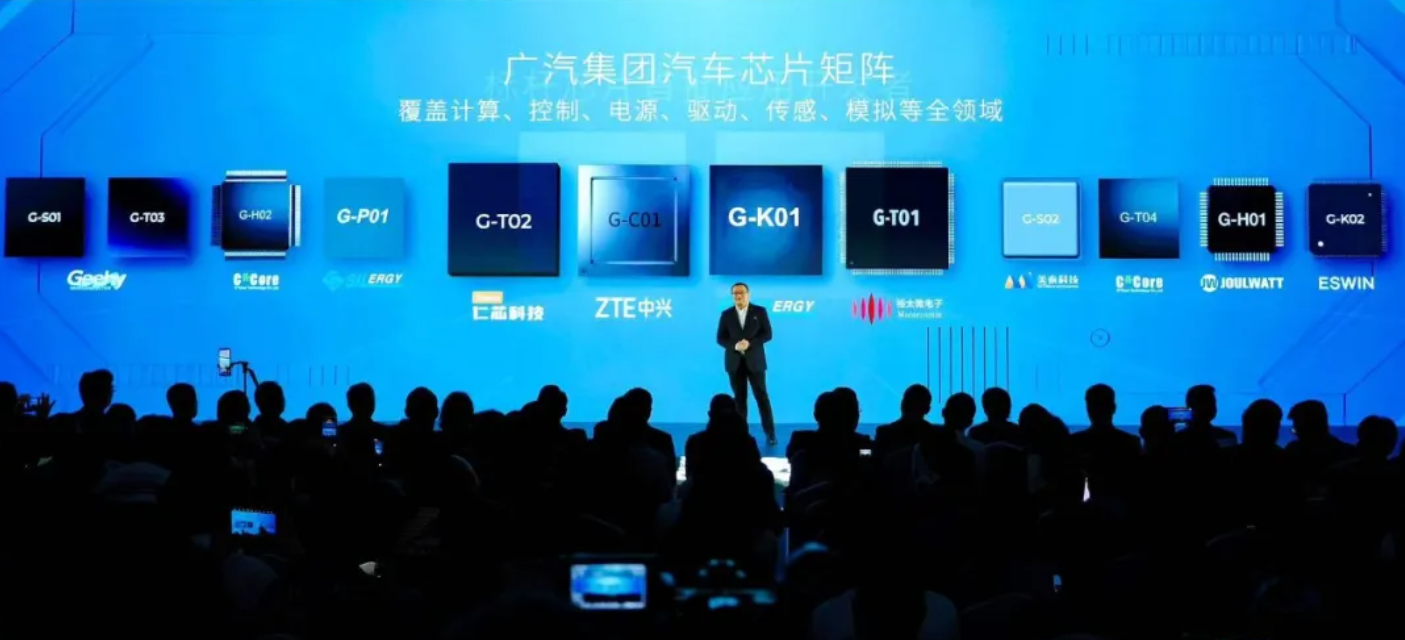
广汽一口气发布12款芯片,覆盖电源管理、底盘、集成安全等领域
Ju Chao Zi Xun· 2025-04-13 02:16
Core Insights - GAC Group officially launched 12 automotive-grade chips, marking a significant technological breakthrough in the smart automotive sector and promoting independent innovation within China's automotive industry [2][3] Group 1: Chip Development - The chips were developed in collaboration with various companies, including ZTE Microelectronics, Yutai Microelectronics, Renxin Technology, and others [2] - The C01 chip, developed with ZTE Microelectronics, is China's first self-designed next-generation 16-core multi-domain integrated central processing chip [2] - The G-T01 chip, co-developed with Yutai Microelectronics, is the first automotive-grade gigabit Ethernet TSN switch chip with the highest capacity in China [2] - The G-T02 chip, developed with Renxin Technology, is the world's first SerDes chip with a bandwidth of up to 16Gbps [2] - The G-K01 chip, developed with Silergy Corp, is the world's first 6-core RISC-V chip that meets ASIL-D functional safety standards [2] Group 2: Application Scenarios - The chips are designed for various applications, including power management, braking, and integrated safety in smart vehicles [2] - In power management, these chips can significantly improve energy utilization and extend the driving range of electric vehicles [2] - The G-T01 chip enhances braking response time by processing high-speed data more quickly, thereby improving driving safety [2] - The innovative design of the C01 chip enhances the overall integrated safety performance of vehicles, enabling better responses to emergencies [2] Group 3: Ecosystem and Collaboration - GAC Group announced the "Automotive Chip Application Ecosystem Co-construction Plan," aiming to deepen collaborative innovation across industry, academia, and research [3] - The plan includes the establishment of an end-to-end verification platform linking vehicles, controllers, and chips [3] - The implementation of a "one chip, multiple sources" strategy is intended to ensure the security and stability of the supply chain [3]
广汽集团首款L3级别汽车计划于2025年内上市,与滴滴合作有新进展
第一财经网· 2025-04-13 01:12
Group 1 - GAC Aion and Didi are collaborating to develop the first L4 autonomous vehicle, which is planned for mass production and delivery by the end of 2025 [1][2] - GAC Group is one of the first passenger car companies in China to obtain L3 autonomous driving pilot qualification, with L3 models expected to be launched in Q4 2025 [1] - The penetration rate of L2 and above autonomous driving in new passenger cars in China is expected to reach 65% by 2025, while the penetration rate of intelligent cockpits is projected to reach 76% [1] Group 2 - GAC Group plans to deliver L4 autonomous vehicles in 2025, scale up operations in 2026, and launch L4 models for individual users in 2027 [2] - In 2023, GAC strategically invested in Didi Autonomous Driving, and in 2024, they established a joint venture called Andi Technology [2] - Didi's CEO outlined a three-phase five-year plan for L4 autonomous driving, focusing on technology development, market validation, and global expansion [2] Group 3 - The importance of safe and controllable automotive-grade chips is increasing alongside the rapid development of intelligent driving [3] - GAC Group has launched 12 automotive-grade safety chips in collaboration with multiple companies, targeting various applications such as power management and chassis [3] - GAC initiated an "Automotive Chip Application Ecosystem Co-construction Plan" to enhance the integration of vehicle, controller, and chip verification [3]