通胀黏性

Search documents
巨富金业:美联储政策迷雾未散,中东冲突再添变数
Sou Hu Cai Jing· 2025-07-17 06:58
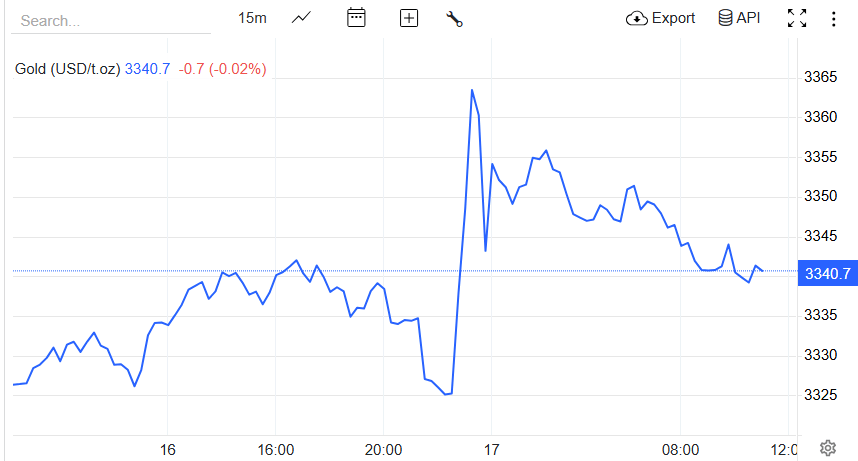
Geopolitical and Trade Friction - The current geopolitical situation is complex, with ongoing tensions in the Israel-Palestine conflict and trade tensions due to the U.S. imposing tariffs on at least 100 small countries, which could lead to a domino effect on the global trade system [1] - Germany's IMK predicts that if U.S. tariffs on the EU are implemented, Germany's economic growth rate could be halved from 1.5% to 1.2% by 2026, increasing the recession risk for export-oriented economies [1] - Despite the heightened geopolitical risks, there has not been a significant influx of funds into gold, contrasting with the liquidity crisis sell-off seen at the beginning of the COVID-19 pandemic [1] Federal Reserve Policy and Inflation - The U.S. core CPI for June showed a year-on-year increase of 2.9% and a month-on-month increase of 0.2%, indicating persistent inflation [2] - The Federal Reserve's Beige Book noted a slight increase in economic activity, but businesses remain cautious due to policy uncertainties, with significant price increases driven by tariff pressures [2] - Market expectations for a 25 basis point rate cut in September have risen to 70%, but the divergence between Powell's optimistic statements and the cost pressures revealed in the Beige Book has led to a rebound in the dollar index to 98.55 and an increase in U.S. Treasury yields to 4.46% [2] Gold Market Dynamics - On July 17, gold prices experienced significant volatility, with a range of over $50, reflecting intense market competition amid multiple risks [3] - Technically, gold is in a wide trading range of $3,300 to $3,370, with key support at $3,330-$3,340 and resistance at $3,358-$3,360, indicating a tug-of-war between bulls and bears [6] - Historical data suggests that gold often rebounds quickly after significant daily declines, as seen in March 2020, indicating potential for new trend beginnings following current volatility [6] Central Bank Gold Purchases - A trend of global central banks increasing gold reserves provides "invisible support" to the market, with 95% of surveyed central banks indicating plans to continue purchasing gold in the next 12 months [8] - China has increased its gold reserves for eight consecutive months, reaching 73.9 million ounces, reflecting a strategic shift towards "de-dollarization" amid weakening U.S. dollar credibility [8] - The dual drivers of central bank gold purchases and geopolitical risks continue to reinforce gold's status as a safe haven in a fragmented global economy [8]

不轻松的经济“软着陆”
HTSC· 2025-06-03 08:14
Group 1: Policy Outlook - The report indicates that the U.S. tariff fluctuations are expected to decrease, with a focus on domestic policies as the Trump administration faces feedback constraints from judicial bodies and the market [2][12]. - The total level of tariffs imposed by the U.S. on global imports is projected to stabilize around 15%, with strategic goods like steel, aluminum, and pharmaceuticals likely to retain high tariffs [2][12]. - The "Beautiful Bill" passed by the House is expected to increase the fiscal deficit by $3.1 trillion over ten years, with the deficit rate potentially rising to 7% by 2026 [3][13][25]. Group 2: Economic Growth Forecast - Following a negative growth in Q1, the U.S. economic growth momentum is anticipated to recover marginally from May onwards, with annual growth expected to reach 1.6% in 2025 [3][27]. - The report predicts that consumer confidence and corporate investment willingness will improve due to fiscal expansion and reduced tariff impacts, contributing to a more stable labor market with an unemployment rate around 4.5% [3][27][30]. - The report highlights that while the labor market remains resilient, new non-farm employment is expected to slow down in the second half of 2025 due to uncertainties surrounding tariffs and immigration policies [30]. Group 3: Inflation and Monetary Policy - Core inflation in the U.S. is expected to remain sticky, with projections indicating it will stay above 3% annually through 2026, influenced by fiscal expansion and tariff policies [3][4][28]. - The Federal Reserve is anticipated to implement preventive rate cuts in late 2025, although high long-term interest rates may limit the effectiveness of these cuts [4][10]. - The report suggests that the high yield on U.S. Treasury bonds could become a significant constraint on fiscal and tariff policies, as well as market performance [4][10][40]. Group 4: Asset Valuation and Market Dynamics - The valuation premium of the U.S. dollar and dollar-denominated assets is expected to continue shrinking, with rising risk premiums and challenges in bond yields [4][10]. - The report forecasts that the 10-year U.S. Treasury yield will remain in the range of 4.5% to 5% in the second half of 2025, which could negatively impact stock valuations [4][10][41]. - The report notes that the rapid increase in Treasury yields could drag down stock valuations, indicating a potential volatility source for risk assets [4][10][41].
现阶段黄金还能入手吗?黄金后续还有上涨空间吗
Sou Hu Cai Jing· 2025-05-23 08:25
Group 1 - The current gold market is in a phase of short-term adjustment while maintaining long-term support, requiring investors to make cautious decisions based on multiple dimensions [1] - International gold prices have fallen from a high of $3500 per ounce in April to $3234 per ounce in May, with domestic gold jewelry prices dropping below 1000 yuan per gram [1][3] - The decline in gold prices is primarily influenced by a stronger US dollar, easing US-China trade tensions, and technical selling and profit-taking [1][4] Group 2 - Central banks continue to purchase gold, with global net purchases exceeding 300 tons in Q1 2025, and China increasing its gold reserves to 73.77 million ounces (approximately 2294.51 tons) [6][4] - The proportion of gold in China's foreign exchange reserves is only 4.3%, significantly lower than the global average of about 15%, indicating substantial future accumulation potential [6][4] - Geopolitical tensions, such as the ongoing Russia-Ukraine conflict and Middle East issues, contribute to the long-term risk premium for gold [6][4] Group 3 - Short-term support for international gold prices is seen in the range of $3200-$3240 per ounce, with potential downside to $3150 if broken, while resistance is at $3250-$3300 [5][4] - The market sentiment is cautious, with speculative funds withdrawing, as evidenced by over 3 billion yuan net outflow from gold ETFs in April [6][4] - Historical trends suggest that gold often experiences a "first dip, then rise" pattern during interest rate hike cycles, indicating potential for recovery in 2025 if economic data weakens [9][4] Group 4 - Investment strategies suggest accumulating gold in the $3200-$3240 range, with a stop-loss at $3150 and a target price of $3300 [10][4] - A diversified asset allocation strategy is recommended, combining gold with bonds and high-dividend stocks to hedge against interest rate reversal risks [10][4] - Different scenarios for gold prices are outlined, with optimistic projections suggesting prices could exceed $3500 under certain conditions, while pessimistic scenarios could see prices drop to $2500 [10][4]
美国痛失三大机构最高评级,黄金王者归来?
财富FORTUNE· 2025-05-19 13:02
Core Viewpoint - After a significant increase in gold prices, recent events such as the downgrade of the U.S. sovereign credit rating by Moody's have reignited interest in gold as a potential safe-haven asset, despite short-term volatility in prices [1][3]. Group 1: U.S. Sovereign Credit Rating and Economic Indicators - Moody's downgraded the U.S. sovereign credit rating from Aaa to Aa1, indicating a loss of the highest rating from all three major rating agencies, primarily due to concerns over rising fiscal deficits and debt levels [1][2]. - The U.S. federal debt has surpassed $36 trillion, with interest payments projected to exceed $1.1 trillion in the 2024 fiscal year, accounting for 22% of federal revenue [1][2]. - The Congressional Budget Office warned of potential debt default if the debt ceiling is not raised, which could lead to increased refinancing costs for the federal government [2]. Group 2: Impact on Gold and Currency Markets - The downgrade by Moody's is expected to weaken the dollar's credit system, leading to a potential shift in investor preferences towards gold and other currencies as safer assets [3][4]. - Despite rising U.S. Treasury yields, gold prices have surged, indicating a shift in gold's monetary attributes and a divergence from traditional correlations with bond yields [3][4]. - Global central banks are increasing gold purchases, with a net acquisition of 1,044.6 tons in 2024, reflecting a trend of moving away from dollar-denominated assets [4]. Group 3: Future Outlook for Gold - The path for gold to regain its status as a dominant asset is expected to be gradual, influenced by ongoing geopolitical risks and economic conditions [5][6]. - Factors such as persistent inflation, geopolitical tensions, and the potential for U.S. fiscal policies to lead to further monetary expansion are likely to support gold's appeal as an inflation hedge [5][6]. - Prominent investors, like Ray Dalio, emphasize the importance of holding gold in light of unsustainable U.S. debt levels, suggesting that the transition to gold as a currency alternative is still in its early stages [6].