
非制造业商务活动指数

Search documents
11月制造业PMI回升至49.2%,制造业出口趋稳
第一财经· 2025-11-30 04:34
Core Viewpoint - The article discusses the recent trends in China's manufacturing and non-manufacturing sectors, highlighting improvements in manufacturing PMI and challenges in the non-manufacturing sector due to seasonal factors and economic pressures [3][10]. Manufacturing Sector - The manufacturing PMI for November is reported at 49.2%, a slight increase of 0.2 percentage points from the previous month, indicating a modest recovery in market confidence [3][4]. - New export orders index rose to 47.6%, up by 1.7 percentage points, reflecting a stabilization in manufacturing exports across various industries, including high-tech and consumer goods [5]. - The production index for manufacturing stands at 50%, indicating a return to the expansion zone after a brief contraction, with equipment manufacturing, high-tech manufacturing, and consumer goods all showing positive growth [4][5]. - Finished goods inventory index decreased to 47.3%, suggesting smoother sales activities for enterprises [6]. - Raw material prices are on the rise, with the purchasing price index at 53.6%, indicating upward pressure on production costs [8]. Non-Manufacturing Sector - The non-manufacturing business activity index fell to 49.5%, down 0.6 percentage points, primarily due to the seasonal decline in consumer-related services following the holiday peak [10][11]. - The construction industry showed improvement with a business activity index of 49.6%, indicating a slight recovery in construction activities [11]. - Despite the slowdown in non-manufacturing activities, there are positive indicators such as sustained financial activities and optimism in the construction sector, which may support economic stability towards year-end [11].


透过11月份“关键经济指标”看中国制造业“稳+进” 金融活动和新动能表现良好
Yang Shi Wang· 2025-11-30 04:20
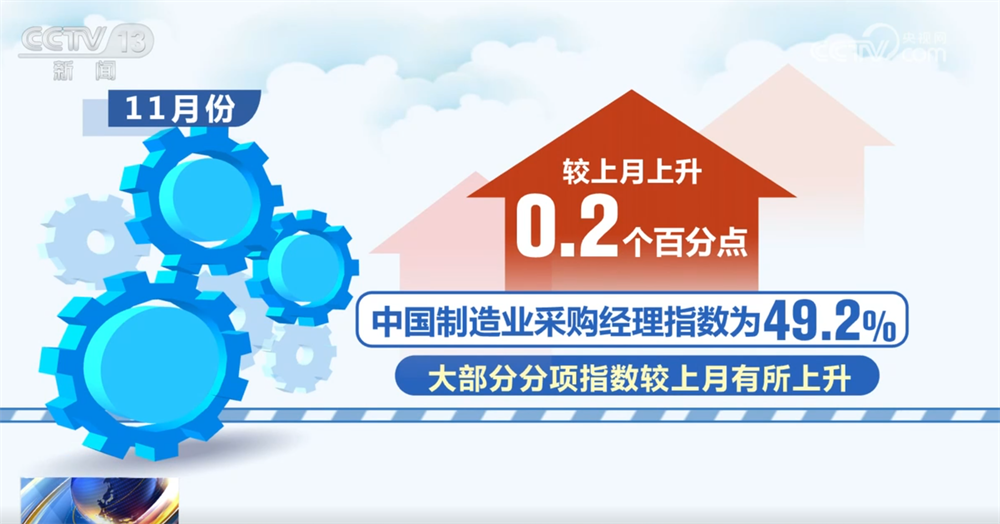
Core Viewpoint - The manufacturing sector in China shows signs of stabilization and recovery in demand, with the Purchasing Managers' Index (PMI) indicating an overall positive trend in November [1][3]. Manufacturing Sector Summary - The manufacturing PMI for November is reported at 49.2%, an increase of 0.2 percentage points from the previous month, with most sub-indices showing improvement [3]. - The production index and new orders index both increased, with the production index reaching the critical point of 50% [4]. - New export orders across four major industries and businesses of various sizes have all risen compared to the previous month, particularly high-tech manufacturing, which saw an increase of over 3 percentage points [6]. - The production index for November is at 50%, up by 0.3 percentage points, indicating stable manufacturing activity [10]. - The finished goods inventory index decreased to 47.3%, down 0.8 percentage points from the previous month, suggesting smoother sales activities for enterprises [10]. Non-Manufacturing Sector Summary - The non-manufacturing business activity index for November stands at 49.5%, reflecting a slowdown in overall business activities, particularly in consumer-related services [11]. - Financial activities and new momentum sectors are performing well, with the financial business activity index and new orders index both rising significantly above 55% [11]. - The non-manufacturing business activity expectation index is at 56.2%, up 0.1 percentage points from the previous month, indicating stable optimistic expectations among enterprises for future market development [15].
11月份制造业采购经理指数回升 小型企业PMI为近6个月高点
Zhong Guo Zheng Quan Bao· 2025-11-30 03:13
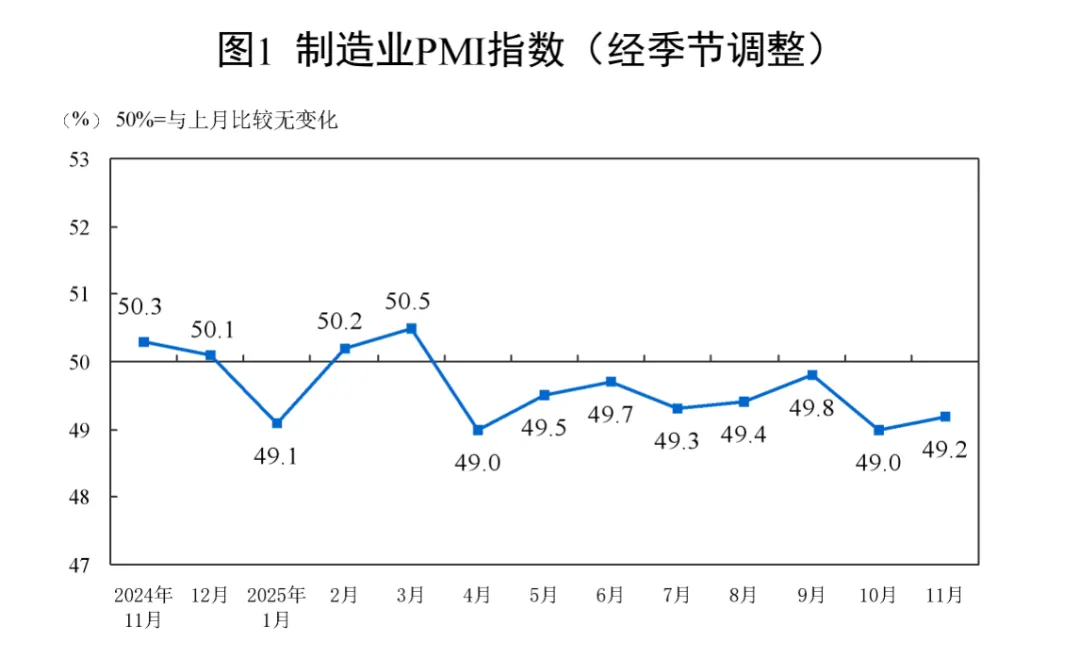
Core Insights - The manufacturing Purchasing Managers' Index (PMI) for November is reported at 49.2%, showing a slight increase of 0.2 percentage points from the previous month, indicating a stabilization in economic conditions [1][2] - The non-manufacturing business activity index decreased to 49.5%, down 0.6 percentage points from last month, reflecting a decline in the non-manufacturing sector's economic activity [1][6] - The comprehensive PMI output index fell to 49.7%, a decrease of 0.3 percentage points from the previous month, suggesting a slight contraction in overall economic activity [1] Manufacturing Sector - The production index and new orders index for November are at 50.0% and 49.2%, respectively, with increases of 0.3 and 0.4 percentage points, indicating improvements in both production and demand [4] - Small enterprises showed a significant recovery with a PMI of 49.1%, up 2.0 percentage points, marking a six-month high [4] - High-tech manufacturing PMI remains above the critical point at 50.1%, continuing its expansion for ten consecutive months [4] Non-Manufacturing Sector - The non-manufacturing business activity index is at 49.5%, reflecting a decrease due to seasonal factors and a high base effect from the previous month [6][9] - The construction business activity index improved to 49.6%, up 0.5 percentage points, indicating a recovery in the construction sector [10] - The business activity expectation index for the service industry is at 55.9%, indicating optimism despite a slight decrease from the previous month [10] Market Expectations - The production and business activity expectation index for November is at 53.1%, up 0.3 percentage points, suggesting increased confidence among manufacturing enterprises [5] - Industries such as non-ferrous metal smelting and processing, as well as railway and aerospace equipment, have high expectation indices above 57.0%, indicating positive outlooks [5] - Analysts predict that the manufacturing sector will continue to stabilize and recover as various industries enter the year-end push phase [5]
国家统计局:11月份制造业采购经理指数小幅回升 非制造业商务活动指数有所回落
Guo Jia Tong Ji Ju· 2025-11-30 01:58
Group 1: Manufacturing PMI Insights - In November, the manufacturing PMI rose to 49.2%, indicating a slight improvement in economic conditions, up by 0.2 percentage points from the previous month [2][3] - Both production index and new orders index improved, reaching 50.0% and 49.2% respectively, with production index crossing the critical point, suggesting better demand and supply dynamics [3] - Small enterprises showed significant recovery with a PMI of 49.1%, up by 2.0 percentage points, marking a six-month high, while large enterprises saw a decline to 49.3% [3] Group 2: Non-Manufacturing PMI Insights - The non-manufacturing business activity index fell to 49.5%, down by 0.6 percentage points, indicating a decrease in the non-manufacturing sector's economic activity [2][5] - The service sector's business activity index dropped to 49.5%, influenced by the end of holiday effects, with certain industries like real estate showing weaker market activity [5] - The construction sector's business activity index improved to 49.6%, up by 0.5 percentage points, reflecting a slight recovery in confidence among construction enterprises [5] Group 3: Composite PMI Insights - The composite PMI output index decreased to 49.7%, down by 0.3 percentage points, with manufacturing production index at 50.0% and non-manufacturing business activity index at 49.5% [6]
X @外汇交易员
外汇交易员· 2025-11-30 01:41
Manufacturing Sector - Manufacturing production and demand showed some improvement, with the production index rising to the threshold [1] Non-Manufacturing Sector - The non-manufacturing business activity index was 49.5%, influenced by factors such as the fading holiday effect [1] - Industries such as real estate and residential services saw business activity indices below the threshold, indicating weak market activity [1]
华联期货周报:制造业PMI弱于季节性年底美联储降息生变-20251109
Hua Lian Qi Huo· 2025-11-09 10:36
Report Industry Investment Rating No relevant content provided. Core View of the Report - In October 2025, the national consumer price index (CPI) increased by 0.2% year-on-year, with food prices down 2.9% and non-food prices up 0.9%. The average CPI from January to October decreased by 0.1% compared to the same period last year [4]. - The national producer price index (PPI) for industrial products decreased by 2.1% year-on-year in October 2025, with the decline narrowing by 0.2 percentage points from the previous month, and the month-on-month change turned from flat to an increase of 0.1%. The average PPI from January to October decreased by 2.7% compared to the same period last year, and the purchase price of industrial producers decreased by 3.2% [4]. - China's gold reserves at the end of October 2025 were 74.09 million ounces, an increase of 300,000 ounces from the end of August, showing a continuous increase for 12 months. The scale of foreign exchange reserves at the end of October was US$3.3433 trillion, an increase of US$470 million from the end of September, with a growth rate of 0.14% [4]. - From January to September 2025, the total profit of industrial enterprises above designated size reached 5.3732 trillion yuan, a year-on-year increase of 3.2%. The operating income was 102.08 trillion yuan, a year-on-year increase of 2.4% [5]. - In October 2025, the manufacturing PMI was 49%, a significant decrease of 0.8 percentage points from the previous month, indicating a seasonal decline in the manufacturing prosperity level. The non-manufacturing business activity index was 50.1%, an increase of 0.1 percentage points from the previous month, rising to the expansion range [5]. Summary by Relevant Catalogs National Economic Accounting - The GDP quarterly year-on-year growth rates from Q2 2023 to Q3 2025 were 6.5%, 5%, 5.3%, 5.3%, 4.7%, 4.6%, 5.4%, 5.4%, 5.2%, and 4.8% respectively. Different industries showed varying growth trends during this period [7]. - The contributions of different industries to the GDP growth rate also changed over time. For example, the contribution of the primary industry, secondary industry, and tertiary industry to the constant-price GDP year-on-year growth rate and the pull effect on GDP showed different trends from 2013 to 2025 [13]. Industry - The year-on-year growth rates of added value in different industries showed fluctuations. For example, the coal mining and washing industry, oil and gas extraction industry, and other industries had different growth rates from August 2024 to September 2025 [22]. - The output of major industrial products also showed different trends. For example, the output of crude oil, coal, steel, and other products changed from September 2024 to September 2025 [24]. - In September 2025, China's total social electricity consumption was 888.6 billion kilowatt-hours, a year-on-year increase of 4.5%. The electricity consumption of different industries also showed different growth trends [31]. - From January to September 2025, the total profit of industrial enterprises above designated size reached 5.3732 trillion yuan, a year-on-year increase of 3.2%. Different industries had different profit growth rates, with some industries showing growth and others showing decline [5][35]. - As of the end of September 2025, the finished product inventory of industrial enterprises above designated size was 6.71 trillion yuan, a year-on-year increase of 2.8%. The inventory turnover days were 20.2 days, an increase of 0.2 days compared to the same period last year [5]. Price Index - In October 2025, the CPI increased by 0.2% year-on-year, with food prices having a significant impact on the CPI decline. Different CPI sub-items showed different year-on-year and month-on-month changes [4][49]. - The PPI for industrial products decreased by 2.1% year-on-year in October 2025, with the decline narrowing. Different industries' PPI also showed different trends, with production materials prices generally declining more than living materials prices [56]. - The purchase price of industrial producers also showed different trends, with some categories such as fuel and power showing a decline, while others such as non-ferrous metal materials and wires showing an increase [60].
中国采购经理指数公布10月份制造业采购经理指数
Jing Ji Guan Cha Wang· 2025-11-03 02:48
Group 1 - The manufacturing Purchasing Managers' Index (PMI) for China in October is reported at 49.0%, indicating a decrease of 0.8 percentage points from the previous month [1] - The non-manufacturing business activity index stands at 50.1%, showing an increase of 0.1 percentage points compared to last month [1] - The composite PMI output index is at 50.0%, which is a decline of 0.6 percentage points from the previous month [1]
华泰证券:假期错位拖累10月制造业PMI回落
Xin Lang Cai Jing· 2025-11-01 05:11
Group 1 - The core viewpoint of the article indicates that the manufacturing PMI for October has decreased to 49% from 49.8% in September, reflecting a weaker performance compared to seasonal levels in previous years [1] - The non-manufacturing business activity index has slightly increased to 50.1% from 50% in September, partially due to disruptions from holiday scheduling and a reduction in working days impacting production activities [1] - Overall, the October industrial production and export readings may be affected by holiday scheduling disruptions, while consumption indicators could see marginal improvement [1] Group 2 - Looking ahead, the PMI indicators remain in a weak range, suggesting that counter-cyclical policies need to be strengthened to boost the manufacturing sector's performance [1]

10月制造业PMI为49.0%经济总体产出保持稳定
Zhong Guo Zheng Quan Bao· 2025-11-01 02:09
Group 1 - The manufacturing Purchasing Managers' Index (PMI) for October is reported at 49.0%, a decrease of 0.8 percentage points from the previous month, indicating a slowdown in manufacturing activity [1] - The non-manufacturing business activity index is at 50.1%, an increase of 0.1 percentage points from last month, suggesting stability in the non-manufacturing sector [1] - The comprehensive PMI output index stands at 50.0%, down 0.6 percentage points from the previous month, reflecting overall economic stability [1] Group 2 - In October, the production index and new orders index for manufacturing are at 49.7% and 48.8%, respectively, showing declines of 2.2 and 0.9 percentage points, indicating reduced production and market demand [1] - Key industries such as food processing, automotive, and aerospace show production and new orders indices above 52.0%, indicating active supply and demand [1] - Large enterprises maintain production and new orders indices above the critical point, with values of 50.9% and 50.1%, respectively, indicating sustained expansion for six consecutive months [1] Group 3 - High-tech manufacturing, equipment manufacturing, and consumer goods industries have PMIs of 50.5%, 50.2%, and 50.1%, respectively, all remaining in the expansion zone and significantly above the overall manufacturing level [2] - The production and business activity expectation index for October is at 52.8%, indicating optimistic market expectations among manufacturing enterprises [2] - The non-manufacturing business activity index reflects a slight increase, with the service sector's index at 50.2%, indicating a recovery in service sector activity [2] Group 4 - The business activity expectation index for the service sector is at 56.1%, indicating strong confidence among service enterprises regarding industry development [2] - Overall, non-manufacturing sectors are stabilizing, with positive changes in investment and consumption-related activities, supported by effective growth policies [2] - The fourth quarter is expected to see strengthened domestic demand, providing solid support for achieving annual economic and social development goals [2]
金属普涨 期铜继续下跌,但月线连升第三个月【10月31日LME收盘】
Wen Hua Cai Jing· 2025-11-01 00:31
Group 1 - LME copper prices continued to decline due to weak demand expectations, a strong dollar, and profit-taking after reaching record highs [1] - As of October 31, LME three-month copper fell by $29.5, or 0.27%, closing at $10,887.5 per ton, marking a drop for the second consecutive day after hitting $11,200 [1][2] - In October, copper prices have increased by $619, or 6.03%, marking the third consecutive month of gains [3] Group 2 - China's manufacturing Purchasing Managers' Index (PMI) fell to 49.0% in October, a decrease of 0.8 percentage points from the previous month, while the non-manufacturing business activity index rose slightly to 50.1% [5] - ING's commodity strategist noted that the sentiment in the base metals market is poor, with supply disruptions expected to keep prices around $10,000 per ton, but strong demand growth is needed for further price increases [5] - Citigroup analysts remain optimistic about copper prices, predicting an increase by 2026 due to cyclical demand expectations and constrained mine supply [5] - A stronger dollar index has added pressure to the market, making dollar-denominated assets more expensive for holders of other currencies [5] - Marex warned that copper prices may further decline, suggesting caution as some indicators hint at potential price corrections [5]
