预定利率下调

Search documents
中国太保张远瀚:持续支持多元浮动收益型产品经营
Bei Jing Shang Bao· 2025-08-29 11:37
Core Viewpoint - China Pacific Insurance (Group) Co., Ltd. is focusing on enhancing its floating income product offerings and transforming its product structure in response to the changing market conditions [1] Group 1 - The company aims to continuously improve the supply of floating income products and complete the transformation of its product structure [1] - It will support the operation of diverse floating income products while strategically planning for the potential reduction in preset interest rates [1] - The company is committed to deepening its health insurance segment and strengthening the diversification of its asset management and duration management [1]

新华保险龚兴峰回应预定利率下调:建立了产品动态调整工作机制
Bei Jing Shang Bao· 2025-08-29 07:53
Core Viewpoint - Xinhua Life Insurance Company is implementing a dynamic product adjustment mechanism to enhance competitiveness and promote high-quality business development in response to the reduction of the preset interest rate [1] Group 1: Product Strategy - The company is constructing a diversified product system, strengthening product combination strategies and scenario-based marketing to meet diverse insurance needs throughout the customer lifecycle [1] - There is a deep integration of products and services, creating one-stop insurance solutions through combinations of insurance with pension, health, and financial services to enhance customer experience [1] - The company is transforming risk protection products by focusing on risk control and advancing products like increasing death benefit life insurance, pension annuities, and whole life insurance, emphasizing long-term financial planning and pension protection [1] Group 2: Market Positioning - The company aims to increase the supply of protection-type products, delving into personalized and differentiated protection needs to provide comprehensive risk protection solutions for customers [1] - The brand "Good Products at Xinhua" is being developed to establish product advantages in niche markets, making the company's offerings more accessible [1]

中国银河证券:寿险增速持续扩大 财险维持稳健增长
智通财经网· 2025-08-29 07:28
Group 1 - The insurance industry in China achieved original premium income of 42,085 billion yuan from January to July, a year-on-year increase of 6.75% [1] - In the same period, the life insurance sector reported premium income of 33,202.78 billion yuan, growing by 7.53% year-on-year, with a notable increase compared to the previous growth rate of 5.64% [1] - The property insurance sector generated premium income of 8,882.52 billion yuan, reflecting a year-on-year growth of 3.95%, slightly narrowing from the previous growth rate of 4.06% [1] Group 2 - In July 2025, the insurance industry recorded original premium income of 4,735.47 billion yuan, marking a year-on-year growth of 19.70% [2] - The life insurance business achieved premium income of 3,596.78 billion yuan in July, with a significant year-on-year increase of 26.04%, driven by a reduction in the preset interest rate [2] - The total assets of the insurance industry reached 39.59 trillion yuan by the end of July 2025, representing a year-on-year growth of 16.78% [3] Group 3 - Life insurance companies accounted for 87.61% of the total assets in the insurance industry, with total assets amounting to 34.69 trillion yuan [3] - The net assets of the insurance industry grew by 26.07% year-on-year, reaching 3.84 trillion yuan [3]

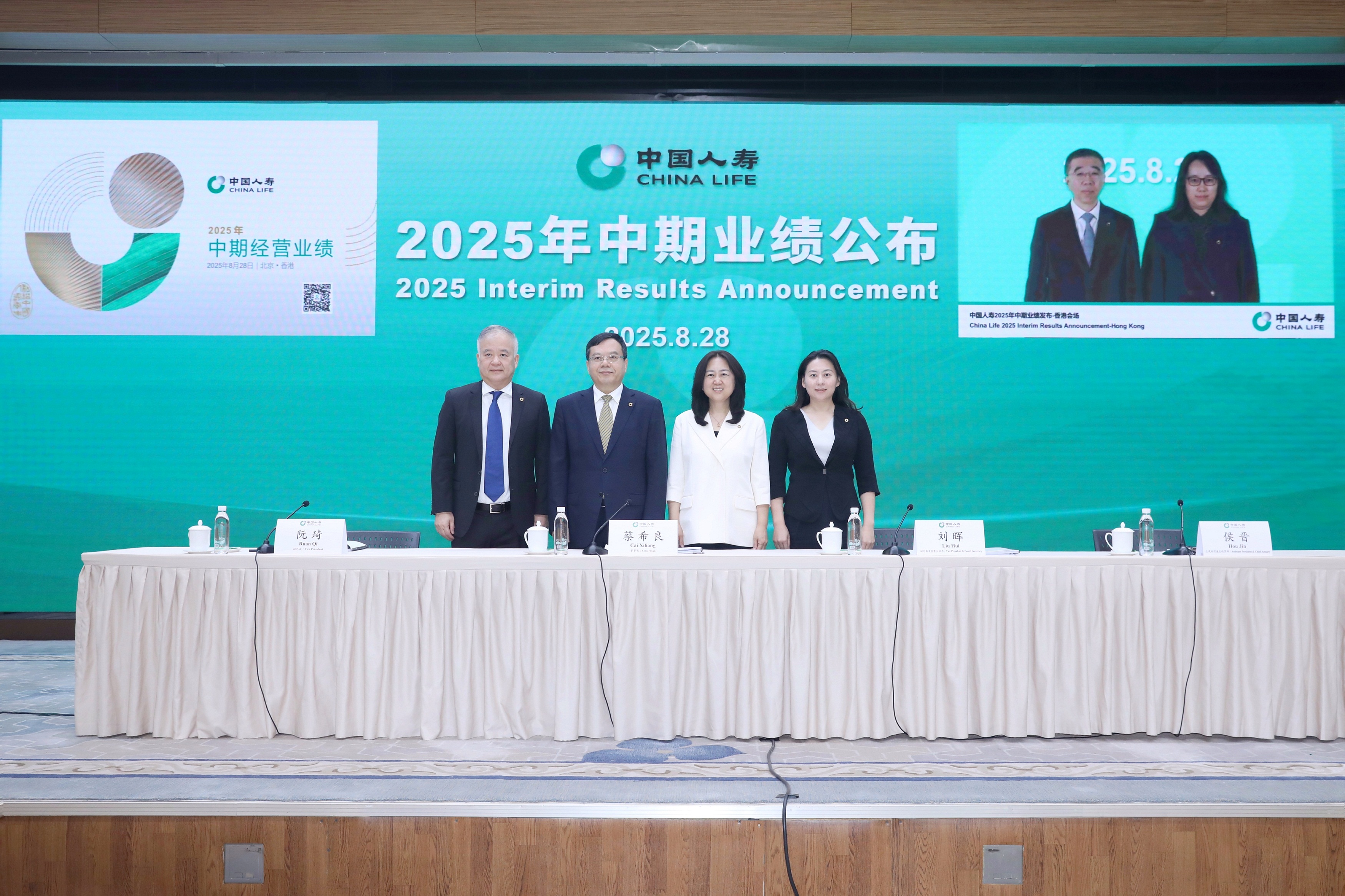
中期分红67.27亿元!下半年中国人寿怎么干|直击业绩会
Guo Ji Jin Rong Bao· 2025-08-28 12:21
Core Viewpoint - China Life Insurance has demonstrated strong performance in the first half of 2025, achieving significant growth in total premiums and net profit, while maintaining strategic focus amidst a complex market environment [1][3]. Financial Performance - In the first half of 2025, China Life's total premium income reached 525.088 billion yuan, a year-on-year increase of 7.3% [3]. - The net profit attributable to shareholders was 40.931 billion yuan, reflecting a growth of 6.9% compared to the previous year [1]. - Total assets and investment assets both surpassed 7 trillion yuan, standing at 7.29 trillion yuan and 7.13 trillion yuan respectively by the end of June 2025 [1]. Dividend Distribution - The board of directors proposed a mid-year cash dividend of 2.38 yuan per 10 shares (tax included), totaling 6.727 billion yuan in dividends [1]. Business Segments - The life insurance segment contributed 439.134 billion yuan, growing by 8.5% year-on-year, while health insurance premiums were 78.958 billion yuan, up by 2.0% [3]. - The individual insurance channel generated 400.448 billion yuan in premiums, a 2.6% increase, while the bank insurance channel saw a significant rise of 45.7%, reaching 72.444 billion yuan [3]. Strategic Outlook - The company remains optimistic about the long-term growth of the life insurance industry in China, citing large development space, significant demand for protection, and strong policy support as key factors [4]. - China Life is prepared for upcoming adjustments in predetermined interest rates, having established a comprehensive management system across various operational aspects [4]. Investment Strategy - As of mid-2025, investment assets grew by 7.8% compared to the end of 2024, with bond investments at 4.21 trillion yuan [7]. - The net investment income was 96.067 billion yuan, with a net investment yield of 2.78% [8]. - The company plans to maintain a flexible asset allocation strategy, focusing on high-quality dividend stocks and new economic sectors for long-term returns [8][9]. Market Focus - China Life has received a QDII quota of 5 million USD and is particularly attentive to the Hong Kong stock market, which has shown strong recovery and growth [9].


中国人寿利明光:预定利率下调预计整体影响较为有限
Bei Jing Shang Bao· 2025-08-28 04:00
利明光表示,在预定利率调整后,公司能够迅速应对、敏捷投放产品,及时触达客户。预计整体影响较 为有限。 北京商报讯(记者 李秀梅)8月28日,在中国人寿保险股份有限公司(以下简称"中国人寿")召开的 2025年中期业绩发布会上,对于预定利率下调,中国人寿总裁利明光表示,就本次预定利率下调而言, 公司已经做了充分的准备工作,包括新产品储备、销售管理、人员培训、系统建设、政策宣传、舆情监 测等方面,形成了贯穿公司前中后台的综合化经营管理体系。 ...
东吴证券:7月寿险保费单月增速显著提升 财险业务保持稳健
Zhi Tong Cai Jing· 2025-08-28 02:45
Group 1: Insurance Industry Overview - The insurance industry's liability and asset sides are continuously improving, with significant upward valuation potential remaining [1] - The market's savings demand remains strong, and with ongoing regulatory guidance and proactive transformation by insurance companies, liability costs are expected to gradually decrease, alleviating pressure from interest rate spreads [1] - The ten-year government bond yield has recently fallen to approximately 1.76%, and it is anticipated that as the domestic economy recovers, long-term interest rates may rise, easing pressure on new fixed-income investment returns for insurance companies [1] Group 2: Life Insurance Sector Performance - In July, the life insurance sector's premium income increased by 26.2% year-on-year, significantly up from June's growth rate [1] - From January to July 2025, the original premium income for life insurance reached 33,203 billion yuan, a year-on-year increase of 7.5%, while the scale premium was 37,498 billion yuan, up 6.4% year-on-year [1] - The growth in July's premium income is attributed to the ongoing "deposit migration" phenomenon and the suspension of old products due to reduced preset interest rates [1] Group 3: Health Insurance Sector Insights - In July, health insurance premiums increased by 2.6% year-on-year, marking a return to positive growth after a decline in June [2] - From January to July 2025, health insurance premiums grew by 2.3% year-on-year, compared to a 7.8% increase in the same period of 2024 [2] - The long-term outlook for health insurance remains positive, with potential for growth through the establishment of a comprehensive health ecosystem integrating insurance, medical services, and wellness management [2] Group 4: Property Insurance Sector Developments - In July, property insurance premiums rose by 5.3% year-on-year, with non-auto insurance business showing improved growth [3] - From January to July 2025, property insurance premiums totaled 10,933 billion yuan, reflecting a year-on-year increase of 5.1% [3] - The growth in non-auto insurance premiums in July was driven by health insurance, with significant increases in various segments such as health, accident, agricultural, and liability insurance [3]

保险行业7月保费:寿险保费单月增速显著提升,财险业务保持稳健
Soochow Securities· 2025-08-27 13:37
Investment Rating - The report maintains an "Accumulate" rating for the insurance industry [1] Core Insights - In July, the life insurance premium growth rate significantly increased, while the property insurance business remained stable [1] - The life insurance companies' original premium income for the first seven months of 2025 reached 33,203 billion yuan, a year-on-year increase of 7.5%, with a total premium income of 37,498 billion yuan, up 6.4% year-on-year [4] - The report anticipates a shift towards dividend insurance products following adjustments in the preset interest rates, indicating a positive outlook for the industry's liability cost optimization [4] - The health insurance premium in July showed a year-on-year increase of 2.6%, marking a return to positive growth [4] - The property insurance companies' premium income for the first seven months of 2025 was 10,933 billion yuan, reflecting a year-on-year increase of 5.1% [4] - The report highlights that the market's savings demand remains strong, and the liability costs are expected to gradually decrease, alleviating pressure from interest rate differentials [4] Summary by Sections Life Insurance - July's single-month life insurance premium reached 3,447 billion yuan, a year-on-year increase of 26.2%, with a notable acceleration from June's growth [4] - The new investment contributions from policyholders showed a year-on-year decrease of 1% for the first seven months, but July saw a significant increase of 21% [4] Health Insurance - The health insurance premium for July was 2.6% higher year-on-year, reversing the negative trend observed in June [4] - The report emphasizes the potential for long-term growth in health insurance through the integration of various health-related services [4] Property Insurance - The property insurance premium for July increased by 5.3% year-on-year, with non-auto insurance business showing improved growth [4] - The report notes that the growth in non-auto insurance premiums was driven by health insurance, with specific segments like health and accident insurance showing substantial increases [4] Market Outlook - The report indicates that the valuation of the insurance sector remains at historical lows, with expected valuations for 2025 ranging from 0.64 to 0.95 times PEV and 1.10 to 2.24 times PB [4] - The report concludes that the leading insurance companies are likely to maintain robust growth and profitability, particularly in the context of ongoing reforms [4]


预定利率下调“倒计时”!分红险竞争优势凸显,险企该如何竞逐?
Huan Qiu Wang· 2025-08-27 11:50
Core Viewpoint - The insurance industry is undergoing a significant shift as the predetermined interest rates for life insurance products are set to decrease, prompting companies to phase out non-compliant products and introduce new ones. This has led to a heightened interest in participating insurance products, which are expected to dominate the market in a low-interest-rate environment [1][3][5]. Group 1: Changes in Predetermined Interest Rates - The China Insurance Industry Association announced a new research value for ordinary life insurance products' predetermined interest rate at 1.99%, down from 2.34% in January and 2.13% in April, marking a significant decline [3][5]. - Major insurance companies, including China Life and Ping An Life, have adjusted their maximum predetermined interest rates, with ordinary life insurance rates dropping from 2.5% to 2%, and participating insurance rates from 2% to 1.75% [3][5][7]. - The new rates will take effect after August 31, with no applications accepted for products exceeding these limits [3]. Group 2: Shift Towards Participating Insurance Products - In response to the declining interest rates, participating insurance products are gaining traction due to their combination of guaranteed and floating returns, appealing to consumers seeking higher returns [5][6]. - Participating insurance allows policyholders to receive a share of the insurer's profits, with a minimum of 70% of the distributable surplus allocated to policyholders each year [5][9]. - The competitive advantage of participating insurance is further enhanced by its flexibility in product design, allowing for additional features such as universal accounts and health management services [7][8]. Group 3: Market Dynamics and Consumer Behavior - The low-interest-rate environment and asset scarcity are driving insurance companies to expand their offerings of participating and other floating-return products [8][9]. - Data from the China Insurance Industry Association indicates that nearly 40% of new life insurance products launched in the first quarter were participating or universal life insurance [8]. - The performance of participating insurance products is closely tied to the company's actual operating results, with the dividend realization rate being a critical measure of their competitiveness [9][10]. Group 4: Consumer Considerations - Consumers are advised to evaluate the dividend realization rate over the past 5-10 years to assess the stability and variability of the insurer's performance [9][10]. - The speed of cash value growth is also crucial, as faster growth indicates better liquidity and shorter lock-in periods for funds [10]. - Additional factors such as the insurer's investment return rates, solvency ratios, and hidden costs like commissions and management fees should be considered when selecting products [10].

预定利率下调冲击普通人:钱袋子遭 “双重挤压”,长期规划不确定性陡增
Sou Hu Wang· 2025-08-20 08:16
Core Viewpoint - The scheduled interest rate for insurance products in China is set to decrease to 2.0%, significantly impacting consumers' insurance purchases and the insurance industry as a whole [1][7]. Summary by Relevant Sections Impact on Savings-Type Insurance - The reduction in the preset interest rate will lead to a notable decrease in the returns from savings-type insurance products, affecting future pension payouts and overall wealth accumulation for families [2][5]. - The cash value growth of products like endowment life insurance will slow down, diminishing the long-term wealth appreciation effect [2][5]. Impact on Protection-Type Insurance - Premiums for protection-type insurance products, such as critical illness and term life insurance, are expected to rise. For instance, a 30-year-old male will see an increase of 1,830 yuan annually for a specific critical illness insurance product due to the new rate [2][4]. - The average premium increase across various products is estimated to be around 20%, with products that include investment savings features likely experiencing higher adjustments compared to pure protection products [3][4]. Financial Planning Uncertainty - The decrease in preset interest rates introduces uncertainty into long-term financial planning, particularly for essential needs like retirement and education funding, necessitating a reassessment of financial goals and strategies [5][6]. Strategies for Consumers - Consumers are advised to take advantage of the remaining time before the new rates take effect by locking in higher interest rate products, particularly in annuity insurance [6][7]. - It is recommended to diversify asset allocation to mitigate interest rate risks, including increasing investments in fixed-income assets like government bonds [6][7]. - Families without basic protection insurance are encouraged to finalize their plans before premium increases, opting for products that combine protection and savings [6][7].

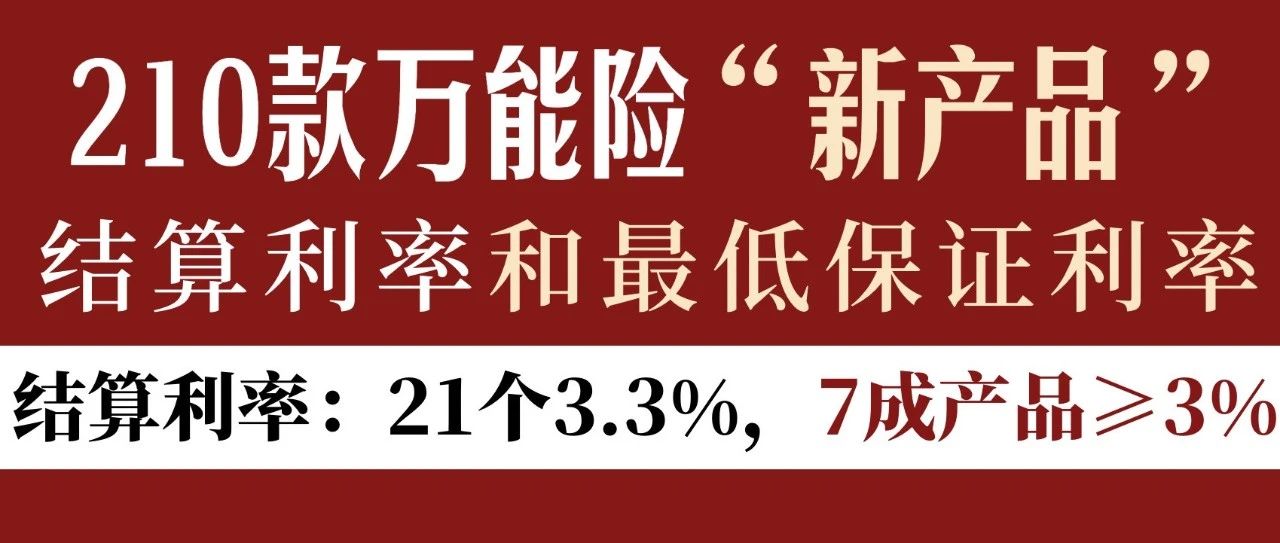
210款万能险的结算利率和最低保证利率:21个3.3%,73个3.0%,7成结算利率≥3%...
13个精算师· 2025-08-19 16:01
Core Viewpoint - The article discusses the trends and changes in the insurance market, particularly focusing on the new universal insurance products launched in 2024, their settlement rates, and minimum guaranteed rates, highlighting the competitive landscape among major insurance companies [1][12]. Summary by Sections Universal Insurance Products - 210 new universal insurance products have been launched in 2024, with 70% of them having a settlement rate of at least 3% [1]. - Among these, 21 products have a settlement rate of 3.3%, while 73 products have a rate of 3.0% [1]. Settlement Rates and Stability - Major insurance companies, referred to as "old six," have maintained a stable settlement rate around 3% for their universal insurance products [1]. - The minimum guaranteed rate for universal insurance is crucial as it sets the lower limit for future settlement rates [1]. Changes in Guaranteed Rates - As of September, the guaranteed rates for various insurance products are set to decrease, with the maximum guaranteed rate for universal insurance dropping to 1.0% [12]. - This change is a response to the current market conditions, where the highest pricing for ordinary insurance products has been adjusted due to regulatory triggers [12]. Market Dynamics - The article notes an increase in activity among insurance agents as they promote the last opportunities to purchase products before the rate changes take effect [12]. - The competitive landscape is characterized by a focus on floating yield products, with universal insurance settlement rates being more transparent and directly observable [13].