
数字经济

Search documents
贵州省政协委员张晖:打造“数字物流大脑” 进一步降低贵州物流成本
Xin Hua Wang· 2026-02-02 03:50
Core Viewpoint - During the "14th Five-Year Plan" period, Guizhou has successfully reduced the proportion of total social logistics costs to GDP to a historical low of 14.3%, but there is still room for optimization compared to developed regions. The proposal to create a "Digital Logistics Brain" aims to further lower social logistics costs through data collaboration [1] Group 1: Infrastructure and Digital Logistics - Guizhou aims to enhance its logistics system by focusing on hardware upgrades and improving internal capabilities, emphasizing the development of a multimodal transport and digital intelligence framework [1] - The proposal includes establishing a unified logistics data sharing platform led by the National Development and Reform Commission and local logistics enterprises to integrate data from various logistics infrastructures and government departments [1] Group 2: Data-Driven Logistics Solutions - By utilizing big data analysis for optimizing logistics routes, capacity scheduling, and warehousing, the proposal addresses the "information island" issue in multimodal transport, enhancing the efficiency of intermodal transport [2] - The development of "digital intermodal + customized services" solutions is suggested to meet the transportation needs of Guizhou's specialty agricultural products and industrial goods, promoting efficient models like "railway fast pass" and "export direct pass" [2] Group 3: Talent Development and Innovation - The proposal includes the establishment of a "Digital Logistics Industry College" to train skilled logistics professionals through a model of school-enterprise cooperation, focusing on smart scheduling and logistics big data analysis [3] - A special fund for digital logistics innovation is suggested to support collaboration between local universities and research institutions in advancing technologies such as autonomous heavy trucks and logistics AI models [3]

2025年A股业绩前瞻:结构分化加剧,资源与制造板块领跑
ZHONGTAI SECURITIES· 2026-02-02 00:55
Overall Performance - As of January 31, 2026, 2,963 listed companies issued earnings warnings, with 1,095 companies (approximately 37%) reporting positive forecasts and 1,867 companies (approximately 63%) reporting negative forecasts[4] - The overall trend indicates a stabilization in earnings, but many companies still struggle to achieve growth, reflecting significant performance divergence across sectors[4] Industry Analysis - Industries with concentrated positive forecasts include non-bank financials, non-ferrous metals, beauty care, automotive, and public utilities, while industries facing negative forecasts include coal, real estate, light manufacturing, food and beverage, and construction decoration[10] - The non-bank financial sector showed a strong improvement, with 88% of companies reporting positive forecasts, driven by a recovery in the capital market and increased investment returns[19] - The non-ferrous metals sector had about 66% of companies reporting positive forecasts, benefiting from rising commodity prices and production capacity release[19] Automotive Sector Insights - The automotive sector had a positive forecast ratio of approximately 54%, indicating strong internal differentiation, with some companies facing profit pressures while others in the supply chain showed growth[24] - Major companies like GAC Group and Dongfeng Group reported losses, while automotive parts manufacturers experienced profit growth due to rising demand[24] Traditional Industries Challenges - The coal industry faced a high negative forecast ratio of about 93%, primarily due to falling prices after a period of high prices from 2022 to 2024, leading to significant profit declines[22] - The real estate sector also struggled, with over 81% of companies reporting negative forecasts, impacted by market downturns and debt issues[22] Future Outlook - The TMT (Technology, Media, and Telecommunications) sector is expected to continue its recovery, supported by policy encouragement and strong demand, particularly in AI and digital economy initiatives[23] - High-end manufacturing, particularly in the renewable energy sector, is showing signs of bottoming out, with expectations of gradual recovery in early 2026[28] Investment Recommendations - Focus on sectors with strong demand and certainty, particularly in commodities like precious metals and new energy metals, as well as strategic resources like rare earths[26] - Caution is advised regarding consumer-related sectors that may experience weak demand elasticity, particularly in real estate and luxury goods[26]
远光软件年度工作会定调:凝聚共识抢抓机遇,共绘数智发展新蓝图
Zhong Guo Jin Rong Xin Xi Wang· 2026-02-02 00:39
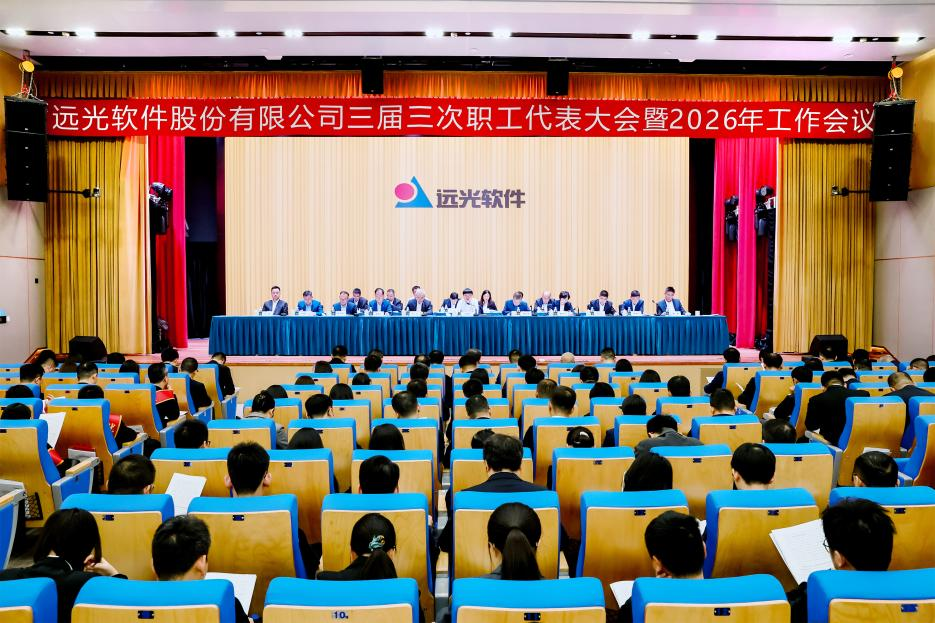
Core Viewpoint - The company held its third employee representative conference and 2026 work meeting, summarizing achievements from 2025 and outlining key tasks for 2026 to strengthen core competitiveness and explore new development opportunities [1] Group 1: 2025 Achievements - The company maintained steady operations in a complex external environment, achieving significant results through its "dual diversification" strategy, focusing on market and product diversification [3] - Key projects completed include the National Grid's smart financial platform and the South Grid's financial domain optimization, with a steady increase in new customer numbers and enhanced market resilience [3] - The company upgraded its core product capabilities, establishing the "Nine Sky" intelligent R&D system and enhancing its digital enterprise core system, leading to improved product autonomy and intelligence [3] - The company was recognized in multiple industry rankings, including being listed among the "Top 100 Software and Information Technology Service Competitiveness" for 2025 and maintaining its status as a "National Encouraged Key Software Enterprise" for 22 consecutive years [3] Group 2: Strategic Opportunities and 2026 Development Plan - The meeting identified strategic opportunities from the advancement of the digital economy, the rise of AI technologies, and the acceleration of new energy systems, aligning with national strategies for technological innovation [4] - The company plans to focus on "smart enterprises" and "smart energy," accelerating market expansion and enhancing its diversified product matrix, while seizing opportunities in domestic innovation, AI, and energy digital transformation [4] - The development blueprint for 2026 emphasizes both deepening and expanding market presence, particularly in the energy and power sectors, while also targeting construction, manufacturing, and healthcare industries [4] - The company aims to enhance its product development and application experience through advanced technologies, ensuring efficient service responses to meet customer needs [4] Group 3: Commitment to Strategic Implementation - The meeting reinforced the company's commitment to seizing market opportunities and deepening strategic implementation for 2026 [5] - The company will leverage its dual advantages as a state-owned enterprise and a publicly listed company, enhancing product competitiveness and market coverage based on years of experience in the digital transformation of state-owned enterprises [5] - The focus will be on creating greater value in supporting national strategies and enabling digital transformation across various industries [5]


全文 | 北京市政府工作报告
Bei Jing Ri Bao Ke Hu Duan· 2026-02-01 22:39
过去一年,在以习近平同志为核心的党中央坚强领导下,在中共北京市委直接领导下,在市人大及其常 委会监督支持下,我们坚持以习近平新时代中国特色社会主义思想为指导,全面贯彻党的二十大和二十 届历次全会精神,深入贯彻习近平总书记对北京重要讲话精神,加强"四个中心"功能建设,提高"四个 服务"水平,深化"五子"联动服务和融入新发展格局,坚持统筹发展和安全,经济顶压前行、向新向优 发展,社会大局保持稳定,较好完成了市十六届人大三次会议确定的目标任务。全市地区生产总值5.2 万亿元、增长5.4%、高于全国0.4个百分点,一般公共预算收入增长4.8%,城镇调查失业率4.1%,居民 政府工作报告 ——2026年1月25日在北京市第十六届人民代表大会第四次会议上 北京市市长 殷勇 殷勇同志作政府工作报告。本报记者 戴冰摄 各位代表: 现在,我代表北京市人民政府,向大会报告政府工作,请予审议,并请市政协委员提出意见。 一、2025年工作回顾 2025年是"十四五"规划收官之年。习近平总书记高度重视首都工作,在听取中国人民抗日战争暨世界反 法西斯战争胜利80周年纪念活动总结报告时发表重要讲话,充分肯定纪念活动服务保障工作;向2025 ...
从数据之“米”到智能之“饭”
Xin Lang Cai Jing· 2026-02-01 21:21
Core Viewpoint - The establishment of the Artificial Intelligence Development Bureau in Nanjing's Yuhuatai District signifies a strategic shift towards actively utilizing data resources to drive industrial upgrades and regional economic growth, emphasizing the importance of collaboration between data management and AI application [3][4][6] Group 1: Relationship Between Data and AI Management - The metaphor of "managing rice" (data) and "managing meals" (AI) illustrates the interdependent yet distinct roles of data governance and AI development [3] - The new bureau aims to transform data into tangible economic and social benefits, highlighting a shift from merely accumulating data to generating real-world value [4] - Successful collaboration between the data bureau and the AI bureau is crucial, as AI applications require high-quality data, while data governance must adapt based on AI's practical needs [4][5] Group 2: Implications for Modern Governance and Industry - The separation and collaboration of data and AI management reflect a fundamental issue in modern professional specialization, emphasizing the need for transparent and permeable boundaries between data repositories and algorithm libraries [5] - The initiative in Yuhuatai District serves as a microcosm for exploring how organizational adjustments can stimulate new productivity development forms [5][6] - The transition from "managing rice" to "managing meals" encapsulates the entire value creation chain in the digital economy, highlighting the ongoing tension between specialized functions and systemic collaboration in modern governance [6]

向新、向绿、向智能——电力数据折射深圳经济高质量发展新动向
Xin Hua She· 2026-02-01 16:44
Group 1 - The core viewpoint of the article highlights Shenzhen's significant transformation towards high-quality development, focusing on new, green, and intelligent initiatives, as evidenced by various electricity consumption statistics and the growth of the automotive industry [1][5][6] - In 2025, Shenzhen's automotive manufacturing electricity consumption increased by 23.98%, while traditional high-energy-consuming manufacturing saw a decline of 3.56%. BYD's sales of new energy vehicles reached 4.602 million units, a growth of 7.73%, with pure electric vehicle sales increasing by 27.86% to 2.2567 million units [1][5] - The overall electricity consumption in Shenzhen reached 127.215 billion kilowatt-hours in 2025, marking a growth of 4.71%, with the secondary industry growing by 2.28% and the tertiary industry by 7.24% [5][6] Group 2 - The "20+8" industrial cluster strategy in Shenzhen is flourishing, with electricity consumption in the pharmaceutical manufacturing, computer communication equipment manufacturing, and instrumentation manufacturing sectors growing by 6.57%, 8.87%, and 9.20%, respectively [6] - The construction of over 1,000 supercharging stations has led to a 16.22% increase in electricity consumption for charging stations, reaching 6.942 billion kilowatt-hours, which accounts for nearly 15% of the tertiary industry's electricity consumption [12] - In 2025, the information transmission, software, and IT service sectors saw a 27.07% increase in electricity consumption, with data center electricity consumption reaching 3.454 billion kilowatt-hours, a growth of 14.92% [12][15]

政策高频 | 加快培育服务消费新增长点(申万宏观·赵伟团队)
申万宏源宏观· 2026-02-01 16:04
Group 1 - The State Council's plan aims to optimize service supply and cultivate new growth points in service consumption to enhance quality of life and support high-quality economic development [1] - Key areas of focus include promoting the integration of transportation services and tourism, expanding inbound consumption, and optimizing performance management in the entertainment sector [1][2] - The plan emphasizes the importance of financial and fiscal support, establishing credit systems in sectors like elderly care and tourism, and developing relevant standards for service consumption [1] Group 2 - The National Science and Technology Work Conference highlighted the need to strengthen basic research and enhance the capacity for independent research and development [3][4] - The conference emphasized the integration of technological innovation with industrial innovation and the importance of international cooperation to improve the overall effectiveness of the national innovation system [3] Group 3 - The National Taxation Work Conference outlined a focus on high-quality tax practices, emphasizing the need for legal compliance, digital transformation, and strict tax management [5][6] - Key goals include creating a comprehensive tax revenue governance system and addressing issues related to tax compliance and management in key sectors [5] Group 4 - The Ministry of Civil Affairs and the Ministry of Finance released guidelines to improve the temporary assistance system, focusing on providing quick aid for urgent needs and supporting vulnerable families [7][8] - The guidelines aim to enhance the efficiency and accessibility of temporary assistance, particularly for families facing sudden financial burdens [7] Group 5 - The Ministry of Natural Resources and other departments introduced measures to lower costs and optimize resource use to support the reform and development of elderly care services [9][10] - Key initiatives include allowing flexible land use for elderly care facilities and promoting innovative resource combinations to enhance service delivery [9] Group 6 - The Ministry of Commerce announced plans to deepen "Belt and Road" cooperation and optimize foreign investment policies to enhance market access and support foreign enterprises [11][12] - The focus is on expanding cooperation in emerging sectors such as green minerals, clean energy, and digital economy [11][12] Group 7 - The State-owned Assets Supervision and Administration Commission outlined the direction for the next round of state-owned enterprise reforms, focusing on optimizing the layout and structure of state-owned economies [14][15] - Emphasis is placed on promoting technological innovation and enhancing the management and supervision of state-owned assets [14] Group 8 - The Ministry of Human Resources and Social Security outlined key tasks in employment, social security, talent development, and labor relations to enhance social welfare [17] - Initiatives include expanding employment opportunities, reforming social security systems, and protecting the rights of new employment forms [17]
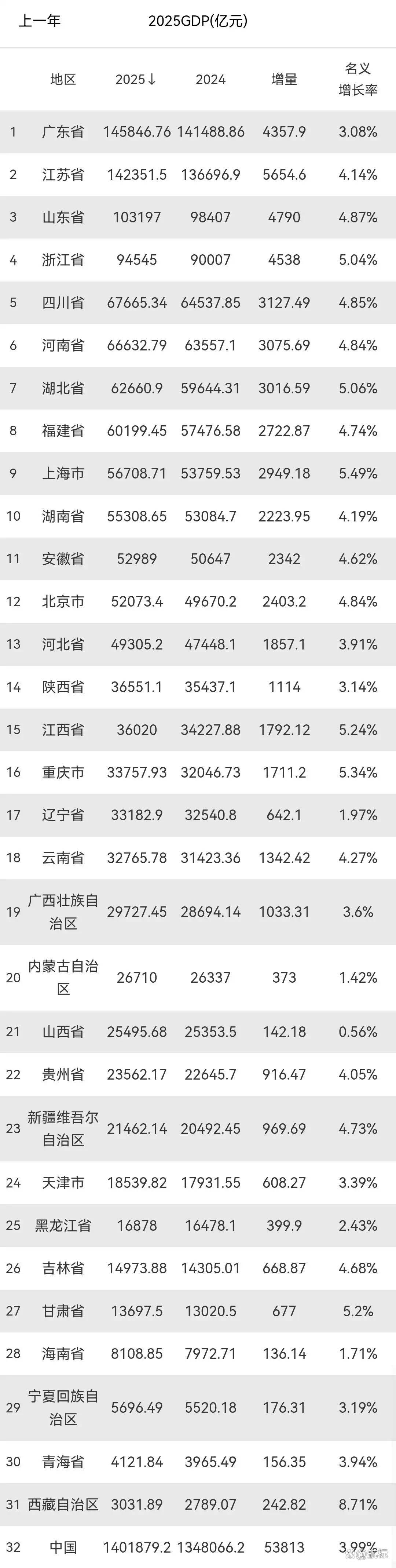
31省2025年经济数据揭晓:从广东到西藏,各省GDP到底怎么涨的?哪些数据影响你的生活?
Sou Hu Cai Jing· 2026-02-01 15:35
Core Viewpoint - The 2025 national GDP reached 140 trillion yuan, showcasing the diverse economic landscape of China through the performances of key provinces and cities, particularly Guangdong, Hubei, Liaoning, and Tibet [1][12]. Group 1: Guangdong Province - Guangdong's GDP reached 145,846.76 billion yuan, accounting for 10.4% of the national economy, with a growth rate of 3.08% and an increase of 4,357.9 billion yuan [2][4]. - The province's economic strength is attributed to its open position, with a 38.7% increase in newly established foreign enterprises and over 90 million inbound tourists [5]. - Innovation is a key driver, with R&D investment exceeding 500 billion yuan, and new economic value contributing 26.7% to GDP [5]. Group 2: Hubei Province - Hubei's GDP reached 62,660.9 billion yuan, ranking seventh nationally, with a growth rate of 5.06%, significantly above the national average [7]. - The province benefits from its strategic location as a transportation hub, with a 26.7% increase in airport cargo throughput and a consistent rise in international freight train shipments [7]. - High-tech manufacturing in Hubei saw a value-added growth rate of 15.5%, supported by significant advancements in the optical electronics industry [7]. Group 3: Liaoning Province - Liaoning's GDP was 33,182.9 billion yuan, with a growth rate of 1.97% and an increase of 642.1 billion yuan [9]. - The province is transitioning from traditional industries, maintaining strong performance in shipbuilding while also seeing a 31.7% increase in new energy vehicle production [9]. - Investments in aerospace manufacturing surged by 61.2%, indicating a shift towards digital economy initiatives [9]. Group 4: Tibet Autonomous Region - Tibet's GDP reached 3,031.89 billion yuan, with the highest growth rate in the country at 8.71%, resulting in an increase of 242.82 billion yuan [11]. - The region's economic growth is driven by tourism, with over 70 million visitors and total tourism revenue exceeding 81.6 billion yuan [11]. - The development of clean energy is significant, with industrial electricity consumption growing by 16%, making up 42.4% of total electricity use [11].
广州举办2026年APEC首次高官会,中国引领亚太合作新征程
2 1 Shi Ji Jing Ji Bao Dao· 2026-02-01 14:02
Core Points - The APEC 2026 First Senior Officials' Meeting is being held in Guangzhou, marking the first official event of the "China Year" for APEC, focusing on the theme of "Building an Asia-Pacific Community for Common Prosperity" and three priority areas: openness, innovation, and cooperation [1][3][12] - The meeting emphasizes discussions on technology innovation, regulatory coordination, health work, and data privacy, with a strong consensus among APEC economies on potential cooperation directions in technology innovation [2][10] Group 1: Event Significance - The choice of Guangzhou for the APEC meeting reflects China's strategic considerations and the city's unique advantages, showcasing its role as a hub for trade and investment liberalization [3][4] - Guangzhou's historical significance as a key node in the Maritime Silk Road and its current status as a core engine of the Guangdong-Hong Kong-Macao Greater Bay Area align with APEC's goals [4][8] Group 2: Economic Cooperation - Guangzhou has attracted nearly $120 billion in foreign investment from APEC economies, accounting for 82.8% of the city's total foreign investment, indicating a strong economic integration with the Asia-Pacific region [7][8] - The city has also invested in 2,684 non-financial projects across 20 APEC economies, with a total investment amount of $24.72 billion, highlighting its active role in regional economic collaboration [7][8] Group 3: Future Prospects - The integration advantages of the Guangdong-Hong Kong-Macao Greater Bay Area are expected to evolve from simple accumulation to complex fusion, enhancing cooperation across various sectors [9] - Guangdong aims to explore high-standard international trade rules in areas like data flow and intellectual property protection, positioning itself at a new starting point in its relationship with APEC economies [9][12] Group 4: China's Leadership Role - China is recognized as a responsible participant in APEC, having transitioned from an active participant to a core agenda leader, especially in the context of rising protectionism and geopolitical tensions [10][12] - The emphasis on openness, innovation, and cooperation in China's proposals for APEC reflects a commitment to maintaining a multilateral trade system and addressing common challenges such as climate change and development gaps [12][13]
1月制造业PMI为49.3% 出厂价格指数近20个月来首次升至临界点以上
Xin Lang Cai Jing· 2026-02-01 13:07
Group 1 - In January, the manufacturing Purchasing Managers' Index (PMI) decreased to 49.3%, indicating a decline in economic sentiment [1] - The non-manufacturing business activity index fell to 49.4%, reflecting a decrease in overall economic activity [1] - The comprehensive PMI output index also dropped to 49.8%, showing a general downturn in economic conditions [1] Group 2 - The decline in manufacturing PMI is attributed to seasonal factors, as many industries enter a traditional off-peak period in January [2] - The PMI index is affected by a high base effect from December 2025, which saw a significant increase, thus impacting January's figures [2] - Weak internal investment and consumption demand, along with high external uncertainties, are major factors dragging down the manufacturing sector [2] Group 3 - The raw material purchase price index rose to 56.1%, while the factory price index increased to 50.6%, marking the first time in nearly 20 months that the factory price index exceeded the critical point [3] - The difference between the raw material purchase price index and the factory price index indicates a transfer of profits upstream [3] - Recent structural policies aimed at supporting small and medium enterprises and technology firms are expected to take time to positively impact the manufacturing sector [3] Group 4 - The non-manufacturing business activity index's decline is influenced by the downturn in industries such as construction, with the index falling to 49.4% [4] - The real estate sector's business activity index dropped below 40.0%, indicating a weak overall sentiment in that industry [4] - Financial services and capital market services showed higher activity levels, with indices above 65.0%, reflecting a more active market [4] Group 5 - The overall macroeconomic sentiment is declining due to seasonal fluctuations, high previous month bases, and insufficient effective demand from the real estate market [5] - The manufacturing production index is expected to decline significantly in February due to the extended Spring Festival holiday [5] - Future manufacturing sentiment will be influenced by export growth, real estate market trends, and the timing and intensity of growth-stimulating policies [5]