
无人驾驶

Search documents
帝王的陨落
Datayes· 2025-12-17 12:00
A股复盘 | 暴赚 / 2025.12.17 哈哈哈,写文章之前看到这张图,给我笑死,群总被做局了! 昨天刚把那张帝王股图表发给别人,也写在早报里了,希望一切都好 都别骂我! 今天上午大家还是"任人宰割"的态度,下午GJD打卡上班了,指数大反弹,沪指都涨一个点,势要把3900点收复了! 群友评论,是白宫炸了还是日本沉了,涨得不踏实! 大家忙不迭得开始找原因,宽指ETF放量,应该是GJD的手法! 说到GJD,盘中传出一个消息。但 汇金的消息一般都是官网发布,然后各大媒体转,这个消息哪里都找不到,大概率是假的,或者是内幕! 12月以来,新生代核心宽基中证A500主题ETF资金流入显著活跃。根据中证报统计,从盘中表现来看,A500ETF华泰柏瑞(563360)今日 成交额罕见突破140亿元,创下历史新高。 截至12月16日,中证A500主题ETF本月已净流入超220亿元, 其中A500ETF南方(159352)、A500ETF华泰柏瑞(563360)、 A500ETF基金(512050)净流入额位居前三,分别为91.24亿元、82.05亿元、48.85亿元。 除了GJD的托底外,日本央行前副行长、政府小组成员若田部 ...


世纪天鸿:公司或公司参股公司未涉足无人驾驶领域
Mei Ri Jing Ji Xin Wen· 2025-12-17 09:33
每经AI快讯,有投资者在投资者互动平台提问:公司参股的无人驾驶公司现在进程如何了? 世纪天鸿(300654.SZ)12月17日在投资者互动平台表示,公司或公司参股公司未涉足该领域。 (文章来源:每日经济新闻) ...


星宸科技涨2.32%,成交额3.54亿元,今日主力净流入-1118.68万
Xin Lang Cai Jing· 2025-12-17 08:44
Core Viewpoint - Xingchen Technology has shown a positive market performance with a 2.32% increase in stock price, reaching a market capitalization of 24.502 billion yuan, indicating investor interest in the company's growth potential in the AI and semiconductor sectors [1]. Company Overview - Xingchen Technology Co., Ltd. is located in Xiamen, Fujian Province, and specializes in the design, research, and sales of edge AI SoC chips, primarily serving sectors such as intelligent security, IoT, and automotive applications [3][7]. - The company was established on December 21, 2017, and went public on March 28, 2024. Its main revenue source is from product sales, accounting for 99.93% of total income [7]. Financial Performance - For the period from January to September 2025, Xingchen Technology reported a revenue of 2.166 billion yuan, reflecting a year-on-year growth of 19.50%. The net profit attributable to shareholders was 202 million yuan, with a growth of 3.03% compared to the previous year [7]. - The company has distributed a total of 126 million yuan in dividends since its A-share listing [8]. Market Activity - The stock has experienced a net outflow of 11.1868 million yuan today, with a total market activity showing no significant trend in major shareholder movements [4][5]. - The average trading cost of the stock is 59.77 yuan, with the current price approaching a resistance level of 59.22 yuan, indicating potential volatility in the near term [6]. Strategic Developments - The company has developed chips suitable for AI glasses and is actively engaging with various clients, including mobile brands and ODMs, to expand its market reach [2]. - Xingchen Technology has invested 10 million yuan in Nanjing Qipao Electronic Technology Co., Ltd., acquiring a 4% stake, which focuses on low-power satellite navigation chips for smart wearables [2].
智能汽车ETF(159889)涨超1.2%,行业加速与结构性机会受关注
Mei Ri Jing Ji Xin Wen· 2025-12-17 07:14
Group 1 - The smart driving industry is expected to accelerate its development by 2025, with leading OEMs like BYD increasing their investment in smart driving, leading to a continuous rise in penetration rates [1] - In 2026, despite ongoing price competition among OEMs and pressure from subsidy reductions, there are still structural opportunities in the industry: 1) The competition landscape for smart driving chips is favorable, with significant room for domestic production rate improvement, as local manufacturers like Horizon Robotics, Black Sesame Intelligence, and Huawei have achieved mass production capabilities [1] - The overseas market is becoming an important growth driver, with low penetration rates in regions like Europe, the US, and Japan, allowing local Tier 1 and lidar companies to accelerate their international expansion based on product competitiveness [1] Group 2 - The new autonomous driving sector is witnessing breakthroughs from 0 to 1, with policies accelerating the commercialization of Robotaxi, and companies like Pony.ai are going public [1] - The commonality of technical architecture allows for the reuse of core components such as smart driving chips and sensors in the robotics field, creating industrial synergy effects [1] - The Smart Car ETF (159889) tracks the CS Smart Car Index (930721), which selects listed companies providing terminal perception and platform applications for smart cars from the Shanghai and Shenzhen markets, reflecting the overall performance of securities related to the smart car industry [1]
长安、北汽L3级车型明年一季度试点上路,资本市场闻风动
Bei Ke Cai Jing· 2025-12-17 05:40
Core Viewpoint - The Ministry of Industry and Information Technology has announced the first batch of L3 conditional autonomous driving vehicle permits in China, with Changan Automobile and BAIC's Arcfox planning to pilot their models in designated areas of Beijing and Chongqing by the first quarter of 2026 [1][2]. Group 1: Company Plans - Changan Automobile's model, the Deep Blue SL03, and BAIC's Arcfox Alpha S (L3 version) will be operated by Chongqing Changan Car Networking Technology Co., Ltd. and Beijing Mobility Automotive Service Co., Ltd., respectively [2]. - Both companies aim to accumulate practical experience for a replicable and scalable autonomous driving operation system, with plans to initiate L3 operations in specific scenarios by the first quarter of 2026 [2]. Group 2: Market Impact - Following the announcement of the permit list, BAIC Blue Valley's stock hit the daily limit, while Changan Automobile's stock closed with a 4.42% increase; the intelligent driving sector saw a surge, with multiple stocks reaching their daily limits [2]. - However, by the afternoon of December 17, both Changan Automobile and BAIC Blue Valley experienced declines, although the intelligent driving index continued to rise [2].


金禄电子:公司PCB有应用于雷达、摄像头等传感器
Mei Ri Jing Ji Xin Wen· 2025-12-17 03:47
Group 1 - The core viewpoint of the article highlights the involvement of the company in the autonomous driving sector through its PCB products, which are utilized in sensors like radar and cameras [1] - The company has established partnerships with leading firms in the intelligent driving field, including Suyuan Juchuang, Tudatong, Siwei Tuxin, Youjia Innovation, and Daisi Intelligent [1]
光大期货金融期货日报-20251217
Guang Da Qi Huo· 2025-12-17 03:33
Report Industry Investment Rating - No specific industry investment rating is provided in the report. Report's Core View - **Stock Index Futures**: The stock index futures market has been fluctuating around the lower edge of the central range since October, with limited differentiation between large - and small - cap indexes and frequent sector rotations. The recent important meetings have a long - term positive impact on the stock index, but in the short term, it will mainly fluctuate. The expected GDP growth target of 5% in 2026 remains unchanged, and policies will focus on "stabilizing domestic demand" and "promoting the rapid development of new - quality productivity". Fiscal and monetary policies will continue to work together, and the scale may increase slightly compared to this year. Overseas, the Fed's interest rate cut and restart of the balance - sheet expansion plan, along with the upcoming Bank of Japan's interest - rate meeting, may affect the market [1]. - **Treasury Bond Futures**: Treasury bond futures showed mixed performance. The central economic work conference has set the tone for a moderately loose monetary policy in 2026, but interest - rate cuts will be cautious. In the short term, the bond market's volatile pattern is difficult to change due to reasonable and sufficient funds, economic recovery, and price warming [2]. Summary by Directory Research View - **Stock Index Futures**: The market adjusted throughout the day, with the Shanghai Composite Index and Shenzhen Component Index both falling more than 1%, and the ChiNext Index falling more than 2%. Over 4,300 stocks in the Shanghai, Shenzhen, and Beijing markets declined, and the trading volume was 1.75 trillion yuan. The short - term impact of policies on the market is expected to increase. The expected GDP growth target of 5% in 2026 remains unchanged, and policies will focus on "stabilizing domestic demand" and "promoting the rapid development of new - quality productivity". Overseas, the Fed's interest - rate cut and the upcoming Bank of Japan's interest - rate meeting may affect the market. The short - term trend is mainly fluctuating [1]. - **Treasury Bond Futures**: The 30 - year main contract of treasury bond futures fell 0.19%, the 10 - year main contract rose 0.05%, the 5 - year main contract rose 0.03%, and the 2 - year main contract fell 0.02%. The central bank conducted 1353 billion yuan of 7 - day reverse repurchases, with a winning bid rate of 1.4%. The net investment was 180 billion yuan. The central economic work conference set the tone for a moderately loose monetary policy in 2026, but interest - rate cuts will be cautious. In the short term, the bond market's volatile pattern is difficult to change [2]. Daily Price Changes - **Stock Index Futures**: On December 16, 2025, IH was at 2,951.4, down 32.4 or 1.09% from the previous day; IF was at 4,499.4, down 46.2 or 1.02%; IC was at 7,010.2, down 105.6 or 1.48%; IM was at 7,189.0, down 119.0 or 1.63% [3]. - **Stock Indexes**: The Shanghai 50 Index was at 2,954.8, down 32.3 or 1.08%; the CSI 300 Index was at 4,497.6, down 54.5 or 1.20%; the CSI 500 Index was at 7,001.3, down 112.6 or 1.58%; the CSI 1000 Index was at 7,181.6, down 127.5 or 1.74% [3]. - **Treasury Bond Futures**: TS was at 102.43, down 0.028 or 0.03%; TF was at 105.80, up 0.01 or 0.01%; T was at 107.91, up 0.035 or 0.03%; TL was at 111.39, down 0.14 or 0.13% [3]. Market News - **Overall Market**: The market adjusted throughout the day, with the Shanghai Composite Index and Shenzhen Component Index both falling more than 1%, and the ChiNext Index falling more than 2%. Over 4,300 stocks in the Shanghai, Shenzhen, and Beijing markets declined, and the trading volume was 1.75 trillion yuan. The Shanghai Composite Index closed down 1.11%, the Shenzhen Component Index down 1.51%, and the ChiNext Index down 2.1% [4]. - **Industry Sectors**: Retail, education, digital currency, and unmanned driving sectors led the gains, while precious metals, controllable nuclear fusion, cultivated diamonds, and non - ferrous metals sectors led the losses [5]. - **Popular Concepts**: Retail and other consumer stocks strengthened against the trend, with many stocks such as Yonghui Superstores and Anji Foods hitting the daily limit. The unmanned driving concept was active, with stocks like Zhejiang Shibaobao and BAIC BluePark hitting the daily limit. Digital currency concept stocks rose, with stocks like Cuiwei Co., Ltd. and Hengbao Co., Ltd. hitting the daily limit. On the decline side, the photovoltaic sector adjusted, with Zhongli Group hitting the daily limit down; the controllable nuclear fusion concept declined, with Sinomach Heavy Equipment hitting the daily limit down [5]. Chart Analysis - **Stock Index Futures**: The report provides charts of the trends of IH, IF, IM, IC main contracts, and their respective monthly basis trends [6][7][8]. - **Treasury Bond Futures**: The report provides charts of the trends of treasury bond futures main contracts, treasury bond spot yields, basis, inter - period spreads, cross - variety spreads, and capital interest rates [13][14][18]. - **Exchange Rates**: The report provides charts of the central parity rates of the US dollar, euro against the RMB, forward exchange rates, the US dollar index, and exchange rates between the euro, pound, and yen against the US dollar [20][21][27].
4500只个股下跌、资金却疯狂涌入这个板块、午后关注三大信号
Sou Hu Cai Jing· 2025-12-17 02:18
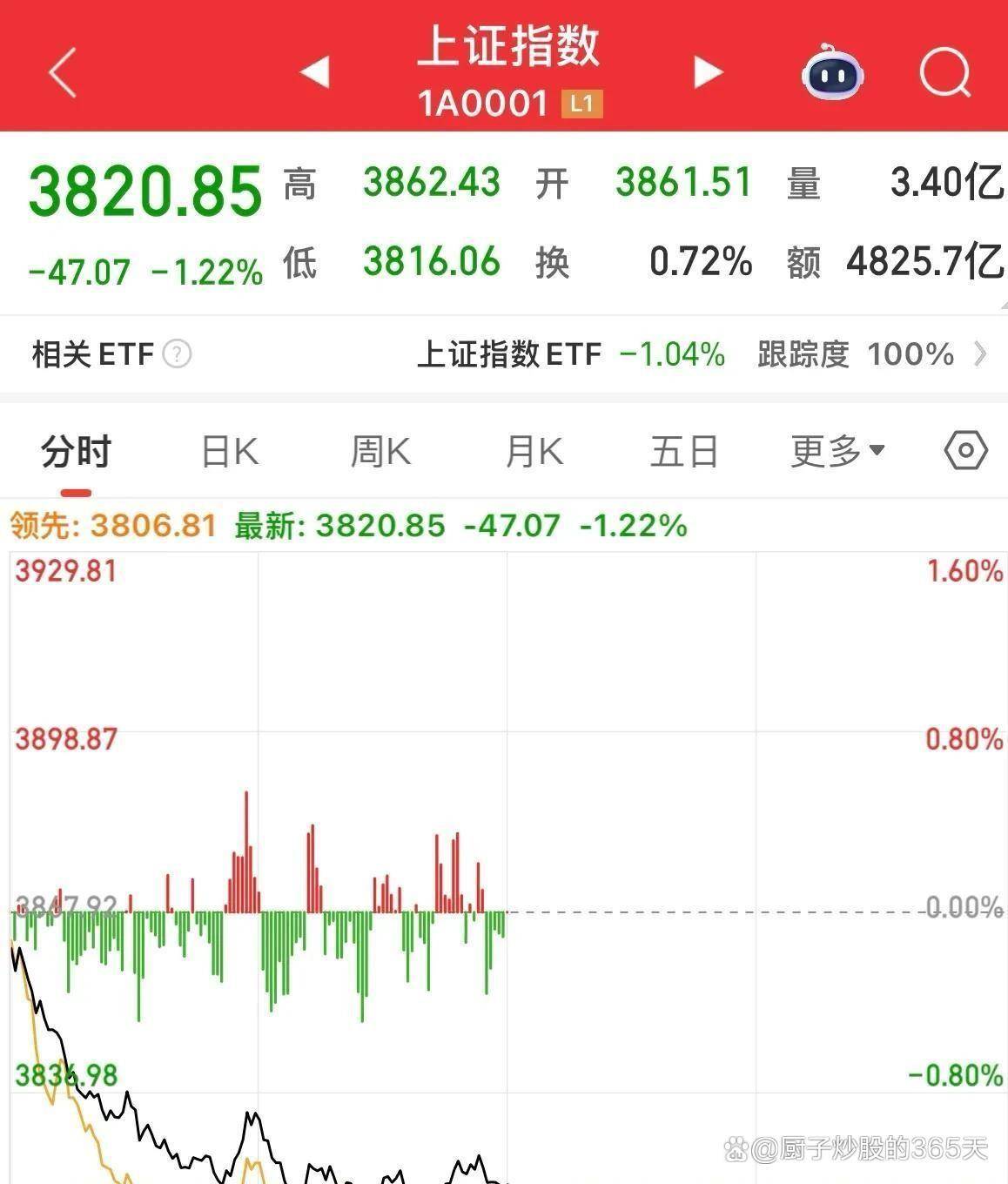
Core Viewpoint - The A-share market experienced a significant decline, with the Shanghai Composite Index dropping below 3820 points, reflecting a broader trend of nearly 90% of stocks declining, primarily driven by internal capital outflows and external market pressures [1][2]. Market Performance - The Shanghai Composite Index fell by 1.22%, while the ChiNext Index dropped by 2.35% and the Sci-Tech 50 Index decreased by 1.98% [1]. - Over 4500 stocks declined, with a half-day trading volume of 1.12 trillion yuan, down 606 billion yuan from the previous day, and a net outflow of 68 billion yuan in main funds [1]. - Retail and food & beverage sectors showed slight resilience, while small-cap stocks faced significant losses, with some indices dropping over 2.5% [1]. Global Market Influence - The decline in A-shares was exacerbated by a global market downturn, particularly in the U.S. tech sector, where major companies like Nvidia and Oracle saw declines exceeding 3% [2][3]. - The Bank of Japan's indication of a potential interest rate hike triggered a reversal of carry trade flows, leading to capital outflows from emerging markets like A-shares [3]. Sector Analysis - High valuation sectors such as CPO, semiconductors, and photovoltaic equipment faced severe sell-offs, with notable declines in stocks like Longi Green Energy and Zhongji Xuchuang [6]. - Defensive sectors, including consumer goods and tourism, showed gains, with stocks like Yonghui Supermarket and Kweichow Moutai experiencing price increases [6]. Investment Strategy Shifts - A significant shift in investment strategy was observed, with over 80% of industries declining, while sectors with stable cash flows became preferred choices for risk-averse investors [7]. - The market's trading volume dropped to a recent low, indicating a cautious sentiment among investors, with potential implications for liquidity and future market adjustments [7]. Future Outlook - The potential for market reversal hinges on three signals: recovery in tech stock sentiment, increased trading volume above 1.5 trillion yuan, and a return of foreign capital inflows [11]. - Despite the current downturn, there are structural opportunities in sectors like autonomous driving and innovative pharmaceuticals, supported by favorable policies [11].
财信证券晨会纪要-20251217
Caixin Securities· 2025-12-16 23:30
Market Strategy - The market is experiencing continuous volume contraction, with the retail sector showing resilience [5][10] - The overall A-share market saw a decline of 1.45%, with the Shanghai Composite Index down 1.11% and the ChiNext Index down 2.10% [9][10] - The retail sector is expected to benefit from government policies aimed at boosting consumption, especially as the year-end shopping season approaches [10][11] Company Tracking - Chongqing Beer (600132.SH) is involved in a lawsuit and is planning to sign a mediation agreement, which may impact its financials positively [38][41] - Miao Ke Lan Duo (600882.SH) announced expected related party transactions for 2026, with a projected decrease in procurement amounts compared to 2025 [33][35] - YH Bio (688575.SH) received two medical device registration certificates, indicating potential growth in its product offerings [36] - Mingyang Smart Energy (601615.SH) won a bid for a significant offshore wind power project valued at 1.834 billion yuan, enhancing its market position in renewable energy [42][44] Industry Dynamics - The Three Gorges Jiangsu Dafeng 800 MW offshore wind power project has achieved full capacity grid connection, marking a significant advancement in China's offshore wind energy capabilities [31][32] - The National Development and Reform Commission emphasized the need to enhance domestic consumption and support various sectors, including e-commerce and health care, to stimulate economic growth [21][22]



一扫年初阴霾!无人驾驶迈出关键一步 特斯拉(TSLA.US)股价触及历史新高
Zhi Tong Cai Jing· 2025-12-16 22:44
Core Viewpoint - Tesla is experiencing a strong rebound in its stock price after a significant decline earlier this year, driven by advancements in autonomous driving technology and positive market sentiment [1][2]. Group 1: Stock Performance - Tesla's stock price has recovered from a 36% drop in the first quarter, closing at a record high of $489.88, with a year-to-date increase of 21% [1]. - The company's market capitalization has reached approximately $1.63 trillion, making it the seventh largest publicly traded company globally [2]. Group 2: Autonomous Driving Developments - Tesla's CEO Elon Musk announced that the company is testing fully autonomous vehicles in Austin, Texas, without any occupants, which is seen as a significant step towards realizing the "robotaxi" vision [1]. - Despite the advancements, there are ongoing discussions regarding safety and regulatory compliance for the autonomous driving system, which has not yet been made widely available to the public [2]. Group 3: Financial Performance - Tesla's first-quarter vehicle deliveries fell by 13% year-over-year, with automotive revenue declining by 20%, while the second quarter saw a 16% drop in automotive revenue [3]. - In the third quarter, Tesla reported a 12% year-over-year revenue increase, driven by consumer purchases ahead of the expiration of federal electric vehicle tax credits [3]. Group 4: Market Challenges - The company faces challenges from the cancellation of tax incentives, negative public sentiment towards Musk, and intense competition from companies like BYD, Xiaomi, and Volkswagen [3]. - Tesla has introduced cheaper versions of the Model Y and Model 3, but these models have not significantly boosted sales in the U.S. and Europe, with November sales in the U.S. hitting a four-year low [3]. Group 5: Analyst Outlook - Despite the challenges, some Wall Street analysts remain optimistic about Tesla's future, with Mizuho Securities raising its target price from $475 to $530, citing improvements in Tesla's Full Self-Driving (FSD) technology [4]. - The potential for expanding the robotaxi fleet in cities like Austin and San Francisco is seen as a key factor for future growth, although the transition to fully autonomous operation remains a critical focus for the market [4].
