
云计算

Search documents
怎么看亚马逊和阿里云涨价
2026-01-26 15:54
Summary of Conference Call on Cloud Services Price Trends Industry Overview - The conference call discusses the recent price increases in cloud services, particularly focusing on Amazon Web Services (AWS) and Alibaba Cloud, with a specific emphasis on AI and GPU-related services [1][2]. Key Points and Arguments Price Increases - AWS has raised prices for GPU-related cloud services by approximately 15%, with specific instances increasing from $30.34 to $39 per hour, breaking a trend of price reductions since 2020 [2]. - Alibaba Cloud has followed suit, increasing prices for AI computing services while basic cloud services like CPU instances and object storage are still in a price reduction cycle, with some overseas ECS instances seeing price drops of 10%-12% [2]. Scope of Price Increases - Price hikes are not limited to GPU services but also include AI-related PaaS offerings such as virtualization and containerization, with expected increases of 5%-8% in the future [1][5]. - Current AI infrastructure, including GPU, CPU, and storage devices, has already seen price increases, while PaaS and SaaS layers have not yet shown clear price hike expectations [3][13]. Supply Chain and Market Dynamics - A shortage of storage chips is a primary driver of price increases, with expectations that supply issues will persist until mid-2027 [8]. - The shift in demand from training to inference in AI workloads is causing a non-linear increase in task volume, contributing to the upward price trend [7][8]. Technological Changes - The cloud computing architecture is evolving towards intelligent computing centers, with significant changes in network architecture, business applications, storage technology, and energy management [9][11]. - New technologies such as SAD QLC storage and HAMR are being introduced to enhance performance and cost-effectiveness in AI databases and training tasks [12]. Competitive Landscape - The domestic cloud computing market has transitioned from a three-player model to a multi-modal structure, including traditional giants, telecom operators, emerging AI computing companies, and vertical private cloud enterprises [16]. Additional Important Insights - The price increases are partly due to the need for companies to balance operational costs and recovery periods, especially in the AI computing sector, where high operational costs can lead to prolonged periods of loss [18]. - The profit margins for companies have improved post-price hikes, emphasizing the importance of ensuring that investments in AI capabilities yield profitability [19]. - Small and medium-sized customers are sensitive to price increases and may consider building their own data centers if costs become prohibitive, potentially shifting demand away from major cloud providers [21]. Conclusion - The overall trend indicates a sustained increase in prices for AI and GPU-related cloud services, driven by supply chain constraints and evolving market dynamics, while basic services may continue to see competitive pricing to attract smaller clients.

【公告全知道】商业航天+可控核聚变+芯片+人形机器人+云计算!公司产品已应用可控核聚变试验项目(EAST)
财联社· 2026-01-26 15:38
《公告全知道》每周日至每周四推送明日股市重大公告!内容包含"停复牌、增减持、投资中标、收 购、业绩、解禁、高送转"等一系列个股利好利空公告,其中重要公告均以红色标注,帮助投资者提前 寻找到投资热点,防范各类黑天鹅事件,并且有充足的时间进行分辨和寻找合适的上市公司。 前言 ...


两部门印发《网络货运承运平台经营管理办法》
Xin Lang Cai Jing· 2026-01-26 14:54
Core Viewpoint - The "Management Measures for Network Freight Carriage Platforms" aims to promote the integration of road freight transport with the internet, regulate the operations of network freight platforms, maintain market order, and protect the legal rights of all parties involved [2]. Group 1: General Principles - The management of network freight platforms should adhere to principles of voluntariness, equality, fairness, and integrity, complying with laws and business ethics [2][3]. - The Ministry of Transport is responsible for the national management of network freight platforms [4]. Group 2: Operational Management - Platforms must apply for a road transport operating license from local transport authorities, which will issue licenses to qualified applicants [6]. - Network freight platforms must comply with internet service management regulations and possess adequate online service capabilities [7]. - Platforms are required to establish safety management systems and provide safety education for personnel [8]. Group 3: Compliance and Responsibilities - Platforms must verify the qualifications of actual carriers and ensure that vehicles and drivers meet legal requirements [8]. - Platforms are prohibited from transporting goods that are legally restricted and must not fabricate transportation transactions [10]. - Platforms should maintain accurate records of user information and transaction data for a minimum of three years [13]. Group 4: Supervision and Evaluation - Provincial transport authorities are tasked with establishing monitoring systems to ensure platforms upload documentation accurately and timely [15]. - Platforms engaging in tax violations will be subject to penalties as per tax laws [24]. - A credit evaluation mechanism for network freight platforms will be established to promote compliance and accountability [27].
AI并非“泡沫”,而是产业趋势
3 6 Ke· 2026-01-26 12:26
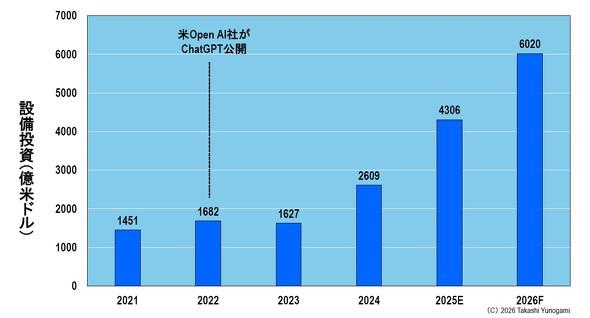
Core Insights - The capital expenditure (Capex) of the top eight cloud service providers is projected to grow from $145.1 billion in 2021 to $602 billion by 2026, representing an increase of over four times [1][5][20] - This surge in investment is driven by the exponential demand for computing power, particularly due to generative artificial intelligence (AI), which requires significantly more computational resources than traditional services [1][2][12] - The current investment trend is not a bubble but a structural shift in demand for computing infrastructure, fundamentally different from past economic bubbles [14][19] Group 1: Investment Trends - The top eight cloud service providers include Amazon (AWS), Microsoft (Azure), Google Cloud, Meta, Oracle (OCI), Alibaba Cloud, Tencent Cloud, and ByteDance [3] - Despite a temporary decline in capital expenditure during 2022-2023, a rebound is expected starting in 2024, coinciding with the launch of ChatGPT by OpenAI [5][20] - The investment in generative AI is seen as essential for maintaining competitive advantage in the cloud market, as failing to invest would lead to a loss of core value [2][23] Group 2: Computing Demand - The demand for computing power driven by generative AI is fundamentally different from traditional computing needs, necessitating a complete overhaul of the cloud computing infrastructure [6][12] - Generative AI's processing requirements are orders of magnitude greater than those of traditional search engines, with computational needs differing by a factor of 10,000 to 100,000 times [10][12] - The industry is experiencing a structural change in computing demand, with a significant increase in the need for data centers, power supply, cooling technologies, and network architecture [13][19] Group 3: Market Dynamics - The semiconductor market, particularly for data center logic chips, is expected to expand significantly, with the GPU market projected to grow from $100 billion to over $230 billion by 2030 [24][26] - The AI ASIC market is anticipated to grow ninefold, from $9 billion to $84 billion, indicating a shift towards specialized hardware for AI applications [24][26] - The memory market, especially for high-bandwidth memory (HBM), is also expected to see substantial growth, with DRAM market projections reaching $194 billion by 2030 [27][29] Group 4: Competitive Landscape - The competitive landscape for cloud service providers is becoming increasingly harsh, with a clear delineation that companies lacking sufficient computing power will be eliminated from the market [23][24] - Investment in AI-related infrastructure is viewed as a necessity for maintaining market position rather than a discretionary expenditure [23][24] - The transition from traditional computing to AI-driven infrastructure represents a significant shift in the market, with companies like TSMC poised to benefit from the demand for advanced semiconductor technologies [32][35]


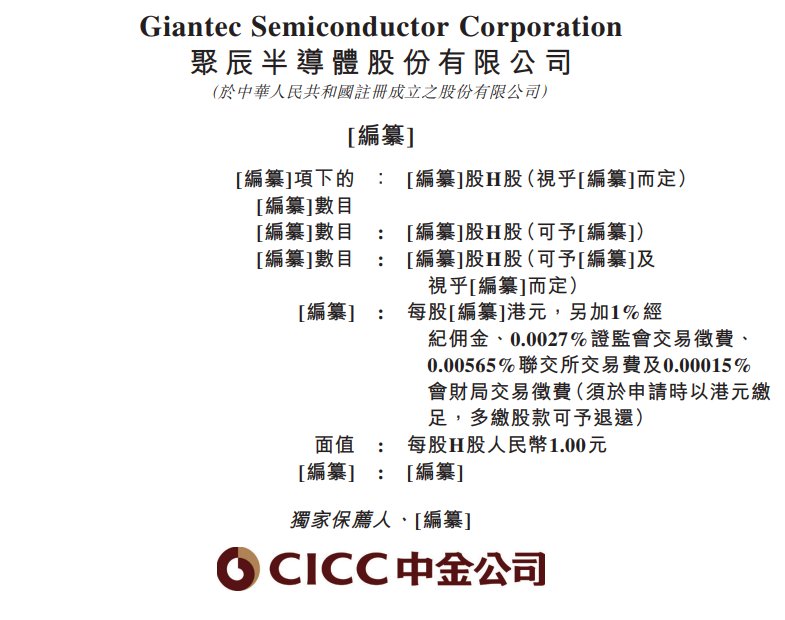
新股消息 | 聚辰股份(688123.SH)递表港交所 按2024年收入计全球DDR5 SPD芯片市场份额超40%
智通财经网· 2026-01-26 11:51
Company Overview - Jucheng Semiconductor Co., Ltd. is a leading global designer of high-performance non-volatile memory (NVM) chips, focusing on meeting the storage demands of the AI era with products such as SPD chips, EEPROM, NOR Flash, camera motor driver chips, and NFC chips [4] - The product portfolio includes storage chips for various applications, mixed-signal chips, and other products, with a strong emphasis on AI infrastructure, automotive electronics, industrial control, and consumer electronics [4] Market Position - The company holds over 40% of the global DDR5 SPD chip market and 14% of the global EEPROM market by revenue, ranking as the third-largest EEPROM supplier globally and the largest in China for 2023 and 2024 [5] - By the end of 2025, the company will be the only Chinese supplier capable of providing a full range of automotive-grade EEPROM chips, leveraging its first-mover advantage and the trend of localization among domestic automakers [5] Industry Overview - The global non-volatile memory chip market size decreased from $65.5 billion in 2022 to $40 billion in 2023 due to oversupply, but is expected to rebound to $70.4 billion in 2024, with a compound annual growth rate (CAGR) of 3.8% from 2020 to 2024 [6][13] - The market is projected to reach $109.7 billion by 2030, driven by explosive growth in downstream markets such as AI servers, automotive electronics, and consumer electronics [6][13] Financial Performance - The company reported revenues of approximately 703.5 million RMB for 2023, projected to increase to 1.028 billion RMB in 2024, with a nine-month revenue of 769.1 million RMB for 2024 and 932.8 million RMB for 2025 [7][10] - Net profit for 2023 was approximately 82.7 million RMB, expected to rise to about 276 million RMB in 2024, with nine-month profits of approximately 204.3 million RMB for 2024 and 310.2 million RMB for 2025 [8][10] Integrated Circuit Market - The global integrated circuit market is expected to grow from $361.2 billion in 2020 to $539.5 billion in 2024, with a CAGR of 10.5% [11] - By 2030, the market is projected to reach $981.3 billion, driven by digital transformation and high-performance computing demands [11]

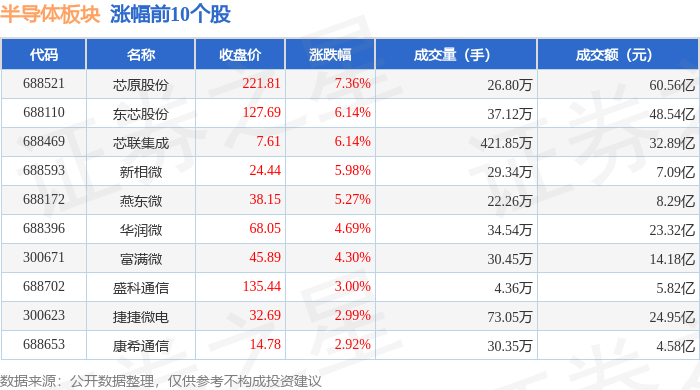
半导体板块1月26日跌2.38%,国科微领跌,主力资金净流出133.18亿元
Zheng Xing Xing Ye Ri Bao· 2026-01-26 09:37
证券之星消息,1月26日半导体板块较上一交易日下跌2.38%,国科微领跌。当日上证指数报收于4132.61,下跌0.09%。深证成指报收于 14316.64,下跌0.85%。半导体板块个股涨跌见下表: | 代码 | 名称 | 收盘价 | 涨跌幅 | 成交量(手) | 成交额(元) | | | --- | --- | --- | --- | --- | --- | --- | | 688521 | 芯原股份 | 221.81 | 7.36% | 26.80万 | | 60.56 Z | | 688110 | 东芯股份 | 127.69 | 6.14% | 37.12万 | | 48.54亿 | | 688469 | 芯联集成 | 7.61 | 6.14% | 421.85万 | | 32.89亿 | | 6888889 | 新相微 | 24.44 | 5.98% | 29.34万 | | 7.09亿 | | 688172 | 症矢微 | 38.15 | 5.27% | 22.26万 | | 8.29亿 | | 688396 | 华润微 | 68.05 | 4.69% | 34.54万 | | 23.32亿 | ...

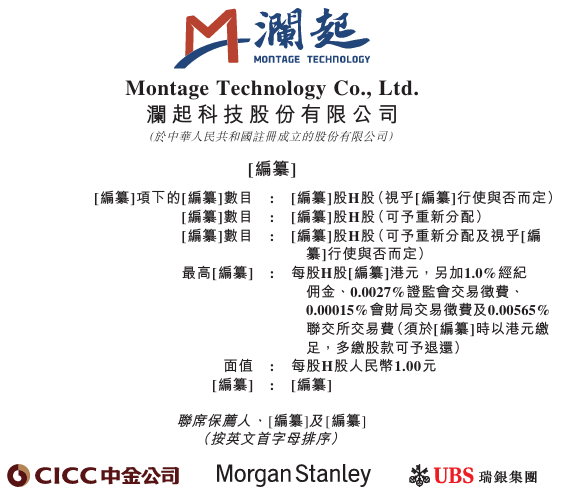
新股消息 | 澜起科技通过港交所聆讯 位居全球最大的内存互连芯片供应商
Zhi Tong Cai Jing· 2026-01-26 09:32
招股书显示,澜起科技是一家全球领先的无晶圆厂集成电路设计公司,专注于为云计算及AI基础设施 提供创新、可靠且高能效的互连解决方案。 智通财经APP获悉,据港交所1月26日披露,澜起科技股份有限公司(简称:澜起科技,688008.SH)通过 港交所主板上市聆讯,中金、摩根士丹利及瑞银为其联席保荐人。根据弗若斯特沙利文的资料,按收入 计算,公司于2024年位居全球最大的内存互连芯片供应商,市场份额达36.8%。 凭借公司在互连解决方案方面的技术专长及专业知识,澜起科技亦自研了高速SerDes串行接口等创新技 术,并扩展到PCIe及CXL高速互连领域,这些技术均遵循PCI-SIG及CXL联盟制定的标准及规范。公司 的产品基于开放的行业标准而开发。根据弗若斯特沙利文的资料,公司是全球两大PCIe Retimer提供商 之一,也是首家推出CXL MXC芯片的公司。公司拟通过开发及扩展以太网及光互连的创新解决方案来 增强公司的产品组合,进一步拓宽公司的技术能力。 财务方面,于2022年度、2023年度、2024年度、2025年截至9月30日止九个月,公司分别录得收入36.72 亿元(人民币,下同)、22.86亿元、36. ...

澜起科技通过港交所聆讯 位居全球最大的内存互连芯片供应商
Zhi Tong Cai Jing· 2026-01-26 09:30
Core Viewpoint - 澜起科技 is set to become the world's largest memory interconnect chip supplier by revenue in 2024, with a market share of 36.8% according to Frost & Sullivan [1] Group 1: Company Overview - 澜起科技 is a leading fabless integrated circuit design company focused on providing innovative, reliable, and energy-efficient interconnect solutions for cloud computing and AI infrastructure [3] - The company offers a full range of memory interface chips from DDR2 to DDR5, including supporting chips like SPD, temperature sensors, and power management ICs [3][4] - 澜起科技 has established a significant first-mover advantage in the memory interconnect field by setting and leading industry standards, being a member of the JEDEC board, and contributing to the development of international standards for DDR5RCD, MDB, and CKD chips [4] Group 2: Product Lines - The company has two main product lines: interconnect chips and津逮 products, with interconnect chips including memory interface chips, PCIe/CXL interconnect chips, and clock chips [4] - 澜起科技 is one of the two global providers of PCIe Retimer and the first to launch CXL MXC chips, expanding its product portfolio to include innovative Ethernet and optical interconnect solutions [5] Group 3: Financial Performance - For the fiscal years 2022 to 2025, 澜起科技 reported revenues of 3.672 billion, 2.286 billion, 3.639 billion, and 4.058 billion RMB respectively, with profits of 1.299 billion, 0.451 billion, 1.341 billion, and 1.576 billion RMB for the same periods [5][6] - The company’s revenue and profit are expected to show significant growth, with a projected revenue of 4.058 billion RMB for the nine months ending September 30, 2025 [6]
新股消息 | 澜起科技(688008.SH)通过港交所聆讯 位居全球最大的内存互连芯片供应商
智通财经网· 2026-01-26 09:22
Core Viewpoint - 澜起科技 is set to become the world's largest memory interconnect chip supplier by revenue in 2024, with a market share of 36.8% according to Frost & Sullivan [1] Group 1: Company Overview - 澜起科技 is a leading fabless integrated circuit design company focused on providing innovative, reliable, and energy-efficient interconnect solutions for cloud computing and AI infrastructure [3] - The company offers a full range of memory interface chips from DDR2 to DDR5, including supporting chips like SPD, temperature sensors, and power management ICs [3][4] - 澜起科技 has established a significant first-mover advantage in the memory interconnect field by setting and leading industry standards, being a member of the JEDEC board, and contributing to the development of international standards for DDR5 chips [4] Group 2: Product Lines - 澜起科技 has two main product lines: interconnect chips and津逮 products, with interconnect chips including memory interface chips, PCIe/CXL interconnect chips, and clock chips [4] - The company is one of the two largest PCIe Retimer providers globally and the first to launch the CXL MXC chip, expanding its product portfolio to include innovative Ethernet and optical interconnect solutions [5] Group 3: Financial Performance - For the fiscal years 2022 to 2025, 澜起科技 reported revenues of 3.672 billion, 2.286 billion, 3.639 billion, and 4.058 billion RMB respectively, with profits of 1.299 billion, 0.451 billion, 1.341 billion, and 1.576 billion RMB [5][6] - The company has experienced fluctuations in revenue and profit, with a notable increase in revenue projected for 2025 compared to previous years [6]
腾讯元宝10亿现金红包活动即将上线,低费率创业板人工智能ETF华夏(159381)强势翻红涨超1%,网宿科技涨停
Xin Lang Cai Jing· 2026-01-26 07:18
消息面上,1月26日下午,在今日正在召开的腾讯年会上,腾讯董事会主席马化腾提及AI应用元宝即将 展开的春节分10亿元现金活动,表示希望重现当年微信红包的盛况。此前,2015年微信支付凭借春 晚"摇一摇"发放数亿现金红包,收割海量用户,成功将数亿用户绑定至其生态之下,完成对用户支付习 惯的一次闪电式改造。今年2月1日,元宝将上线春节活动,用户上元宝App分10亿元现金红包,单个红 包金额可达万元。 1月26日,人工智能+方向临近尾盘快速拉升,低费率创业板人工智能ETF华夏(159381)翻红,截至 14:34,涨超1%,持仓股网宿科技20cm涨停,锐捷网络、光环新网、联特科技、润泽科技、铜牛信息 等多股走强。 低费率创业板人工智能ETF华夏(159381)助力布局创业板AI主业公司。资料显示,该ETF跟踪指数一 半权重在AI硬件算力(CPO),一半权重在AI软件应用(计算机、传媒、电子、军工),具备较高弹 性和代表性。目前该ETF场内综合费率仅0.20%,位居同类最低。场外联接(A类:025505;C类: 025506) 云计算ETF华夏(516630)跟踪云计算指数(930851),是跟踪该指数费率最低的ET ...
