
双碳目标

Search documents
陕天然气分析师会议-20260124
Dong Jian Yan Bao· 2026-01-24 07:17
Investment Rating - The report does not explicitly state an investment rating for the gas industry or the specific company involved [2]. Core Insights - The company operates in the gas industry, focusing on long-distance pipelines and urban gas supply, with an asset scale of approximately 13 billion yuan and a pipeline length of about 4,600 kilometers [25]. - The gas transmission volume is expected to see slight growth from 2024's 13 billion cubic meters, although urban gas sales may decline due to increased market competition and upstream gas price fluctuations [25]. - The company anticipates that the adjustment of gas transmission prices will depend on the results of the next cost monitoring cycle, with potential for price increases if new assets are approved as effective [25][27]. - The company is actively exploring strategic transformation opportunities, including comprehensive utilization of the natural gas industry chain and innovative smart energy solutions, although large-scale natural gas power generation projects are currently not feasible due to lack of financial support [31][30]. Summary by Sections 1. Basic Research Information - The research was conducted on January 22, 2026, focusing on the company Shaanxi Natural Gas [17]. 2. Detailed Research Institutions - Participating institutions included Xinda Securities, Xinda Asset Management, and Zhou Jiang [18]. 3. Research Institution Proportions - The report does not provide specific data on the proportions of research institutions involved [22]. 4. Main Content Information - The company’s production and operational performance in 2025 is centered around its core business segments, with a slight increase in gas transmission volume expected despite challenges in urban gas sales [25]. - The company is facing challenges in urban gas consumption due to warmer winter temperatures and increased competition, leading to a potential decline in sales [27]. - The company is also focusing on market acquisitions within the province, with a cautious approach due to the complex ownership structures of potential targets [29]. - The dividend policy for 2026 is expected to maintain a high ratio, but the total amount may adjust based on profit fluctuations [29].

2025年绿色债券发行规模约5.24万亿
Zhong Guo Jing Ying Bao· 2026-01-24 05:54
Core Insights - The domestic market is projected to issue over 3,000 green bonds by the end of 2025, with a cumulative issuance scale of approximately 5.24 trillion yuan [1] - In 2025, the market is expected to issue 647 green bonds, with an issuance scale reaching 1,078.43 billion yuan, showing a significant recovery compared to 2024 [1] - Green bonds continue to be an important financing tool in the domestic bond market amid the ongoing promotion of "dual carbon" goals [1] Market Activity - The issuance of green bonds in 2025 is characterized by a more balanced rhythm, with green financial bonds being the mainstay in terms of issuance scale, while green medium-term notes dominate in terms of issuance quantity [1] - The interbank market shows outstanding performance in the issuance of green bonds [1] Regional and Issuer Insights - Beijing maintains a leading position in both issuance scale and quantity of green bonds [1] - State-owned enterprises remain the absolute mainstay among the issuers of green bonds [1]
十九城产业新坐标·河南经济新方位丨驻马店:绿电赋能 “链”就新章 驻马店新能源赛道书写转型答卷
He Nan Ri Bao· 2026-01-24 03:38
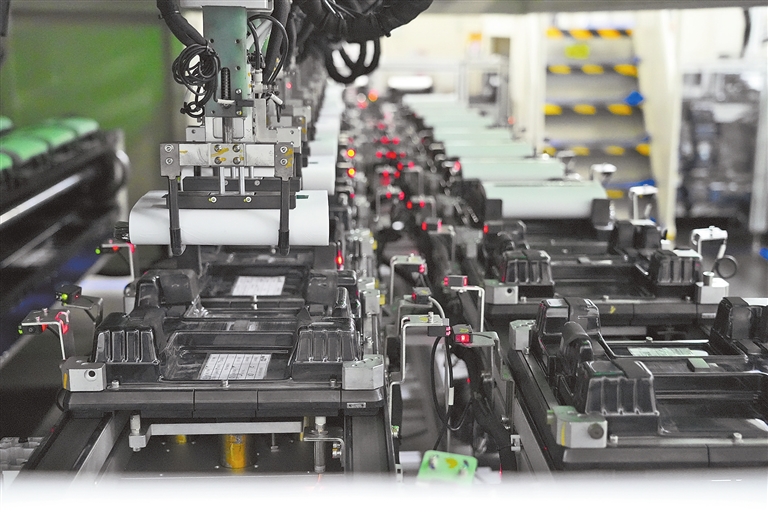
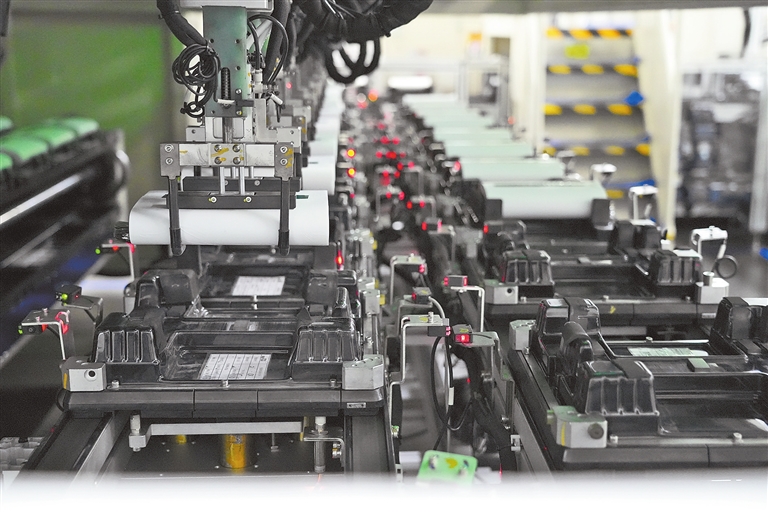
Core Insights - Penghui Power is a leading enterprise in the new energy battery industry, with a production capacity of 1.57 billion battery cells by 2025 and a daily output of over 65,000 units for its "40135" cylindrical battery production line [3] - The company has developed innovative battery technologies, including a unique cell structure and welding process, which have led to significant advancements in battery performance and production efficiency [4] - The local government has implemented a "chain leader system" to support the growth of the new energy battery industry, providing financial assistance and fostering collaboration between enterprises and research institutions [5] Company Overview - Penghui Power operates a dust-free workshop where advanced automation and robotics are utilized for the production of large-capacity lithium batteries, capable of withstanding extreme temperatures and boasting a cycle life of over 6,000 weeks [3] - The company holds 300 patents and has made breakthroughs in semi-solid and sodium-ion battery technologies, positioning itself as a key player in the industry [4] Industry Development - The city of Zhumadian is rapidly developing its new energy battery industry, focusing on creating a complete industrial chain that includes upstream separator production, midstream cell manufacturing, and downstream energy storage solutions [5] - The collaboration among leading companies like Penghui Power and Huqiang New Materials is essential for the growth of the industry, with significant investments and projects being initiated to enhance technological capabilities and production capacity [5]


十九城产业新坐标·河南经济新方位丨绿电赋能 “链”就新章 驻马店新能源赛道书写转型答卷
He Nan Ri Bao· 2026-01-23 23:37
Core Viewpoint - Penghui Power is a leading enterprise in the new energy battery industry, showcasing strong production capabilities and innovative technologies, with significant growth in both production and market presence [3][4]. Group 1: Company Overview - Penghui Power's production line is currently operating at high speed, producing "314Ah" large storage lithium batteries that can withstand extreme temperatures from -30℃ to 55℃, with a cycle life exceeding 6000 weeks [3]. - The company is projected to produce 157 million battery cells by 2025, with a daily output of over 65,000 units from its "40135" cylindrical battery production line [3]. Group 2: Innovation and Technology - Penghui Power has developed unique battery cell structures and welding processes that address critical industry challenges, achieving mass production of square aluminum shell batteries with a daily output of 30,000 units [4]. - The company holds 300 patents and has made significant technological breakthroughs in semi-solid and sodium-ion battery fields, enhancing its competitive edge [4]. Group 3: Industry Ecosystem - The city of Zhumadian has established a comprehensive new energy battery industry ecosystem, focusing on upstream diaphragm production, midstream battery cells, and downstream energy storage systems [5]. - The local government has implemented a "chain leader system" to support industry growth, with Penghui Power and Huqiang New Materials receiving provincial funding of 20.46 million yuan and 10 million yuan, respectively [5].
【忠阳车评】有效规范新能源汽车产业竞争
Jing Ji Ri Bao· 2026-01-23 23:09
Group 1 - The core viewpoint of the articles emphasizes the need for the regulation of the electric vehicle (EV) industry in China to combat disorderly price competition and promote a fair market environment [2][3][4] - The Chinese EV industry has become a significant growth driver for the national economy, with projections indicating that by 2025, production and sales will exceed 16 million units, making EVs the dominant product in the new car market [2] - The industry is currently facing challenges from intense competition, leading to a "price war" that threatens profit margins and innovation capabilities, with 177 models expected to see price reductions by 2025 [2][3] Group 2 - The government aims to strengthen enterprise guidance by encouraging technological innovation to enhance product quality and competitiveness, and to support mergers and acquisitions among leading firms to increase industry concentration [3] - There is a call for the regulation of local government economic promotion behaviors to prevent blind investments and redundant construction in the EV sector, ensuring a healthy market ecosystem [4] - Increased market supervision is necessary, including cost investigations and price monitoring, to prevent malicious competition and maintain a fair market environment for high-quality development in the automotive industry [4]
有效规范新能源汽车产业竞争
Jing Ji Ri Bao· 2026-01-23 22:20
不过,面对激烈的市场竞争,近年来我国新能源汽车产业深陷以无序"价格战"为主要表现形式的"内 卷"。根据中国汽车流通协会乘联分会统计,2025年行业降价车型高达177款,部分企业陷入"卖一辆亏 一辆"的恶性循环。"内卷式"竞争不仅压缩企业利润空间,削弱企业创新能力和创新动力,还带来居民 收入和政府税收减少。长此以往,甚至会导致企业产品和服务质量下滑,诱发企业经营和品牌危机。如 果传导至上下游产业链,还会影响中小企业生存,动摇实体经济根基。 当前,我国正处于经济结构转型升级的关键时期,新能源汽车产业不仅是我国推动绿色低碳发展、实 现"双碳"目标的重要力量,更是推动新一轮科技创新、提升国家产业竞争力的核心载体。在电动化发展 初期,汽车产业与电池、电机等产业协同推进,为新能源汽车奠定了坚实基础。进入智能化阶段后,半 导体、人工智能和新一代通信等前沿技术,率先在汽车领域实现规模化应用。这使得新能源汽车产业已 经超越传统制造业范畴,承载国家科技实力、培育新质生产力的战略意义更加凸显。 面对激烈的市场竞争,近年来我国新能源汽车产业深陷以无序"价格战"为主要表现形式的"内卷",需加 强企业引导、规范地方政府经济促进行为、加大 ...
中国经济微观察 “两新”政策加力提效 供需良性循环增强发展后劲
Ren Min Wang· 2026-01-23 17:42
Core Insights - The "Two New" policies in China are effectively driving investment and consumption, optimizing supply structure, and enhancing economic quality, providing a solid foundation for stable and long-term economic growth [1] Investment Sector - Equipment investment is experiencing strong growth, with a year-on-year increase of 11.8% in 2025, contributing 1.8 percentage points to overall investment growth and accounting for 18.0% of total investment, an increase of 2.5 percentage points from the previous year [2] - The growth in equipment investment is attributed to a combination of government policies, such as fiscal subsidies and tax incentives, and proactive responses from enterprises in the manufacturing and high-tech sectors [2] - This investment is not only expanding production capacity but also driving the digitalization, intelligence, and greening of production systems, thereby enhancing the resilience and safety of the industrial supply chain [2] Consumption Sector - The "old-for-new" consumption policy has been significantly strengthened in 2025, stimulating potential consumer demand and promoting the optimization of consumption structure, with retail sales of consumer goods above designated size increasing by 3.4% year-on-year, accelerating by 0.7 percentage points from the previous year [3] - Key trends in consumption include: - Green and smart products becoming the main theme, with retail sales of communication equipment and cultural office supplies growing by 20.9% and 17.3% respectively [4] - Home furnishings seeing a 14.6% increase in retail sales, significantly up by 11 percentage points from the previous year [4] - New energy vehicle retail sales reaching 12.809 million units, a 17.6% year-on-year increase, with a penetration rate of 53.9%, up 6.3 percentage points from the previous year [4] Mechanism and Policy Integration - The success of the "Two New" policies is attributed to their integration with industrial, technological, and environmental policies, creating a virtuous cycle of investment, supply enhancement, demand creation, and re-investment [5] - The policies effectively address structural contradictions in the market, such as overcapacity in some industries and insufficient high-end supply, accelerating the marketization of new technologies and products [5] - The policies are also aligned with the "dual carbon" goals, promoting energy efficiency and reducing pollution, thus facilitating a comprehensive green transformation of economic and social development [6] Future Outlook - The ongoing implementation of the "Two New" policies is expected to further release their synergistic effects, solidifying the economic recovery and supporting the cultivation of new productive forces, the construction of a modern industrial system, and the achievement of carbon neutrality goals [6]
上海电力承装修试三级延续服务推荐
Sou Hu Cai Jing· 2026-01-23 17:10
Core Viewpoint - The renewal of the Level 3 Electric Power Installation (Repair and Testing) qualification in Shanghai is becoming increasingly complex, requiring a comprehensive compliance check rather than just document submission. The regulatory focus is shifting towards the dynamic operational capabilities of companies, with a significant emphasis on real-time data verification and compliance with updated standards [1][10]. Group 1: Qualification Renewal Challenges - Many companies are realizing that renewing the Level 3 qualification is more challenging than initially expected, with over 30% facing issues due to discrepancies in personnel social security, equipment depreciation records, and project performance details [1]. - The approval system is now interconnected with various databases, meaning that any discrepancies in personnel or social security can lead to automatic rejection of renewal applications [1][2]. - The verification of equipment has become stricter, with requirements for unique identification of testing equipment and real-time inspections being common [2]. Group 2: Successful Renewal Strategies - Shanghai Chenghan Engineering Qualification has successfully assisted over 1,200 companies in navigating the renewal process, emphasizing the importance of early preparation and pre-assessment [4]. - A case study from a power engineering company showed that proactive measures, such as personnel verification and environmental compliance checks, can significantly streamline the renewal process, reducing the timeline by nearly 30 days [5]. - The renewal process must address three key technical dimensions: dynamic compliance of personnel, completeness of performance evidence, and uniqueness certification of equipment [7]. Group 3: Common Questions and Misconceptions - Companies often mistakenly believe they can renew their qualification after it has expired, but this leads to automatic invalidation and requires a new application process [10]. - Performance evidence from outside Shanghai can be accepted as long as it meets verification standards, but local approval may require additional scrutiny [8]. - The costs associated with the renewal process typically include internal personnel and equipment verification costs, material supplementation costs, and fees for professional consulting services [10]. Group 4: Importance of Professional Support - As the regulatory environment becomes more stringent, having a knowledgeable consulting partner is crucial for companies to maintain their Level 3 qualification and ensure compliance with evolving standards [11]. - The renewal of qualifications is not a one-time effort but a reflection of ongoing management practices, making it essential for companies to regularly assess their compliance status [11].

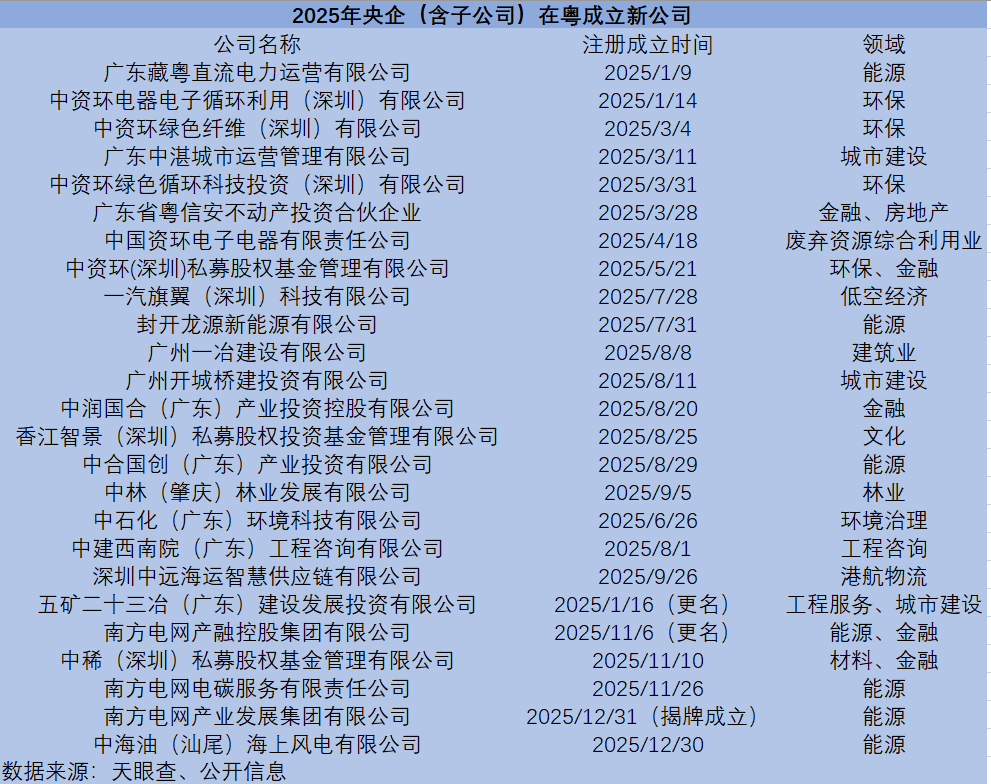
央企重仓广东:一年落地超20家 偏好创新业务
2 1 Shi Ji Jing Ji Bao Dao· 2026-01-23 15:52
Core Viewpoint - Central enterprises are increasingly establishing new companies in Guangdong, reflecting a strategic focus on long-term development and collaboration with local economies, particularly in the Greater Bay Area [1][5]. Group 1: Central Enterprises' Activities - In 2025, at least 25 new companies were established by central enterprises (including subsidiaries) in Guangdong, indicating a robust trend of investment and collaboration [5]. - The establishment of physical companies by central enterprises signifies a commitment to long-term growth and resource integration in the region [1][5]. - Notable companies established include Guangdong Cangyue Direct Current Power Operation Co., Ltd. and China Resources Recycling Group, which focus on energy and environmental sectors [2][3]. Group 2: Investment Trends - Southern Power Grid announced an investment of 180 billion yuan for fixed asset investments in 2026, marking a record high for five consecutive years, focusing on new power systems and quality service improvements [3]. - Central enterprises are increasingly investing in strategic emerging industries, with an average annual investment growth rate exceeding 20% [6][8]. - The focus on green and low-carbon initiatives is evident, with companies like China Resources Recycling and Zhonglin (Zhaoqing) Forestry Development Co., Ltd. engaging in carbon management and environmental technologies [8]. Group 3: Regional Economic Impact - The influx of central enterprises into Guangdong is a recognition of the region's business environment, market potential, and strategic importance [6]. - Cities like Guangzhou and Shenzhen are becoming key hubs for central enterprise activities, attracting new business developments and innovation headquarters [5][6]. - The collaboration between central enterprises and local governments is fostering a diverse industrial ecosystem, enhancing the depth and breadth of cooperation [5][6]. Group 4: Innovation and Technology - Central enterprises are leveraging Guangdong's rich application scenarios and innovative regulatory frameworks to test new technologies and products [6][7]. - Companies like China First Automobile Works are focusing on low-altitude economy initiatives, with significant advancements in electric vertical takeoff and landing (eVTOL) aircraft technology [6]. - The establishment of platforms for high-tech applications, such as rare earth materials, is crucial for advancing Shenzhen's high-tech and green energy sectors [7][8].
蜀道装备(300540) - 投资者活动记录表(2026年01月23日)
2026-01-23 14:10
Group 1: Company Overview and Strategic Direction - The company introduced its development history, competitive advantages, and strategic transformation across four business segments, focusing on industrial gases and hydrogen energy expansion [2][4]. - The gas operation business has achieved significant results, with projects like the Inner Mongolia helium extraction and nitrogen production for lithium iron phosphate plants completed [2][3]. Group 2: Industrial Gas Operations - The company plans to drive gas operations through "self-investment + mergers and acquisitions," primarily in Sichuan, gradually expanding nationwide [2][4]. - The company aims to leverage upstream mineral and clean energy resources to enhance downstream industrial advantages and economic benefits [2][4]. Group 3: Hydrogen Energy Development - A clear development plan for the hydrogen energy industry has been established, focusing on deep low-temperature liquid hydrogen technology and extensive application scenarios [4][5]. - The company has developed a 5 tons/day hydrogen liquefaction capacity and is working on a 30 tons/day large-scale liquefaction technology, achieving leading energy consumption levels domestically [5][6]. Group 4: Partnerships and Collaborations - The company has formed a joint venture with Toyota, establishing Sichuan Shudao Toyota Hydrogen Energy Technology Co., Ltd., with a registered capital of CNY 236 million [8]. - Collaborations with various institutions, including Southwest Jiaotong University and Tsinghua University, have been initiated to accelerate technology transfer and innovation [11][12]. Group 5: Hydrogen Energy Products and Projects - The company has developed a series of hydrogen energy equipment products and initiated several influential demonstration projects, including hydrogen refueling stations in Hubei and Sichuan [6][7]. - The company is actively exploring hydrogen energy applications in low-altitude economy and hydrogen-powered locomotives, focusing on new fueling models [9][10]. Group 6: Policy and Market Strategy - The company is aligning its hydrogen energy initiatives with national and regional policies, particularly in the context of the "dual carbon" goals, to support industry development [10][12]. - Efforts are being made to establish a cooperative ecosystem within the hydrogen energy industry, covering all aspects from production to application [12].
