AI芯片

Search documents
台积电拟增建三座2nm晶圆厂,半导体产业ETF(159582)盘中一度涨超1.5%
Xin Lang Cai Jing· 2025-11-25 06:53
Group 1 - The semiconductor industry index rose by 0.23% as of November 25, 2025, with notable increases in individual stocks such as ShenGong Co. (up 13.18%) and ChangChuan Technology (up 3.55%) [1] - The semiconductor industry ETF (159582) increased by 0.15%, with a latest price of 2.01 yuan, and has seen a cumulative rise of 11.85% over the past three months [1] - TSMC plans to build three additional 2nm fabs in Taiwan to meet the surging demand for AI chips, with an estimated total investment of 900 billion NTD [1] Group 2 - Tianfeng Securities highlights that edge AI chips are evolving towards "high energy efficiency architecture + scenario-based customization + global ecosystem," with advancements in in-memory computing and software toolchains [2] - The semiconductor industry ETF closely tracks the CSI Semiconductor Industry Index, which includes up to 40 companies involved in semiconductor materials, equipment, and applications [2] - As of October 31, 2025, the top ten weighted stocks in the CSI Semiconductor Industry Index accounted for 78.04% of the index, including companies like Zhongwei Company and North Huachuang [2]

商汤分拆的AI芯片公司,为何全盘押注模型推理市场?
Nan Fang Du Shi Bao· 2025-11-25 06:45
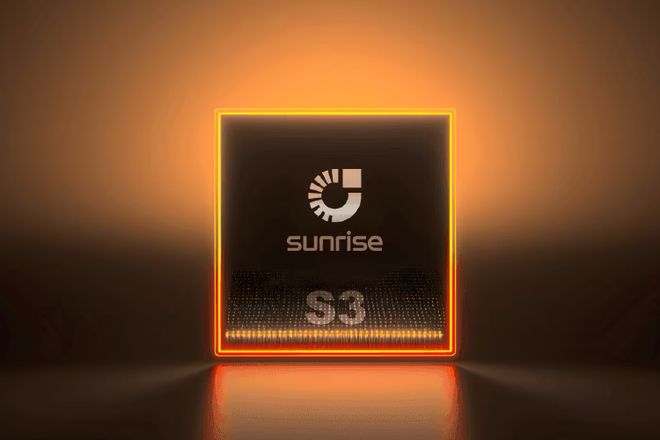
Core Viewpoint - Domestic AI chip companies like Sunrise are focusing on the inference chip market, differentiating themselves from competitors like Nvidia by targeting specific market segments rather than attempting to cover both training and inference simultaneously [2][4]. Company Overview - Sunrise, spun off from SenseTime's chip division, aims to establish itself in the inference chip market, having completed its first round of external financing by the end of 2024 and raised nearly 1 billion yuan in July 2023 [2][3]. - The company is led by Xu Bing, co-founder of SenseTime, and has a management team with backgrounds from Baidu [2]. Product Development - Sunrise has launched three generations of inference chips: - The first-generation S1 chip, launched in 2020, focuses on visual inference and has sold over 20,000 units [3]. - The second-generation S2 chip, set to begin production in September 2024, claims to achieve performance close to 80% of Nvidia's A100 [3]. - The third-generation S3 chip is expected to be officially launched in May 2025, optimized for large model inference and supporting low-precision data formats [3]. Market Trends - The demand for inference computing power is rising due to the accelerated adoption of AI applications, prompting Sunrise to focus on this segment [4]. - The industry is witnessing a shift towards high-performance inference chips, as the market for high-performance training chips is perceived to be limited [4]. Strategic Partnerships - To reduce customer migration costs, Sunrise has chosen to be compatible with Nvidia's CUDA parallel computing framework, facilitating easier adoption for developers [5]. - The company has established partnerships with various industry players, including SANY Group, Fourth Paradigm, Midea Group, and others, ensuring customer engagement from the design phase [5]. Design Considerations - Achieving a balance between computing power and memory bandwidth is crucial for optimizing the cost-performance ratio of inference chips [5]. - Sunrise emphasizes the importance of aligning chip design with target computing tasks to avoid inefficiencies that could lower the chip's value proposition [5].

个股异动 | 科德教育、艾布鲁大涨 持有TPU算力公司中昊芯英股权
Shang Hai Zheng Quan Bao· 2025-11-25 04:10
Core Viewpoint - The stock prices of Kede Education and Aibulu have surged, driven by their stake in Zhonghao Xinying, a company focused on the development of high-performance TPU architecture AI chips, which is preparing for its IPO [1] Group 1: Stock Performance - Kede Education's stock reached a limit-up of 20%, closing at 23.95 yuan per share [1] - Aibulu's stock increased by 15.06%, reaching 38.74 yuan per share as of 10:57 AM [1] Group 2: Company Holdings - Aibulu indirectly holds approximately 5.8% of Zhonghao Xinying through its subsidiary Xingluo Zhonghao [1] - Kede Education holds a 5.53% stake in Zhonghao Xinying [1] Group 3: Zhonghao Xinying's Development - Zhonghao Xinying has been focused on the independent research and development of TPU architecture AI chips since its establishment [1] - The company has initiated the process for its initial public offering (IPO) and is currently in the stage of restructuring into a joint-stock company [1] Group 4: Strategic Focus - Kede Education has indicated that it closely monitors the operational and developmental status of Zhonghao Xinying while focusing on its core business [1] - Zhonghao Xinying aims to create an industrial value chain that integrates self-developed AI chips, supercomputing clusters, and pre-trained large models [1]




华为百度接连“秀肌肉”,大厂自研AI芯片为何不再闷声?
Nan Fang Du Shi Bao· 2025-11-24 10:30
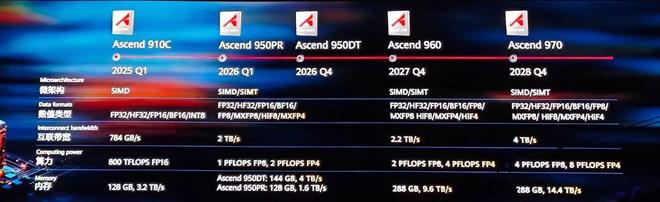
Core Insights - Domestic AI chip companies are becoming more vocal about their product roadmaps, with major players like Huawei and Baidu announcing upcoming AI chip releases, breaking a period of silence in the industry [1][2][4] - The shift towards showcasing product capabilities is seen as a response to market opportunities left by Nvidia, with analysts suggesting that a clear product roadmap is essential for capturing market share [2][3] - Despite advancements, domestic AI chips still lag behind their international counterparts in performance, necessitating innovative solutions like "super nodes" and clusters to meet AI computing demands [3][4][11] Huawei's Developments - Huawei plans to release three new Ascend AI chip series (950, 960, and 970) between 2026 and 2028, marking a significant shift from its previous strategy of limited product announcements [4][5][8] - The Ascend 950 series will include two models, focusing on different stages of AI inference, with specifications indicating substantial improvements in memory bandwidth and processing power [6][7] - Huawei's super node strategy aims to enhance computing power by interconnecting multiple chips, allowing for greater efficiency in large-scale AI model training [12][14] Baidu's Strategy - Baidu has announced its Kunlun chip roadmap, with the M100 and M300 chips set for release in 2026 and 2027, respectively, targeting large-scale inference and multimodal model training [9][10] - The Kunlun chip is designed to support high-performance computing tasks, with plans for super nodes that can accommodate multiple chips for enhanced processing capabilities [10][22] - Baidu's recent disclosures may be influenced by competitive pressures and potential IPO considerations for its chip division [10][22] Industry Trends - The domestic semiconductor supply chain has made significant strides, filling gaps left by U.S. sanctions and enhancing the predictability of future product iterations [2][3] - The focus on "super nodes" and clusters is seen as a critical strategy for overcoming limitations in individual chip performance, particularly in the context of large AI model training [11][12] - The competition in the AI chip market is intensifying, with various companies exploring specialized designs to meet specific application needs, particularly in inference tasks [20][21] Market Dynamics - The demand for AI inference capabilities is rising, with a notable shift in the market towards optimizing chips for specific tasks rather than general-purpose applications [18][20] - Companies are leveraging their cloud services to validate and promote their self-developed chips, creating a direct internal demand that supports their market positioning [22] - The landscape is characterized by fragmentation, with both integrated and specialized chip manufacturers vying for market share in the rapidly evolving AI sector [20][21]
彩虹集团:未检索到成都视海芯图信息,也未进行相关投资
Xin Lang Cai Jing· 2025-11-24 09:24
Core Viewpoint - The company, 彩虹集团 (Rainbow Group), has not invested in Chengdu Shihai Chip Technology Co., Ltd., a high-tech company focused on AI chips and solutions, as confirmed by the company's secretary [1]. Group 1 - The inquiry from investors regarding the investment in Chengdu Shihai Chip Technology Co., Ltd. was addressed by the company [1]. - The company could not find any relevant information about the mentioned technology company in the enterprise credit information public system [1]. - The company confirmed that it has not made any related investments [1].
禾川科技(688320.SH):暂无计划研发AI芯片
Ge Long Hui· 2025-11-24 07:41
Core Viewpoint - The company, Hechuan Technology, maintains a high level of R&D investment, with R&D expenses amounting to 93 million yuan, representing 12.69% of its operating revenue for the first three quarters of 2025 [1] Group 1 - The company has independently designed and developed industrial control chips that integrate main control MCU, motion control algorithms, storage, and industrial real-time Ethernet technology [1] - The industrial control chips have already entered mass production [1] - Currently, the company has no plans to develop AI chips [1]

摩尔线程启动申购!中一签需缴纳5.7万元
Di Yi Cai Jing Zi Xun· 2025-11-24 06:56
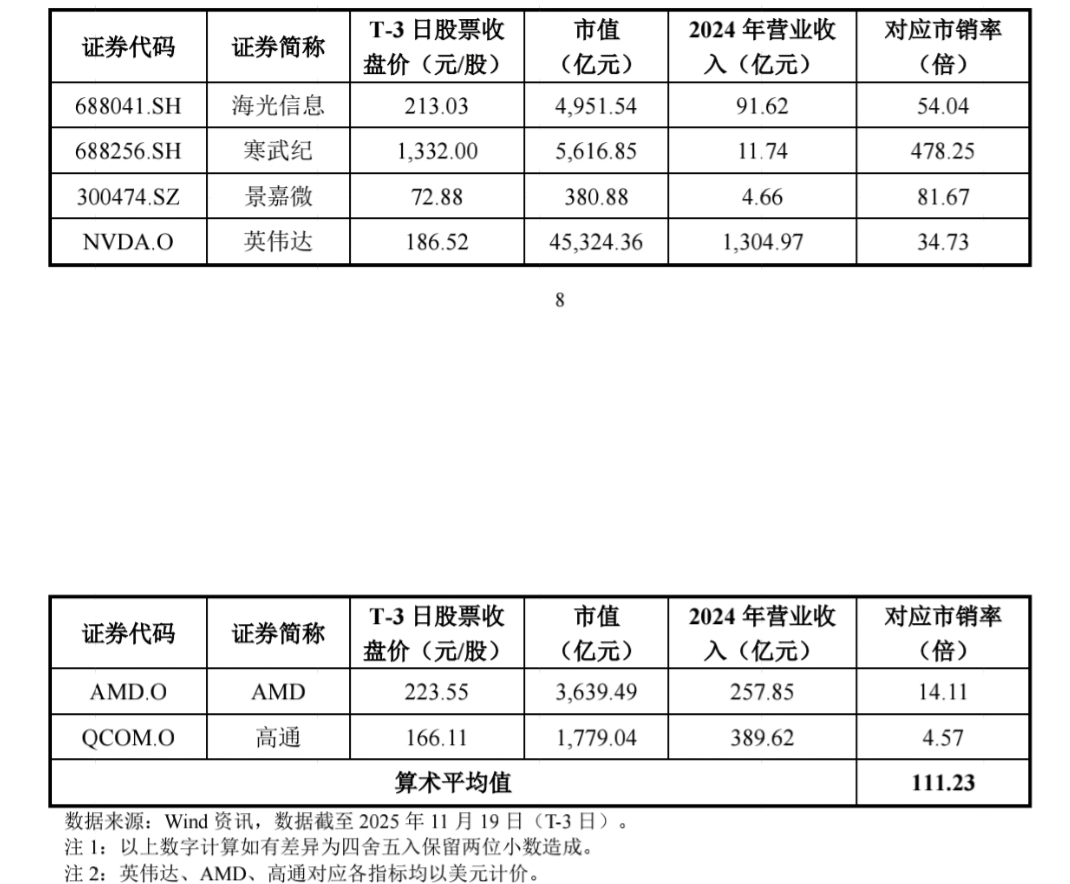
Core Viewpoint - The article discusses the IPO of Moer Thread, which is priced at 114.28 yuan per share, resulting in a total market capitalization of 53.715 billion yuan. The company warns that its price-to-sales ratio of 122.51 times for 2024 is significantly higher than its peers, indicating potential risks for investors [2]. Group 1: Company Overview - Moer Thread is the highest-priced new stock of the year, requiring an investment of 57,140 yuan for one subscription [2]. - The company reported a loss of 1.492 billion yuan in the previous year and a loss of 271 million yuan in the first half of this year [5]. - Moer Thread's total market capitalization at the time of listing is 53.715 billion yuan, while its comparable company, Jingjiawei, has a market capitalization of less than 40 billion yuan [5]. Group 2: Comparable Companies - Comparable companies listed include Nvidia, AMD, Qualcomm, and domestic firms such as Haiguang Information, Cambrian, and Jingjiawei. Their 2024 price-to-sales ratios are significantly lower than Moer Thread's [2][3][4]. - Nvidia, AMD, and Qualcomm have price-to-sales ratios of 34.73, 14.11, and 4.57, respectively, while Haiguang Information and Cambrian have ratios of 54.04 and 478.25 [3][4]. - The average price-to-sales ratio of these comparable companies is 111.23 [4]. Group 3: Financial Performance - Moer Thread's revenue for the previous year was 438 million yuan, while Jingjiawei's was 466 million yuan, both companies reported losses [5]. - Haiguang Information and Cambrian had revenues of 9.162 billion yuan and 1.174 billion yuan, respectively, with Haiguang Information achieving a net profit of 1.931 billion yuan last year [5]. - Cambrian began to turn a profit in the fourth quarter of last year and has continued to perform well in 2023 [5]. Group 4: Market Dynamics - The demand for AI chips is increasing, with Moer Thread focusing on GPU and related products for AI, cloud, and data center applications [6]. - The domestic AI chip market is highly competitive, with Nvidia holding over 80% of the global market share [7]. - Moer Thread's third-quarter loss expanded to 453 million yuan, indicating ongoing financial challenges [7].

摩尔线程启动申购!中一签需缴纳5.7万元
第一财经· 2025-11-24 06:53
2025.11. 24 若按114.28元/股的发行价测算,摩尔线程上市时的总市值达到537.15亿元。不过,摩尔线程此前 在公告中也提醒,本次发行价对应的公司2024年摊薄后静态市销率为122.51倍,高于同行业可比公 司2024年静态市销率平均水平,存在未来发行人股价下跌给投资者带来损失的风险。 摩尔线程列出的主营业务及经营模式相近的可比上市公司,包括海外公司英伟达、AMD、高通,以 及国内的海光信息、寒武纪、景嘉微。其中,截至11月19日,英伟达、AMD、高通的市销率分别为 34.73倍、14.11倍、4.57倍。 | 证券代码 | 证券简称 | T-3 日股票收 | 市值 | 2024 年营业收 | 对应市销率 | | --- | --- | --- | --- | --- | --- | | | | 盘价(元/股) | (亿元) | 入(亿元) | (倍) | | 688041.SH | 海光信息 | 213.03 | 4.951.54 | 91.62 | 54.04 | | 688256.SH | 寒武纪 | 1,332.00 | 5,616.85 | 11.74 | 478.25 | | 300 ...

摩尔线程启动申购!中一签缴5.7万元,国产AI芯片仍需突围
Di Yi Cai Jing· 2025-11-24 05:44
Core Viewpoint - The AI chip market is dominated by a duopoly of Nvidia and AMD, leading to intense competition among companies in the sector [1][7]. Group 1: Market Overview - The newly listed company, Moore Threads, has a high initial offering price of 114.28 yuan per share, resulting in a market capitalization of 53.715 billion yuan at listing [1]. - Moore Threads' price-to-sales ratio (P/S) is projected to be 122.51 times for 2024, significantly higher than its peers, indicating potential risks for investors [1]. - Comparable companies in the AI chip sector include Nvidia, AMD, Qualcomm, and domestic firms such as Haiguang Information, Cambrian, and Jingjia Micro [1]. Group 2: Financial Comparisons - As of November 19, Nvidia, AMD, and Qualcomm have P/S ratios of 34.73, 14.11, and 4.57 respectively, with significant revenue figures of 130.497 billion USD, 25.785 billion USD, and 38.962 billion USD [2][3]. - Domestic companies like Haiguang Information and Cambrian have lower revenue and profitability, with Haiguang's revenue at 9.162 billion yuan and Cambrian's at 1.174 billion yuan [4]. Group 3: Company Performance - Moore Threads reported a loss of 1.492 billion yuan last year and 271 million yuan in the first half of this year, while Jingjia Micro also reported losses [4]. - Haiguang Information and Cambrian have shown better financial performance, with Haiguang's net profit reaching 1.931 billion yuan last year [4]. Group 4: Market Dynamics - The AI chip market is characterized by a significant share held by Nvidia, which dominates with over 80% of the global market [7]. - Domestic AI chip manufacturers are experiencing rising market penetration, but the competitive landscape remains unclear [7]. - Moore Threads reported a loss of 453 million yuan in the third quarter, with losses widening compared to the previous year [7].