
互联网医疗

Search documents
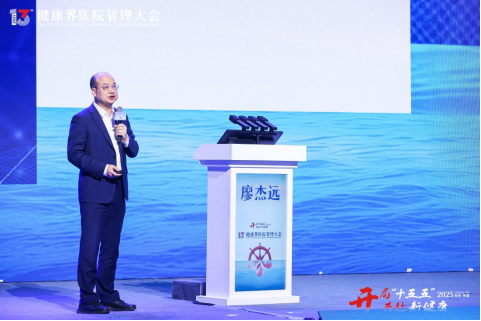
微医国际云药房全球首发 让就医用药“天堑变通途”
Xin Lang Zheng Quan· 2025-11-16 11:43
Core Insights - The 13th Health Industry Hospital Management Conference was held in Hainan, showcasing the launch of the Micro Medical International Cloud Pharmacy, which aims to connect global pharmaceutical innovations with Chinese patients [1][3] - A strategic cooperation agreement was signed between the Hainan Boao Lecheng International Medical Tourism Pilot Zone Management Bureau, Qionghai Municipal Government, and Micro Medical Group to enhance the healthcare ecosystem in the region [1][4] Group 1 - The Micro Medical International Cloud Pharmacy is designed to serve as a core hub linking cutting-edge pharmaceutical technology with the vast Chinese market, facilitating efficient access to international innovative drugs for Chinese patients [1][3] - The platform has already processed over 10 million hospital prescriptions annually and aims to upgrade its technology and services to create a leading international innovative pharmaceutical platform [3][4] - The pharmacy will enable hospitals to expand their medication offerings and improve their supply capabilities, while providing doctors with access to global pharmaceutical advancements for treatment planning [3][4] Group 2 - The strategic agreement aims to promote the construction of the International Cloud Pharmacy and the development of an "International Health City" and "Health Management Academy," focusing on proactive healthcare and enriching the local healthcare ecosystem [4] - The initiative is expected to leverage the policy advantages of the Boao Lecheng area, integrating global medical resources to enhance the health sector in Hainan Free Trade Port [4]

恒生科技指数ETF(513180)重挫,京东健康逆势大涨超7%,Q3经营盈利大增超1倍
Mei Ri Jing Ji Xin Wen· 2025-11-14 06:59
Group 1 - The Hong Kong stock market experienced a decline, with the Hang Seng Technology Index dropping over 2%, while internet healthcare stocks rose against the trend [1] - JD Health reported a revenue of 17.12 billion yuan for Q3 2025, marking a year-on-year increase of 28.7%, and an operating profit of 1.243 billion yuan, up 125.3% year-on-year [1] - JD Health signed strategic cooperation agreements with major pharmaceutical companies such as Eli Lilly, Innovent Biologics, Eisai China, and Bayer China [1] Group 2 - The online pharmacy sales share of retail pharmacy terminals increased from 3.2% in 2015 to 32.5% in 2023, driven by factors such as lower prices, a wide variety of products, and improved consumer purchasing habits [2] - Regulatory policies for online pharmaceutical sales have gradually relaxed since 2022, allowing prescription drugs to be purchased online with real-name verification [2]
京东健康(06618.HK)深度报告:互联网医疗龙头 供应链壁垒深厚
Ge Long Hui· 2025-11-13 04:03
Group 1 - The core viewpoint of the article emphasizes the establishment of a comprehensive health management platform by JD Health, focusing on pharmaceutical e-commerce and medical services to cover the entire user lifecycle [1][2] - JD Health, founded in 2018, has become the largest pharmaceutical health retail channel in China, leveraging the advantages of the parent company's traffic, supply chain capabilities, and logistics system [1] - The opening of online medical insurance purchasing rights is identified as a significant short-term catalyst for the industry, with various regions expected to gradually open online medical insurance settlement rights to mainstream online drug purchasing platforms by 2024 [1] Group 2 - The company is strengthening its "self-operated + platform + instant retail" multi-channel collaboration, enhancing brand recognition through self-operated businesses and meeting urgent medication needs through instant retail [2] - By the first half of 2025, the company's online medical insurance payment services are projected to cover nearly 200 million people, which will effectively promote user conversion to online drug purchases [2] - The company is expected to benefit from the increasing online penetration of pharmaceutical products and the opening of online medical insurance payment rights, with projected revenues of 70.9 billion, 82.4 billion, and 94.2 billion yuan for 2025-2027, and adjusted net profits of 5.7 billion, 6.2 billion, and 7.2 billion yuan respectively [2]
京东健康(06618):互联网医疗龙头,供应链壁垒深厚
CAITONG SECURITIES· 2025-11-12 13:50
Investment Rating - The report assigns a "Buy" rating for JD Health (06618) for the first time [2]. Core Insights - JD Health aims to build a comprehensive health management platform centered on pharmaceutical and health product supply, leveraging its supply chain and logistics capabilities to become the largest pharmaceutical retail channel in China [8]. - The opening of online medical insurance purchasing rights is seen as a significant short-term catalyst for the industry, with expectations of increased online drug sales due to policy support [8]. - The company is expected to benefit from the increasing online penetration of pharmaceutical products and the opening of online medical insurance payment permissions, with projected revenues of 70.9 billion, 82.4 billion, and 94.2 billion RMB for 2025-2027 [8]. Summary by Sections Company Overview - JD Health, established in 2018, is a subsidiary of JD Group focused on healthcare, aiming to create a digital-driven health management platform covering the entire lifecycle of users [11]. - The company has a strong market position, with over 15,000 partnered pharmacies and a presence in more than 490 cities across China [11][29]. Pharmaceutical E-commerce Business - The report highlights the importance of the opening of online medical insurance purchasing rights and the increasing online penetration of pharmaceutical sales as key growth drivers [23]. - JD Health's strategy includes a combination of self-operated, platform-based, and instant retail channels to enhance service capabilities and meet urgent medication needs [26][29]. Financial Forecasts and Valuation - Revenue projections for JD Health are set at 70.9 billion, 82.4 billion, and 94.2 billion RMB for 2025, 2026, and 2027, respectively, with adjusted net profits expected to be 5.7 billion, 6.2 billion, and 7.2 billion RMB [34]. - The report anticipates a gradual improvement in gross margins and a decrease in marketing expenses over time, reflecting operational efficiencies [34]. Management and Shareholder Structure - The management team is experienced, with a stable ownership structure, where JD Jiankang Limited holds 67.16% of the shares, controlled by Liu Qiangdong [13][15].
11月12日药易购(300937)涨停分析:股权优化、现金流改善、流感需求驱动
Sou Hu Cai Jing· 2025-11-12 07:41
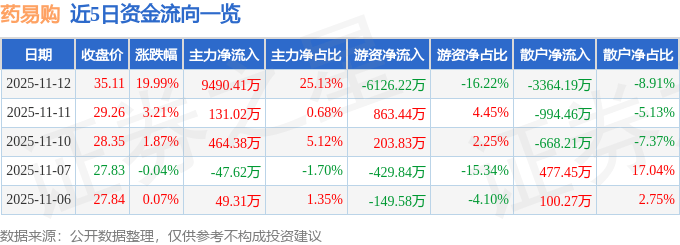
Core Insights - The stock of YaoYigou reached a closing price of 35.11 yuan on November 12, with a limit-up increase of 19.99% [1] - The stock's limit-up was driven by several factors including strategic collaboration through share transfer, improved operational fundamentals, favorable industry policies, and technological advantages [1] Group 1: Stock Performance - YaoYigou's closing price on November 12 was 35.11 yuan, marking a 19.99% increase [2] - The stock experienced a limit-up at 9:34 AM and did not open the limit, with a closing order amount of 86.25 million yuan, accounting for 3.9% of its market capitalization [1] Group 2: Factors Driving Stock Performance - Shareholder structure optimization was a key driver, with the controlling shareholder transferring 5.23% of shares to a resource-oriented investor in the pharmaceutical industry, who committed to not selling shares for 18 months and plans for industry chain cooperation [1] - The company's operational fundamentals improved, successfully recovering 44 million yuan in loans and unfreezing nearly 100 million yuan in deposits, alongside a 7.41% year-on-year revenue growth and a 112.16% increase in long-term equity investments [1] - Industry policies are also a catalyst, with the National Disease Control Bureau predicting a peak in flu cases and the Medical Insurance Bureau strengthening price regulation in pharmacies, enhancing the outlook for the pharmaceutical e-commerce sector [1] Group 3: Market Sentiment and Capital Flow - On November 12, the net inflow of main funds was 94.90 million yuan, accounting for 25.13% of the total transaction volume, while retail investors saw a net outflow of 33.64 million yuan, representing 8.91% of the total [1][2] - The pharmaceutical commercial sector rose by 1.56%, the pharmaceutical sector increased by 0.77%, and the internet healthcare sector grew by 0.28% on the same day [4]

海口江东新区首家互联网医院正式营业
Hai Nan Ri Bao· 2025-11-12 01:58
Core Insights - The Haikou Jinkang Internet Hospital officially opened its Meilan Jinkang Comprehensive Outpatient Department, marking the gradual establishment of an integrated service model of "online diagnosis and treatment + offline entities" in the Jiangdong New District [1] Group 1: Service Model - The internet hospital is built on physical medical resources, focusing on breaking the limitations of time and space in medical treatment and simplifying the diagnosis and treatment process [1] - A multi-dimensional convenient service system has been created, allowing users to register and create a profile through the official mini-program "Haikou Jinkang Internet Co., Ltd." [1] Group 2: User Experience - Users can select departments or doctors for appointments, receive electronic prescriptions, choose medication delivery methods, and settle payments, with the ability to review records and follow-up visits in their personal center [1] - The hospital aims to provide regular internet medical services to residents, leveraging online platforms to overcome geographical limitations, primarily serving the Haikou city area [1]
跨国药企们,看上了这个“超级医药供应链”
Di Yi Cai Jing Zi Xun· 2025-11-11 06:55
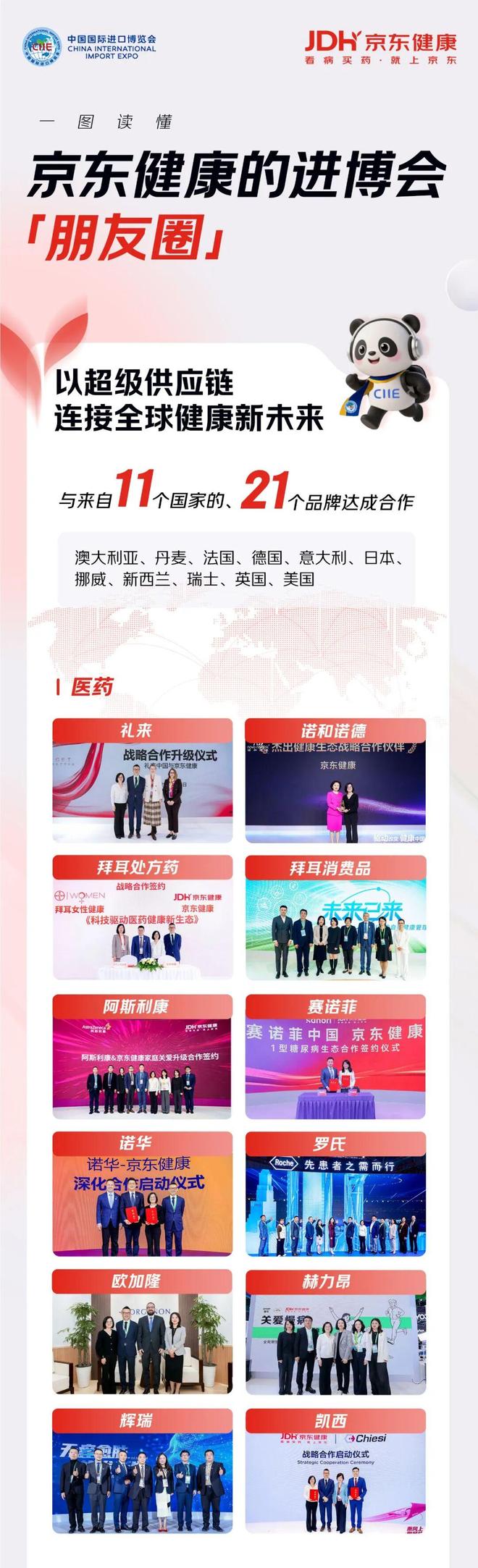
Core Insights - The eighth China International Import Expo saw JD Health establish partnerships with numerous multinational pharmaceutical companies and health brands, surpassing previous collaboration scales and focusing on top global pharmaceutical brands [1][2][3] - JD Health is leveraging its "super pharmaceutical supply chain" to empower companies and transition partnerships from simple channel cooperation to building a health ecosystem [1][3] Group 1: Strategic Collaborations - JD Health and Eli Lilly upgraded their strategic partnership during the expo, discussing future plans in diabetes care [2] - A strategic cooperation agreement was signed between JD Health and Kasey, focusing on disease education and chronic disease management [2][3] - JD Health is a key partner for Novo Nordisk, collaborating on a comprehensive service model for obesity and diabetes management [3] - Bayer and JD Health initiated a women's health literacy enhancement program, integrating medical resources and building a professional content library [3] - Sanofi and JD Health signed an ecological cooperation agreement to establish a Type 1 diabetes management center [3] Group 2: Market Dynamics - The outpatient market is becoming a critical battleground for pharmaceutical companies, shifting from a secondary option to a primary focus due to changes in patient consumption habits and healthcare policies [6][7] - JD Health is addressing the complexities of the outpatient market by offering a unified platform for pharmaceutical companies, reducing communication costs and enhancing operational efficiency [7] - The online pharmaceutical sales market is projected to grow, with JD Health leveraging over 200 million active users to enhance its digital marketing capabilities [8] Group 3: Internet Healthcare Transformation - The internet healthcare sector is reshaping patient treatment habits, with JD Health enhancing its services to meet evolving consumer health needs [10][11] - JD Health's internet hospital is facilitating a closed-loop service for flu prevention, allowing online consultations and prescription management [10] - The company is developing specialized healthcare services across various fields, providing a comprehensive approach to chronic disease management [11] Group 4: Future Outlook - The Chinese pharmaceutical retail market is expected to reach 501.9 billion yuan in 2024, with online sales growing faster than traditional retail [8] - JD Health aims to continue building an integrated healthcare service ecosystem, focusing on user-centered value creation and supply chain advantages [11]
国证国际港股晨报-20251030
Guosen International· 2025-10-30 11:10
Group 1: Market Overview - The Hong Kong stock market experienced a decline, with the Hang Seng Index falling by 0.33%, the Hang Seng China Enterprises Index down by 0.97%, and the Hang Seng Tech Index decreasing by 1.26% [2][3] - The total market turnover was HKD 242.7 billion, with short selling amounting to HKD 33.6 billion, representing 15.99% of the total turnover [2] - Southbound capital inflow decreased to HKD 2.26 billion, with the most net buying in China Mobile, Hua Hong Semiconductor, and Pop Mart, while Alibaba, Tencent, and ZTE saw the most net selling [2] Group 2: Sector Performance - Defensive stocks and resource stocks were sold off due to a rebound in market risk appetite, leading to a significant drop in gold prices [3] - The gold and non-ferrous metal sectors saw notable declines, with major gold stocks like Zijin Mining, Zhaojin Mining, and Shandong Gold all falling [3] - The consumer sector also faced downward pressure, with sports goods, luxury goods, tobacco, and local retail stocks all weakening [3] - The pharmaceutical and biotech sectors continued to adjust, with companies like Heng Rui Pharmaceutical experiencing significant declines post-earnings [3] Group 3: Company Analysis - Tmall (6110.HK) - Tmall reported a 6.6% year-on-year decline in revenue to HKD 27.01 billion and a 41.9% drop in net profit to HKD 1.29 billion, which was in line with expectations [8][9] - The company declared a final dividend of HKD 0.02 per share and a special dividend of HKD 0.12 per share, resulting in an annual payout ratio of 135% [9] - Despite the revenue decline, Tmall achieved a 20% increase in operating cash flow, reaching HKD 3.8 billion, due to effective working capital management [9] Group 4: Strategic Initiatives - Tmall is focusing on optimizing its store structure, with a 18.3% reduction in the number of direct stores to 5,020 and a 12.4% decrease in sales area [10] - The company is implementing stricter standards for store openings and locations to enhance operational efficiency [10] - Tmall is deepening collaborations with high-end brands like SOAR Running and Norda to diversify its brand matrix and strengthen its market presence [10] Group 5: Future Outlook - The report predicts a gradual recovery in performance as the retail consumption environment improves, with expected EPS of HKD 0.21, 0.22, and 0.23 for FY26, FY27, and FY28 respectively [10] - A target price of HKD 3.6 is set for the 2026 fiscal year, maintaining a "Buy" rating based on the company's high dividend policy and potential for recovery [8][10]
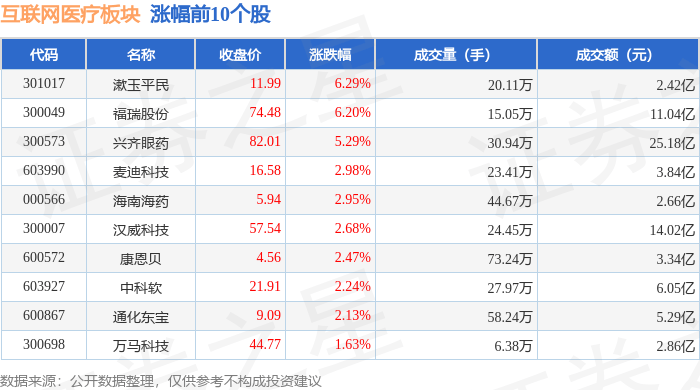
互联网医疗板块10月29日涨0.21%,漱玉平民领涨,主力资金净流出11.25亿元
Sou Hu Cai Jing· 2025-10-29 08:45
Core Insights - The internet healthcare sector experienced a slight increase of 0.21% on October 29, with notable gains from companies like Jiangyu Pingmin, which rose by 6.29% [1] - The Shanghai Composite Index closed at 4016.33, up 0.7%, while the Shenzhen Component Index closed at 13691.38, up 1.95% [1] Company Performance - Jiangyu Pingmin (301017) closed at 11.99 with a gain of 6.29%, trading volume of 201,100 shares and a transaction value of 242 million [1] - Furuishi (300049) closed at 74.48, up 6.20%, with a trading volume of 150,500 shares and a transaction value of 1.104 billion [1] - Xingqi Eye Medicine (300573) closed at 82.01, increasing by 5.29%, with a trading volume of 309,400 shares and a transaction value of 2.518 billion [1] - Other notable performers include Maidi Technology (603990) with a 2.98% increase and a transaction value of 384 million, and Hanhui Technology (300007) with a 2.68% increase and a transaction value of 1.402 billion [1] Market Dynamics - The internet healthcare sector saw a net outflow of 1.125 billion from institutional investors, while retail investors contributed a net inflow of 926 million [2][3] - The overall market sentiment indicated a mixed response, with some stocks experiencing significant declines, such as Jiayuan Technology (301117) which fell by 13.29% [2] - The trading activity highlighted a divergence in investor behavior, with institutional investors pulling back while retail investors remained active [2][3]





平台巨头竞速互联网医疗,商业模式如何可持续?
Di Yi Cai Jing· 2025-10-19 06:05
Core Viewpoint - Leading platform companies and AI technology firms are increasingly entering the healthcare sector, leveraging AI technology and vast health search data to enhance online medical services and efficiency [1][2]. Group 1: Industry Trends - Many top-tier hospitals are moving towards seeking external AI service resources as they enter a "cooling period" in developing their own AI models [1]. - The rise of large models has revitalized interest in internet healthcare, which had previously faced challenges [1]. - Companies like Baidu Health and ByteDance's Xiaohua Health are launching AI-driven healthcare applications, expanding their services from health education to intelligent medical consultations [2]. Group 2: AI Model Development - Concerns have been raised regarding the quality and availability of data for training medical AI models, which can impact decision-making accuracy in serious medical scenarios [3]. - Experts suggest that general-purpose AI models can play a crucial role in healthcare by enhancing reasoning and multi-modal capabilities, provided they are trained with sufficient and updated medical data [3]. Group 3: Application and Commercialization - Baidu Health's AI manager app integrates real-time verification by human doctors, ensuring that AI decisions are validated [2][5]. - The commercial landscape for internet healthcare is evolving, with challenges in user engagement and payment pathways, leading companies to focus on partnerships with medical institutions [6]. - Hospitals are beginning to adopt AI models cautiously, ensuring safety and establishing independent computing platforms for their applications [6][7].
