
供应链金融

Search documents
中国商业保理指数连接产业链、金融链、政策链
Zhong Guo Jing Ji Wang· 2026-01-12 00:32
我国商业保理行业首个指数近日正式亮相。在中国物流与采购联合会与诚通商业保理有限公司近日举行 的"中国商业保理指数"发布会上,中国物流信息中心党委书记、主任刘宇航说,作为国内首个聚焦商业 保理行业的综合性指数,希望利用指数动态、准确、及时地反映商业保理行业运行态势以及在支持实体 经济方面的功能作用,加强指数化在商业保理行业中的应用,让指数成为连接产业链、金融链、政策链 的重要纽带。 近年来,我国企业应收账款规模快速扩大,中小企业融资需求也在不断上升。我国商业保理行业立足实 体经济,以应收账款融资为出发点,走"产业+金融+科技"融合发展之路,为畅通资金循环、化解中小 企业融资难融资贵融资慢问题、降低企业负债率、健全商业信用体系发挥了重要作用。 当前,国家对供应链金融的重视程度进一步提升,国务院在《关于推进普惠金融高质量发展的实施意 见》中明确强调,要健全多层次普惠金融机构组织体系,引导商业保理公司专注主业,更好服务普惠金 融重点领域。在此背景下,作为供应链金融重要组成部分的商业保理行业实现飞速发展,已经成为我国 供应链金融领域的重要组成部分,对实体经济的支持作用不断显现。 据介绍,中国商业保理指数的前期调研工作已 ...
连接产业链、金融链、政策链——中国商业保理指数正式亮相
Xin Lang Cai Jing· 2026-01-12 00:28
转自:北京日报客户端 我国商业保理行业首个指数近日正式亮相。在中国物流与采购联合会与诚通商业保理有限公司近日举行 的"中国商业保理指数"发布会上,中国物流信息中心党委书记、主任刘宇航说,作为国内首个聚焦商业 保理行业的综合性指数,希望利用指数动态、准确、及时地反映商业保理行业运行态势以及在支持实体 经济方面的功能作用,加强指数化在商业保理行业中的应用,让指数成为连接产业链、金融链、政策链 的重要纽带。 近年来,我国企业应收账款规模快速扩大,中小企业融资需求也在不断上升。我国商业保理行业立足实 体经济,以应收账款融资为出发点,走"产业+金融+科技"融合发展之路,为畅通资金循环、化解中小 企业融资难融资贵融资慢问题、降低企业负债率、健全商业信用体系发挥了重要作用。 当前,国家对供应链金融的重视程度进一步提升,国务院在《关于推进普惠金融高质量发展的实施意 见》中明确强调,要健全多层次普惠金融机构组织体系,引导商业保理公司专注主业,更好服务普惠金 融重点领域。在此背景下,作为供应链金融重要组成部分的商业保理行业实现飞速发展,已经成为我国 供应链金融领域的重要组成部分,对实体经济的支持作用不断显现。 为了响应国家发展普 ...
连接产业链、金融链、政策链 中国商业保理指数正式亮相
Jing Ji Ri Bao· 2026-01-11 23:27
我国商业保理行业首个指数近日正式亮相。在中国物流与采购联合会与诚通商业保理有限公司近日 举行的"中国商业保理指数"发布会上,中国物流信息中心党委书记、主任刘宇航说,作为国内首个聚焦 商业保理行业的综合性指数,希望利用指数动态、准确、及时地反映商业保理行业运行态势以及在支持 实体经济方面的功能作用,加强指数化在商业保理行业中的应用,让指数成为连接产业链、金融链、政 策链的重要纽带。 本次发布的中国商业保理指数通过层次分析法确定指标权重,确保指数的客观性,最终用扩散指数 计算方法加权计算得出综合指数,全面反映商业保理行业运行态势、周期波动及服务实体经济效能。 近年来,我国企业应收账款规模快速扩大,中小企业融资需求也在不断上升。我国商业保理行业立 足实体经济,以应收账款融资为出发点,走"产业+金融+科技"融合发展之路,为畅通资金循环、化解 中小企业融资难融资贵融资慢问题、降低企业负债率、健全商业信用体系发挥了重要作用。 当前,国家对供应链金融的重视程度进一步提升,国务院在《关于推进普惠金融高质量发展的实施 意见》中明确强调,要健全多层次普惠金融机构组织体系,引导商业保理公司专注主业,更好服务普惠 金融重点领域。在此 ...
监管规范供应链金融,推进应收账款电子凭证融资业务登记标准化
Bei Jing Shang Bao· 2026-01-08 08:05
(文章来源:北京商报) 北京商报讯2026年1月8日,中国互联网金融协会官微发布消息称,根据《关于规范供应链金融业务引导 供应链信息服务机构更好服务中小企业融资有关事宜的通知》(银发〔2025〕77号)关于"应收账款电 子凭证融资,由当事人通过中国人民银行征信中心动产融资统一登记公示系统办理登记"的相关规定, 为进一步推进应收账款电子凭证融资业务登记标准化,不断提升登记和查询质效,中国互联网金融协会 和中国人民银行征信中心共同组织编制了《应收账款电子凭证融资业务登记——财产信息描述示例》, 现予以发布。相关当事人办理应收账款电子凭证融资业务登记时,可参考示例对有关财产信息进行描 述。 ...
2025年中国第三方支付行业研究报告
3 6 Ke· 2026-01-08 01:14
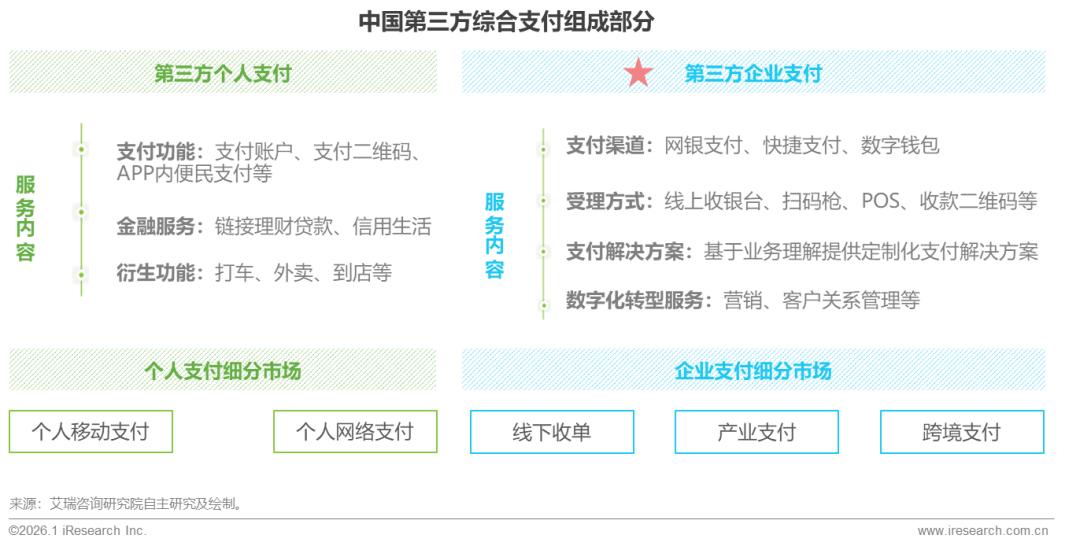
Core Insights - The transaction volume of China's third-party comprehensive payment is expected to reach 577 trillion yuan by 2025, with a year-on-year growth of 3.0%, driven by a 2.9% increase in personal payment transactions and a 3.2% increase in corporate payment transactions [1][16] - The industry has entered a phase of intensified competition, with a focus on compliance and regulatory requirements, making it increasingly difficult to rely solely on transaction fees for profitability [1][7] - The report emphasizes the importance of "payment+" development, analyzing the value of third-party payment segments and predicting future industry trends [1] Industry Overview - The third-party payment industry in China has evolved from a nascent stage in 2000 to a mature and regulated market by 2019, with significant growth in transaction volumes and improved regulatory frameworks [4] - The market is now characterized by a dual focus on personal and corporate payments, with corporate payments gaining traction due to digital transformation and cross-border e-commerce [2][16] Regulatory Environment - The implementation of the "Non-Bank Payment Institutions Supervision Management Regulations" in 2024 has led to a normalization of compliance and accelerated industry consolidation, with increased regulatory scrutiny evident in the number and amount of fines imposed [7] Technological Integration - The industry is actively embracing AI technology to enhance operational efficiency and customer service, with applications in smart risk control, process automation, and personalized services [9][15] - AI is expected to reduce operational costs and improve service quality, thereby enhancing the overall competitiveness of the payment industry [9] Market Dynamics - The personal payment market is nearing saturation, with a projected decline in growth rates, while corporate payments are expected to continue growing at a faster pace due to ongoing digitalization [16][21] - The online commercial payment market is anticipated to grow steadily, with a compound annual growth rate of 4.8% from 2020 to 2025 [25] Payment Segmentation - The offline acquiring market is facing challenges due to saturation, while online industrial payments are expected to maintain stable growth driven by digital transformation [35][47] - Cross-border payments are emerging as a significant growth area, with the market projected to reach 3.3 trillion yuan by 2025, fueled by the expansion of cross-border e-commerce [55] Future Trends - The introduction of new payment methods, such as "look-and-pay," is expected to drive the evolution towards a more seamless payment experience [66] - The promotion of digital currency and stablecoins is anticipated to enhance cross-border payment efficiency and create new growth opportunities [68][74]

金融之力 破瘠成沃 八桂大地奏响乡村产业振兴进行曲
Jin Rong Shi Bao· 2026-01-07 02:10
Core Viewpoint - The article discusses the transformation of rural assets in Guangxi, China, through financial innovation and technology, addressing the challenges faced by the agricultural sector and enhancing the connection between finance and rural industries [1][6][12]. Group 1: Challenges in Rural Development - Rural industries in Guangxi face multiple challenges, including dormant assets that are difficult to monetize and a lack of standardized valuation systems for livestock and aquaculture [3][5]. - Natural and market risks significantly impact agricultural production, making it vulnerable to environmental changes and price fluctuations, which complicates traditional financing models [4][5]. - The local sugar industry, despite being a major contributor to national production, struggles with financing issues that hinder its competitiveness and growth [5]. Group 2: Financial Innovations and Solutions - To address these challenges, Guangxi has implemented innovative financial practices, such as issuing property rights certificates for aquaculture, which allows farmers to secure loans based on clearly defined assets [6][7]. - Advanced technologies, like AI facial recognition for livestock, have been introduced to create unique digital identities for animals, facilitating better insurance and financing options [7][12]. - A collaborative financial model has been developed, combining insurance, credit, and government support to provide comprehensive financial services to farmers, resulting in significant loan amounts being disbursed [8][11]. Group 3: Economic Growth and Sustainability - The integration of supply chain finance and the development of specialized credit products have been emphasized to support local agricultural sectors, ensuring timely payments and reducing financing costs for farmers [8][12]. - E-commerce initiatives have been established to enhance the marketing of local agricultural products, providing training for villagers to improve their sales techniques and increase income [9]. - The overall financial ecosystem in Guangxi is evolving towards a more systematic approach, focusing on long-term sustainability and resilience in rural economic development [10][12].

金融之力 破瘠成沃
Jin Rong Shi Bao· 2026-01-07 01:46
Core Viewpoint - The article highlights the transformation of rural assets in Guangxi through financial innovation and technology, addressing the challenges faced by the agricultural sector and promoting sustainable development in rural areas [1][11][21]. Group 1: Challenges in Rural Development - Rural areas in Guangxi face multiple challenges, including asset dormancy and industry shackles, which hinder development [4]. - The lack of standardized valuation systems for livestock and other agricultural assets makes it difficult for farmers to secure loans from traditional banks [5]. - Natural and market risks, such as flooding and price volatility, further exacerbate the vulnerability of agricultural production [6][8]. Group 2: Financial Innovations and Solutions - Financial institutions are innovating by developing policy insurance for local agricultural products, such as the "富硒星油藤" brand, which has secured insurance coverage of 4.1592 million yuan for 1,040 acres [3]. - The introduction of property rights certificates for aquaculture has allowed farmers to convert their rights into collateral, facilitating access to credit [11][12]. - Advanced technologies, such as AI facial recognition for livestock, have improved the efficiency of insurance and loan processes, enabling better risk management [12]. Group 3: Collaborative Financial Ecosystem - A collaborative model involving insurance, credit, and government support has been established to address financing challenges in the agricultural sector [12][21]. - The implementation of tailored financial products, such as marine carbon sink loans and index insurance for aquaculture, has been initiated to support specific agricultural needs [15][21]. - The establishment of e-commerce platforms and training programs for local farmers aims to enhance market access and sales of agricultural products [16][18]. Group 4: Systematic Policy Support - The People's Bank of China has implemented policies to provide financial resources to the agricultural sector, including fiscal subsidies and risk compensation mechanisms [19]. - The promotion of digital credit profiles for farmers has facilitated access to unsecured loans, significantly increasing loan amounts for agricultural projects [20]. - The establishment of a financial service command center for the sugar industry has led to the development of specialized financing models that support the entire supply chain [21].


“脱核”融资!招行青岛分行小微企业供应链融资模式悄然转型
Qi Lu Wan Bao· 2026-01-06 06:36
Core Insights - The article discusses the transformation of supply chain financing from a credit-based model reliant on core enterprises to a "de-coupled" model that leverages transaction data and performance metrics of businesses [2][3] - The introduction of the "Dealer Easy Loan" by China Merchants Bank's Qingdao branch allows small distributors to access financing based on their transaction data with Lu Hua Group, addressing previous financial constraints [1][5] Policy and Market Dynamics - The shift to de-coupled financing is driven by policy support and market demand, as highlighted by the People's Bank of China and other regulatory bodies encouraging financial institutions to adopt this model [2] - Traditional financing models placed high demands on core enterprises, which limited the accessibility of financing for small and micro enterprises [2] Technological Advancements - China Merchants Bank has developed an advanced online intelligent risk control model that integrates various data sources to create a comprehensive profile of businesses, facilitating the de-coupled financing approach [3][4] - The bank's financing products, such as "Dealer Easy Loan" and "Supply Chain Loan," utilize this model to provide efficient and accessible financial solutions to small and micro enterprises [3][4] Product Offerings - "Dealer Easy Loan" is designed for downstream distributors, providing credit loans that ensure funds are directed to core enterprise accounts, thus controlling usage [4] - "Supply Chain Loan" offers online credit loans without collateral or on-site due diligence, simplifying the application process for small businesses [4] Operational Efficiency - The bank's "One Bank Serves One" model enhances collaboration across branches, allowing for direct partnerships with core enterprises and streamlined services for their upstream and downstream clients [4][5] - The financing model has significantly improved service efficiency, enabling rapid loan approvals and disbursements [5] Impact on Supply Chain Ecosystem - The de-coupled financing model has positively influenced the supply chain ecosystem by reducing reliance on core enterprise credit, thus promoting stability and health within the supply chain [7] - The financing solutions provided by China Merchants Bank have addressed the funding challenges faced by small distributors, leading to lower interest rates compared to traditional financing options [7] Performance Metrics - By the end of December 2025, the Qingdao branch achieved a loan balance of 2.146 billion yuan in supply chain financing, marking an 82% year-on-year increase, with de-coupled financing growing by 377% [8] - The bank's efforts in supply chain financing have positioned it as a key player in promoting inclusive finance, with significant growth in the adoption of de-coupled products [8]

中国商业保理指数正式亮相,为行业发展注入新动能
Feng Huang Wang Cai Jing· 2026-01-05 13:14
1月5日,中国物流与采购联合会与诚通商业保理有限公司在京举行"中国商业保理指数"发布会,部分省 市保理协会共同参与,中国商业保理行业首个指数正式亮相。 中国物流与采购联合会党委常委、副会长何辉,中国诚通控股集团有限公司党委委员、副总经理童来明 出席会议并致辞。诚通商业保理有限公司有关负责人、中国物流信息中心和中国物流与采购联合会物流 与供应链金融分会领导、供应链金融领域权威专家、部分省市保理协会代表、保理企业代表等出席会 议。 商业保理作为供应链金融的重要组成部分,立足服务实体经济,以应收账款融资为核心,走"产业+金 融+科技"融合发展之路,在缓解中小企业融资难题、降低企业负债率、健全商业信用体系等方面发挥 重要作用。 中国商业保理指数,是以扩散指数编制理论为依据,以问卷调查为基础,建立的一套指标体系,由反映 商业保理行业变化的供需、业务费率、保理普惠性、特色服务、保理多元化服务能力、筹资能力、客户 稳定性和业务预期等方面指标构成。一方面通过指数化形式综合反映商业保理行业运行态势,数据化呈 现行业服务实体经济成效;另一方面通过指数的持续运行,强化社会各界对商业保理的关注和理解,提 升品牌建设能力,助力行业高质 ...
宁夏石嘴山:依托数字化赋能推动供应链金融创新发展
Xin Lang Cai Jing· 2026-01-05 10:44
Core Viewpoint - The People's Bank of China, Shizuishan Branch, is innovating supply chain finance to alleviate the financing difficulties faced by small and micro enterprises, enhancing regional economic resilience and vitality through digital technology and a new operational model [1][6]. Group 1: Supply Chain Finance Innovations - The Shizuishan Branch has implemented a "Three Mechanisms, Three Lists + N" model to improve inclusive financial services, focusing on the financing challenges of small and micro enterprises [2][7]. - Since 2023, the branch has organized 37 various matching activities, engaging over 1,500 enterprises, with on-site signed amounts exceeding 6.7 billion yuan, effectively supporting enterprises' loan stability and expansion needs [2][7]. - The introduction of the digital supply chain financing product "Ding e Credit" and the successful implementation of online reverse factoring have provided one-stop financing support to key enterprises, alleviating payment pressures [2][7]. Group 2: Digital Empowerment and Credit Assessment - The Shizuishan Branch is promoting a "de-core" supply chain finance service model that shifts credit assessment from core enterprise credit to transaction data credit, creating a financing loop that does not occupy core enterprise credit limits [3][8]. - The use of blockchain, electronic signatures, and invoice verification technologies enables online transaction background audits, ensuring trade authenticity and significantly reducing loan approval times to 2-3 working days [4][9]. Group 3: Financial Growth and Impact - By the end of Q3 2025, the supply chain financial loan balance of Shizuishan Bank increased by 473 million yuan, with inventory pledge financing growing by 318 million yuan, marking significant progress in supply chain finance innovation [5][10]. - The "de-core" financing model has facilitated 20 financing transactions totaling 58.27 million yuan for four chain enterprises, opening new pathways for regional small and micro financing services [5][10]. - As of October 2025, the balance of inclusive small and micro loans in Shizuishan has increased by 10.8% year-on-year, with a net increase of 1.16 billion yuan since the beginning of the year [5][10].