债务风险

Search documents
青岛城投集团102亿债券获受理!年亏超2亿叠加900亿短债压顶
Sou Hu Cai Jing· 2025-08-18 10:22
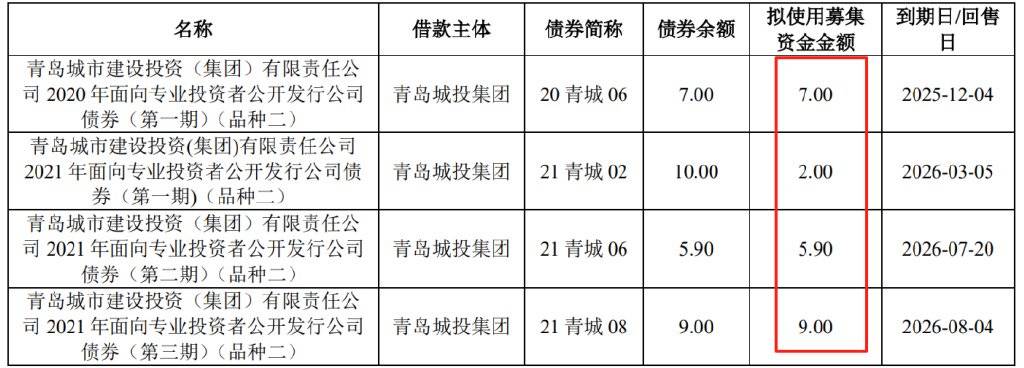
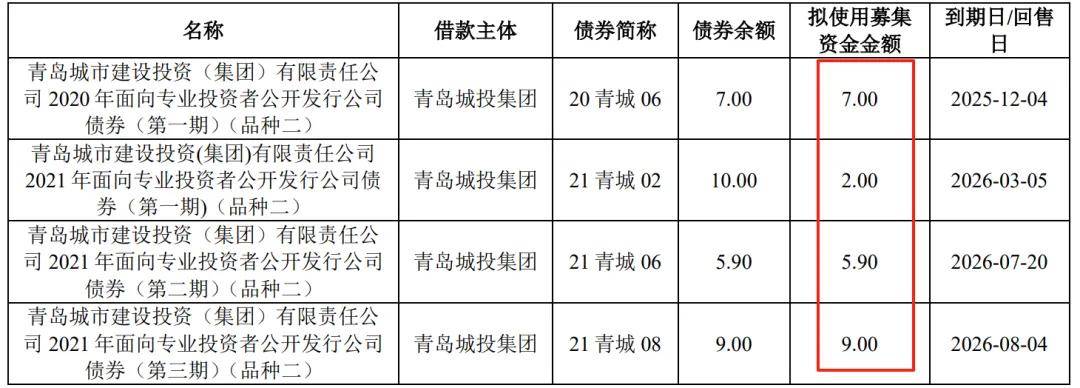
Core Viewpoint - Qingdao Urban Construction Investment Group is facing significant debt risks due to its expanding debt scale and deteriorating profitability, leading to increased short-term repayment pressures [1][2][6] Debt Situation - As of the end of 2024, the total debt of Qingdao Urban Construction Group reached 2,616.17 billion, with a notable increase to 2,660.16 billion by the end of March 2025, indicating a clear trend of debt expansion [2] - Short-term debt due within one year amounted to 896.63 billion, accounting for 34.27% of total debt, highlighting concentrated repayment pressures [2][10] - The company has acknowledged that even with the successful issuance of 102 billion in bonds, it will still face concentrated repayment risks [6] Financial Performance - In 2024, the company reported revenues of 469.76 billion, a year-on-year increase of 6.28%, but net profit turned from a profit of 7.78 billion in 2023 to a loss of 2.89 billion, indicating a significant decline in profitability [1][7] - The first quarter of 2025 saw further deterioration, with revenues declining by 6.74% to 105.43 billion and a loss of 1.24 billion [7] - The company's operating expenses reached 105.27 billion in 2024, representing 22.41% of revenues, severely eroding profit margins [7] Investment Dependency - The company has increasingly relied on investment income, which was 23.14 billion in 2024, accounting for 4.93% of total revenue, and rose to 6.43% in the first quarter of 2025 [8] - Investment income has been declining, with figures of 39.14 billion in 2022, 26.53 billion in 2023, and 23.14 billion in 2024, raising concerns about the sustainability of this income source [8] Liquidity Issues - The cash coverage ratio for short-term debt dropped from 0.29 in 2022 to 0.18 in 2024, indicating a liquidity crisis [10] - The company experienced a net cash outflow of 22.66 billion in 2024, reflecting a continuous trend of cash outflows over the years [11] - Significant amounts of funds are tied up in long-term receivables, with other receivables reaching 336.65 billion by the end of 2024, further exacerbating liquidity pressures [11] Debt Management - The issuance of the 102 billion bond is intended solely for repaying maturing debt, revealing a "borrow new to repay old" strategy [3][6] - The company has a substantial amount of public welfare assets, totaling 11.64 billion, which have negligible liquidity due to their nature [11]

青岛城投集团102亿债券获受理!年亏超2亿叠加900亿短债压顶,流动性危机一触即发?
Sou Hu Cai Jing· 2025-08-18 05:12
Core Viewpoint - Qingdao Urban Construction Investment Group is facing significant debt risks due to expanding debt levels and deteriorating profitability, leading to heightened market concerns about its financial stability [1][2][9] Debt Situation - As of the end of 2024, the total debt of Qingdao Urban Construction Investment Group reached 2,616.17 billion, with a notable increase to 2,660.16 billion by the end of March 2025, indicating a clear trend of debt expansion [2] - Short-term debt due within one year amounted to 896.63 billion, representing 34.27% of total debt, which poses a concentrated repayment pressure [2][9] - The company has acknowledged that even with the successful issuance of 102 billion in bonds, it will still face concentrated repayment risks [6] Financial Performance - In 2024, the company reported revenue of 469.76 billion, a year-on-year increase of 6.28%, but the net profit turned from a profit of 7.78 billion in 2023 to a loss of 2.89 billion, highlighting a significant contradiction of "increased revenue without increased profit" [1][7] - The first quarter of 2025 saw further deterioration, with revenue declining by 6.74% year-on-year to 105.43 billion and a loss of 1.24 billion [7] - The company's operating expenses reached 105.27 billion in 2024, accounting for 22.41% of revenue, severely eroding profit margins [7] Investment Dependency - The company has increasingly relied on investment income, which was 23.14 billion in 2024, accounting for 4.93% of revenue, and rose to 6.43% in the first quarter of 2025 [8] - This investment income is primarily derived from financial asset fair value changes, which are highly volatile and lack stability, posing a long-term risk to the company's profit structure [8] Liquidity Concerns - The cash coverage ratio for short-term debt has significantly decreased from 0.29 in 2022 to 0.18 in 2024, indicating a liquidity crisis [9] - The company has a net cash outflow of 22.66 billion in 2024, reflecting a continuous trend of cash outflow over the years, which tightens the funding chain [10] Structural Risks - The company is heavily reliant on bank loans (1,338.05 billion) and bond issuance (1,129.77 billion), with a rising financial leverage ratio, as both asset-liability ratio and total capitalization ratio have exceeded 65% [10] - The company has significant amounts tied up in long-term receivables, with other receivables reaching 336.65 billion by the end of 2024, which are difficult to recover and further strain liquidity [11]
河北审计工作报告公布:平台类企业分类转型不到位、转型滞后与化债不力、专项资金遭挤占挪用!
Sou Hu Cai Jing· 2025-08-17 04:13
Fiscal Management - The provincial general public budget revenue for 2024 totaled 674.8 billion, with expenditures of 670.81 billion, resulting in a carryover of 3.99 billion to the next year [7] - The provincial government fund revenue reached 310.17 billion, with expenditures of 307.9 billion, leading to a carryover of 2.27 billion [7] - The social insurance fund budget showed a revenue of 440.27 billion and expenditures of 405.23 billion, ending with a surplus of 35.03 billion [7] Audit Findings - Irregularities in fiscal revenue organization were noted, with 1 city and 17 counties implementing policies linked to local fiscal contributions, resulting in a disguised return of 737 million [11] - Ineffective management of existing funds led to 1.991 billion remaining unallocated, while 1.297 billion in land transfer fees and project surplus funds were not collected [11] - The responsibility for resolving hidden debts was inadequately enforced, with 1 city and 3 counties failing to address 2.582 billion in hidden debt [11] Debt Risk in State-owned Enterprises - A special audit revealed that 1 city and 6 counties did not effectively promote the classification transformation of 12 enterprises, failing to detach government financing functions [24] - Misrepresentation of assets occurred, with 3 counties improperly injecting public assets into enterprises, inflating assets by 1.173 billion, and 2 cities and 3 counties transferring municipal infrastructure assets, resulting in 16.785 billion in inflated assets [24][25] - Instances of abuse of power and corruption were identified, including a county investment enterprise that failed to follow decision-making procedures, leading to asset losses [25] Investment and Economic Development - The government aims to enhance economic recovery through active fiscal policies, including the issuance of special bonds totaling 150 billion for major projects [4] - The province secured 562.5 million in special long-term bonds to stimulate consumption, projected to increase retail sales by approximately 70 billion [4] - The province's disaster recovery efforts post-flooding received 122.19 billion in national bond funding, with local contributions of 6.63 billion [5] Audit Rectification Efforts - A comprehensive rectification framework was established, addressing issues such as improper management of special bonds and budget performance, with a completion rate of 95.33% for rectification of 1,371 identified issues [6]
健盛集团:2025年中报显示业绩下滑,现金流改善,债务与应收账款需关注
Zheng Quan Zhi Xing· 2025-08-08 22:25
Financial Performance Overview - The total revenue of the company for the first half of 2025 was 1.171 billion yuan, a slight increase of 0.19% year-on-year [1] - The net profit attributable to shareholders was 142 million yuan, a decrease of 14.46% year-on-year [1] - The net profit excluding non-recurring items was 136 million yuan, down 15.84% year-on-year [1] - In Q2, total revenue was 611 million yuan, a decline of 1.52% year-on-year [1] - The net profit attributable to shareholders in Q2 was 81.62 million yuan, a decrease of 2.23% year-on-year [1] - The net profit excluding non-recurring items in Q2 was 74.98 million yuan, down 8.39% year-on-year [1] Key Financial Indicators - Accounts receivable at the end of the reporting period was 511 million yuan, representing 157.25% of the latest annual net profit, indicating significant collection risk [3] - The net cash flow from operating activities increased by 146.96% year-on-year, mainly due to a substantial recovery of receivables [3] - Interest-bearing liabilities amounted to 1.028 billion yuan, an increase of 8.71% year-on-year [4] - The interest-bearing asset-liability ratio was 27.32%, indicating some pressure in debt management [4] - Current non-current liabilities due within one year increased by 701.96%, and long-term borrowings rose by 5495.72%, suggesting significant short-term repayment pressure [4] Cost and Expenses - Operating costs increased by 1.21% year-on-year, primarily due to rising labor costs [5] - Selling expenses, administrative expenses, and financial expenses increased by 5.59%, 12.8%, and 60.85% respectively, with the significant rise in financial expenses attributed to reduced exchange gains due to currency fluctuations [5] Industry Background - The textile and apparel industry showed resilience during the reporting period, with total exports of textiles and apparel reaching 143.978 billion USD, a year-on-year increase of 0.76% [6] - The industry has reduced its reliance on single markets, despite complex international trade conditions [6] - Global monetary policy divergence has intensified exchange rate fluctuations, and ongoing geopolitical conflicts have raised logistics and energy costs, further suppressing demand recovery [6] Development Outlook - The company plans to continue adjusting orders between production bases to maintain a competitive advantage of "high quality, low cost, and short delivery time" [7] - The company aims to stabilize existing customers while actively exploring new ones [7] - There will be an acceleration in the construction of information technology and smart factories, along with strengthening the core team and overall team building [7] - The company will continue to focus on investor returns [7] Profitability Metrics - Gross margin was 28.17%, a decrease of 2.5% year-on-year [8] - Net margin was 12.11%, down 14.62% year-on-year [8] - The ratio of three expenses to revenue was 11.82%, an increase of 15.72% year-on-year [8] - Earnings per share were 0.4 yuan, a decrease of 11.11% year-on-year [8] - The net asset per share was 6.86 yuan, an increase of 4.48% year-on-year [8] - Operating cash flow per share was 0.71 yuan, an increase of 158.08% year-on-year [8]

道道全:2025年中报显示盈利能力显著提升,现金流状况值得关注
Zheng Quan Zhi Xing· 2025-08-01 22:11
Core Viewpoint - The company has significantly improved its profitability in the first half of 2025, with substantial increases in revenue and net profit compared to the previous year [1] Financial Performance - Total revenue reached 2.792 billion yuan, a year-on-year increase of 1.16% - Net profit attributable to shareholders was 181 million yuan, up 563.15% year-on-year - Non-recurring net profit was 157 million yuan, an increase of 428.51% year-on-year - In Q2, total revenue was 1.306 billion yuan, a 5.15% increase year-on-year - Q2 net profit attributable to shareholders was 78.23 million yuan, up 267.04% year-on-year - Q2 non-recurring net profit was 57.81 million yuan, an increase of 234.08% year-on-year - Gross margin was 11.65%, up 24.85% year-on-year - Net margin was 6.64%, an increase of 612.48% year-on-year [1] Cost Control - Total operating expenses (selling, administrative, and financial expenses) amounted to 109 million yuan, accounting for 3.9% of revenue, a decrease of 43.32% year-on-year - Financial expenses decreased by 98.28%, primarily due to reduced net interest expenses and exchange losses [2] Cash Flow Situation - Operating cash flow per share was 0.94 yuan, a decrease of 76.48% year-on-year - Net cash flow from operating activities decreased by 76.48%, mainly due to increased payment for goods - Monetary funds were 169 million yuan, down 63.83% year-on-year, primarily due to increased raw material procurement [3] Debt Situation - Interest-bearing liabilities were 1.143 billion yuan, a decrease of 39.12% year-on-year - Interest-bearing asset-liability ratio was 25.72%, indicating a relatively high level of debt risk - Accounts payable increased by 77.64%, mainly due to increased raw material payables [4] Main Business Analysis - Revenue from the main business, packaging oil, was 1.751 billion yuan, accounting for 62.71% of total revenue, with a gross margin of 15.67% - Revenue from meal products was 627 million yuan, accounting for 22.45% of total revenue, with a gross margin of 5.40% - Revenue from bulk oil was 382 million yuan, accounting for 13.67% of total revenue, with a gross margin of only 0.19% - Other business revenue was 32.55 million yuan, accounting for 1.17% of total revenue, with a gross margin of 49.84% [5] Regional Distribution - Revenue was primarily concentrated in the Central China region, amounting to 1.284 billion yuan, accounting for 45.99% of total revenue, with a gross margin of 12.20% - Revenue from East China was 769 million yuan, accounting for 27.55% of total revenue, with a gross margin of 10.66% - Revenue from Southwest China was 428 million yuan, accounting for 15.34% of total revenue, with a gross margin of 10.72% - Revenue from other regions was 311 million yuan, accounting for 11.12% of total revenue, with a gross margin of 13.10% [6] Development Prospects - The company is a key national leading enterprise in agricultural industrialization, with a strong market share and brand influence - New products such as high oleic rapeseed oil, tea oil, and various specialty oils have been launched to enhance competitiveness - The company adheres to a brand-oriented operation philosophy and collaborates with quality media for brand promotion - However, cash flow and debt situations need further improvement to ensure long-term stable development [7]

15亿乡村振兴债终止,信阳建投四次累计54亿融资折戟
Sou Hu Cai Jing· 2025-07-21 10:40
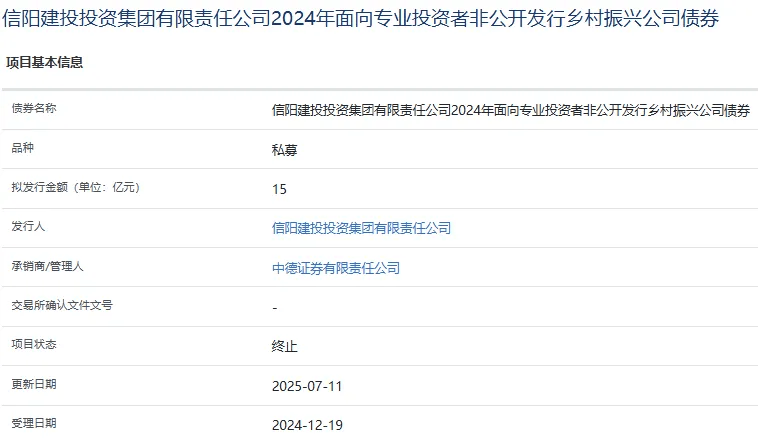
Core Viewpoint - The bond issuance project of Xinyang Construction Investment Group Co., Ltd. for 1.5 billion yuan has been terminated, marking the fourth failed financing attempt in 2025, indicating significant liquidity pressure on the company [1][3]. Financing Status - The company planned to issue 1.5 billion yuan in rural revitalization bonds, but the project status has been updated to "terminated" [2]. - This termination is part of a broader trend, with a total of 5.42 billion yuan in financing projects halted within five months, including a 1.2 billion yuan green corporate bond and a 1.22 billion yuan water supply contract asset-backed plan [3]. Liquidity Pressure - Xinyang Construction Investment has shown signs of liquidity stress, with nine commercial bills overdue in the first half of 2025, amounting to 360 million yuan [3]. - The company is listed among 889 firms with multiple overdue bills, which may affect its ability to secure future financing [3][4]. Debt Structure - As of the end of 2024, the company's total bond issuance reached 17.4 billion yuan, with new issuances of 7.58 billion yuan and repayments of only 4.41 billion yuan during the same period [4]. - Short-term debt is particularly concerning, with short-term borrowings at 3.11 billion yuan and current liabilities totaling 5.73 billion yuan, of which over 65% are bonds payable [4]. Guarantee Risks - The company has a significant guarantee network, with 87 guarantees totaling 17.01 billion yuan and 72 external guarantees amounting to 7.54 billion yuan, some of which are already overdue [5]. - Restricted assets amount to 6.87 billion yuan, representing 33.1% of net assets, further limiting financing options [5]. Cash Flow Challenges - The company reported a net cash flow from operating activities of -2.33 billion yuan in 2024, worsening from -680 million yuan in 2023, indicating reliance on external financing [6]. - Investment cash flow has been negative for four consecutive years, reaching -560 million yuan in 2024 [6]. Financial Performance - In 2024, the company achieved operating revenue of 1.97 billion yuan with a net profit of 90 million yuan, resulting in a net profit margin of 4.7% [6]. - The first quarter of 2025 saw a 121.4% increase in operating revenue to 470 million yuan, but net profit fell by 22.1% to 14.29 million yuan, highlighting a disconnect between revenue growth and profitability [7].
关税暂停期将结束,金价波动可能加大
Tong Guan Jin Yuan Qi Huo· 2025-07-07 05:51
Group 1: Report Industry Investment Rating - No relevant content provided Group 2: Core Views of the Report - Last week, precious metal prices showed a volatile and slightly stronger trend. The "Great Beauty Act" was passed, and the approaching tariff negotiation deadline on July 9 increased market uncertainty. After the better - than - expected non - farm payroll data, the market's expectation of a Fed rate cut weakened [3]. - On July 3, the "Great Beauty Act" was passed in the House, and Trump signed it into law. It provides greater fiscal flexibility but raises concerns about fiscal sustainability and debt risks. The approaching tariff suspension deadline on July 9 intensifies concerns about global trade prospects [3]. - The US June non - farm data was 147,000, far exceeding expectations, and the unemployment rate unexpectedly dropped to 4.1%. After the report, the probability of a Fed rate cut in September in the interest rate futures market dropped from 98% to about 80% [3]. - Although the market's expectation of a Fed rate cut decreased, the tax - cut bill and the approaching tariff suspension deadline add new uncertainties, and short - term precious metal price fluctuations may increase [3]. Group 3: Summary by Related Catalogs 1. Last Week's Trading Data - SHFE Gold closed at 777.06 yuan/gram, up 8.42 yuan (1.10%), with a total trading volume of 175,040 lots and a total open interest of 178,255 lots [4]. - Shanghai Gold T + D closed at 771.57 yuan/gram, up 7.42 yuan (0.97%), with a total trading volume of 39,244 lots and a total open interest of 220,656 lots [4]. - COMEX Gold closed at 3336.00 dollars/ounce, up 49.90 dollars (1.52%) [4]. - SHFE Silver closed at 8919 yuan/kilogram, up 127 yuan (1.44%), with a total trading volume of 522,479 lots and a total open interest of 634,627 lots [4]. - Shanghai Silver T + D closed at 8885 yuan/kilogram, up 157 yuan (1.80%), with a total trading volume of 415,618 lots and a total open interest of 3,258,756 lots [4]. - COMEX Silver closed at 37.04 dollars/ounce, up 0.88 dollars (2.42%) [4]. 2. Market Analysis and Outlook - The "Great Beauty Act" became law, and the approaching tariff negotiation deadline on July 9 increases uncertainties. The better - than - expected non - farm data weakened the market's expectation of a Fed rate cut [3][6]. - The EU is trying to reach a "principled" trade agreement with the US before the deadline, and Japan plans to send its chief trade negotiator to the US again this weekend [7]. - This week, focus on the end of the US "reciprocal tariff" suspension period on July 9, the 17th BRICS Leaders' Summit, the release of the Fed's monetary policy meeting minutes, and Fed officials' speeches [7]. 3. Important Data Information - US June non - farm employment increased by 147,000, far exceeding the expected 110,000, and the unemployment rate dropped to 4.1%. After the data release, the probability of a September Fed rate cut dropped to about 80% [9]. - US June ADP employment decreased by 33,000, the first negative growth since March 2023, and service - sector employment decreased by 66,000 [9]. - US May job openings increased from 7.4 million to 7.769 million, exceeding expectations, and lay - offs decreased [9]. - US June ISM manufacturing PMI rose to 49, still in the contraction range, with new orders decreasing for five consecutive months and inflation showing signs of acceleration [9]. - US June ISM non - manufacturing index was 50.8, slightly higher than expected, with business activities and orders rebounding but the employment index contracting [10]. - US May factory orders increased by 8.2% month - on - month, the largest increase since 2014 [10]. - US May trade deficit increased by 18.7% month - on - month to 71.5 billion dollars, with imports down 0.1% and exports down 4% [10]. - Eurozone June CPI rose 2% year - on - year, reaching the ECB's target, and ECB officials said the rate - cut cycle is in the final stage [10]. - Eurozone June manufacturing PMI reached 49.5, the highest since August 2022, with new orders stabilizing and export orders stopping falling [10]. 4. Related Data Charts - Gold ETF total holdings were 947.66 tons on July 4, 2025, down 7.16 tons from last week [11]. - Ishares Silver ETF holdings were 14,868.74 tons on July 4, 2025, up 2.55 tons from last week [11]. - The report also includes various charts showing the price trends, inventory changes, non - commercial positions, and correlations of precious metals and related economic indicators [14][16][18][21][25][26][30][32][35][37][42]
特朗普签署“大而美”法案!“反诈大使”朱时茂遇诈骗!商户直播军舰进出港被查!全国用电负荷创历史新高!台风“丹娜丝”生成!
新浪财经· 2025-07-05 01:54
Group 1: "Big and Beautiful" Act - The "Big and Beautiful" tax and spending act was signed into law by President Trump on July 4, 2023, after passing the House of Representatives with a vote of 218 to 214 [2] - The act extends corporate and personal tax cuts from Trump's first term and includes provisions such as exempting tips and overtime pay from taxation, with a core focus on lowering corporate taxes [2] - Initial analyses suggest that the act could increase the U.S. deficit by approximately $3.3 trillion over the next decade and reduce tax revenue significantly, raising concerns about a potential debt crisis [2][3] Group 2: U.S. National Debt Concerns - The U.S. national debt currently stands at $36.2 trillion, and the new act is expected to exacerbate the structural deficit, making it harder for lawmakers to control debt levels [3] - The act has been criticized for potentially leading to increased borrowing at a time when the national debt is already at a historical high, which could have long-term implications for future generations [3] Group 3: Electricity Demand Surge - On July 4, 2023, China's national electricity load reached a record high of 1.465 billion kilowatts, an increase of approximately 200 million kilowatts from late June and nearly 150 million kilowatts from the same period last year [22] - The eastern power grid recorded a load of 422 million kilowatts, with air conditioning demand accounting for about 37% of this load [22] - Due to ongoing high temperatures, electricity demand is expected to remain elevated in the coming week, prompting the State Grid to utilize its resources to ensure reliable power supply [22]

ST宁科: ST宁科关于新增及累计诉讼、仲裁情况的公告
Zheng Quan Zhi Xing· 2025-07-02 16:25
Core Viewpoint - Ningxia Zhongke Biotechnology Co., Ltd. is facing significant financial distress, with a total debt of 2.236 billion yuan, including overdue debts of 1.81 billion yuan and litigation-related debts of 1.84 billion yuan, leading to a severe impact on its ability to continue operations [1][5]. Debt and Financial Situation - As of the announcement date, the company's total debt stands at 2.236 billion yuan, with overdue debts totaling 1.81 billion yuan and litigation-related debts amounting to 1.84 billion yuan [1][5]. - Most of the company's bank accounts, except for those of its subsidiaries, are frozen, indicating a critical liquidity crisis [1][5]. - The company lacks sufficient funds and liquid assets to meet its debt obligations, raising concerns about its ability to continue as a going concern and potential bankruptcy [1][5]. Litigation Status - The company and its subsidiaries have been involved in multiple lawsuits over the past 12 months, with various stages including concluded, executed, and pending cases [2]. - The total amount involved in the current litigation is approximately 8.7 million yuan, along with associated litigation and preservation costs [2]. - The company is currently a defendant in several lawsuits related to loan agreements, equity transfer disputes, sales contracts, construction contracts, and securities fraud claims [2][5]. Specific Case Details - A specific lawsuit has been filed by Yantai Jiuqi Construction Engineering Installation Co., Ltd. against the company and Shandong Guiyuan Biotechnology Co., Ltd. for unpaid construction fees totaling 3.699 million yuan [2][3]. - The lawsuit is based on a construction contract where the plaintiff claims that the defendants have delayed payment for completed work [3]. Impact on Future Profitability - Due to the ongoing litigation and the current financial situation, it is difficult to accurately assess the impact on the company's current and future profitability [4][5].

马斯克与特朗普“口水战”升级:特斯拉股价领跌,美股集体承压
Sou Hu Cai Jing· 2025-07-02 10:45
Core Viewpoint - The public dispute between Elon Musk and President Trump has led to a significant drop in Tesla's stock price, highlighting the fragility of U.S. political and business relationships and raising concerns about policy uncertainty in the market [1][4][5] Group 1: Market Reaction - Tesla's stock price fell approximately 7% on July 1, becoming a focal point in the market [1] - The overall U.S. stock market also experienced declines, with the Dow Jones Industrial Average down 24 points (0.1%), the S&P 500 down 0.2%, and the Nasdaq Composite down 0.5% [4] - The volatility of Tesla's stock is seen as a bellwether for the tech sector and the electric vehicle industry [4] Group 2: Political Context - The conflict arose from Trump's proposed "big and beautiful" tax and spending bill, which aims to reduce taxes by $3.8 trillion over the next decade, potentially increasing federal debt to 125% [1] - Musk's strong opposition to the bill included threats to form a new political party if it passed, indicating a direct challenge to Trump's economic policies [1][5] - Trump's response included personal attacks on Musk, questioning the sustainability of Tesla without government subsidies and suggesting an investigation into Tesla's subsidies [2][5] Group 3: Implications for Tesla and the Industry - The escalating conflict between Musk and Trump could have broader implications for Tesla's business strategy and the entire renewable energy sector [5] - Increased policy uncertainty may dampen corporate investment and consumer confidence, posing risks to economic growth [5] - The upcoming earnings season in mid-July will be a critical test for companies, particularly in the tech and electric vehicle sectors, as underperformance could exacerbate market sell-off pressures [5]