
减税降费

Search documents
全国财政收入增速由负转正
Di Yi Cai Jing· 2025-08-19 13:33
Core Insights - The national narrow fiscal revenue growth has turned positive, reflecting a stable economic recovery [2][3] Fiscal Revenue Overview - From January to July, the national general public budget revenue reached 135,839 billion yuan, with a year-on-year growth of 0.1% [3] - The revenue growth rate has shown a gradual decline this year, but the decrease is narrowing, with July's revenue growth rate reaching a new high of 2.6% [3] - Tax revenue, which is a major component of fiscal revenue, totaled 110,933 billion yuan, down 0.3% year-on-year, but the decline is also narrowing [3][5] Tax Revenue Analysis - In July, tax revenue was 18,018 billion yuan, showing a year-on-year increase of 5%, marking a continuous recovery since April [3][5] - The four major tax categories showed improvement, with domestic VAT increasing by 3%, domestic consumption tax by 2.1%, and personal income tax by 8.8% [5] - Despite a decline in corporate income tax by 0.4%, the reduction is significantly less than in the first half of the year [5] Non-Tax Revenue Insights - Non-tax revenue for the first seven months was 24,906 billion yuan, growing by 2%, which is significantly lower than the previous year's growth of 12% [6] - Government fund revenue, primarily from land sales, saw a decline, but the decrease is narrowing due to increased competition for quality land in core cities [6] Fiscal Expenditure Trends - General public budget expenditure reached 160,737 billion yuan, with a year-on-year growth of 3.4%, supporting economic stability [7] - Social welfare, education, and health expenditures grew by 9.8%, 5.7%, and 5.3% respectively, surpassing the average growth rate [7] - Government fund budget expenditure increased significantly by 31.7% to 54,287 billion yuan, directed towards major project construction and new sectors [8]

全国财政收入增速由负转正
第一财经· 2025-08-19 13:12
Core Viewpoint - The article highlights that the national narrow fiscal revenue growth has turned positive, reflecting a stable improvement in the economy [3][4]. Fiscal Revenue Overview - In the first seven months of this year, the national general public budget revenue reached 135,839 billion yuan, with a year-on-year growth of 0.1% [3]. - The revenue growth rate has shown a decline this year, but the rate of decline is gradually narrowing, with July's revenue growth reaching a new high of 2.6% [3][4]. Tax Revenue Analysis - National tax revenue for the first seven months was 110,933 billion yuan, a year-on-year decrease of 0.3%, but the decline is narrowing [4]. - In July, tax revenue was 18,018 billion yuan, showing a year-on-year increase of 5%, marking a continuous recovery since April [4]. - The overall tax revenue growth rate remains lower than the economic growth rate, which was 5.3% in the first half of the year [4]. Specific Tax Types Performance - Major tax types showed improvement: domestic value-added tax increased by 3%, domestic consumption tax by 2.1%, and personal income tax by 8.8% [5]. - Corporate income tax decreased by 0.4%, but the decline was significantly less than in the first half of the year [5]. - Land value-added tax and deed tax saw double-digit declines due to a sluggish real estate market [5]. Non-Tax Revenue Trends - Non-tax revenue for the first seven months was 24,906 billion yuan, with a year-on-year growth of 2%, significantly lower than the previous year's 12% [6]. - Government fund revenue, primarily from land sales, decreased by 0.7% to 23,124 billion yuan [7]. Fiscal Expenditure Insights - General public budget expenditure reached 160,737 billion yuan, with a year-on-year increase of 3.4%, supporting economic stability [8]. - Social security, education, and health expenditures grew by 9.8%, 5.7%, and 5.3% respectively, exceeding the average growth rate [8]. Government Fund Expenditure - Government fund budget expenditure expanded significantly to 54,287 billion yuan, a year-on-year increase of 31.7%, directed towards major project construction and new sectors [9].
一文读懂前7月财政数据:财政收入增速由负转正
Di Yi Cai Jing· 2025-08-19 10:47
Group 1 - The overall fiscal revenue is recovering, supported by increased government bond issuance, while fiscal expenditure remains robust [1][6] - In the first seven months of the year, the national general public budget revenue reached 135839 billion yuan, with a year-on-year growth of 0.1% [2] - The tax revenue for the same period was 110933 billion yuan, showing a slight decline of 0.3% year-on-year, but the decline is narrowing [2][4] Group 2 - The growth rate of tax revenue has not kept pace with economic growth, which was 5.3% in the first half of the year [2][3] - Major tax categories showed improvement, with domestic value-added tax increasing by 3%, domestic consumption tax by 2.1%, and personal income tax by 8.8% [4] - Non-tax revenue grew by 2% to 24906 billion yuan, significantly lower than the previous year's growth of 12% [5] Group 3 - Government fund budget revenue was 23124 billion yuan, down 0.7% year-on-year, with land use rights revenue declining by 4.6% [6] - Fiscal expenditure for the first seven months was 160737 billion yuan, up 3.4%, with social security and education spending growing above average [6][7] - Government fund budget expenditure surged by 31.7% to 54287 billion yuan, primarily directed towards major project construction [7]
奏响“国库为民”乐章
Jin Rong Shi Bao· 2025-08-19 02:39
Core Viewpoint - The People's Bank of China in Qinzhou City emphasizes its commitment to serving the public through effective treasury management, policy implementation, and national debt benefits, contributing significantly to local economic and social development [1][2]. Group 1: Treasury Management and Policy Implementation - The bank adheres to the principle of "responsibility for treasury management," establishing a robust internal control system to ensure accurate budget revenue collection and compliant fiscal expenditure [1]. - In response to natural disasters, the bank implements an emergency response mechanism with a "24/7 standby" system to ensure the smooth flow of treasury funds during critical times [1]. - The bank collaborates with fiscal and tax departments to complete tax reforms and establish a "T+0" mechanism for budget revenue and expenditure, enabling immediate settlement and same-day fund availability [1]. Group 2: Tax Reduction and Social Welfare - Since the implementation of tax reduction policies, the bank has adopted a "1+4" model to facilitate tax refunds, ensuring that the benefits of tax policies reach businesses effectively [1]. - From 2025 onwards, the bank has allocated 13.403 billion yuan for social welfare expenditures, marking a year-on-year increase of 14.6%, focusing on infrastructure, housing security, and healthcare education [1]. Group 3: Promotion of National Debt - The bank promotes national debt in rural areas by guiding commercial banks to set up national debt underwriting service points in 49 townships [2]. - During promotional activities, the bank collaborates with financial institutions to set up service booths, making national debt an attractive investment option for rural residents [2]. - To ensure timely payment of national debt, the bank has established a reminder system, categorizing personal national debt information and notifying holders 30 days in advance [2].
2021年至今年上半年全国累计新增减税降费9.9万亿元
Shen Zhen Shang Bao· 2025-08-18 16:44
Core Viewpoint - The article discusses the recent trends and developments in the financial market, highlighting the impact of economic indicators on investment strategies and market performance [2] Group 1: Economic Indicators - Recent economic data shows a significant increase in consumer spending, which rose by 5% in the last quarter, indicating a robust economic recovery [2] - Unemployment rates have decreased to 4.2%, reflecting improvements in the job market and consumer confidence [2] - Inflation rates have stabilized at around 2.5%, suggesting that the central bank's monetary policies are effective in controlling price levels [2] Group 2: Market Performance - The stock market has experienced a rally, with the S&P 500 index gaining 15% year-to-date, driven by strong corporate earnings and positive economic outlook [2] - Technology stocks have outperformed other sectors, with a 20% increase in the NASDAQ index, fueled by advancements in AI and cloud computing [2] - Bond yields have risen, with the 10-year Treasury yield reaching 1.8%, indicating investor expectations of higher interest rates in the future [2] Group 3: Investment Strategies - Analysts recommend a diversified investment approach, focusing on sectors that are expected to benefit from economic recovery, such as consumer discretionary and technology [2] - There is a growing interest in ESG (Environmental, Social, and Governance) investments, with a reported 30% increase in funds allocated to sustainable companies [2] - The article emphasizes the importance of monitoring geopolitical developments, as they can significantly impact market volatility and investment decisions [2]
辽宁财政多措并举 助力小微企业发展
Zheng Quan Shi Bao Wang· 2025-08-15 02:47
Group 1 - The core focus of Liaoning Province's financial policies is to address the financing difficulties and high costs faced by small and micro enterprises since 2025, through measures such as reducing burdens, facilitating financing, optimizing the environment, and promoting innovation [1] - The implementation of tax reduction policies, including VAT exemptions for small-scale taxpayers and income tax reductions for small and micro enterprises, aims to enhance the precision and timeliness of policy execution [1] - Liaoning Province has launched a financing guarantee business that has added 32 billion yuan in new financing guarantees this year, benefiting over 36,000 small and micro enterprises and individual businesses, representing a 50% year-on-year increase [2] Group 2 - The government procurement policy supports small and micro enterprises by creating a comprehensive policy model that includes price deductions, reserved quotas, financing guarantees, and exemptions from contract prepayments and bid guarantees, significantly reducing operational pressures [2] - A total of 0.98 billion yuan has been allocated to support the development of specialized and innovative small and medium-sized enterprises, enhancing their innovation capabilities and market competitiveness [3] - Liaoning Province plans to continue optimizing policy supply and strengthening financial support to help small and micro enterprises face challenges and achieve sustainable development [3]
让企业享受实实在在的政策红利
Xiao Fei Ri Bao Wang· 2025-08-13 02:35
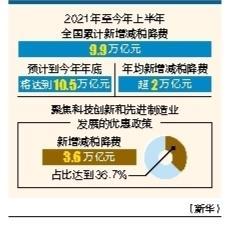
Group 1 - The core viewpoint of the articles highlights that during the "14th Five-Year Plan" period, the cumulative tax reductions and fee cuts in China are expected to exceed 10 trillion yuan, providing significant financial support for various business entities and driving high-quality economic development [1][2][4] - The Hebei Yinghu Agricultural Machinery Co., Ltd. is projected to achieve nearly 770 million yuan in revenue and 110 million yuan in profit in 2024, attributing part of its success to tax incentives that have provided over 28 million yuan in tax benefits [1] - The National Taxation Administration reported that the cumulative tax reductions and fee cuts during the "14th Five-Year Plan" period are expected to reach 10.5 trillion yuan, with export tax rebates anticipated to exceed 9 trillion yuan [1][2] Group 2 - Tax reduction policies are focused on supporting technological innovation and advanced manufacturing, with 3.6 trillion yuan in new tax cuts accounting for 36.7% of the total [2] - The private economy, including private enterprises and individual businesses, has benefited from 7.2 trillion yuan in new tax reductions, representing 72.9% of the total [2] - Small and medium-sized enterprises have received 6.3 trillion yuan in new tax reductions, making up 64% of the total, indicating a significant focus on supporting these businesses [2] Group 3 - As of mid-2023, the number of tax-registered business entities in China has surpassed 100 million, an increase of 30 million since 2020 [3] - Sales revenue in the equipment manufacturing and high-tech manufacturing sectors has seen annual growth rates of 9.6% and 10.4% respectively from 2021 to 2024, with significant year-on-year increases in the first half of 2023 [3] - The share of private economy sales revenue in the national total has risen from 68.9% in 2020 to 71.7% in the first half of 2023, reflecting the growing importance of the private sector [3]
2021年财政政策执行情况报告出炉
Xin Hua Wang· 2025-08-12 06:30
Core Viewpoint - The report highlights the significant growth in China's fiscal revenue in 2021, with total public budget revenue surpassing 20 trillion yuan for the first time, indicating a recovery in the economy and effective tax policies [1] Group 1: Fiscal Revenue and Taxation - In 2021, China's total public budget revenue reached 20.25 trillion yuan, a year-on-year increase of 10.7% and a 6.4% increase compared to 2019, exceeding revenue targets [1] - Tax revenue amounted to 17.27 trillion yuan, reflecting an 11.9% year-on-year growth, driven by increases in major tax categories such as domestic VAT (11.8%), domestic consumption tax (15.4%), and corporate income tax (15.4%) [1] - Non-tax revenue was recorded at 2.98 trillion yuan, showing a 4.2% increase year-on-year [1] Group 2: Fiscal Policy and Support for Market Entities - The fiscal department has implemented innovative macro-control measures and optimized tax reduction policies to support market entities, resulting in a reduction of approximately 1.1 trillion yuan in taxes and fees in 2021 [1] - The report emphasizes the importance of market entities in economic development and the need for continued support through fiscal measures [1] Group 3: Local Government Financing and Debt Management - In 2021, the National People's Congress approved an additional local government special bond quota of 3.65 trillion yuan, with 3.5 trillion yuan allocated for project construction [2] - A total of 3.43 trillion yuan in new local government special bonds were issued, accounting for 98% of the allocated quota, primarily directed towards key areas such as transportation infrastructure and social projects [2] Group 4: Future Fiscal Policy Directions - For 2022, the report outlines six key areas for fiscal policy focus, including enhanced tax reduction measures, maintaining appropriate spending intensity, and supporting key project construction through local government special bonds [3] - The report stresses the importance of fiscal discipline and the need for government agencies to operate efficiently [3]
央行向中央财政上缴利润 是国际通行做法
Xin Hua Wang· 2025-08-12 06:30
Group 1 - In 2021, China implemented tax cuts and fee reductions amounting to approximately 1.1 trillion yuan, with new policies planned for 2022 to further stimulate investment and improve corporate profitability [1] - The significance of tax cuts and fee reductions lies in enhancing the investment enthusiasm of enterprises, optimizing investment structure, and alleviating economic downward pressure [1] - The large-scale tax cuts will lead to a decrease in fiscal revenue, highlighting the need for balance in fiscal income and expenditure, which can be addressed by utilizing special remittances from state-owned financial institutions [1] Group 2 - The practice of central banks remitting profits to the government is common among major economies, with examples including the Federal Reserve and the Bank of Japan, which have clear regulations regarding profit remittance [2] - The essence of central bank profit remittance is akin to paying a form of tax on the monopoly of currency issuance, known as seigniorage, which has historically been a significant source of government revenue [2]
十年来新增减税降费累计8.8万亿元
Xin Hua Wang· 2025-08-12 06:26
Group 1 - The core viewpoint of the news is that over the past decade, China's fiscal and tax reforms have significantly strengthened the country's financial capabilities, with substantial reductions in tax burdens and an increase in the number of market entities [1][2][3] - The total tax reductions and fee cuts over the past ten years amount to 8.8 trillion yuan, with the number of newly registered tax-related market entities exceeding 90 million [1][2] - From 2012 to 2021, the national general public budget revenue increased from 11.73 trillion yuan to 20.25 trillion yuan, with a total of 163.05 trillion yuan accumulated over the decade, reflecting an average annual growth rate of 6.9% [1][2] Group 2 - The national general public budget expenditure grew from 12.6 trillion yuan in 2012 to 24.63 trillion yuan in 2021, totaling 193.64 trillion yuan over ten years, with an average annual growth rate of 8.5% [1][2] - The macroeconomic regulation of fiscal policy has been continuously improved, with active fiscal policies implemented from 2012 to 2021, effectively reducing economic cycle fluctuations and supporting high-quality economic development [2][3] - The number of general VAT taxpayers increased from 5.44 million at the end of 2015 to 12.38 million by the end of 2021, indicating a sustained effect of stimulating market vitality through tax reductions [2]