可穿戴设备

Search documents
切入“AI+”赛道,华盛昌抢滩垂直领域大模型布局
2 1 Shi Ji Jing Ji Bao Dao· 2025-10-04 13:58
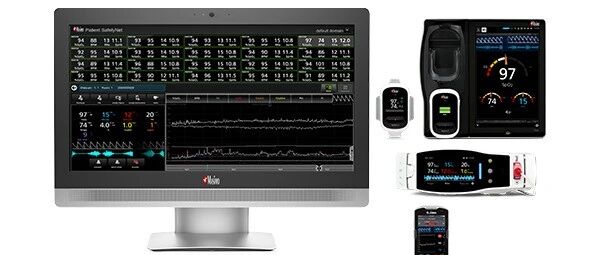
Core Viewpoint - The rapid development of AI smart glasses has attracted attention from both tech giants and traditional eyewear companies, with Huashengchang also entering this emerging market by leveraging its AI capabilities and existing expertise in measurement and medical devices [1][4]. Group 1: Company Developments - Huashengchang has announced the development of its "DeepSense" AI model, which has passed the generative AI service filing and will soon be available for internal testing [1]. - The company showcased four AI medical devices at the 2025 China International Medical Device Expo, including a smart blood pressure monitor with an AI voice assistant, demonstrating its commitment to integrating AI into healthcare solutions [2]. - Huashengchang has a strategic focus on combining AI with measurement and sensor technologies, aiming to provide customized industrial measurement solutions [3]. Group 2: Market Trends - The AI glasses market in China is experiencing significant growth, with a reported shipment of 664,000 units in Q2 2025, marking a year-on-year increase of 145.5% [5]. - The market is projected to have a compound annual growth rate of 56% over the next five years, indicating a robust growth trajectory for AI glasses [5]. - The overall market for smart glasses is expected to reach 415.3 million units by 2029, with a potential market size exceeding 100 billion yuan [6]. Group 3: Competitive Landscape - Huashengchang's AI glasses are positioned to serve specific industrial applications rather than being mere consumer products, aiming to enhance operational efficiency and provide real-time data support for technicians [4]. - The company faces competition in a rapidly evolving market, where the integration of AI technology is crucial for maintaining a competitive edge [6].

苹果叫停轻量化Vision Pro,押注2027年智能眼镜对标Meta雷朋生态
Huan Qiu Wang Zi Xun· 2025-10-02 06:15
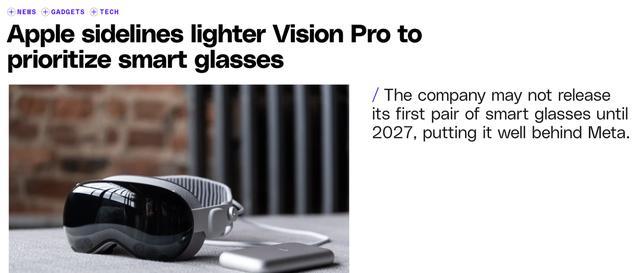
Core Insights - Apple has officially suspended the development of a lighter version of the Vision Pro headset and redirected core hardware engineers to focus on smart glasses, aiming to catch up with Meta's lead in wearable imaging and voice AI [1][4] - The first screenless smart glasses are expected to be released in 2026 and launched in 2027, featuring a self-developed dedicated chip, emphasizing voice interaction and multimodal AI [1][4] - The display version of the smart glasses is targeted for an earlier release by 2028, directly competing with Meta's recently launched Ray-Ban Display glasses [1][4] Product Features - The smart glasses will include built-in speakers, cameras, and various frame designs, similar in functionality to Meta's second-generation products, but will deeply integrate Siri and Apple Intelligence for offline wake-up, real-time visual search, and spatial audio calls [4] - The main chip of the glasses will utilize TSMC's 4nm process, resulting in a 75% reduction in power consumption compared to the Vision Pro's main control unit, allowing for all-day wear [4] Engineering and Production Adjustments - Apple has reassigned approximately 20% of mechanical and sensor engineers from the Vision Pro team to the smart glasses project [4] - Production of the initial Vision Pro will continue to be reduced, maintaining only one assembly line for a "moderate upgrade" version, expected to be released by the end of 2025, focusing on M3-level computing units and longer battery life, with minimal changes to the appearance [4]


梁耀铭:全运会撬动城市跃升|十五运365天365人
2 1 Shi Ji Jing Ji Bao Dao· 2025-09-26 23:04
Group 1 - The 15th National Games and the 12th National Paralympic Games will be held in the Guangdong-Hong Kong-Macao Greater Bay Area, serving as a significant platform to showcase urban development, technological innovation, and regional cooperation [1][3] - The event is expected to enhance the overall image of the Greater Bay Area and deepen regional integration, with a focus on promoting public health management from "having" to "optimizing" [1] - The demand for event operations, health monitoring, and scientific fitness will drive breakthroughs and commercialization in AI medical big data, wearable devices, and smart healthcare [1] Group 2 - The integration of "sports + healthcare" is anticipated to break industry boundaries, attracting high-end resources to the Greater Bay Area and creating a "platform for events, stage for industries" effect [1] - The 15th National Games is viewed as an important opportunity to promote high-quality development in sports and public fitness [3] - A special column titled "15th Games 365 Days 365 People" will be launched to highlight stories and expectations surrounding the event, aiming to increase public awareness and engagement [3]
四点半观市 | 机构:A股市场上行推动居民部门大类资产配置调整
Shang Hai Zheng Quan Bao· 2025-09-24 10:42
Market Performance - A-shares experienced a collective rise on September 24, with the Shanghai Composite Index up 0.83%, Shenzhen Component Index up 1.80%, ChiNext Index up 2.28%, STAR Market 50 Index up 3.49%, and Northbound 50 Index up 2.03% [1] - The total trading volume in the Shanghai, Shenzhen, and Beijing markets was 23,471 billion yuan, a decrease of 1,713 billion yuan compared to the previous day [1] - Over 4,400 stocks in the market rose, with nearly 90 stocks hitting the daily limit [1] International Indices - The Nikkei 225 Index closed up 0.3% at 45,630.31 points, while the Korean Composite Index fell 0.4% to 3,472.14 points on the same day [1] Commodity and Bond Markets - Most domestic commodity futures contracts rose, with glass futures leading the gains [1] - Government bond futures contracts closed lower, influenced by the strong stock market and rising risk appetite, which exerted pressure on the bond market [1] ETF Performance - The semiconductor equipment ETF (159516) rose by 9.55%, and the semiconductor equipment ETF fund (159327) increased by 9.40% [1] Convertible Bond Market - The China Convertible Bond Index rose by 1.3%, closing at 476.83 points [2] Institutional Insights - UBS Securities noted that the upward trend in A-shares has begun to drive adjustments in asset allocation among residents, attracting outside capital into the market [3] - Open Source Securities highlighted that after several months of rising indices, the market is at a relatively high position, with most sectors in technology facing high valuations [3] - Silver Fund emphasized that international leading tech companies have raised their annual capital expenditure expectations from $300 billion to $350 billion, indicating increased investment in data centers and AI infrastructure [3] - China Galaxy Securities remains optimistic about the computing power sector, which is still in the performance realization phase, and anticipates 2026 to be a key year for the foldable screen market recovery [3]
可穿戴设备迎大利好 这一品类出货量大增超60%!外资机构密集调研4股
Zheng Quan Shi Bao Wang· 2025-09-23 00:08
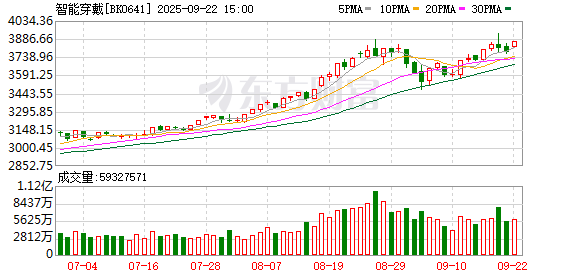
Group 1 - The core viewpoint of the articles highlights the favorable policies and rapid growth in the wearable device industry, driven by advancements in technology and increasing consumer demand for health monitoring [2][3]. - The National Sports Administration of China has issued guidelines to promote the digital and intelligent upgrade of health services through wearable devices, emphasizing the use of big data and AI technologies [2]. - The global wearable device market is expected to see significant growth, with IDC forecasting a shipment of 49.22 million wrist-worn devices in Q2 2025, representing a year-on-year increase of 12.3% [3]. Group 2 - China is the largest market for wrist-worn devices, with a shipment volume of 20.8 million units in Q2 2025, reflecting a year-on-year growth of 33.8% [3]. - The smart watch segment is experiencing remarkable growth, with a 64% year-on-year increase in shipments for adult smart watches in China [3]. - The wearable device market is expanding its application range, with potential coverage in healthcare, military defense, industrial IoT, and financial payments [2][3]. Group 3 - A total of 67 A-share companies are involved in the wearable device sector, with a concept index rising by 2.47% as of September 22 [4]. - Eleven stocks in this sector have seen cumulative gains exceeding 10%, with Longying Precision, Tianyue Advanced, and Luxshare Precision leading with gains of 43.59%, 35.78%, and 32.56% respectively [4]. - Longying Precision has made significant breakthroughs in developing key components for AI-based laptops and wearable products, achieving a "20cm" limit on September 22 [4]. Group 4 - Foreign institutional interest in wearable device stocks has increased, with 20 stocks receiving attention since July, including Luxshare Precision and Crystal Optoelectronics [5]. - Luxshare Precision has a broad layout in the AI glasses sector, providing support for about one-third of the market categories in this area [5]. - The market capitalization and performance of various wearable device stocks have been tracked, with Luxshare Precision having a market cap of 442.01 billion and a year-to-date increase of 32.56% [6].

艾为电子(688798):META推出新款AI眼镜 搭载公司多款芯片
Xin Lang Cai Jing· 2025-09-22 00:35
Core Viewpoint - Meta has launched its first smart glasses with a display, the Meta Ray-Ban Display, and a new version of Ray-Ban Meta (Gen 2) smart glasses, along with the Hyperscape feature for Quest 3 and Quest 3S VR headset users, indicating a significant advancement in wearable technology and AI integration [1][2][3]. Product Launches - The Meta Ray-Ban Display features a full-color high-resolution screen on the right lens, capable of displaying key information without obstructing the user's view, supporting functions like subtitle translation, navigation maps, and camera previews, with a mixed-use battery life of approximately 6 hours and a total of 30 hours with a charging case [2][3]. - The new Ray-Ban Meta (Gen 2) smart glasses offer an extended battery life of up to 8 hours, nearly double that of the first generation, and include a 12-megapixel ultra-wide camera capable of 3K video recording at 60 frames per second, with an upgraded charging case providing an additional 48 hours of power [2][3]. Hyperscape Feature - The Hyperscape feature allows users of the Quest 3 and Quest 3S VR headsets to scan their real-world environment and convert it into a virtual space, enhancing the immersive experience [3]. Industry Insights - The development of smart glasses and mixed reality (MR) ecosystems is maturing, with advancements in AI technology expected to drive sales growth [1][4]. - The company has multiple chips integrated into the Meta Ray-Ban smart glasses and Quest MR series, which are expected to enhance performance and user experience in next-generation wearable and immersive devices [3]. Financial Projections - The company maintains its performance forecast, expecting net profits attributable to the parent company to reach 393 million, 523 million, and 621 million yuan for the years 2025-2027, corresponding to price-to-earnings ratios of 51, 39, and 33 times based on the stock price as of September 19, 2025 [1][4].

SiTime releases new chip aimed at wearable gadgets
Reuters· 2025-09-17 23:27
Group 1 - SiTime has released a new chip targeting the $4 billion market for wearable electronic devices [1]

云南锗业:公司子公司的化合物半导体产品为砷化镓晶片、磷化铟晶片
Zheng Quan Ri Bao Zhi Sheng· 2025-09-17 12:09
Core Viewpoint - Yunnan Zheye's subsidiary produces compound semiconductor products, specifically Gallium Arsenide (GaAs) chips and Indium Phosphide (InP) chips, which are essential for various high-tech applications [1] Group 1: Product Applications - Indium Phosphide chips are primarily used in the production of lasers and detector chips within optical modules, with downstream applications in 5G communication, data centers, and wearable devices [1] - Gallium Arsenide chips are utilized in radio frequency devices, lasers, sensors, and high-brightness light-emitting diode (HBLED) products, with downstream applications in smartphones, computers, communication base stations, autonomous driving, next-generation displays (MiniLED, MicroLED), industrial lasers, and facial recognition [1]

精研科技:智能手表和AI智能眼镜等新型消费电子产品日益受到市场认可
Zheng Quan Ri Bao Zhi Sheng· 2025-09-15 08:45
Core Insights - The company announced on September 15 that new consumer electronic products such as smartwatches and AI smart glasses are increasingly gaining market recognition [1] - MIM technology is suitable for mass production of small, complex parts, which possess excellent mechanical properties and high strength, aligning well with the precision metal component requirements of wearable devices [1] - The trend towards lightweight and thin wearable products is driving the demand for components with wear resistance, high strength, and lightweight characteristics, leading to a shift towards high-strength, lightweight materials [1] - Titanium alloys and other lightweight alloys are rapidly being adopted in various segments of consumer electronics due to their outstanding strength and corrosion resistance [1] - The company possesses MIM titanium alloy production technology, which meets customer demands and has already achieved mass application in some products [1]
最新!两家巨头扩大合作,对国内厂商有何影响?
思宇MedTech· 2025-09-15 04:09
Core Viewpoint - The strategic collaboration between Philips and Masimo in patient monitoring signifies a shift towards integrated solutions in the medical device industry, highlighting the importance of partnerships to meet clinical demands for comprehensive healthcare solutions [1][6]. Collaboration Content and Focus - Philips and Masimo will deepen their collaboration through technology integration, focusing on enhancing patient monitoring capabilities [2]. - The partnership aims to develop next-generation patient monitoring solutions that address the clinical needs for mobility, wearability, and intelligence, incorporating AI algorithms for improved patient outcomes [5]. Product Features and Collaborative Foundations - Philips has a strong presence in multi-parameter patient monitoring devices, particularly in high-acuity settings, while Masimo specializes in non-invasive sensors and innovative monitoring parameters [4]. - Key technologies include Masimo's SET pulse oximetry technology and Radius PPG wearable sensors, which will be integrated into Philips' monitoring systems [4][5]. Insights for Domestic Manufacturers - Domestic companies often excel in specific innovations but may struggle to scale without partnerships with larger firms. Finding complementary partners to embed innovations into comprehensive solutions is crucial for growth [9]. - Mindray serves as a representative example of a domestic firm that integrates sensors, algorithms, and monitoring platforms internally, adopting a "full-stack self-research" model [9]. Areas Suitable for Collaboration - The medical device industry is moving towards systematic strategies for collaboration, emphasizing the need for integrated solutions rather than isolated innovations [6][10]. - Collaborations can enhance market efficiency, shorten the path from R&D to market, and facilitate access to reimbursement and regulatory approvals [10]. Areas Unsuitable for Collaboration - Direct competition in core devices, such as ventilators and surgical robots, may hinder collaboration due to potential dilution of competitive advantages [11]. - Areas with severe product homogeneity or conflicting business models may also present challenges for effective partnerships [11]. Future Observations - The trend of collaboration among multinational companies to quickly address market gaps may influence domestic firms to consider open partnerships in emerging fields like AI and wearable sensors [12].