
大模型技术

Search documents
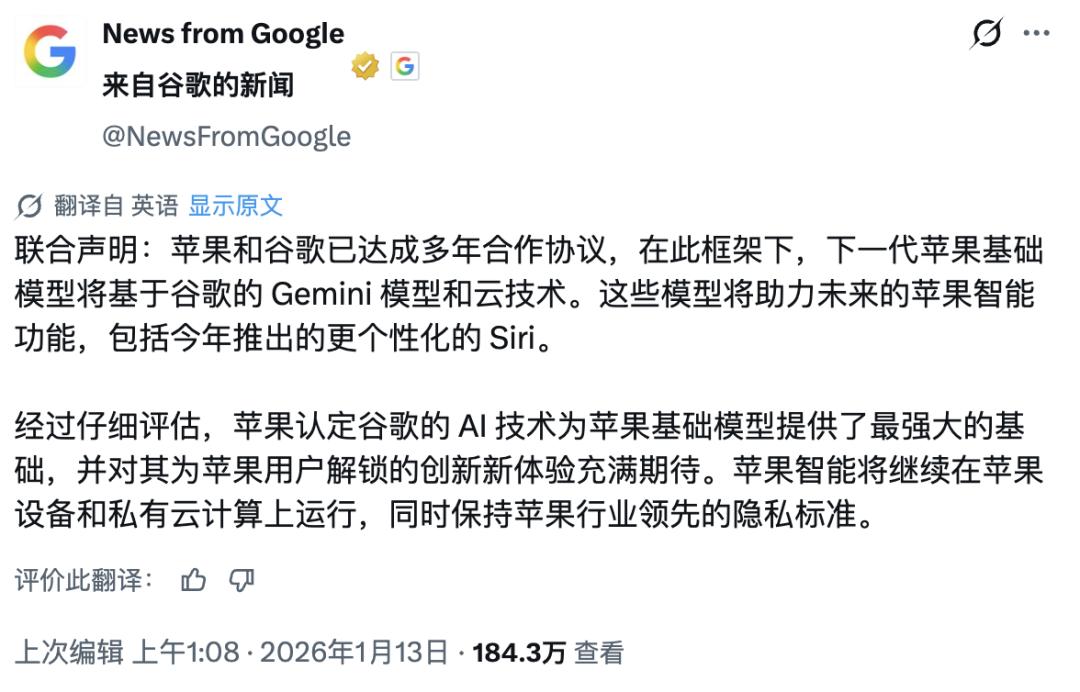
刚刚,苹果官宣 iPhone 将搭载最强 AI,马斯克第一个跳出来骂
3 6 Ke· 2026-01-12 23:56
Core Viewpoint - Apple and Google have announced a long-term partnership to develop the next generation of Apple Intelligence based on Google's Gemini model and cloud technology, marking a significant shift in Apple's AI strategy [1][3]. Group 1: Partnership Details - The collaboration will lead to a complete overhaul of Siri, which will now be powered by the Gemini model, while maintaining Apple's privacy standards through device-side or private cloud computing [3][18]. - Following the announcement, both Apple and Google's stock prices rose, with Alphabet's market capitalization surpassing $4 trillion, indicating positive market sentiment towards this partnership [3][24]. - The partnership is seen as a strategic move for Apple to address its shortcomings in large model technology, as it has been reported that Apple plans to pay approximately $1 billion annually for Google's AI technology [6][11]. Group 2: Competitive Landscape - The collaboration has raised concerns from competitors, particularly Elon Musk, who criticized the concentration of power in the hands of Google, which already dominates the Android and Chrome markets [4]. - Analysts suggest that Google's Gemini will become the default AI layer for Apple devices, relegating OpenAI to a secondary role in Apple's AI ecosystem [5][19]. Group 3: Technical Aspects - Google's Gemini model boasts 1.2 trillion parameters, significantly surpassing Apple's existing model with 150 billion parameters, which impacts the capabilities of Siri in terms of reasoning, knowledge breadth, and task complexity [8][10]. - The integration of Gemini is expected to enhance Siri's functionalities, including summarization and task planning, while Apple retains control over user data through its private cloud infrastructure [18][19]. Group 4: Strategic Implications - The partnership allows Apple to leverage Google's advanced AI capabilities while addressing its internal challenges, such as talent retention and resource limitations in AI development [10][23]. - Apple's modular design for the new Siri is conducive to integrating third-party AI models, providing flexibility in adapting to different market needs, including potential collaborations with local firms for the Chinese market [21][23]. Group 5: Market Impact - This collaboration is anticipated to improve Apple's product delivery timelines, allowing the company to meet consumer expectations more effectively in the rapidly evolving AI landscape [19][23]. - For Google, this partnership represents a significant victory, embedding its AI technology into billions of active Apple devices, reinforcing its position in the AI market [24].



今天面试了一个字节女生,当场想给她offer!
猿大侠· 2026-01-12 04:06
Core Insights - The rapid growth of generative AI and large model technologies has created a "golden explosion period" for AI engineering positions, with median monthly salaries for large model algorithm engineers approaching 30,000 yuan and top talents earning over 1 million yuan annually, surpassing traditional tech roles [1][3]. Salary Trends - The 2026 campus recruitment data shows that the median monthly salary for large model algorithm engineers is nearing 30,000 yuan, with top talents earning over 1 million yuan annually, significantly higher than traditional roles like front-end, operations, and embedded positions [1]. - Companies like ByteDance, Tencent, and JD have invested heavily in AI departments, leading to salary increases of up to 40% for many positions in the field [3]. Job Market Opportunities - The current job market presents a favorable opportunity for job seekers and those transitioning into AI roles, as many companies are actively hiring for core AI positions [4]. - The "AI Algorithm Engineer Training Program" has been developed to meet the hiring standards of major companies, ensuring a high alignment with job requirements [4]. Training Program Details - The training program is led by top algorithm leaders from leading companies and promises a job placement guarantee, with a refund policy if salary expectations are not met [5][18]. - The program focuses on practical skills, covering a wide range of industry-relevant projects and technologies, including multi-modal content understanding, intelligent customer service systems, and automated financial report generation [7][10][47]. Learning Outcomes - Participants will gain hands-on experience in various AI applications, including multi-modal data processing, intelligent customer service system design, and automated financial report generation [16][40][47]. - The program emphasizes real-world problem-solving skills, preparing students to become competent AI algorithm engineers capable of addressing industry needs [5][7]. Employment Success Stories - Previous participants have successfully secured offers from major companies, with average salaries exceeding 350,000 yuan, and some achieving salaries as high as 850,000 yuan [5][55]. - The program has seen a 90% success rate in job placements, with many students transitioning from non-technical backgrounds to high-paying AI roles [55][74].

国泰海通|传媒:搜索入口迁徙,GEO营销起量——AI营销系列报告一
国泰海通证券研究· 2026-01-11 13:54
Core Insights - The article discusses the emergence of GEO marketing driven by the shift in traffic entry points due to AI advancements, transitioning from traditional search engines to social media and AI platforms [1][2] - GEO's essence lies in optimizing advertising content for AI search platforms, contrasting with traditional SEO which focuses on keyword matching [1] - The global GEO market is projected to exceed $11.2 billion by 2025, with China's market expected to reach 2.9 billion yuan [2] Market Trends - The GEO market is experiencing rapid growth, with a forecasted year-on-year increase of over 200% in China's market by Q2 2025, as 78% of decision-makers prioritize AI search optimization in digital transformation [2] - Traditional search engine traffic is predicted to decline by 25% by 2026, with AI chatbots and virtual optimization methods capturing more market share [2] - By 2028, it is anticipated that 50% of search engine traffic will be taken over by AI searches [2] Future Outlook - The growth of large models as traffic entry points is expected to increase advertising space, with GEO companies likely to benefit from this growth phase [3] - In the long term, as the large model landscape stabilizes and advertising commercialization begins, GEO marketing firms are positioned to thrive as partners in the advertising ecosystem [3] Investment Recommendations - The article suggests focusing on publicly listed companies that are early adopters of GEO business, particularly those with technological capabilities and marketing industry expertise [4]

洲明科技:牵手全球大模型第一股智谱,加速AI场景化落地进程
Zheng Quan Shi Bao Wang· 2026-01-11 12:13
Core Viewpoint - The investment by Zhouming Technology in Zhipu Technology marks a significant step in deepening its AI strategy and aims to capture the technological high ground in AI industry development [1][2]. Group 1: Investment and Strategic Importance - Zhouming Technology's wholly-owned subsidiary, Zhouming Hong Kong, successfully subscribed to 66,900 shares of Zhipu Technology, amounting to HKD 7.7738 million, indicating a strategic move towards AI integration [1]. - The investment is not merely financial but a strategic positioning in the AI sector, aligning with national policies promoting AI innovation and integration with the real economy [2][5]. Group 2: Technological Synergy - Zhipu Technology is recognized as a leading AI large model enterprise, focusing on model development and deployment, which complements Zhouming Technology's strengths in end-user applications [2][3]. - The collaboration allows Zhouming to leverage Zhipu's advanced AI technologies, enhancing its transition from a traditional hardware manufacturer to an AI-focused entity [3]. Group 3: Joint Ventures and New Market Opportunities - The establishment of Shenzhen Zhixian Robot Technology Co., a joint venture with Zhipu and Yuankexijie, aims to create a new market for AI smart terminals, with Zhouming holding a 50% stake [4]. - This partnership integrates hardware manufacturing capabilities, AI model technology, and visual interaction expertise, forming a comprehensive solution for AI smart terminals [5]. Group 4: Future Outlook - The ongoing development of Zhipu in the capital market and the gradual rollout of joint venture products are expected to provide Zhouming with a competitive edge in the AI smart terminal sector [6]. - The collaboration is anticipated to drive intelligent upgrades in various industries, including education, meetings, and cultural tourism, marking a transformative shift from traditional display to intelligent interaction [5][6].

诚邀体验 | 中金点睛数字化投研平台
中金点睛· 2026-01-11 01:04
Core Viewpoint - The article emphasizes the establishment of a digital research platform by CICC, aimed at providing efficient, professional, and accurate research services through the integration of insights from over 30 specialized teams and a comprehensive coverage of more than 1,800 stocks [1]. Group 1: Research Services - CICC's digital research platform, "CICC Insight," offers a one-stop service that includes research reports, conference activities, fundamental databases, and research frameworks [1]. - The platform utilizes advanced model technology to enhance the research experience for clients [1]. Group 2: Research Content - Daily updates on research focus and timely article selections are provided through the "CICC Morning Report" [4]. - The platform features live broadcasts where senior analysts interpret market hotspots [4]. Group 3: Data and Frameworks - CICC Insight includes over 160 industry research frameworks and more than 40 premium databases, along with a comprehensive data dashboard [10]. - The platform also offers AI search capabilities for efficient information retrieval and intelligent Q&A features [10].

医渡科技尾盘涨超6% 公司与北大医院共建北京市重点实验室 以AI重塑专科诊疗决策
Zhi Tong Cai Jing· 2026-01-09 07:22
Core Viewpoint - Yidu Tech (02158) saw a significant stock increase of over 6%, currently trading at 5.94 HKD with a transaction volume of 74.37 million HKD, following the approval of a key laboratory focused on intelligent diagnosis and treatment systems for metabolic syndrome [1] Group 1 - The "Multimodal Intelligent Diagnosis and Treatment System Research and Application Key Laboratory" has been successfully approved, led by Peking University First Hospital with Yidu Tech as a core partner [1] - The laboratory will focus on intelligent diagnosis and treatment for heart-kidney metabolic syndrome, marking a significant milestone in Yidu Tech's commitment to specialized intelligent diagnosis [1] - Yidu Tech will integrate its large model technology capabilities into the laboratory's research chain, providing a solid foundation for the implementation of intelligent diagnosis [1] Group 2 - The development of medical artificial intelligence has entered a phase of value verification through practical application [1] - The establishment of the laboratory exemplifies a collaborative innovation model that integrates industry, academia, research, and medicine [1] - Yidu Tech has partnered with several renowned hospitals in China to establish joint laboratories, supporting research from data governance to model development and system construction [1]
全球AGI产业迎来里程碑,智谱AI与MiniMax相继登陆资本市场
Jing Ji Guan Cha Wang· 2026-01-09 07:08
Group 1 - The global AGI sector has reached a significant milestone with the IPOs of Zhipu AI and MiniMax, marking a new era in the industry [2] - Zhipu AI became the first publicly listed company in the large model sector, providing a crucial valuation reference and invigorating domestic large model enterprises [2] - On its first trading day, Zhipu AI's stock price opened at 120 HKD, closing at 131.5 HKD, a 13.17% increase, with a market capitalization of 57.89 billion HKD [2] Group 2 - Zhipu AI's technology foundation dates back to 1996, and it has attracted over 2.5 billion RMB in funding before its IPO [3] - The company serves over 8,000 institutions and approximately 80 million devices, facing competition from major tech firms like Alibaba and ByteDance [3] - MiniMax, founded in 2021, focuses on a different technical route and has seen its stock price surge over 70% on its first trading day, reaching a market cap of over 90 billion HKD [5] Group 3 - MiniMax has over 2.12 million personal users globally, with a monthly active user count of approximately 27.62 million and 177,000 paying users [5] - The company's revenue for the first nine months of 2025 reached 53.437 million USD, with a year-on-year growth of over 170% [5] - Despite significant R&D investments, both companies are experiencing substantial losses, with Zhipu AI's net loss expanding from 144 million RMB in 2022 to 2.958 billion RMB in 2024 [6]

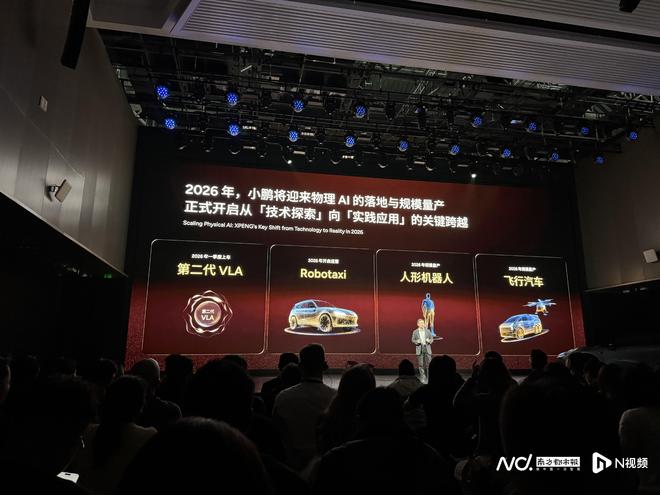
小鹏2026年第一弹:人形机器人今年要规模量产
Nan Fang Du Shi Bao· 2026-01-09 00:52
Core Insights - Xiaopeng Motors announced the commencement of physical AI's implementation and mass production phase at the 2026 global product launch, marking a significant transition from "technological exploration" to "practical application" [1] - The company revealed plans for four major physical AI applications and confirmed that the mass production version of its humanoid robot has completed initial debugging, set to begin mass production in 2026 [1] Group 1: Development and Technology - Xiaopeng Motors has been developing robotics for seven years, initially focusing on quadruped robots due to technological limitations, but shifted to humanoid robots as large model capabilities advanced [3] - The upcoming humanoid robot, IRON, features 82 degrees of freedom for movement and is equipped with three Turing AI chips, providing a computing power of 2250 TOPS [5] - IRON utilizes a high-level brain capability combination of "VLT+VLA+VLM" to achieve advanced intelligence in operations, walking, and interaction [5] Group 2: Market Position and Future Outlook - Xiaopeng's approach contrasts with traditional software-driven robots, focusing instead on AI-driven integration that allows for greater adaptability and generalization across various scenarios [5][7] - The company anticipates that the robotics industry will transition from early exploration to large-scale commercial applications between 2028 and 2038, with significant growth expected as technology matures [6][7] - The CEO expressed confidence that the market for robotics could reach $20 trillion, suggesting that sales could surpass those of automobiles in the future [7]


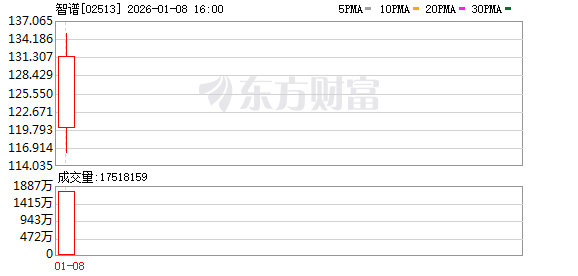
“全球大模型第一股”登陆港交所 上市首日股价跌宕
2 1 Shi Ji Jing Ji Bao Dao· 2026-01-08 09:49
Core Viewpoint - Beijing Zhiyu Huazhang Technology Co., Ltd. (Zhiyu) officially listed on the Hong Kong Stock Exchange on January 8, becoming the "first global large model stock" with a closing price increase of 8.06%, reaching a market capitalization of over HKD 55 billion [1] Group 1: Company Performance - Zhiyu's public offering was oversubscribed by 1,159.46 times, indicating strong market interest, with cornerstone investors committing a total of HKD 2.98 billion [1] - Despite a volatile first trading day, the stock price fluctuated but ultimately stabilized above the issue price [1] - The company reported a significant revenue increase from CNY 57.4 million in 2022 to CNY 312.4 million in 2024, but also faced a cumulative net loss of approximately CNY 6.2 billion from 2022 to mid-2025 [2] Group 2: Business Model and Strategy - Zhiyu, founded in 2019, has a strong technical foundation stemming from Tsinghua University's Computer Science Department, focusing on making machines think like humans [3] - The company primarily generates revenue by providing localized deployment of large model services, accounting for about 70% of total revenue [4] - Zhiyu plans to allocate approximately 70% of the net proceeds from its IPO (around HKD 2.9 billion) to further develop general AI large models, aiming to strengthen its technological moat [2] Group 3: Industry Outlook - The large model industry is experiencing rapid growth, with domestic companies in China leading in global competition, although no single company has established a dominant market position yet [4] - The industry faces challenges such as high research and development costs and increasing losses, which are common among AI large model companies [2]
东吴证券:智谱从清华实验室到港股AI新贵 关注模型迭代与生态飞轮
Zhi Tong Cai Jing· 2026-01-08 08:52
Core Viewpoint - Dongwu Securities expresses optimism about Zhipu AI's strengths in local model technology, open-source ecosystem, and local implementation capabilities, anticipating stable growth in local business and cloud services as the main growth driver, suggesting to pay attention to the company [1] Company Overview - Zhipu AI, established in 2019, is a leading independent general large model developer in China, originating from Tsinghua University's Knowledge Engineering Group (KEG) [1] - The company has developed its own GLM (General Language Model) pre-training framework, which differs from mainstream GPT architectures, offering unique advantages in long text understanding, logical reasoning, and low hallucination rates [1] - Zhipu AI follows a dual strategy of open-source and commercialization, creating a comprehensive model matrix covering language, multimodal, code, and intelligent agent fields, with flagship products GLM-4.5 and GLM-4.7 ranking high in international benchmark tests [1] Market Position - According to Frost & Sullivan data, Zhipu AI ranks first among independent general large model developers in China and second overall, with a market share of 6.6% as of 2024 [2] - By mid-2025, the company has served over 8,000 institutional clients, with 9 out of the top 10 internet companies in China using GLM models [2] - The global download volume of open-source models exceeds 45 million, with over 2.7 million registered developers on the MaaS platform, and daily token consumption reaching 4.2 trillion by November 2025 [2] Business Model - The business model centers around the MaaS (Model as a Service) platform, driven by both localized and cloud deployments [3] - Localized deployment targets government and enterprise clients, providing private operation and customization services, accounting for 84.8% of revenue in the first half of 2025 with a gross margin of 59% [3] - Cloud deployment, through API calls and subscription services, is rapidly growing, making up 15.2% of revenue in the first half of 2025, with a focus on increasing API revenue share in the long term [3] Financial Performance - Historical financial performance shows high revenue growth, with revenues of 0.57 million, 1.25 million, and 3.12 million yuan from 2022 to 2024, reflecting a compound annual growth rate of over 130% [3] - In the first half of 2025, revenue reached 1.91 billion yuan, a year-on-year increase of 325%, surpassing the total revenue for 2023 [3] IPO Details - The IPO price is set at 116.20 HKD per share, with a global offering of 37.42 million H shares, raising approximately 4.3 billion HKD, leading to a market capitalization of about 51.1 billion HKD post-funding [4] - The raised funds will primarily enhance general large model research (about 70%), optimize the MaaS platform infrastructure (about 10%), expand ecosystem cooperation and strategic investments (about 10%), and supplement working capital [4] - Key investors include prominent institutions such as Shanghai Gao Yi, GF Fund, and Taikang Life, with the founding team controlling about 33% of shares through a concerted action agreement [4] Competitive Advantages - The company's core competitive advantages lie in its full-stack self-research technology system, leading model performance, open-source ecosystem, and deep adaptation to domestic computing power [4] - The R&D personnel account for 74%, with a core team from Tsinghua KEG, possessing deep academic accumulation in natural language processing [4] - The rapid iteration of the GLM series, particularly GLM-4.7, shows strong performance in programming scenarios, while AutoGLM enables AI to autonomously operate smartphones and computer GUIs, marking a new paradigm for agents [4] Revenue Forecast - Revenue projections for 2025-2027 are estimated at 790 million (up 151%), 1.55 billion (up 97%), and 3.22 billion (up 108%), with a gradual shift from localized to cloud-dominated revenue structure [5] - The overall gross margin is expected to reach 50% in 2025, stabilizing around 51% in 2026-2027, with cloud gross margins improving from low levels to 40% [5] - The valuation for Zhipu AI in 2026 is projected at a PS ratio of 30 times, higher than comparable companies, but with significant room for compression as revenue grows rapidly [5]
