
指数增强策略

Search documents
量化选股策略周报:指增组合本周超额回撤-20250816
CAITONG SECURITIES· 2025-08-16 13:04
Core Insights - The report highlights that the market indices have shown positive performance, with the Shanghai Composite Index rising by 1.70% and the Shenzhen Component Index increasing by 4.55% as of August 15, 2025, marking a new high since 2022 [5][8] - The report emphasizes the construction of an AI-based low-frequency index enhancement strategy using deep learning frameworks, which has resulted in significant outperformance of enhanced index portfolios compared to their respective benchmarks [5][13] Market Index Performance - As of August 15, 2025, the Shanghai Composite Index increased by 1.70%, the Shenzhen Component Index by 4.55%, and the CSI 300 Index by 2.37%, with the Shanghai Composite Index reaching a new high since 2022 [5][9] - Year-to-date performance shows the CSI 300 Index up by 6.8%, while the CSI 300 enhanced portfolio has risen by 17.1%, yielding an excess return of 10.3% [5][17] - The CSI 500 Index has increased by 14.7% year-to-date, with its enhanced portfolio up by 21.6%, resulting in an excess return of 6.9% [5][22] - The CSI 1000 Index has seen a year-to-date increase of 19.5%, with its enhanced portfolio rising by 29.4%, leading to an excess return of 9.9% [5][29] Enhanced Portfolio Performance - The report details the performance of the CSI 300 enhanced portfolio, which has achieved a return of 17.1% year-to-date compared to the CSI 300's 6.8% [17][18] - The CSI 500 enhanced portfolio has delivered a year-to-date return of 21.6%, outperforming the CSI 500's 14.7% [22][23] - The CSI 1000 enhanced portfolio has recorded a year-to-date return of 29.4%, significantly higher than the CSI 1000's 19.5% [29][30] Sector Performance - The report notes that the telecommunications, electronics, and non-bank financial sectors performed well this week, with weekly returns of 7.66%, 7.02%, and 6.48% respectively [9][10] - Conversely, the banking, steel, and textile sectors underperformed, with weekly returns of -3.19%, -2.04%, and -1.37% respectively [9][10]
再论沪深300增强:从增强组合成分股内外收益分解说起
GUOTAI HAITONG SECURITIES· 2025-08-13 08:17
- The report discusses a multi-factor model suitable for the constituents of the CSI 300 Index, combined with a small-cap high-growth portfolio as an external satellite strategy to improve the performance of the CSI 300 enhanced strategy[1][3][5] - The internal part of the enhanced strategy uses a multi-factor model based on fundamental and momentum indicators, including factors such as ROE, ROE YoY, SUE, expected net profit adjustment, accelerated growth, cash flow ratio, value (dividend yield and BP equal weight composite), momentum, buy-in strength after opening, and large order-driven rise[16][17] - The external part of the enhanced strategy uses a small-cap high-growth portfolio, constructed using factors such as SUE, EAV, expected net profit adjustment, cumulative R&D investment, PB_INT, small-cap, late trading volume ratio, and large order net buy-in ratio after opening[35][36] - The internal multi-factor model shows more stable stock selection performance within the CSI 300 Index constituents compared to the all-A multi-factor model, with higher IC and RankIC information ratios[16][17] - The small-cap high-growth portfolio has an annualized return of 25.0% since 2016, with an annualized excess return of 24.4% relative to the CSI 300 Index, but also higher tracking error[35][36] - The GARP strategy, which balances growth potential and reasonable pricing, is also considered as an external satellite strategy, showing an annualized return of 20.9% for the GARP 20 portfolio and 17.4% for the GARP 50 portfolio since 2016[39][40][42] - Combining the internal multi-factor model and external satellite strategies (small-cap high-growth or GARP) can significantly improve the performance of the CSI 300 enhanced strategy, with annualized excess returns not less than 10% and information ratios above 2.0 since 2016[29][45][55] Model and Factor Construction Process - **Internal Multi-Factor Model**: Constructed using fundamental and momentum indicators, including ROE, ROE YoY, SUE, expected net profit adjustment, accelerated growth, cash flow ratio, value (dividend yield and BP equal weight composite), momentum, buy-in strength after opening, and large order-driven rise[16][17] - **Small-Cap High-Growth Portfolio**: Constructed using factors such as SUE, EAV, expected net profit adjustment, cumulative R&D investment, PB_INT, small-cap, late trading volume ratio, and large order net buy-in ratio after opening[35][36] - **GARP Strategy**: Constructed by excluding high-risk stocks, using PB and dividend yield as value factors, and ROE, SUE, EAV, expected net profit adjustment, and two-year compound growth rate as growth factors, selecting the top 20 or 50 stocks based on composite scores[41][42] Model and Factor Performance Metrics - **Internal Multi-Factor Model**: IC monthly average 6.36%, IC monthly win rate 67.0%, annualized ICIR 1.67; RankIC monthly average 7.53%, RankIC monthly win rate 72.2%, annualized ICIR 2.00[17] - **Small-Cap High-Growth Portfolio**: Annualized return 25.0%, annualized excess return 24.4%, tracking error 20.3%, information ratio 1.21, relative drawdown 39.6%, monthly win rate 61.4%[36] - **GARP 20 Portfolio**: Annualized return 20.9%, annualized excess return 20.3%, tracking error 15.8%, information ratio 1.26, relative drawdown 36.0%[42] - **GARP 50 Portfolio**: Annualized return 17.4%, annualized excess return 16.8%, tracking error 14.6%, information ratio 1.14, relative drawdown 37.2%[42] Combined Strategy Performance - **Internal 20% + External 10% (Small-Cap High-Growth)**: Annualized excess return 11.7%, information ratio 2.35, tracking error 5.2%, relative drawdown 21.9%[45][48] - **Internal 20% + External 10% (GARP)**: Annualized excess return 11.3%, information ratio 2.41, tracking error 4.3%, relative drawdown 5.8%[50][53]
两融十年“破茧”,杠杆水温未沸,小盘指增正当时
Sou Hu Cai Jing· 2025-08-12 02:53
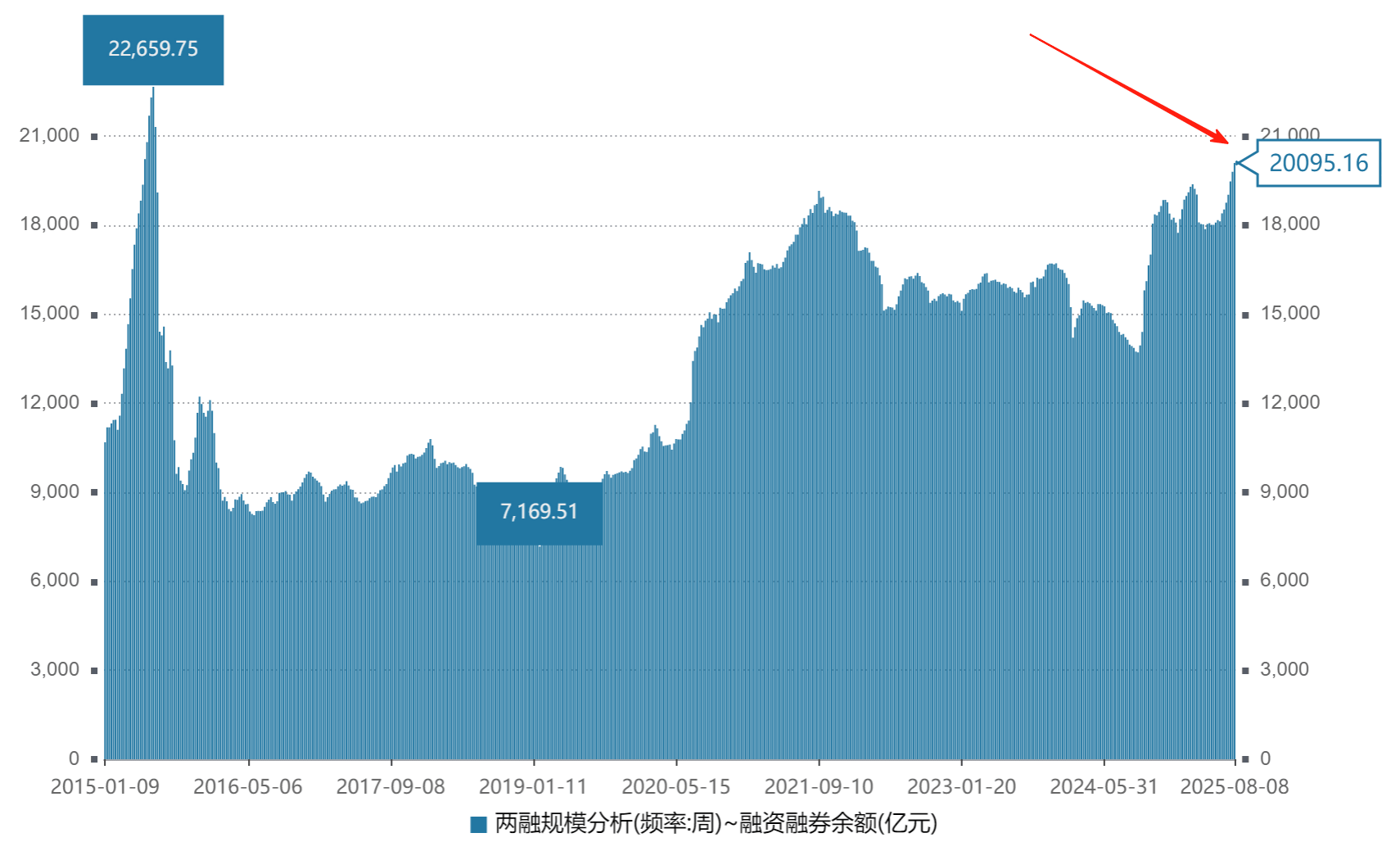
Core Viewpoint - The market is experiencing a significant increase in risk appetite, with a notable rise in small-cap growth stocks, supported by a high level of margin financing that has returned to over 2 trillion yuan for the first time since 2015, although its market share has decreased [1][3][5]. Group 1: Market Performance - The three major indices opened higher on August 12, with the Shanghai Composite Index continuing to strengthen after reaching a new high since 2022 [1]. - As of August 11, the margin financing balance has remained above 2 trillion yuan for four consecutive trading days, marking a significant return to this level [1][3]. Group 2: Margin Financing Insights - Despite the high absolute value of margin financing, its proportion of the A-share market's circulating market value is only 2.30%, less than half of the 4.73% seen in April 2015, indicating a healthier leverage structure [3]. - This situation suggests that there may still be marginal incremental capital supporting the market, with leverage levels not yet reaching alarm thresholds [3]. Group 3: Investment Strategy - The current market dynamics favor small-cap growth stocks, which are particularly sensitive to changes in liquidity and risk appetite, as evidenced by the performance of the CSI 1000 index, which has risen 16.55% year-to-date compared to the 8.82% increase of the Shanghai Composite Index [5]. - The 1000 ETF Enhanced (159680) has seen a year-to-date net value increase of 25.25%, significantly outperforming its benchmark, with a substantial inflow of 213 million shares over the year [8]. - The strategy of using index enhancement may be beneficial for investors looking to balance their portfolios while capturing both beta and alpha returns in the small-cap sector [10]. Group 4: Future Considerations - The market's increasing heat and the gains across various sectors suggest that a refined approach to portfolio rebalancing may be prudent, particularly through low-cost dollar-cost averaging or phased entry strategies [11].

易方达上证科创板综合增强策略交易型开放式指数证券投资基金基金份额发售公告
Shang Hai Zheng Quan Bao· 2025-08-11 19:02
Group 1 - The fund is named "E Fund Shanghai Stock Exchange Science and Technology Innovation Board Comprehensive Enhanced Strategy ETF" and is a type of open-ended index fund [23] - The fund will be available for subscription from August 18 to August 22, 2025, with both online and offline cash subscription options [2][23] - The maximum fundraising scale for the fund is set at 2 billion RMB, excluding interest and subscription fees [5][23] Group 2 - Investors must have a Shanghai Stock Exchange A-share account or a securities investment fund account to subscribe to the fund [3][44] - The subscription fee for the fund will not exceed 0.80% of the subscribed amount [4][28] - The fund's investment objective is to pursue returns that exceed the performance benchmark while controlling the average tracking deviation and annualized tracking error [24][25] Group 3 - The fund's underlying index is the Shanghai Stock Exchange Science and Technology Innovation Board Comprehensive Index, which includes stocks listed on the Science and Technology Innovation Board [12][13] - The fund will be managed by E Fund Management Co., Ltd., with Ping An Bank as the custodian [1][64] - The fund's shares will be issued at an initial value of 1 RMB per share [23]

中证A500指数产品版图再扩大 首只增强策略ETF成立
Zheng Quan Ri Bao· 2025-08-08 07:19
Group 1 - Morgan Asset Management launched the first-ever CSI A500 Enhanced Strategy ETF, providing new investment options for investors focusing on core Chinese assets [1][2] - The fundraising amount during the subscription period for the Morgan CSI A500 Enhanced Strategy ETF reached 1.016 billion yuan, with 7,765 effective subscriptions [1] - Morgan Asset Management subscribed to 30 million shares of the ETF using its own funds, accounting for 2.95% of the total fund shares, demonstrating confidence in the Chinese capital market [1] Group 2 - The main sales channels for the Morgan CSI A500 Enhanced Strategy ETF included CITIC Securities and Guotai Junan Securities, with nearly 260 training roadshows conducted to promote the product [2] - The CSI A500 index is viewed as a new benchmark for A-shares, offering long-term allocation value and a balanced industry distribution, making it an ideal target for enhanced strategies [2][3] - The launch of the Morgan CSI A500 Enhanced Strategy ETF is part of a broader trend, with multiple public institutions actively participating in the CSI A500 index product layout, indicating strong market interest [3]
任职不足两年管理8只产品!林立禾能否复制指数增强基金神话
Sou Hu Cai Jing· 2025-08-07 05:11
Core Viewpoint - Hai Fu Tong Fund has announced changes in fund management, appointing Lin Lihe as the new fund manager for "Hai Fu Tong Xin Xiang Mixed" and co-manager for "Hai Fu Tong An Yi Hedge" alongside current manager Zhu Binquan [1][12]. Group 1: Fund Manager Profile - Lin Lihe holds a master's degree in quantitative finance and risk management from the University of Michigan and has previously worked in quantitative risk management at China Europe Fund [1]. - Since joining Hai Fu Tong Fund in August 2020, Lin has managed a total of 8 products with a combined management scale of 5.254 billion yuan [1][3]. Group 2: Fund Performance - Under Lin's management, the scale of the "Hai Fu Tong Hu Shen 300 Index Enhancement" fund has increased significantly from 268 million yuan to 5.254 billion yuan, a growth of 19.6 times [3][5]. - The "Hai Fu Tong Hu Shen 300 Index Enhancement" fund achieved a cumulative return of 30.31% since Lin took over, with a notable annual return of 22.20% in 2024, outperforming its benchmark by 8.16 percentage points [7][9]. Group 3: Fund Management Strategy - The rapid growth in management scale is attributed to the strong performance of the "Hai Fu Tong Hu Shen 300 Index Enhancement" fund, which accounted for 90.75% of Lin's total management scale as of June 30, 2025 [5][9]. - Lin has been appointed as the manager for multiple products across different investment types, including enhanced index, ordinary stock, flexible allocation, and long-short equity funds [12][15]. Group 4: Challenges and Performance of Other Funds - Despite the success with the index enhancement fund, Lin's performance with other fund types has been less impressive, with the "Hai Fu Tong Fu Li Three-Month Holding" fund ranking in the lower half of its category [16]. - The management scale of some funds under Lin's management remains small, with four out of six products having scales below 100 million yuan, indicating a potential challenge in replicating success across different fund types [15][16].

市场回暖私募备案再创新高,A股赚钱效应还将继续成共识
Di Yi Cai Jing· 2025-08-06 10:50
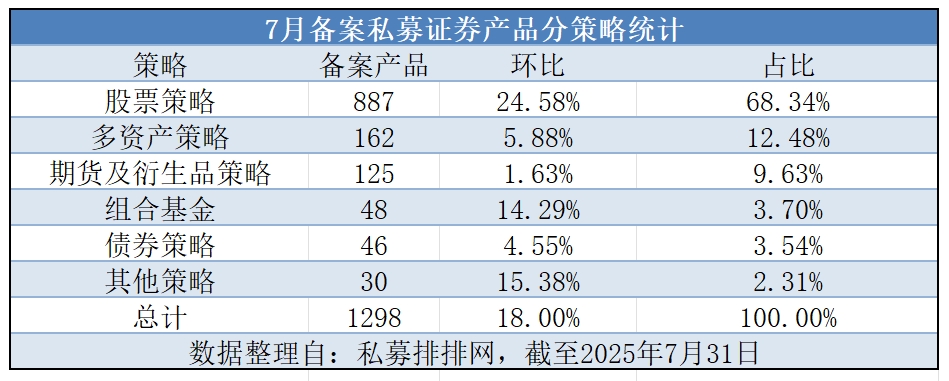
Core Viewpoint - The private equity securities product registration reached a new high in July, driven by the continuous recovery of the A-share market and strong performance of private equity products [2][3]. Group 1: Private Equity Product Registration - In July, a total of 1,298 private equity securities products were registered, marking an 18.00% month-on-month increase and the highest level in nearly 27 months [2][3]. - Year-to-date, 6,759 private equity securities products have been registered, reflecting a year-on-year increase of 61.39% [3]. - Among the registered products in July, stock strategy products accounted for 887, representing 68.34% of the total, with a month-on-month growth of 24.58% [4][5]. Group 2: Performance and Strategy Insights - Quantitative products have seen significant growth, with 3,081 registered this year, making up 45.58% of the total, and a year-on-year increase of 77.68% [3]. - In July, 620 quantitative private equity products were registered, accounting for 47.77% of the total, with a month-on-month increase of 19.00% [5]. - The index enhancement products within the quantitative category saw a substantial increase, with 321 registered in July, representing 67.15% of the total quantitative products and a month-on-month growth of 52.13% [5]. Group 3: Market Dynamics and Investor Sentiment - The A-share market's upward trend, with the Shanghai Composite Index surpassing the 3,600-point mark, has boosted investor confidence and participation [3][6]. - Nearly 90% of private equity securities products with performance records achieved positive returns as of July 25, with an average return rate of 12.8% [9]. - The private equity industry is experiencing an optimization in supply, with top-tier institutions and quality products emerging, enhancing overall competitiveness and attracting more capital [6][7].
金融工程专题报告:深度学习因子选股体系
CAITONG SECURITIES· 2025-08-01 07:47
Core Insights - The report emphasizes the development of a deep learning factor selection system for stock prediction and portfolio optimization, shifting from traditional logic-driven methods to data-driven approaches [7][10]. - The system integrates diverse data sources, including daily and minute market data, to enhance the performance of alpha signals [7][10]. - The report outlines the construction of multiple models that utilize different network architectures to extract unique alpha signals, demonstrating low correlation among them [8][54]. Data and Network - The input data consists of three categories: daily market data, minute market data, and manually crafted features, with neural networks independently extracting alpha features from each dataset [11]. - The report describes the use of Long Short-Term Memory (LSTM) networks combined with self-attention mechanisms to capture long-term dependencies in time series data [19]. - A Graph Attention Network (GAT) is employed to model the complex relationships between stocks, providing a global analysis perspective [20]. Alpha Models - The report presents various alpha models, including simple equal-weight, tree model weighting, and network weighting, with a focus on combining multiple signals to enhance robustness [3][3.1][3.2]. - The average Information Coefficient (IC) for the combined factors since 2019 is reported as 11.3% for 5-day IC and 12.4% for 10-day IC, indicating strong predictive power [31][32]. Risk Models - The report highlights the use of neural networks to identify high-dimensional non-linear risk patterns directly from raw price and volume data, enhancing risk control in portfolio construction [9]. Index Enhancement Strategies - The report details the performance of enhanced index strategies based on deep learning alpha signals, with annualized returns reported as follows: - CSI 300 enhanced portfolio: 18.2% annualized return, 14.2% excess return over the index [3][5.1]. - CSI 500 enhanced portfolio: 22.4% annualized return, 17.2% excess return over the index [3][5.2]. - CSI 1000 enhanced portfolio: 29.8% annualized return, 24.5% excess return over the index [3][5.3].
国泰海通|金工:基于GRU、TCN模型的深度学习因子选股效果研究
国泰海通证券研究· 2025-07-30 14:37
Core Viewpoint - The report demonstrates the effectiveness of deep learning models, specifically GRU and TCN, in stock selection, with GRU showing slightly better performance than TCN+GRU and TCN. The 10-day return prediction model outperforms the 5-day model. The deep learning factors are highly correlated with low volatility and low liquidity factors, indicating potential investment strategies [1][2]. Group 1: Model Performance - The GRU model is confirmed to be effective, with advantages in prediction accuracy and training speed, making it widely used in the industry [1]. - The TCN model, based on CNN architecture, effectively captures long-term dependencies in time series data through causal convolution and residual connections [1]. - The annualized excess returns since 2017 for various indices are as follows: - CSI 300: 11.8% - CSI 500: 13.6% - CSI 1000: 21.7% - CSI 2000: 27.1% The current year's excess returns are -0.4%, 2.7%, 9.9%, and 9.3% respectively [1][3]. Group 2: Single Factor Stock Selection - The single-factor stock selection shows better performance in small and mid-cap stock pools (CSI 1000, CSI 2000), with minimal impact from market capitalization and industry neutrality [2]. - The original factor values in CSI 300 outperform the market capitalization and industry-neutralized factor values, indicating that deep learning factors capture style and industry rotation patterns [2]. Group 3: Composite Factor Stock Selection - Composite factors, when equally weighted, outperform single factors, and the report outlines the construction of index-enhanced strategies with specific constraints on stock turnover and market exposure [3]. - The maximum drawdown for the CSI 300 index-enhanced strategy since January 2017 is -6.0%, with a current year excess return of -0.4% [3]. - Allowing for slight market and industry exposure results in annualized excess returns of 8.8% for CSI 300 and 14.6% for CSI 500, with current year excess returns of -1.7% and 5.2% respectively [3].

指数Y份额首迎扩容!中小机构用指增“精品店”突围养老基金市场
2 1 Shi Ji Jing Ji Bao Dao· 2025-07-30 02:04
Core Viewpoint - The expansion of personal pension index fund Y shares marks a significant development in the investment landscape, with an increase in the number of available funds and a growing interest in index-enhanced products as a key component of pension asset allocation [1][2][5]. Group 1: Fund Expansion and Market Dynamics - On July 28, Huaxia Fund announced the addition of Y shares for its Huaxia ChiNext ETF linked fund to meet the investment needs of personal pension investors, effective from July 31 [1]. - Following this, four index-enhanced funds also announced the establishment of their Y shares, bringing the total number of index funds available for personal pensions to 90, with the overall number of personal pension Y share funds exceeding 300 for the first time [2]. - The approval of new Y shares for index-enhanced funds indicates a growing trend in the market, with more products expected to be submitted for inclusion in the personal pension product directory [3]. Group 2: Fund Management and Performance - Both Guotai Haitong Asset Management and Bodao Fund have introduced their first index-enhanced personal pension funds, showcasing their unique strategies in the competitive landscape [3][4]. - As of July 29, the total number of index-enhanced funds in the market reached 760, with a combined scale of 222.16 billion yuan, highlighting the increasing popularity of these products [4]. - The average annual return for 20 index-enhanced Y shares in the first half of 2025 was 10%, outperforming their performance benchmark by 3.2% [8]. Group 3: Investment Strategy and Market Outlook - Index-enhanced products are becoming a favored choice for pension allocation, as they provide a means to combat inflation and capitalize on economic growth [5]. - The core logic of index-enhanced products is to optimize stock structure to achieve excess returns while adhering to index styles, which is particularly relevant in the current market environment characterized by liquidity-driven growth and structural rotation [6][7]. - The average return of personal pension funds established before 2025 was 6.98%, with Y share index funds achieving an average return of 8.32%, indicating strong performance in the pension fund sector [6].