
数据要素市场

Search documents
2025中国国际大数据产业博览会昨日开幕
Zheng Quan Ri Bao· 2025-08-28 16:10
Core Insights - The 2025 China International Big Data Industry Expo focuses on the value release of data elements and the process of data assetization in the context of a booming digital economy [1][2] Group 1: Data Element Innovation Ecosystem - Since the establishment of the National Data Bureau in October 2023, significant reforms for market-oriented allocation of data elements have been initiated, with nearly 30 related policies introduced [2] - The National Data Bureau is promoting the construction of national data infrastructure and has established 25 city business nodes, with a total computing power of 780,000 Pflops, ranking second globally [2] Group 2: Data Assetization - Data assetization is becoming a powerful engine for enterprises to unlock data value, serving as a key to address the challenge of realizing data value [4][5] - The introduction of the "Interim Provisions on Accounting Treatment of Enterprise Data Resources" effective from January 1, 2024, clarifies the inclusion of data assets on balance sheets, improving financial indicators for companies [5][6] Group 3: Innovations and Applications - Companies showcased new products at the expo, such as Inspur's Haiyue inSuiteONE, which simplifies digital transformation processes for enterprises [3] - The "Quick Claim for Car Insurance Injury" platform by Qulian Technology utilizes blockchain and privacy computing to enhance claim efficiency and customer satisfaction [3] Group 4: Financialization of Data Assets - The first data asset loan of 5 million yuan was issued in Yunnan Province, marking a significant step in the financialization of data assets in the cultural tourism sector [5] - Companies with substantial data assets can enhance investor confidence and improve market perception of their potential in the digital era [5][6]
当数字普洱、数字榴莲在河南生长——来自郑州数据交易中心的微调研
He Nan Ri Bao· 2025-08-25 23:31
Core Viewpoint - Data has emerged as a critical production factor alongside land, labor, capital, and technology, with its value rapidly being unlocked in the digital era. The development of the Zhengzhou Data Trading Center exemplifies how data can be effectively utilized and traded, aiming to establish a national-level data exchange and lead the construction of a unified national market [1]. Group 1: Development of Zhengzhou Data Trading Center - The Zhengzhou Data Trading Center, as the only licensed data trading venue in Henan, aims to create a national-level data exchange and has made significant progress in data market cultivation, trading system construction, and cross-regional data circulation [1]. - Celebrating its third anniversary on August 21, the center has transformed data from static characters into dynamic, tradable assets, showcasing various data products and trading dynamics [1]. Group 2: Agricultural Digital Consumption Platform - The center has launched China's first agricultural digital consumption platform, utilizing credible data to connect the entire agricultural supply chain through digital rights certificates [2]. - The "Longbai Digital Ginseng" project, which was launched on January 5, represents the first instance of "digital ginseng" in China, enabling full-chain digital supervision from source management to quality certification [2]. Group 3: Expansion of Product Offerings - The trading center has introduced various digital products, including "Digital Pu'er Tea," which utilizes blockchain technology for full lifecycle traceability, enhancing consumer trust and product value [3][5]. - A total of 14 products across four categories have been launched, generating sales of approximately 34.26 million yuan [6]. Group 4: Cross-Regional Collaboration - The establishment of the Hami operation center has facilitated the deployment of a comprehensive data service platform, with 139 data products registered and 10 data enterprises introduced [7]. - The center aims to replicate its data trading model across the Yellow River basin and the central and western regions, contributing to the national unified data market [8]. Group 5: Innovative Trading Models - The Zhengzhou Data Trading Center has completed 1,460 data transactions, with a total transaction value of approximately 3.84 billion yuan, establishing a robust data asset registration mechanism [10]. - The center has developed a comprehensive service platform that includes 12 subsystems to address challenges in data trading and compliance [11]. Group 6: Future Directions - The center plans to enhance its role in the national unified market by promoting the "Henan Model" for data trading, aiming for broader replication and implementation across the country [13].


高质量发展动能十足
Zheng Quan Shi Bao Wang· 2025-08-19 04:58
Market Potential - The structural advantages of China's super-large market are accelerating, with the number of registered business entities reaching 189 million by the end of 2024, a 3.1% increase from 2023, indicating strong economic resilience and market potential [2] - The number of private enterprises has grown from 10.857 million in 2012 to 56.707 million by the end of January 2025, a 5.2-fold increase, highlighting the significant role of private enterprises in technology development and innovation [4] Changes in Circulation System - The index for the development of small and medium-sized enterprises reached 89.5 in the first quarter of 2025, the highest since 2020, due to the relaxation of market access restrictions [5] - The national social logistics total reached 36.06 trillion yuan in 2024, a 5.8% increase year-on-year, with logistics costs as a percentage of GDP decreasing from 18% in 2012 to 14.4% in 2023 [11][15] Fair Competition in the Market - The implementation of the Fair Competition Review Regulations in August 2024 has led to a 2.78 percentage point decrease in identified issues, with an average processing time for simplified cases reduced by 5.7 days [19] - In the first half of the year, market regulators investigated 11 cases of monopoly agreements and abuse of market dominance, imposing fines totaling 632 million yuan [19] Consumer Environment - In 2024, the national market regulatory authorities received 39.239 million consumer complaints, with 18.625 million being complaints, resulting in a recovery of 5.16 billion yuan for consumers [20] - The retail sales of consumer goods reached 24.5458 trillion yuan in the first half of 2025, a 5.0% year-on-year increase, with 19 provinces exceeding the national average growth rate [6]

贵州电网创新电力数据高效流通交易模式
Zhong Guo Dian Li Bao· 2025-08-07 06:50
Group 1: Energy Data Ecosystem Development - China Southern Power Grid aims to create an energy data industry ecosystem, focusing on innovative models for efficient circulation and trading of electricity data, thereby fully releasing the value of electricity data elements [1] - In the first half of 2025, Guizhou Power Grid has registered the first batch of 12 public data resources and 4 public data products and services on the Guizhou public data resource registration platform [1] Group 2: Integration of Big Data and Market Transactions - Guizhou Power Grid proposed constructive suggestions at a provincial seminar to promote orderly data flow and deepen digital transformation, aiming to build a national integrated data element market [2] - The contract demonstration texts should be flexible, allowing for adjustments based on actual transaction payments and data usage restrictions [2] Group 3: Support for Digital Government Initiatives - Guizhou Power Grid is actively participating in the construction of data development and utilization processing bases, aiming to enhance the application value of electricity data across multiple scenarios [3] - The company has developed over 100 data products and signed more than 50 data agreements with the government to support the construction of a digital government in Guizhou [3] Group 4: Market Operations and Data Value Transformation - Guizhou Power Grid is building an operational system through intermediary agencies and authorized operations, entering multiple mainstream data trading platforms to promote market-oriented operation and value transformation of data elements [4] - The company has developed five mature data agents, enhancing the capabilities of various industries in Guizhou [4] Group 5: Financial Integration through Electricity Data - Guizhou Power Grid has successfully facilitated financing for a small and medium-sized enterprise using electricity data as a reliable basis for credit assessment, enabling a loan of 10 million yuan [5] - The collaboration between Guizhou Power Grid and financial institutions marks a new stage in the innovative integration of the energy industry and financial services [5][6]
湖北数据条例10月1日起施行 69条细则构建数据工作全链条
Chang Jiang Shang Bao· 2025-08-07 00:11
Core Points - The Hubei Provincial People's Congress passed the "Hubei Data Regulation," which will take effect on October 1, 2025, providing a legal framework for data work and development in Hubei [1][2] Group 1: Regulatory Framework - The regulation consists of 9 chapters and 69 articles, establishing a comprehensive framework for data rights protection, resource management, circulation, industry development, and security [2] - It clarifies the responsibilities of various government levels and departments in data safety supervision, industry promotion, infrastructure construction, and rights protection [2][3] Group 2: Data Rights Protection - The regulation emphasizes the protection of data rights for individuals and organizations, detailing rules for data collection and personal information protection [2][3] - It mandates service providers to ensure data security and personal information protection, addressing prevalent illegal activities on platforms [2] Group 3: Data Resource Management - The regulation defines the scope of public data and establishes a comprehensive management system for public data resources [3] - It promotes a mechanism for public data sharing and establishes a unified authorization operation system for public data [3] Group 4: Industry Development - The regulation encourages government departments to enhance data industry planning and support the cultivation of data market entities [3][4] - It outlines the need for collaboration among government, enterprises, and society to foster a robust data security governance model [4] Group 5: Support for SMEs - The regulation encourages local governments to provide public data services to small and medium-sized enterprises (SMEs) to support their decision-making and innovation [4] Group 6: Future Initiatives - The establishment of Hubei Big Data Group in June 2025 marks a significant step in developing the data factor market and digital economy [5] - The Hubei Data Bureau aims to break data bottlenecks and increase the total data aggregation to over 1 trillion entries by the end of 2025 [6] Group 7: Intellectual Property Protection - Hubei has been approved as a pilot province for data intellectual property protection, focusing on defining protection paths and enhancing rights protection mechanisms [7]
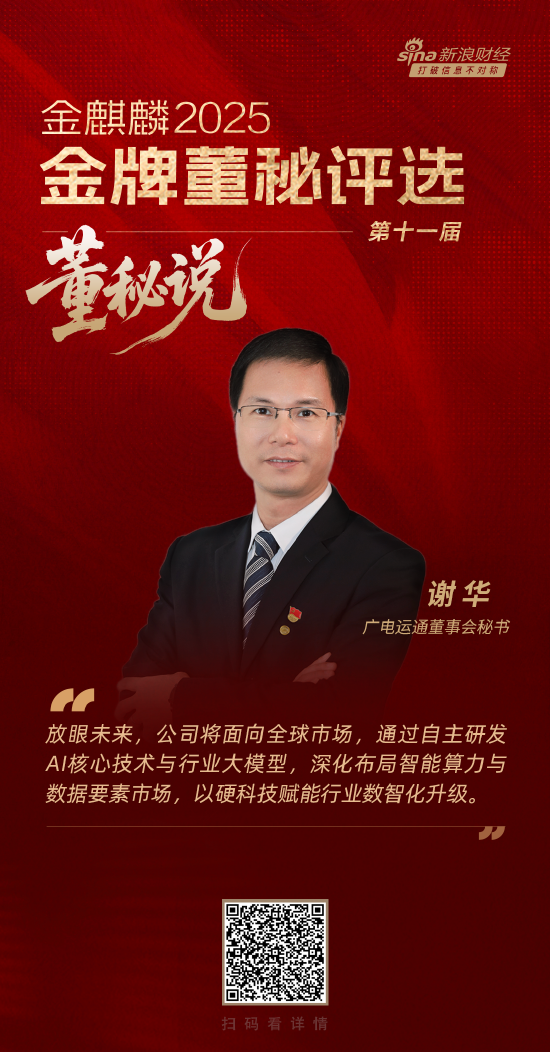
秘说|广电运通董秘谢华:“AI in all”战略引领,核心硬科技筑牢数字经济竞争力
Xin Lang Cai Jing· 2025-07-23 08:19
Core Viewpoint - The company, Guangdian Yuntong, is a leading player in the financial intelligent equipment industry, focusing on digital transformation in financial technology, urban intelligence, and smart transportation, with a projected revenue exceeding 10 billion yuan in 2024, marking a historical high [3][4]. Company Overview - Guangdian Yuntong, founded in 1999 and a subsidiary of Guangzhou Digital Technology Group, is a state-controlled high-tech listed company (stock code: 002152) [3]. - The company has maintained the largest market share in China's intelligent financial equipment sector for 17 consecutive years, with operations in over 120 countries and regions globally [3][4]. Business Expansion - The company is actively expanding into digital finance, digital payment, and big data credit services, aiming to create new growth points [4]. - In the urban intelligence sector, Guangdian Yuntong is involved in smart city construction and has invested in several specialized enterprises, enhancing its growth potential [4]. AI Strategy - The "AI in all" strategy aims to integrate artificial intelligence across all business areas, enhancing product and solution offerings [4][5]. - Key focus areas include: 1. Independent innovation to develop leading "hard technology" in AI [5]. 2. Accelerating the application of AI in various scenarios, particularly in the financial sector [6]. 3. Strengthening industrial capital collaboration to build a core development engine [6][7]. R&D and Innovation - The company has invested over 9.5% of its revenue in R&D for six consecutive years, establishing a robust research organization with nearly 3,000 professionals [8]. - Guangdian Yuntong has developed various AI applications, such as AI-powered financial terminals and smart city management platforms, enhancing operational efficiency and reducing costs [9]. Data Strategy - The company recognizes data as a critical production factor and has established a comprehensive data value chain, focusing on data processing, utilization, and trading [10]. - It has invested in infrastructure to support data circulation and is actively involved in public data operations in Guangzhou [10][11]. Computing Power Development - The demand for computing power is surging due to AI advancements, presenting significant growth opportunities for the company's computing power sector [12]. - Guangdian Yuntong's subsidiary, Guangdian Wuzhou, has a production capacity of 240,000 servers annually and is involved in major AI computing projects [12][13]. Digital Payment Strategy - The company aims to create a comprehensive product and service system for digital payments, focusing on enhancing customer value [14]. - It is actively developing digital RMB payment services and exploring cross-border payment opportunities, leveraging its existing capabilities in the digital currency space [14].

共筑绿色算力大生态,共创人工智能新未来——来自2025绿色算力(人工智能)大会的观察
Xin Hua Cai Jing· 2025-07-12 09:17
Core Insights - The 2025 Green Computing (Artificial Intelligence) Conference held in Hohhot focuses on building a green computing ecosystem and creating new opportunities in the digital economy [1] Group 1: Green Computing Development - The "East Data West Computing" project initiated in February 2022 aims to optimize green computing through technological innovation and policy collaboration, with Hohhot as a key hub benefiting from green electricity [2] - Hohhot's data center has achieved over 80% green electricity usage, with stable electricity prices around 0.35 yuan per kilowatt-hour, making it the region with the highest green electricity usage and lowest electricity prices among the ten major data center clusters in the "East Data West Computing" project [2] Group 2: Computing Power and Infrastructure - The "East Data West Computing" hub index report indicates that Hohhot ranks in the top three for efficiency, energy-saving, and clean collaboration in computing power metrics, with a total computing power exceeding 101,000 P, of which 95% is intelligent computing power [3] - Hohhot plans to enhance computing infrastructure, particularly in the Hohhot data center cluster, and promote zero-carbon data center parks [3] Group 3: Artificial Intelligence Applications - The conference showcased advancements in AI, including human-AI interactions and innovative AI applications across various sectors such as agriculture, industry, education, and healthcare, supported by annual funding of 10 million yuan [4] - AI innovations presented include platforms for cloud services and intelligent data engineering, indicating a strong push towards practical applications of AI technology [4] Group 4: Data Economy and Market Development - Hohhot is developing a new infrastructure model where data is treated as a key resource, aiming to create a national integrated data factor market and promote data sharing [6] - The Inner Mongolia Big Data Trading Center has over 500 companies and nearly 600 data products, achieving a transaction volume of approximately 80 million yuan, highlighting the growing importance of data circulation and marketization [7] - Hohhot has gathered 15 billion data entries across various sectors, establishing itself as a significant player in the digital economy and data-driven innovation [7]
习近平主持召开中央财经委员会第六次会议强调纵深推进全国统一大市场建设 | 宏观经济
清华金融评论· 2025-07-01 10:43
Core Viewpoint - The construction of a nationwide unified market is essential for building a new development pattern and promoting high-quality development in China, emphasizing the need for coordinated efforts and implementation of central government directives [2][3]. Group 1: Nationwide Unified Market Construction - The basic requirements for advancing the nationwide unified market are "five unifications and one openness," which include unifying market basic systems, infrastructure, government behavior standards, regulatory enforcement, and resource markets, while continuously expanding both domestic and foreign openness [3]. - Key focuses include legally addressing low-price disorderly competition among enterprises, guiding companies to enhance product quality, and promoting the orderly exit of backward production capacity [3][4]. - The meeting highlighted the importance of integrating domestic and foreign trade, improving the transparency of investment information, and establishing a favorable fiscal and credit system for market unification [3][4]. Group 2: High-Quality Development of Marine Economy - The development of the marine economy should emphasize innovation-driven growth, efficient collaboration, industrial upgrades, harmonious human-ocean relationships, and win-win cooperation [4]. - Policies should encourage social capital participation in marine economic development, enhance independent innovation capabilities in marine technology, and promote the growth of leading marine technology enterprises [4][10]. - The meeting called for strengthening marine ecological environment protection and actively participating in global marine governance [4][10]. Group 3: Data Element Market - The establishment of a nationwide unified data market is crucial for promoting the marketization of data elements, which are now considered a strategic resource for driving technological innovation and economic transformation [10][11]. - The construction of a unified data market is seen as a necessary step to unlock the potential of China's vast market and enhance national competitiveness [11][14]. - The need for legislative innovation in key and emerging areas related to the unified market was emphasized, alongside the importance of using digital technologies to improve judicial support for market fairness [13][14].

成都数字经济“新基座”:从算力奔跑到产业赋能
Mei Ri Jing Ji Xin Wen· 2025-06-30 10:14
Core Insights - Chengdu is reshaping its economic landscape through a robust digital infrastructure, driven by advancements in computing power, integrated facilities, and data elements [1] Group 1: Computing Power - Chengdu's total computing power has reached 8754 PFlops, with the national supercomputing center achieving speeds of 10 quintillion calculations per second, enabling advanced research [4] - The AI industry in Chengdu is projected to reach a scale of 107.9 billion yuan in 2024, marking a 39% year-on-year growth, with significant increases in both core industry size and the number of related enterprises [4] Group 2: Integrated Infrastructure - Chengdu has established 283 smart factories and digital workshops, becoming a pilot city for "5G + Industrial Internet" applications, facilitating a comprehensive transformation in manufacturing [5] - The city has built a national top-level node in the industrial internet sector, with a registered volume of 10.92 billion identifiers, and has developed extensive testing scenarios in the vehicle networking domain [5][6] Group 3: Data Activation - Chengdu has opened 319 million public data entries since 2018, with over 6.19 million visits to its public data platform, aiming to activate dormant data for industrial growth [9] - The "Rong Data Park" serves as a public service space for the data element industry, attracting 261 data vendors and offering 1050 data products, contributing over 1.4 billion yuan to secondary data vendors [9]

山东数据市场发展观察:国企先行探路,生态构建待深化
Zhong Guo Jing Ying Bao· 2025-06-29 08:48
Core Insights - The article discusses the significant impact of digitalization and data as a production factor in various sectors, highlighting the emergence of data as a crucial asset in economic development, particularly in Shandong Province [1][2] - It emphasizes the challenges faced in the implementation of data asset accounting, including insufficient infrastructure, lack of active participation from private enterprises, and the need for a robust data market [3][4] Group 1: Data Asset Accounting - By 2024, data is expected to be recognized as a key asset, with 92 listed companies and 228 non-listed companies in China reporting data asset accounting [1] - Shandong Province has seen state-owned enterprises leading the way in data asset accounting, with the Shandong High-Speed Group reporting a data asset value of 3.51 million yuan and an assessed value exceeding 72 million yuan [2][3] - The reluctance of private enterprises to engage in data asset accounting is attributed to high costs, low returns, and operational complexities [2][3] Group 2: Challenges in Data Market Development - The article identifies several challenges, including a lack of active participation from enterprises, an immature data market, and insufficient infrastructure for data operations [3][4] - Shandong has established regional data trading institutions, but its trading volume of 220 million yuan is significantly lower than that of leading cities like Shenzhen and Shanghai [5][6] - The absence of a provincial-level public data operation platform hinders the development of a robust data market ecosystem in Shandong [6][7] Group 3: Data Security and Trust - Concerns regarding data security and the establishment of a trusted data space are highlighted as critical issues for the industry [7][8] - The need for a trusted data space is emphasized to ensure data can be shared and utilized securely, with various types of trusted spaces being proposed [8][9] Group 4: Revenue Distribution and Coordination - The article discusses the importance of coordinating interests across departments and levels for effective data utilization and revenue distribution [10][11] - A proposed revenue-sharing model in Qingdao suggests that 50% of the revenue generated from public data operations would be reinvested into supporting data resource management [10][11]