
枢纽经济

Search documents
融入服务全国统一大市场,是河南的机遇
Xin Lang Cai Jing· 2025-12-23 12:55
Core Viewpoint - The recent Henan Provincial Economic Work Conference emphasizes the integration and service of the national unified market as a key direction for the province's development over the next five years [2][3]. Group 1: Market Opportunities - Henan has a population exceeding 100 million, with over 22 million in the middle-income group and more than 11 million business entities, representing significant market capacity and consumer potential [6]. - The core opportunity for Henan in the context of the "14th Five-Year Plan" is to leverage its vast consumer potential to shape industrial clusters, transforming market demand into a fertile ground for industry [7]. - The example of the hot pot industry illustrates this, with Henan ranking fourth in the number of hot pot restaurants nationwide, showcasing the province's ability to attract and develop food supply chains [9][10]. Group 2: Transportation Hub Redefinition - Henan has developed a comprehensive transportation network, including a "米" shaped high-speed rail system and over 10,000 kilometers of highways, which positions it as a critical logistics hub [13]. - The province aims to upgrade its transportation hubs into economic hubs, with recent initiatives including the establishment of six economic pilot zones to enhance industrial clustering [15][16]. Group 3: Environmental Improvement - The development of a favorable business environment is crucial for attracting and retaining enterprises, as evidenced by the increase in wintering swan populations in the region, reflecting improved ecological conditions [17]. - Henan's government is focused on creating a conducive environment for business, shifting from competitive land and tax incentives to a holistic ecosystem that promotes fair competition and transparency [19]. - The establishment of a branch of Shenzhen's leading robotics company in Henan highlights the effectiveness of the province's improved business environment in attracting high-tech enterprises [21]. Group 4: Strategic Development Logic - Henan's integration into the national unified market is seen as a strategic move to drive high-quality development, aligning national needs with local capabilities and business expectations [21].



熊征宇调研蔡甸区、东西湖区:加快提升重大功能性平台能级,为全力打造“五个中心”提供有力支撑
Chang Jiang Ri Bao· 2025-12-23 00:59
Group 1 - The article emphasizes the importance of implementing the spirit of the 20th Central Committee of the Communist Party and the significant speeches by General Secretary Xi Jinping, focusing on enhancing major functional platforms to support the development of a modern Wuhan [1][2] - In the Caidian District, the construction of the Sino-French Wuhan Ecological Demonstration City and the Wuhan Aviation New Materials Industrial Park is highlighted, with a focus on attracting foreign investment and promoting industrial innovation [1] - The article discusses the need for ecological protection and the development of urban agriculture and cultural tourism in Caidian District, aiming for a harmonious urban-rural integration [1] Group 2 - In the Dongxihu District, the establishment of a national cybersecurity talent and innovation base is a priority, with plans to develop emerging industries such as cybersecurity, electronic information, and intelligent manufacturing [2] - The article mentions the goal of building a world-class cybersecurity academy and enhancing the logistics hub capabilities to support the China-Europe Railway Express [2] - It stresses the importance of creating a conducive environment for industrial development, population aggregation, and urban function construction, alongside high-quality urban renewal initiatives [2]
畅通国民经济循环 为实体经济“舒筋活血”
Xin Hua Ri Bao· 2025-12-15 23:19
持续深化产业融合,实现从"制造中心"到"服务高地"的功能拓展。江苏是制造业大省、物流大省,围绕 物流与制造业深度融合,涌现了一批具有较强竞争力的第三方物流、国际供应管理、跨境电商平台等创 新主体。"十五五"期间,我省现代服务业体系正向高端化、绿色化、国际化加速演进,必将推动物流行 业从被动配套的"成本中心"转向主动赋能的"价值中心"。将加快推进产业链供应链生态体系建设,深入 开展两业融合示范项目试点;着力打造供应链柔性补给、全球分拨等新业态,引导传统物流深度融入产 业链供应链全过程;创新"物流枢纽+供应链组织+要素集成"融合新模式,增强重点产业链价值创造与 安全韧性保障能力。 加快新质场景应用,实现从"要素驱动"到"数据驱动"的关键转变。江苏是全国唯一以智慧物流为重点的 降本增效综合改革试点省份,拥有规上物流企业1.5万家,每天产生海量物流数据。"十五五"期间,江 苏智慧物流发展进入以人工智能和大模型深度应用为标志的新阶段。将加快推进数字技术在物流全场景 的集成应用,打造一批物流标杆示范应用场景;以"水运江苏"多式联运数据共享为切入口,打通多域数 据,促进物流数据要素市场化交易;扎实推进《国家物流公共数据共享 ...
围绕“枢纽”建设 奋力谱写中国式现代化河南篇章
Qi Huo Ri Bao· 2025-12-15 01:37
Core Viewpoint - The article discusses the strategic development of Henan Province in China, focusing on the construction of a "hub" to enhance its economic and social development during the 14th Five-Year Plan period, leveraging its geographical advantages and comprehensive resources to integrate into the national unified market [1]. Group 1: National Element Allocation Hub - The core of building a national element allocation hub is to promote the market-oriented allocation of resources, which will enhance overall productivity and support high-quality development [2]. - Henan has the potential to become a national element allocation hub due to its rich resources, large population, and established infrastructure, including being a national big data comprehensive pilot zone [2]. - The Zhengzhou Data Trading Center is crucial for this hub, facilitating the commercialization and financialization of data, which will enhance the province's element allocation capabilities [3]. Group 2: Modern Logistics Hub - The 14th Five-Year Plan suggests implementing actions to reduce logistics costs and enhance logistics infrastructure, aiming to establish several regional logistics hubs and an international logistics center [6]. - To convert "flow" into "retention," it is essential to improve the efficiency of logistics through multi-modal transport and enhance international supply chain stability [7]. - Recommendations include building a multi-layered logistics hub network, innovating logistics service models, and expanding international logistics channels [8]. Group 3: Commodity Distribution Hub - The plan emphasizes supporting the Zhengzhou Commodity Exchange and establishing a resource allocation hub for bulk commodities, focusing on enhancing storage and transportation capabilities [9]. - The development of a comprehensive supplier network and a significant agricultural product trading center is essential for establishing a large-scale market and trade system [10]. - The integration of futures and spot markets at the Zhengzhou Commodity Exchange is seen as a key driver for the resource allocation hub, promoting price discovery and risk management [11].

大市场“中”力量丨流量大省演绎“留量故事”——“大市场‘中’力量”系列报道之二
He Nan Ri Bao· 2025-12-14 23:41
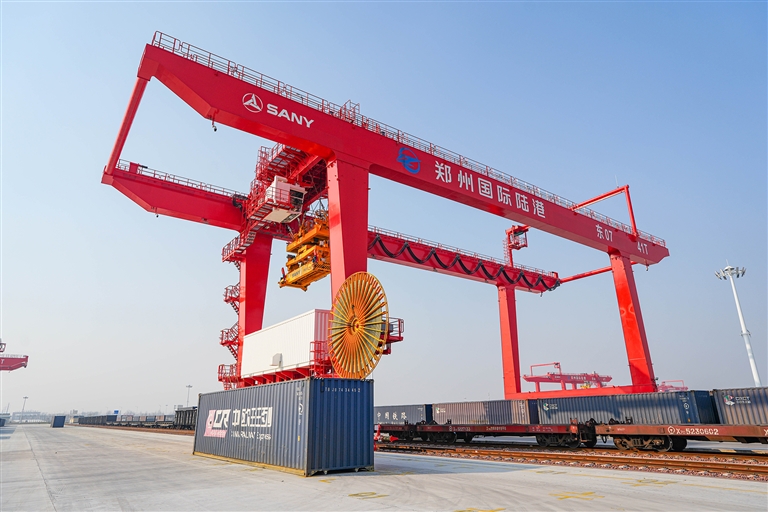
Core Viewpoint - Zhengzhou is establishing itself as a significant logistics hub in China, enhancing its role in both domestic and international markets through improved infrastructure and operational efficiency [4][6][9]. Group 1: Logistics and Infrastructure Development - Zhengzhou International Land Port has achieved regular operations, with the China-Europe Railway Express running 1-2 trains daily and special trains for new energy vehicles operating 4-5 times a day [6]. - The Zhengzhou Airport has seen a cargo volume of 825,200 tons by November 3, 2023, representing a year-on-year increase of 24.76%, surpassing the total volume of the previous year by 58 days [5]. - The Zhengzhou multi-modal transport data service center integrates data from over 450 companies, significantly reducing operational costs and improving efficiency [5]. Group 2: Economic Impact and Business Attraction - Foxconn's investment in Zhengzhou has led to a significant increase in the province's export-import volume, accounting for approximately 60% of the total [7][14]. - The expansion of air cargo routes from 51 to 70, covering 32 countries, has established a "72-hour delivery" network, enhancing Zhengzhou's global logistics capabilities [7]. - The establishment of global spare parts centers by companies like Super Fusion Digital Technology demonstrates the competitive advantage gained from Zhengzhou's logistics flow [8]. Group 3: Future Prospects and Strategic Initiatives - The provincial government is focusing on enhancing transportation networks, including high-speed rail and cargo rail, to strengthen Zhengzhou's position as a comprehensive transportation hub [9][10]. - The launch of the China Post Aviation Hub project aims to support the Belt and Road Initiative and enhance Zhengzhou's role in international trade [9]. - The establishment of the Luxembourg SolarCleano company's Asia-Pacific headquarters in Zhengzhou signifies the growing interest of international companies in the region [10].
【大宗周刊】围绕“枢纽”建设 奋力谱写中国式现代化河南篇章
Qi Huo Ri Bao· 2025-12-13 23:54
Core Viewpoint - The Henan Provincial Committee's 15th Five-Year Plan outlines a strategic framework for economic and social development, emphasizing the establishment of Henan as a national hub for resource allocation, logistics, and commodity distribution, leveraging its geographical advantages and comprehensive industrial base [1][2]. Group 1: National Resource Allocation Hub - The plan aims to enhance the market-oriented allocation of resources, establishing a unified land market, labor market, and technology trading market, while promoting a data market and a talent supply base [2][3]. - Henan's rich resource endowment, including a large population and fertile land, positions it well to become a national resource allocation hub, supported by its status as a national big data pilot zone and a key free trade zone [2][3]. Group 2: Data Trading Center - The Zhengzhou Data Trading Center is pivotal in establishing Henan as a national resource allocation hub, facilitating the commercialization and financialization of data, which is essential for enhancing productivity [3][4]. - The center will focus on institutional innovation, platform development, and application scenarios to integrate data with other resources, thereby improving the efficiency of resource allocation in various industries [3][4]. Group 3: Modern Logistics Hub - The plan emphasizes reducing logistics costs and enhancing infrastructure to support the development of logistics hubs, aiming to establish several regional logistics centers and strengthen the logistics industry [6][7]. - Key strategies include improving multi-modal transport connections, developing smart logistics, and integrating logistics with manufacturing and agriculture to enhance supply chain efficiency [7][8]. Group 4: Commodity Distribution Hub - The plan highlights the importance of supporting the Zhengzhou Commodity Exchange and establishing a hub for the allocation of bulk commodities, focusing on enhancing storage and transportation capabilities [9][10]. - The development of a comprehensive service system integrating spot and futures trading, along with the use of technology to improve transaction efficiency, is crucial for establishing Henan as a significant player in the commodity market [10][11].
周红波在雨花台区调研时强调
Nan Jing Ri Bao· 2025-12-12 01:58
周红波强调,要放大软硬结合、数实融合的优势,一手抓AI+软件创新发展,一手抓AI+硬件融合 应用,加快构建开放创新的人工智能应用生态,推动软件名区向AI高地跨越。要放大全面创新、全域高 新的优势,建强高能级科创平台,壮大高成长性企业矩阵,促进高效率资源配置,加快科技创新和产业 创新深度融合。要放大枢纽门户、要素聚合的优势,积极主动谋划南京南站片区发展,整体提升宜业宜 居环境,加快发展总部经济和楼宇经济,打造具有鲜明标识的现代服务业集聚区。要放大空间整合、功 能焕新的优势,优化城市空间布局,规划建设青年友好的活力街区,在城市更新中注重产城融合、职住 平衡,强化就业创业、公共服务等各种功能的配套和衔接。要强化安全隐患排查治理,守牢城市安全韧 性底线。 12月11日,市委书记周红波在雨花台区调研。他强调,要深入学习贯彻党的二十届四中全会精 神,落实省委、市委全会部署要求,科学谋划"十五五"发展,努力打造中心城区发展的增长极,成为新 质生产力培育的动力源,在现代化人民城市建设中展现新作为。 调研中,周红波先后到艾德克斯电子、雨花数字城核心区、亿维特航空、南京南站片区、AI·镜界 —南京人工智能生态街区,深入了解外资企 ...
中欧班列(成渝)“朋友圈”开会谈了什么?扩大“中欧班列+”效应 建世界陆港枢纽
Si Chuan Ri Bao· 2025-12-10 00:30
Core Insights - The China-Europe Railway Express (Chengdu-Chongqing) has become the most frequently operated and regionally cooperative railway service in China, with over 38,000 trains dispatched to more than 100 cities globally, showcasing accelerated international openness [1][4] Group 1: Development and Achievements - The Chengdu-Chongqing Railway Express celebrated its fifth anniversary with two trains carrying medical equipment and other goods departing for the Netherlands and Germany, highlighting its role in international trade [1] - The establishment of the cold chain distribution center aims to create a comprehensive cold chain service network by 2026, integrating various transportation modes to enhance efficiency in transporting cold chain products [2] - The "Rongou Express" train service from Chengdu to Poland has achieved a fixed weekly schedule with a punctuality rate of 99%, supporting the development of an international mail hub [4] Group 2: Future Opportunities - The Chengdu-Chongqing region is encouraged to leverage supply chain integration to enhance logistics and industry synergy, aiming to transform into a hub economy and build a world-class land port [3][4] - The focus will be on importing European meat and biopharmaceuticals, as well as Southeast Asian fruits and seafood, while also promoting the export of agricultural products from the Chengdu-Chongqing area [2]
2025中欧班列(成渝)全球合作伙伴大会在成都举行
Zhong Guo Xin Wen Wang· 2025-12-09 07:38
Group 1 - The 2025 China-Europe Railway Express (Chengdu-Chongqing) Global Partnership Conference was held in Chengdu, focusing on enhancing the international hub status of Chengdu and Chongqing through multi-level cooperation in international supply chains, industrial chains, and value chains [1] - The conference marked the fifth anniversary of the Chengdu-Chongqing Railway Express, with two trains loaded with medical equipment and other goods departing for the Netherlands and Germany, indicating a new development stage for the service [1] - Over the past five years, the Chengdu-Chongqing Railway Express has become a model for high-quality development in China, with over 38,000 trains dispatched to more than 100 cities globally [1] Group 2 - The Chengdu-Chongqing Railway Express has facilitated various cooperative achievements in building an open market, leading to the establishment of the Global Partnership Conference, which has been successfully held twice [2] - The conference aims to deepen cooperation with countries along the route, enhance trade, and promote the construction of the South Corridor, while achieving practical cooperation results [2] - The Chengdu to Poland Łódź route has established a fixed weekly service, with a punctuality rate of 99%, supporting the development of an international mail hub [2] Group 3 - The "14th Five-Year Plan" period is seen as a golden opportunity for innovation in logistics supply chains and a critical period for the transformation and upgrading of modern logistics [3] - The Chengdu-Chongqing region is encouraged to focus on supply chain development, integrating logistics with industry, and enhancing efficiency and cost reduction to build a world-class land port hub [3]
2025中欧班列(成渝)全球合作伙伴大会在蓉举行
Zhong Guo Xin Wen Wang· 2025-12-05 14:18
当日上午10时,两辆满载医疗设备、车载显示器、邮包等货物的列车——中欧班列(成渝)五周年"川渝 造"班列,同时从成都国际铁路港、重庆团结村中心站缓缓驶出,分别发往荷兰蒂尔堡和德国杜伊斯 堡,以成渝联合之名奔赴新程,标志着中欧班列(成渝)迈入更高层次的发展阶段。 驰骋欧亚,成渝两地以高质量共建"一带一路"为引领,在统一品牌、统一定价机制、整合线路资源、提 升服务水平、降低运营成本等方面开展全方位多层次深度合作。五年来,中欧班列(成渝)被打造为全国 中欧班列合作共建、高效运营和高质量发展样板,探索出全国中欧班列高质量发展的新路径。截至目 前,中欧班列(成渝)开行线路已通达全球超百个城市,累计开行超3.8万列。 受中欧班列(成渝)强牵引,成渝共建开放市场更是取得各种合作成果。基于此,中欧班列(成渝)全球合 作伙伴大会应运而生,且已成功举办两届,分别在成都、重庆两地轮流举办,第一届大会通过共建开放 新通道、共创国际贸易新平台,重点推出多式联运"一单制"合作;第二届大会通过系列活动,推动国际 供应链、产业链、价值链多层次合作,抢占中欧班列南通道开行先机。 中新网成都12月5日电(记者张浪)5日,2025中欧班列(成渝) ...