固态电池技术

Search documents
固态电池设备深度报告
2025-08-25 09:13
Summary of Solid-State Battery Equipment Industry Conference Call Industry Overview - The solid-state battery equipment industry is experiencing significant improvement in fundamentals, with leading manufacturers expecting a surge in order volumes starting Q4 2024, followed by secondary manufacturers in Q1 2025, indicating a potential performance inflection point between Q4 2025 and Q1 2026 [1][3][6] - The industry has undergone a downturn since 2022, with companies having adequately provisioned for impairments. The release of raw material reserves and inventory impairment pressures in 2025 could lead to substantial performance elasticity if profit margins recover [1][3][7] - The solid-state battery technology has promising development prospects, with leading companies expected to achieve mass production between 2025 and 2026, supported by a 6 billion yuan special fund established by the Ministry of Industry and Information Technology [1][4][7] Key Points and Arguments - **Order Growth**: Leading manufacturers began receiving substantial orders from Q4 2024, with secondary manufacturers following suit in Q1 2025, signaling a recovery in market demand [3][7] - **Financial Recovery**: After two years of decline, companies are in a position to recover financially, with significant performance elasticity expected if profit margins improve [3][7] - **Replacement Cycle**: The lifespan of lithium battery equipment is approximately 3 to 5 years, with many projects initiated in 2020 now entering the replacement cycle, further supported by increased domestic and international market demand [1][4][7] - **Commercialization Timeline**: The industry anticipates small-scale production by leading companies in 2027, with full commercialization expected around 2030, contingent on supply chain development and cost reductions [1][7][10] Market Demand and Growth Projections - By 2030, global demand for solid-state batteries is projected to exceed 200 GWh, with a compound annual growth rate (CAGR) exceeding 100%. Equipment demand is expected to reach 30 billion yuan, marking solid-state batteries as a new growth point in the lithium battery equipment industry [2][10][12] - The overall market for solid-state battery equipment is anticipated to surpass 30 billion yuan by 2030, with a significant reduction in investment costs per GWh expected [12] Investment Opportunities - **Configuration Strategies**: Current investment strategies include focusing on companies with comprehensive line layouts (e.g., Xian Dao and Li Yuan Heng), leading firms in niche segments (e.g., Hong Gong Technology and Na Ke Nuo Er), and tracking downstream manufacturers to reverse invest in upstream equipment companies [9][17][18] - **High-Value Segments**: Certain process segments within solid-state battery production are identified as high-value areas for investment, particularly those with cost reduction potential and high technical content [5][15] Important Timeframes and Catalysts - Key upcoming milestones include significant equipment purchases expected from late 2025 to early 2026, crucial testing phases in 2026, and the initiation of small-scale production in 2027 [11][16] - Catalysts for market movement include the mid-term review of the Ministry of Industry and Information Technology's 6 billion yuan project, expected in September-October, and the emergence of large orders from downstream manufacturers [11][16] Conclusion The solid-state battery equipment industry is poised for significant growth driven by technological advancements, increasing market demand, and strategic investments. The upcoming years will be critical for companies to capitalize on these opportunities and navigate the evolving landscape of the lithium battery sector.
固态电池:产业加速发展 设备端迎发展良机
Xi Niu Cai Jing· 2025-08-25 02:34
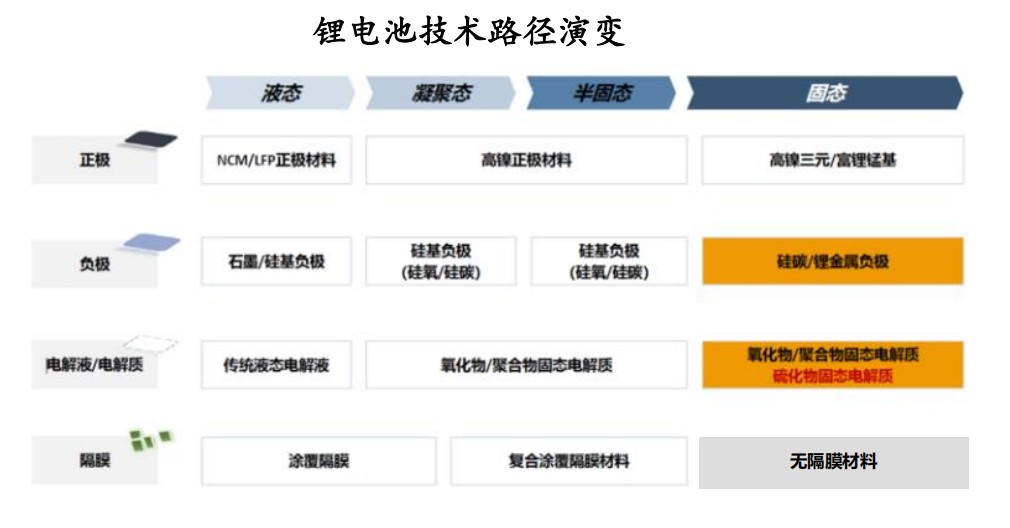
固态电池采用固态电解质,是最具前景的电池新技术。以固态电解质取代液态电池中的液态电解质,具备高能量密度、安全、长循环寿命和宽 应用温度范围等优势,有望解决动力电池能量密度低和安全隐患问题。 依据液态电解质在电芯材料混合物中的质量分数,电池分为液态(25%)、半固态(5%~10%)、准固态(0%~5%)和全固态(0%)四类, 后三者统称固态电池。。 液态锂电池存在诸多不足,如能量密度有上限、锂枝晶带来安全风险、SEI膜增厚影响循环寿命,以及低温性能欠佳限制了应用场景。相比之 下,固态电池凭借高安全性和高能量密度的优势,成为电池技术发展的新趋势。 我国高度重视先进电池技术创新与产业发展,为保持中国电动汽车技术领先地位,2024年6月,工信部发布《锂离子电池行业规范条件(2024年 本)》,新增固态电池相关要求,以规范性能标准,推动其发展。预计到2030年,全球固态电池出货量将达614.1GWh,全固态电池市场规模或 达172亿元。 目前,主流厂商多以半固态、准固态形式切入固态电池领域,采取"液态-半固态-准固态-全固态电池"的逐步转化策略,通过"液态-半固态-准固 态-全固态电池"的发展路径,逐步向全固态电池过渡 ...

中信建投:电池厂技术推进迅速,固态电池下游应用场景逐步拓宽
Xin Lang Cai Jing· 2025-08-25 00:14
Group 1 - The core viewpoint is that Guoxuan High-Tech has announced that its solid-state battery "Jinshi Battery" is in the pilot production stage and has initiated the design work for a mass production line for all-solid-state batteries, indicating rapid progress in the solid-state battery field [1] - The initial development of solid-state batteries is perceived to have a slow penetration rate in the energy storage sector due to high costs, which are particularly sensitive for energy storage applications [1] - Nandu Power has won a significant independent energy storage project order with a total capacity of 2.8 GWh, which is the largest semi-solid-state battery energy storage project globally to date [1] Group 2 - The project will utilize Nandu's self-developed 314Ah semi-solid-state battery, marking the first commercial application of solid-state battery technology in a gigawatt-hour level energy storage project in China [1] - Solid-state battery technology addresses the core demands for "absolute safety" and "long-term reliability" in large-scale energy storage [1]



赣锋锂业20250822
2025-08-24 14:47
Summary of Ganfeng Lithium's Conference Call Company Overview - **Company**: Ganfeng Lithium - **Date**: August 22, 2025 Key Financial Metrics - **Gross Margin**: Approximately 11% for H1 2025, with lithium chemicals at 8.36% and lithium batteries at 14.1% [2][3] - **Net Profit**: Negative 531 million CNY [3] - **Operating Cash Flow**: 300 million CNY [3] - **Total Revenue**: 8.37 billion CNY [3] - **Investment Income**: 314 million CNY [2] - **Fair Value Loss**: 277 million CNY [2] - **Asset Impairment Loss**: 194 million CNY [2] Business Highlights Lithium Projects - **Mariana Project**: Initiated, with production expected to ramp up [2][5] - **Gulamin Project**: Operating normally, with the first shipment dispatched [5] - **Quechua Salt Lake Project**: Achieved half of the annual production target in H1 2025 [2][5] - **Mali Lithium Project**: Targeting 300,000 tons of ore for the year, with production and transport unaffected by local security challenges [2][8][9] Solid-State Battery Developments - **Production Achievements**: - Soft-pack batteries with energy density up to 550 Wh/kg and cylindrical batteries up to 420 Wh/kg [2][6] - Daily production of 50,000 cylindrical batteries planned for mass production by early 2026 [6] - **Collaborations**: Partnerships with drone and EVATO companies [2][6] Energy Storage Innovations - **New Products**: Launched a 304 Ah square solid-state battery, with plans for larger capacity models [2][7] - **Market Demand**: Strong demand for energy storage cells, with supply constraints noted [4][10] Strategic Insights Integrated Strategy - **Impact**: The integrated strategy has shown positive effects, with downstream lithium battery and energy storage businesses compensating for upstream resource challenges [2][8] - **Cost Reduction**: Significant cost reductions in salt lake projects, with cash costs decreasing from 6,800 USD/ton in Q4 2024 to 6,000 USD/ton in H1 2025 [2][12][13] Market Dynamics - **Lithium Price Trends**: Anticipated to remain high due to strong demand, with expectations of prices stabilizing around 70,000 to 90,000 CNY [29] - **Supply Chain Management**: Focus on low-cost resource extraction and adjusting solid-state battery shipment guidance based on market demand [4][29] Future Outlook Production Goals - **2025 Targets**: Maintain 300,000 tons shipment for Mali and 33 GWh for battery business [4][18][19] - **2026 Expectations**: Improved demand and pricing anticipated, with specific forecasts to be clarified by year-end [18] Project Developments - **PPG Project**: Collaboration with Argentinian lithium companies to increase capacity from 50,000 tons to 150,000 tons [2][15] - **Mariana Project**: Expected to reach annual production of 15,000 tons, with cost stabilization anticipated as production ramps up [34] Risk Factors - **Operational Challenges**: High-cost projects in Australia facing operational pressures, with cautious investment attitudes noted [4][16] - **Debt Management**: Rising debt leverage being monitored, with strategies in place to control it through equity financing and capital structure optimization [39][41] Additional Insights - **Inventory Levels**: Current inventory levels are low, with lithium hydroxide nearly sold out [27] - **Accounting Practices**: The accounting treatment of the energy storage business may affect reported profits, though it remains a core operational focus [28] This summary encapsulates the key points from Ganfeng Lithium's conference call, highlighting financial performance, business developments, strategic insights, and future outlook.
锂电行业复盘
2025-08-24 14:47
Summary of Lithium Battery Industry Conference Call Industry Overview - The global electric vehicle (EV) market continues to grow, with China's electrification rate nearing 50%, Europe at approximately 20%, and the US around 10%. The overall global electrification rate is expected to reach 25% this year. [2][4] - The lithium battery industry has experienced multiple cycles, with early companies achieving over 10x growth. Currently, the industry is in a stable growth phase, projected to maintain double-digit growth over the next five years, making leading companies attractive investment opportunities. [2][5] - Emerging sectors such as Artificial Intelligence Data Centers (AIDC), robotics, and solid-state batteries are expected to present new growth opportunities. [2][7] Market Trends - The European EV market is expected to see stagnant sales from 2022 to 2024 due to subsidy reductions and insufficient competitiveness of new models. Sales growth is anticipated to rebound in 2025 as the effects of subsidy reductions are absorbed and new vehicle cycles begin. [2][9] - The US market is influenced by Tesla's new vehicle cycles and subsidy policies, with potential stagnation in sales expected after subsidies are removed by the end of 2025. [2][10] Price Dynamics - The lithium battery supply chain is cyclical, with demand surges leading to price spikes, followed by price declines as capacity is released. The carbonate lithium expansion cycle is approximately three years, while lithium battery materials take about one year. Price fluctuations significantly impact stock prices and profitability. [2][11][28] Development Stages of the Lithium Battery Industry - The lithium battery industry has evolved through three main stages: 1. **Theme Investment Stage (2010-2014)**: Driven by policy initiatives. 2. **Initial Volume Stage (2015-2019)**: Benefiting from subsidies. 3. **Rapid Expansion Stage (2019-present)**: Characterized by rapid penetration rates. [3][12][26] Key Players and Performance - CATL (Contemporary Amperex Technology Co., Limited) is highlighted for its strong performance, with profit expectations revised upwards due to sufficient warranty provisions. [3][24] - Solid-state battery-related companies are expected to perform strongly in 2025, benefiting from anticipated government subsidies and industry advancements. [3][25][34] Investment Recommendations - The lithium battery sector is entering a value zone, with expected growth in the coming years. Key companies to watch include CATL in the battery segment and Keda in the materials segment. [3][33] - New technologies, particularly solid-state batteries, are viewed positively, with expectations for small-scale production by 2027 and large-scale production by 2030. [3][34] Conclusion - The lithium battery industry is poised for continued growth, driven by technological advancements and supportive policies. Investors are encouraged to focus on leading companies with strong fundamentals and emerging technologies for long-term gains. [2][33][34]

调研速递|赣锋锂业接受花旗环球等145家机构调研,透露多项业务进展与规划要点
Xin Lang Cai Jing· 2025-08-24 13:24
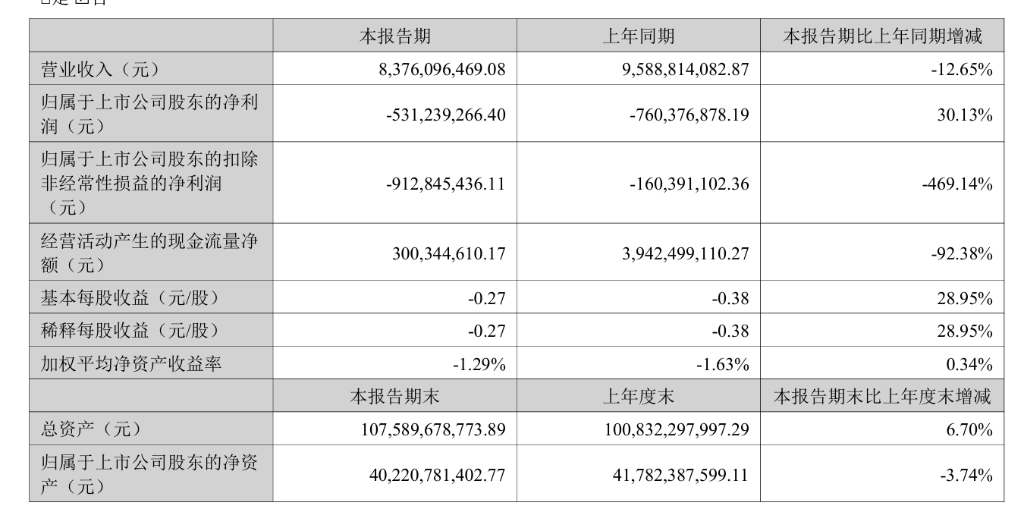
Core Viewpoint - Jiangxi Ganfeng Lithium Co., Ltd. held a performance briefing on August 22, attracting participation from 145 institutions, including Citigroup and Huaxi Securities, to discuss the company's operational performance and business progress for the first half of 2025 [1] Group 1: Financial Performance - In the first half of 2025, Ganfeng Lithium achieved operating revenue of 8.376 billion yuan, with a net profit attributable to shareholders of -531 million yuan, and operating cash flow of 300 million yuan [2] Group 2: Business Segment Progress - Upstream lithium resources: The Mariana lithium salt lake project in Argentina produced its first batch of lithium chloride; the Cauchari-Olaroz lithium salt lake project is operating smoothly and is expected to meet annual targets; the Goulamina spodumene project in Mali is in normal operation with shipments ongoing [3] - Lithium salt segment: The Sichuan Ganfeng lithium salt project completed production line debugging, steadily releasing capacity; the first phase of the Qinghai Ganfeng project is in trial production [3] - Lithium battery segment: The business structure has been optimized, significantly improving profitability; solid-state battery business has achieved integrated upstream and downstream layout with commercial capabilities [3] Group 3: Project Planning and Market Response - Mali project impact: Despite complex political situations, the Goulamina project has not faced direct disruptions, with security upgrades and local support being pursued [4] - Cost reduction and planning: Significant cost reduction effects from the Cauchari-Olaroz project; the Mt Marion lithium mine in Australia is expected to enhance yield and reduce costs through ore selection technology [4] - Solid-state battery capacity: The company is developing lithium sulfide and sulfide electrolyte materials, with lithium sulfide products already certified by customers [4]
国金证券:政策与市场双重驱动下 固态电池市场在新兴领域或迎需求爆发
智通财经网· 2025-08-23 12:25
Core Viewpoint - The solid-state battery industry is experiencing accelerated development, with technological breakthroughs and commercialization progressing simultaneously, particularly in semi-solid batteries achieving large-scale applications [1] Group 1: Solid-State Battery Development - The focus of all-solid-state batteries has shifted towards sulfide routes, which improve safety and energy density by replacing flammable organic electrolytes with non-flammable inorganic solid electrolytes [2] - Sulfide solid electrolytes exhibit high ionic conductivity and good mechanical properties at room temperature, indicating significant future potential, with plans for 3,000 vehicles equipped with sulfide solid-state batteries by 2027 [3] Group 2: Key Materials and Competition - Lithium sulfide is a core raw material for sulfide electrolytes, with purity being a critical parameter affecting production; the industry is currently in the engineering verification stage [4] - The competitive landscape for lithium sulfide is relatively favorable, with higher technical barriers compared to sulfide electrolytes, and costs are expected to decrease as production routes mature [4] Group 3: Market Potential and Policy Support - The solid-state battery industry is projected to transition from initial market development to a rapid growth phase by 2027, supported by a comprehensive policy framework [5] - By 2024, China's solid-state battery shipment is expected to reach approximately 7 GWh, with projections of 18 GWh by 2027 and 30 GWh by 2028, driven by demand in high-energy density and high-safety applications such as eVTOL and humanoid robots [5]

“最好的研发在客户车间”
Zheng Quan Shi Bao· 2025-08-22 18:59
Core Viewpoint - The breakthrough in solid-state battery technology by Chinese lithium battery companies, exemplified by Tianci Materials, represents a significant advancement in industrial innovation and upgrading in China [1][7]. Group 1: Challenges and Innovations - Solid-state batteries are seen as the next-generation power battery solution, but the core component, solid electrolyte, faces the "impossible triangle" of high ionic conductivity, interface compatibility, and electrochemical stability [2]. - Tianci Materials encountered significant challenges with interface impedance when solid electrolytes interacted with high-nickel cathodes, which adversely affected battery performance and lifespan [2]. - The company demonstrated a strong internal drive for innovation, motivated by the need to address industry pain points, leading to original innovations and a robust error-tolerance mechanism [2][3]. Group 2: Research and Development Strategies - Tianci Materials allocated independent budget pools for solid electrolyte research over three consecutive years, marking a historical commitment to this area [4]. - The company adopted a "racehorse" mechanism to evaluate competing technical routes, ultimately favoring the sulfide route based on superior performance metrics [4]. - The CEO emphasized the importance of maintaining a balance between openness and focus in innovation, which has become a consensus within the team [4]. Group 3: Market Dynamics and Collaborations - The demand for solid-state batteries is driven by emerging technologies such as AI devices, which require enhanced battery performance, creating significant market opportunities [6]. - Collaborative innovation has become a norm in the industry, with real-time data sharing between battery manufacturers and clients facilitating rapid problem-solving and iterative improvements [6]. - Tianci Materials and other leading companies are accelerating the industrialization of solid-state batteries, with various initiatives and partnerships underway to enhance their product offerings [5][6].


赣锋锂业上半年营收同比下降12.65%,净利润亏损收窄,锂电池营收增9.89% | 财报见闻
Hua Er Jie Jian Wen· 2025-08-22 13:48
Core Insights - Ganfeng Lithium's revenue for the first half of 2025 decreased by 12.65% year-on-year, with a net profit of -531 million yuan, showing a 30.13% improvement compared to the previous year [1][4] - The lithium compound business accounted for 56.78% of total revenue, down 27.16% year-on-year, primarily due to falling lithium prices [2][4] - The lithium battery business saw a revenue increase of 9.89% year-on-year, contributing to 35.52% of total revenue [2][4] Financial Performance - Total revenue for the reporting period was 8.38 billion yuan, compared to 9.59 billion yuan in the same period last year [1][4] - The net profit attributable to shareholders was -531 million yuan, an improvement from -760 million yuan year-on-year [1][4] - The net cash flow from operating activities decreased by 92.38% to 300 million yuan [1][4] Market Conditions - The global lithium salt industry faced significant adjustments, with lithium compound prices dropping from 850-900 USD/ton at the beginning of the year to 620-640 USD/ton by June, a decline of 25%-31% [2] - Despite these challenges, the company maintained a gross margin of 8.36% through technological upgrades and process optimization [2] Resource and Technology Developments - The company has over 60 million tons of lithium resources, with projects in Mali and Argentina ramping up production [3][5] - The solid-state battery technology has made significant advancements, with high energy density batteries ranging from 320-550 Wh/kg [6] - The company expects a resource self-sufficiency rate of over 50% by 2025, which is significantly higher than the industry average [3][5]
亿纬锂能H1实现营收281.7亿元,动力电池出货量同比增长58.58%
Ju Chao Zi Xun· 2025-08-22 08:58
Core Viewpoint - The company reported a significant increase in revenue but a decline in net profit, indicating challenges in profitability despite strong sales growth in the battery sector [3]. Financial Performance - Total revenue for the reporting period reached 28.17 billion yuan, a year-on-year increase of 30.06% [3]. - Net profit attributable to shareholders was 1.60 billion yuan, down 24.90% compared to the previous year [3]. - Net profit excluding non-recurring items was 1.16 billion yuan, a decrease of 22.82% year-on-year [3]. - Basic earnings per share were 0.78 yuan, a decline of 25.00% [3]. - Diluted earnings per share were 0.74 yuan, down 28.85% [3]. - The weighted average return on equity was 4.20%, a decrease of 1.77% from the previous year [3]. Operational Highlights - The company achieved a battery shipment of 21.48 GWh for power batteries, representing a year-on-year growth of 58.58% [1]. - Energy storage battery shipments reached 28.71 GWh, an increase of 37.02% year-on-year [1]. - The company has launched various product lines to cater to low-altitude economy, humanoid robots, and passenger vehicles [2]. Strategic Developments - The company is advancing its global manufacturing and delivery strategy, enhancing its international presence and local operations [4]. - The Malaysian battery production base is the first overseas facility to achieve mass production, covering a full range of consumer, power, and energy storage batteries [4]. - The successful launch of the Malaysian factory is expected to significantly enhance the company's overseas delivery capabilities and expand its influence in Southeast Asia, Europe, and North America [4].