新能源转型

Search documents
悦意双子星销量超16000辆,一汽奔腾交出新能源转型新答卷
Bei Jing Ri Bao Ke Hu Duan· 2025-07-14 06:33
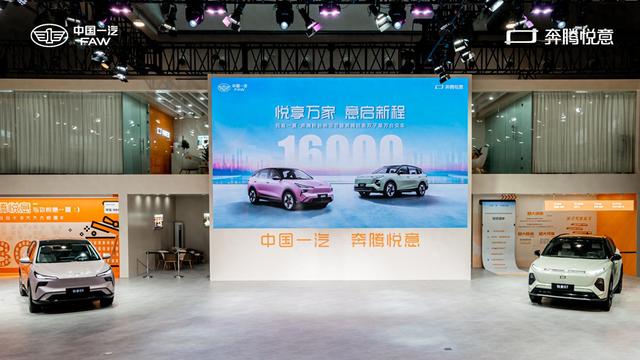
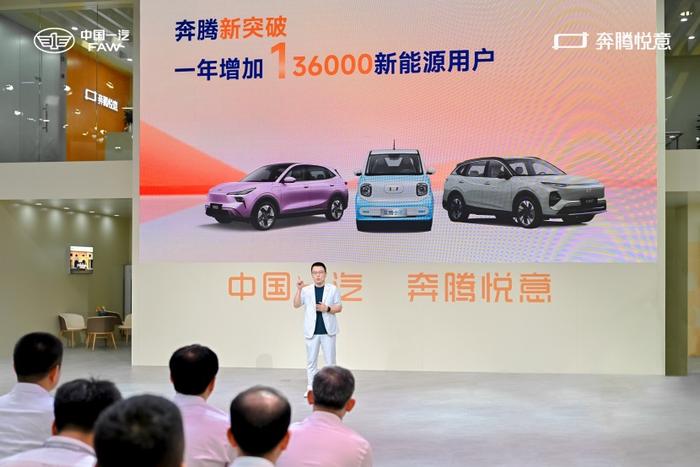
Core Insights - The event held on July 12 at the 22nd Changchun International Auto Expo marked a significant milestone for FAW Bestune, with the delivery of over 10,000 units of the Bestune Yuyue dual-star model, achieving sales exceeding 16,000 units [1][3] Group 1: Sales Performance - In the first half of 2025, FAW Bestune's sales increased by 43% year-on-year, with cumulative users surpassing 2 million, establishing a new level of brand trust [3] - The transition to new energy vehicles has resulted in 136,000 new users within a year, with the pure electric model Bestune Xiaoma achieving over 100,000 deliveries in its first year [3] - In June, the delivery volume of pure electric products reached 15,800 units, marking the brand's entry into the top ten in the industry, with a new energy penetration rate of 83% [3] Group 2: Product Highlights - The Bestune Yuyue series, launched in March, has gained traction, with the Yuyue 03 being favored by young families due to its 2,750 mm wheelbase, 445 km range, and lifetime warranty on the vehicle and three electric systems [5] - The Yuyue 07 has also attracted young families with its comprehensive range of 1,555 km and a 0-100 km/h acceleration time of 6.9 seconds, with over 16,000 units delivered within three months of launch [5] Group 3: Customer Engagement Initiatives - FAW Bestune launched a user service brand "Joy Pai," focusing on three core areas: "shared communication space, shared play area, and shared community," with 353 Yuyue centers covering 241 cities in China [7] - The service system aims to provide accessible and worry-free services to 80% of urban users, complemented by the "Yuyue Summer - Bestune Fan Cooling Festival," which includes free vehicle inspections and exclusive summer benefits [7]

【BCR交易策略】供需拉锯、美元波动,原油投资该如何布局?
Sou Hu Cai Jing· 2025-07-14 03:17
Core Viewpoint - The international oil market is characterized by high volatility as supply-demand dynamics and macroeconomic conditions intertwine, leading to uncertain oil price trends [2] Group 1: Geopolitical Risks and Supply Disruptions - Geopolitical risks remain a significant factor supporting oil prices, with ongoing tensions in the Middle East and unresolved Red Sea shipping security issues [3] - The situation in Ukraine continues to impact the global energy market, with Russian oil exports still constrained by sanctions, providing a solid price floor for crude oil [3] - OPEC+ has extended its production cuts until the first quarter of 2025 to address global demand slowdown and potential economic downturn, with Saudi Arabia and Russia maintaining a united front [3] Group 2: Macroeconomic and Demand Outlook - The uncertainty on the demand side is becoming more apparent, with the U.S. economy showing signs of slowing growth but not yet facing a hard landing [4] - The Federal Reserve has hinted at possible rate cuts, but its cautious stance on inflation limits the upside for oil demand [4] - China's crude oil imports remained high in the first half of the year, but economic recovery is slowing, leading to cautious optimism regarding future demand [4] Group 3: Dollar Fluctuations and Financial Attributes - The recent decline in the U.S. dollar index has indirectly supported oil prices, as a weaker dollar typically boosts commodity prices [5] - The financial attributes of crude oil are increasing, with hedge funds and asset managers raising their net long positions in oil futures, indicating a growing bullish sentiment [5] Group 4: Market Outlook - The oil market is expected to maintain a "volatile but strong" pattern in the short term, supported by controlled supply and unresolved geopolitical risks, while macroeconomic pressures and weak demand may limit further price increases [6]

中年男人最爱的车,破产了
36氪· 2025-07-13 23:52
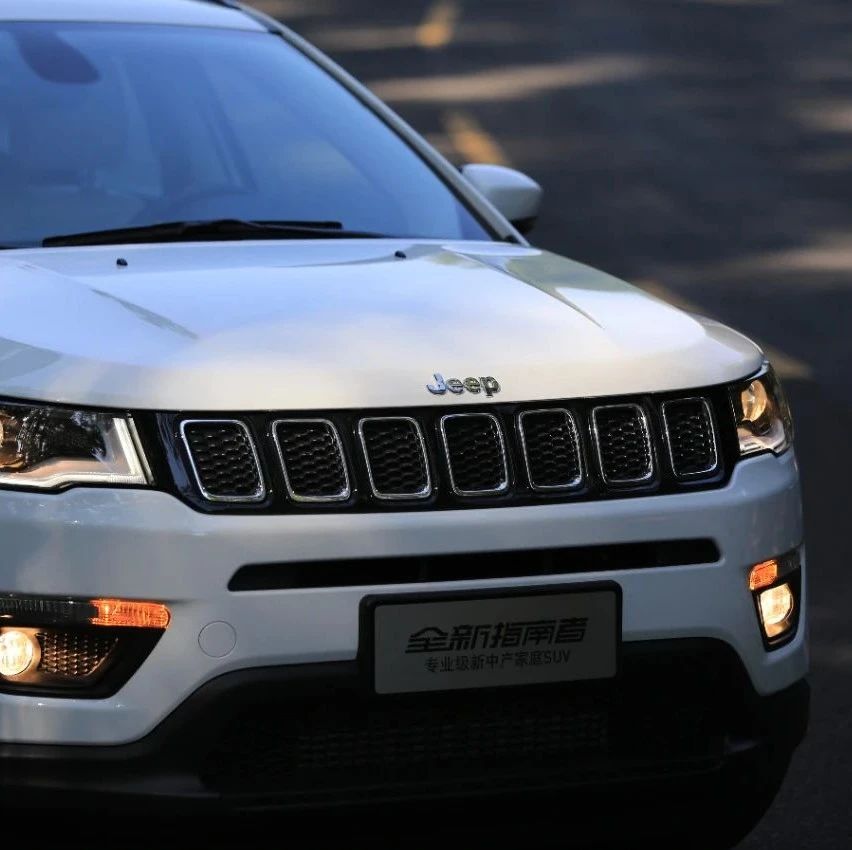
Core Viewpoint - The bankruptcy of GAC Fiat Chrysler (GAC FCA) serves as a warning for joint venture car manufacturers in China, highlighting the urgent need for transformation in response to declining market share and increasing competition from domestic brands [4][21]. Group 1: GAC FCA's Decline - GAC FCA, once a "joint venture dark horse" with annual sales of 220,000 vehicles, has seen a dramatic decline in sales since 2018, with figures dropping to just 1,861 vehicles in 2022 [3][8]. - The company faced multiple challenges, including slow product iteration, lack of electric vehicle strategy, and quality issues such as oil consumption problems, leading to a collapse in consumer trust [3][12]. - The joint venture's assets, including land and production facilities, failed to attract buyers during five public auctions, indicating a significant loss of value [7][12]. Group 2: Industry Context - The market share of joint venture brands in China has plummeted from 50% five years ago to 27.5% as of 2024, reflecting a broader trend of domestic brands gaining ground [4][18]. - Other joint venture companies, such as GAC Mitsubishi and various French and Korean brands, are also experiencing significant challenges, including production halts and declining market presence [17][18]. - The rapid rise of domestic electric vehicle manufacturers has further exacerbated the challenges faced by joint ventures, which have been slow to adapt to the electric and smart vehicle trends [18][19]. Group 3: Strategic Shifts Needed - Joint venture car manufacturers must enhance their local R&D capabilities to better meet the evolving demands of Chinese consumers, moving away from a reliance on foreign headquarters for product development [19][20]. - Companies are beginning to decentralize decision-making to local teams, allowing for quicker responses to market changes and consumer preferences [19][20]. - Collaborations with local tech firms are becoming essential for joint ventures to bridge technological gaps and improve competitiveness in the rapidly changing automotive landscape [20].
中报季“业绩风暴”来袭:广汽集团首亏、华夏幸福巨亏,工业富联“狂赚”百亿成焦点
Jin Rong Jie· 2025-07-13 23:44
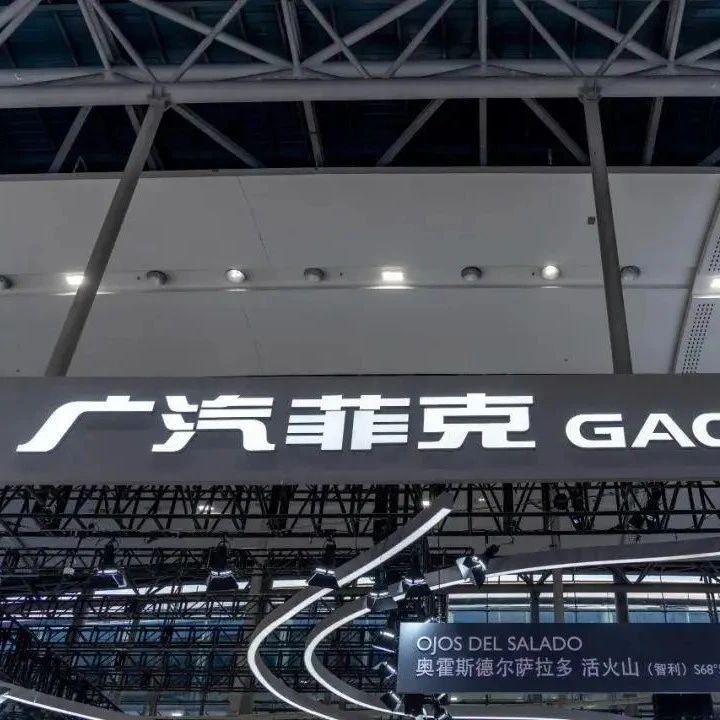
Group 1: Market Overview - The A-share market is experiencing significant stock price fluctuations driven by earnings forecasts as the mid-year reporting season approaches [1][2] - As of July 13, 486 listed companies have disclosed mid-year earnings forecasts, with 283 companies expecting positive results, accounting for 58% [1] Group 2: Automotive Industry Performance - GAC Group has projected a loss of 1.82 billion to 2.6 billion yuan for the first half of 2025, marking its first-ever half-year loss since listing [2] - The company's struggles are attributed to disappointing sales of new energy vehicles and intense price competition in traditional fuel vehicles [2] - In contrast, Seres, closely linked with Huawei, expects a net profit of 2.7 billion to 3.2 billion yuan for the same period, representing a year-on-year increase of 66.2% to 96.98% [2] Group 3: Real Estate Sector Challenges - China Fortune Land Development is expected to report a pre-loss of 7.5 billion yuan, exacerbating concerns among its 190,000 shareholders [2] - The company has already reported a loss of 4.849 billion yuan for the first half of 2024, with further losses anticipated in 2025 [2] Group 4: Other Notable Losses - TCL Zhonghuan is projected to report a pre-loss of 4 billion to 4.5 billion yuan, primarily due to a significant drop in gross margins amid industry price wars [3] - Other companies facing substantial losses include Tianshan Shares, Sinochem International, and Meijin Energy, all of which are in cyclical industries affected by overcapacity and price declines [3] Group 5: Profit Leaders - Industrial Fulian is expected to achieve a net profit of up to 12.158 billion yuan, benefiting from a surge in AI server demand [3] - Muyuan Foods anticipates a net profit of up to 10.7 billion yuan, indicating a recovery in the pig farming sector after two years of downturn [3] - WuXi AppTec, CRRC, and Luxshare Precision also reported strong earnings forecasts, showcasing resilience in the consumer electronics sector [3] Group 6: Investment Focus - Analysts suggest focusing on sectors with upward trends, including upstream industrial metals, wind power, and innovative pharmaceuticals [5] - Key investment themes include high-demand areas such as AI, consumer electronics, and supply-side adjustments in industries like lithium batteries [5] Group 7: Market Sentiment and Strategy - Historical data indicates that stocks with positive earnings forecasts tend to rise by an average of 3.2% in the five trading days following the announcement, while those with negative forecasts decline by 2.7% [6] - Investors are advised to consider the sustainability of earnings, industry conditions, and company competitiveness when making investment decisions [6]



中年男人最爱的车,破产了
凤凰网财经· 2025-07-13 12:43
Core Viewpoint - The bankruptcy of GAC Fiat Chrysler (GAC FCA) highlights the challenges faced by joint venture car manufacturers in China, emphasizing the need for adaptation to local market demands and the rapid evolution of the automotive industry [2][3][4]. Group 1: Bankruptcy Announcement - GAC FCA has been declared bankrupt by the Changsha Intermediate People's Court due to the lack of restructuring possibilities, following multiple failed asset auctions [4][5]. - The company, once a "joint venture dark horse" with annual sales of 220,000 vehicles, has seen a dramatic decline in performance since 2018, leading to its eventual bankruptcy [2][6]. Group 2: Sales Decline and Market Challenges - GAC FCA's sales plummeted from 125,200 vehicles in 2018 to just 1,861 vehicles in 2022, reflecting a nearly halved performance each year [6][12]. - The joint venture's struggles are indicative of a broader trend among joint venture car manufacturers, with market share for these brands dropping from 50% five years ago to 27.5% [3][14]. Group 3: Factors Contributing to Decline - Key issues include slow product iteration, lack of electric vehicle (EV) strategy, and failure to adapt to local consumer preferences, leading to a loss of consumer trust [2][10][12]. - GAC FCA's inability to keep pace with the rapid development of domestic brands and the shift towards electric and smart vehicles has further exacerbated its decline [10][14]. Group 4: Industry Implications - The bankruptcy serves as a warning for other joint venture car manufacturers, emphasizing the urgent need for transformation and local market responsiveness [3][14]. - The overall automotive market in China is increasingly competitive, with domestic brands rapidly gaining market share through innovation and better alignment with consumer needs [14][15]. Group 5: Future Directions for Joint Ventures - Joint venture car manufacturers are recognizing the necessity to enhance local R&D capabilities and adapt to the fast-changing market landscape [15][16]. - There is a shift from a model of importing global vehicles to developing products tailored for the Chinese market, with an emphasis on collaboration with local tech companies [16][17].
多产品矩阵“开花结果” 一汽奔腾全面转型新能源品牌
Zhong Guo Jing Ying Bao· 2025-07-13 09:38
Core Insights - The delivery ceremony for the "Twin Stars" models of FAW Bestune, namely the Bestune Yuyi 03 and Yuyi 07, took place at the 22nd Changchun International Auto Expo, with total sales exceeding 16,000 units as of now [2] - FAW Bestune has successfully launched several key products in its transition to new energy vehicles since 2024, including the popular Bestune Xiaoma and the Yuyi series [2] - The Bestune Yuyi 03 is a large-sized pure electric SUV with significant advantages in space, range, and manufacturing quality, featuring a wheelbase of 2750mm and a range of 445km [2] - The Bestune Yuyi 07 is a super-large plug-in hybrid SUV with a pure electric range of 210km and a comprehensive range of 1555km, designed for both urban commuting and long-distance travel [3] - FAW Bestune's new energy vehicle sales reached 87,500 units in the first half of 2025, with 72,500 units being new energy models, marking a nearly threefold year-on-year increase and an 83% penetration rate for new energy vehicles [3] - The company achieved a historical high in sales volume and new energy growth rate, with 15,800 pure electric vehicles delivered by June 2025, entering the top ten in the industry [3]
风云独立,星途入列,奇瑞IPO前夕架构“大调整”
Hua Xia Shi Bao· 2025-07-11 22:43
Core Viewpoint - Chery is undergoing significant organizational changes as it approaches its IPO, including the establishment of a domestic business group and the elevation of the Fengyun series to an independent brand, aimed at enhancing strategic focus and resource integration [1][2][6]. Group 1: Organizational Changes - Chery has formed a domestic business group under the Chery brand, which includes four divisions: Starway, Aihou (Aiyre and Ruichu), Fengyun, and QQ [2][6]. - The Starway brand remains positioned as Chery's high-end brand despite being integrated into the Chery brand domestic business group [2][6]. - The Fengyun series has been upgraded from a product line to an independent brand, reflecting its historical significance and the company's commitment to innovation and user demands [3][4][6]. Group 2: Sales and Market Performance - Starway's sales have grown significantly from under 20,000 units in its founding year to 126,000 units in 2023, with a projected 141,000 units in 2024 [3][8]. - In the first half of 2023, Starway achieved cumulative sales of 63,000 units, marking a year-on-year increase of 15.1% [3][8]. - Chery's overall sales for 2024 are expected to reach approximately 2.6039 million units, representing a year-on-year growth of 38.4% [8]. Group 3: Market Response and Financial Outlook - Following the organizational adjustments, some brokerages have raised their IPO pricing for Chery by 12%, indicating positive market sentiment [5][8]. - Chery's revenue for 2022 and 2023 was reported at 92.618 billion yuan and 163.205 billion yuan, respectively, with a significant increase in revenue for the first three quarters of 2024 [8]. - The company's net profit attributable to shareholders for the same periods was 6.266 billion yuan, 11.953 billion yuan, and 11.222 billion yuan [8].
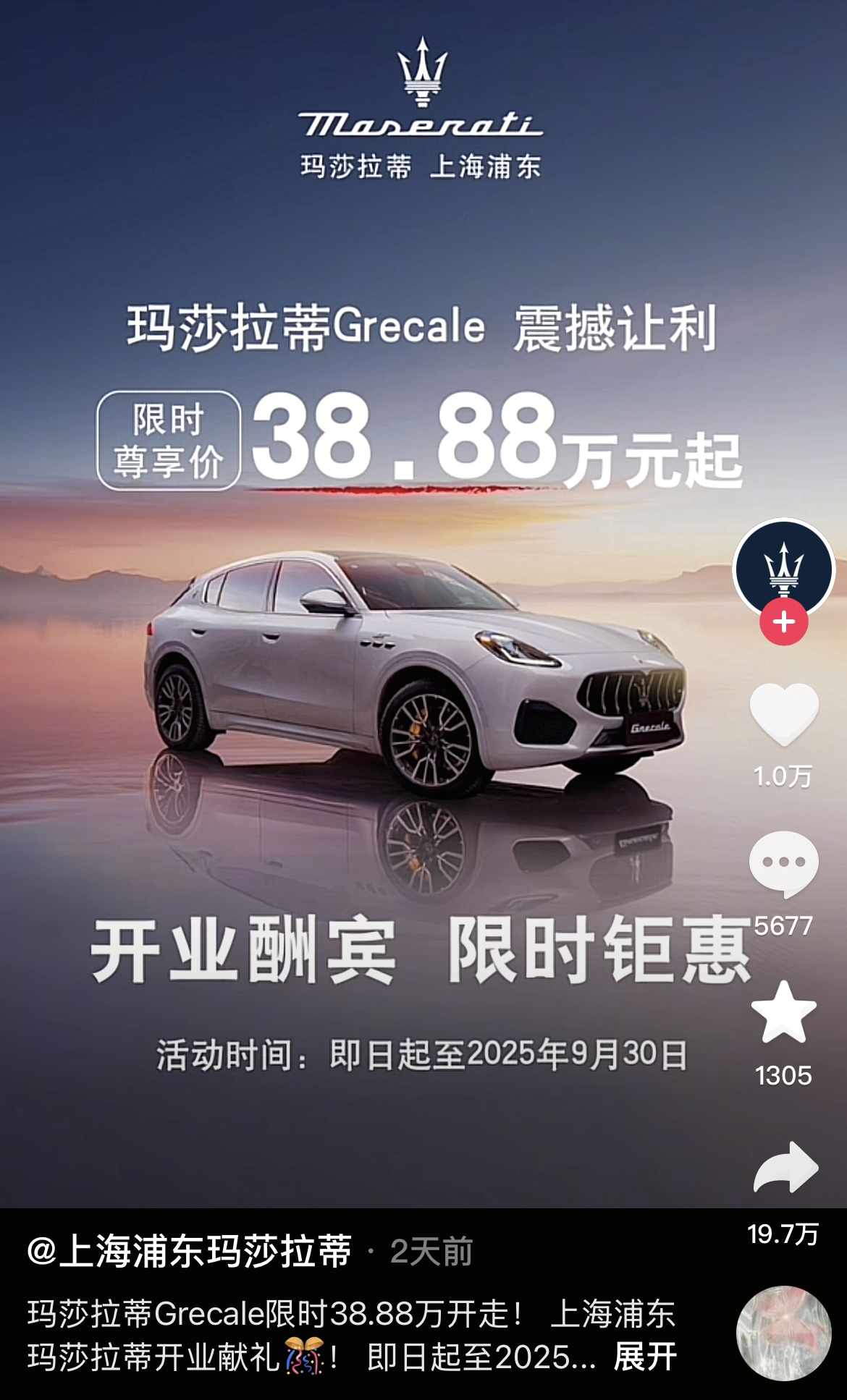
价格降幅超40%,玛莎拉蒂Grecale限时价38.88万元起引发热议
Cai Jing Wang· 2025-07-11 08:21
Core Viewpoint - Maserati is experiencing significant price reductions for its Grecale SUV model in China, reflecting broader challenges in the luxury automotive market due to changing consumer preferences and increased competition [1][4][5]. Group 1: Price Reduction and Sales Impact - Maserati's Grecale SUV is being offered at a promotional price of 388,800 yuan, a reduction of 262,000 yuan (over 40%) from the official starting price of 650,800 yuan [1]. - The promotional pricing is attributed to a drastic decline in sales, with the dealership reporting over 10 units sold within two days of the promotion [5]. - Maserati's sales in China have plummeted, with a forecasted total of 1,228 units for 2024, representing a 71% year-on-year decline [6]. Group 2: Market Dynamics and Competition - The decline in Maserati's sales is linked to several factors, including the rise of domestic electric vehicle brands and a slow transition to electric models by traditional luxury brands [4][6]. - The overall luxury car market in China is facing challenges, with a reported 33% drop in imported car sales in the first five months of 2025 [7]. - Maserati's performance is part of a broader trend affecting traditional luxury brands, as evidenced by declining sales figures across competitors like Bentley, Rolls-Royce, and Ferrari [10][12]. Group 3: Consumer Behavior and Market Trends - Changing consumer perceptions, particularly among younger buyers, are leading to a decreased willingness to pay a premium for luxury brands like Maserati [12]. - The luxury automotive market is undergoing structural changes, with a shift in demand towards electric vehicles and a growing preference for domestic brands [12].
解密“新质”潍柴
Jing Ji Ri Bao· 2025-07-10 22:18
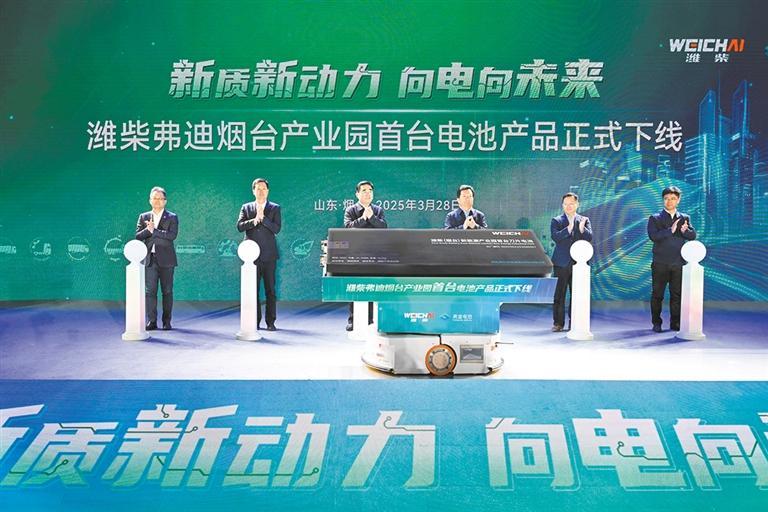
Core Viewpoint - Weichai Group is undergoing significant transformations in both digitalization and new energy sectors, positioning itself to lead in the evolving automotive and equipment manufacturing industries [5][14]. Digital Transformation - Weichai Group has implemented a comprehensive digital transformation strategy, establishing a smart factory that automates key processes, achieving an 80% automation rate in assembly and full automation in logistics [7][10]. - The company has significantly increased its industrial robot density from 390 to 1560 per 10,000 workers over four years, reflecting its commitment to flexible and intelligent production [7][10]. - A dedicated committee for digital transformation has been established, focusing on integrating AI technologies into its operations, enhancing efficiency and reducing costs [8][9]. New Energy Development - The new energy vehicle market is rapidly expanding, with a reported 28.9% year-on-year growth in sales for 2024, and Weichai is strategically positioned to capitalize on this trend [11]. - Weichai has developed a comprehensive range of new energy products, including over 100 battery models and 30 electric motor models, covering various applications from heavy trucks to construction machinery [12][13]. - The company has also made significant advancements in alternative fuels, launching a methanol-powered excavator and achieving a thermal efficiency breakthrough in natural gas engines [13]. Industry Impact - Weichai's dual transformation in digitalization and new energy is not isolated but interconnected, driving a holistic upgrade of the equipment manufacturing industry [14][17]. - The company has established itself as a "chain leader" in the industry, coordinating with over 3,000 suppliers to enhance their capabilities and pushing for smart upgrades across the supply chain [16][17]. - Weichai's initiatives have positioned it to dominate the domestic engine market, contributing significantly to the national power equipment industry's output [17].
7月已达40亿!华电国际:资产重组,密集发债
Da Zhong Ri Bao· 2025-07-10 06:51
Group 1 - The core viewpoint is that Huadian International is facing challenges in its transition to renewable energy while actively engaging in asset restructuring and issuing bonds to manage its financial obligations [1][2][3] Group 2 - On July 9, Huadian International announced the completion of the issuance of its 2025 ninth phase medium-term notes, raising 2 billion yuan with a maturity of 3+N years and a coupon rate of 1.89% [1] - On July 8, the company completed the issuance of its 2025 third phase short-term financing bonds, also raising 2 billion yuan with a maturity of 85 days and a coupon rate of 1.64% [1] - On July 2, Huadian International announced the completion of the issuance of its 2025 eighth phase medium-term notes, raising 1 billion yuan with a maturity of 3+N years and a coupon rate of 1.95% [1] Group 3 - The annual general meeting held on June 17 approved the issuance of financing instruments up to an equivalent of 80 billion yuan, including short-term financing bonds, medium-term notes, and perpetual bonds, based on the company's funding needs [2] Group 4 - Following the completion of asset restructuring, Huadian International is expected to achieve a breakthrough in regions such as Jiangsu, Shanghai, and Guangxi, enhancing its installed capacity and market share [3]