
6G

Search documents
超4200股上涨
Di Yi Cai Jing Zi Xun· 2025-11-24 07:32
Market Overview - A-shares saw collective gains across the three major indices, with the Shanghai Composite Index up 0.05%, the Shenzhen Component Index up 0.37%, and the ChiNext Index up 0.31% [2][3] Sector Performance - The military, satellite navigation, low-altitude economy, AI applications, cloud computing, 6G, and e-commerce sectors showed active performance, while the lithium battery industry chain experienced a pullback, particularly in lithium mining stocks [3] - The military sector saw significant gains, with over 10 stocks hitting the daily limit up, including Jianglong Shipbuilding, Jiuzhiyang, China Shipbuilding Defense, and Guoji Precision [3][4] Stock Highlights - Notable gainers included Jiuzhiyang (+20.00%), Pingao Co. (+19.99%), and Jianglong Shipbuilding (+19.98%) [4] - The total trading volume in the Shanghai and Shenzhen markets was 1.73 trillion yuan, a decrease of 237.9 billion yuan from the previous trading day, with over 4,200 stocks rising [3] Capital Flow - Main capital inflows were observed in the media, aerospace, and automotive sectors, with net inflows into stocks like BlueFocus, 360, and Changcheng Military Industry [6] - Conversely, significant net outflows were noted in stocks such as Industrial Fulian, New Yisheng, and Zhongji Xuchuang [7] Institutional Insights - Huatai Securities indicated that the current market adjustment has begun to show signs of support, with expectations of improved overseas liquidity and reduced domestic funding pressure [8] - Galaxy Securities highlighted structural strengths in emerging industries amid economic transformation, with a narrowing decline in PPI potentially boosting corporate profit margins [8] - Xing Shi Investment noted that historical bull markets often experience pullbacks, attributing the current market adjustment primarily to valuation corrections, while maintaining a "slow bull" outlook for the A-share market [8]






A股午后拉升尾盘跳水,三大股指收涨:军工领涨,4228股收红
Sou Hu Cai Jing· 2025-11-24 07:29
A股三大股指11月24日集体高开。盘初快速下挫后,三大股指早盘震荡下行转跌。午后反转,三大股指直线拉升转涨,但尾盘出现了跳水。 社会服务涨幅居前,君亭酒店(301073)、实朴检测(301228)、中国高科(600730)、国脉科技(002093)等涨停或涨超10%,创业黑马 (300688)、豆神教育(300010)、安车检测(300572)等涨超4%。 石油石化高开低走领跌两市,和顺石油(603353)跌超5%,中国海油(600938)、中国石油(601857)、荣盛石化(002493)、中国石化 (600028)等跌超2%。 煤炭股跌幅靠前,安泰集团(600408)、美锦能源(000723)、晋控煤业(601001)等跌超2%,大有能源(600403)、中国神华(601088)等跌 超1%。 从盘面上看,军工、卫星导航、低空经济、AI应用、云计算、6G、电商概念股表现活跃;锂电池产业链再度回调,锂矿方向领跌;海南本地股走 弱。 至收盘,上证综指涨0.05%,报3836.77点;科创50指数涨0.84%,报1296.6点;深证成指涨0.37%,报12585.08点;创业板指涨0.31%,报2929.04 ...
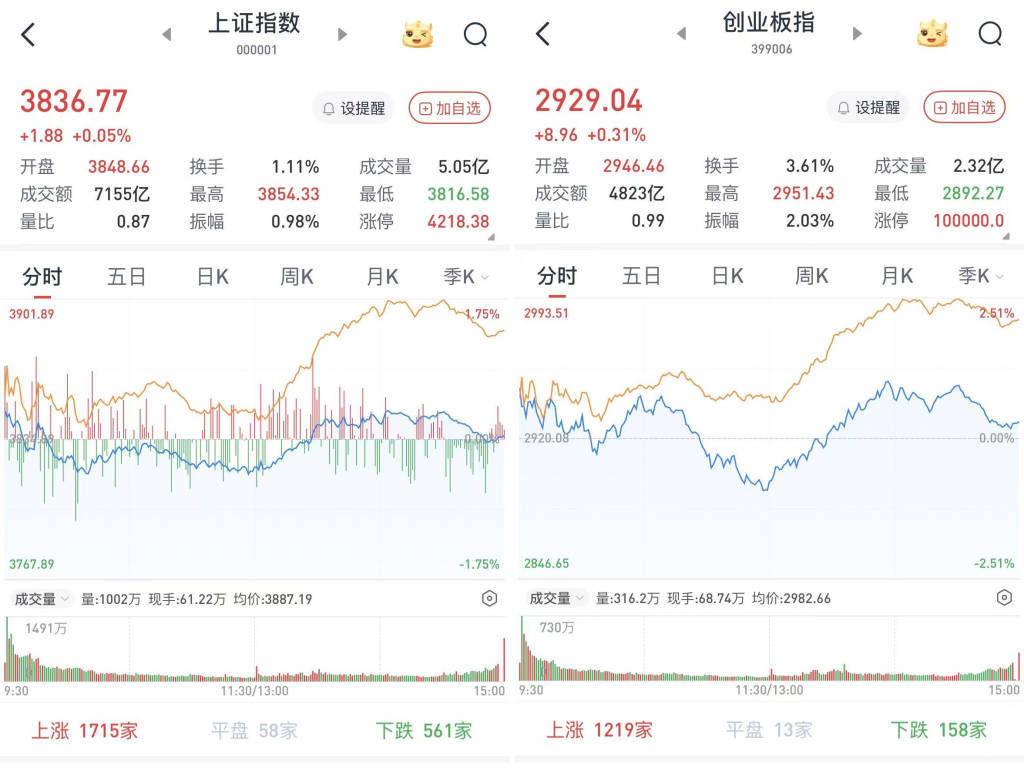
超4200股上涨
第一财经· 2025-11-24 07:24
Market Overview - A-shares saw collective gains across the three major indices, with the Shanghai Composite Index up 0.05%, Shenzhen Component Index up 0.37%, and ChiNext Index up 0.31% [3][4]. - The total trading volume in the Shanghai and Shenzhen markets was 1.73 trillion, a decrease of 237.9 billion from the previous trading day [8]. Sector Performance - The military industry sector experienced a significant surge, with over 10 stocks hitting the daily limit, including Jianglong Shipbuilding and Jiuzhiyang [5]. - Lithium mining stocks continued to adjust, with Shengxin Lithium Energy hitting the daily limit down, and other companies like Jinyuan Co. and Ganfeng Lithium also seeing notable declines [6]. Capital Flow - Main capital inflows were observed in sectors such as media, aerospace, and automotive, while semiconductor, electronics, and securities sectors experienced net outflows [9]. - Specific stocks that attracted net inflows included BlueFocus, 360, and Great Wall Military Industry, with inflows of 1.317 billion, 1 billion, and 842 million respectively [9]. Analyst Insights - Huatai Securities noted that the current market adjustment has begun to show signs of support, with expectations of improved overseas liquidity and reduced domestic funding pressure, leading to a healthier market environment [9]. - Galaxy Securities highlighted that structural highlights in emerging industries are becoming more prominent, with narrowing PPI declines expected to boost corporate profit margins, supporting a positive trend for A-shares [9]. - Xing Shi Investment pointed out that historical bull markets often experience corrections, attributing the current market pullback primarily to valuation adjustments, while anticipating a shift towards fundamental drivers as the market enters an earnings realization phase [10].




收盘丨A三大指数小幅上涨,军工板块掀涨停潮
Di Yi Cai Jing· 2025-11-24 07:13
| 代码 | 名称 | 涨幅量 | 现价 | | --- | --- | --- | --- | | 300516 | 久之洋 | +20.00% | 58.32 | | 688227 | 品高股份 | +19.99% | 58.82 | | 300288 | 江龙船艇 | +19.98% | 26.90 | | 300681 | 晨曦航空 | +14.13% | 20.68 | | 300008 | 天海防务 | +13.13% | 9.22 | | 301327 | 北方长龙 | +12.42% | 17.68 | | 301286 | 侨源股份 | +11.97% | 36.30 | | 688243 | 国科军工 | +11.60% | 58.99 | | 300269 | 联建光电 | +10.88% | 5.81 | | 000070 | 特发信息 | +10.05% | 11.50 | | 200822 | 航大长峰 | +10.03% | 16.68 | | 002413 | 雷科防务 | +10.02% | 6.37 | | 600764 | 中国海防 | +10.02% | 33.61 | ...

武汉高科集团联合中国信科集团发起设立产业基金,总规模50亿元
Jing Ji Guan Cha Wang· 2025-11-24 05:42
Core Viewpoint - The 2025 China 5G + Industrial Internet Conference in Wuhan highlighted the establishment of the Xinke Industrial Investment Fund, initiated by Wuhan High-tech State-owned Holding Group Co., Ltd. [2] Group 1: Fund Establishment - The Xinke Industrial Fund is co-founded by Wuhan High-tech Group, China Information Communication Technology Group, Hubei Railway Fund, and Wuhan Fund [2] - The fund aims to leverage the resources of six listed companies under China Information Communication Technology Group and integrate central enterprise advantages with local capital efficiency [2] Group 2: Investment Focus - The fund will focus on the construction of integrated communication networks across air, land, and sea [2] - It will target six core industrial sectors of China Information Communication Technology Group: optical communication, mobile communication, optoelectronics and integrated circuits, cybersecurity and special communication, intelligent applications, and data communication [2] - The fund will also explore advanced fields such as artificial intelligence, satellite internet, quantum communication, and sixth-generation mobile communication (6G) [2] Group 3: Fund Scale and Impact - The total scale of the Xinke Industrial Investment Fund is set at 5 billion yuan [2] - This fund is expected to enhance central-local collaboration and promote high-quality industrial development in Wuhan [2]

US tech majors Apple, Amazon, Cisco, Meta jointly oppose Reliance Jio and VI’s demand on 6 GHz band spectrum
BusinessLine· 2025-11-24 05:34
Core Viewpoint - US tech giants, including Apple, Amazon, Cisco, Meta, HP, and Intel, oppose the allocation of the 6 GHz band for mobile services, advocating instead for its use for Wi-Fi services [1][2]. Group 1: Spectrum Allocation and Auction - The US technology companies argue that the technical and commercial readiness for mobile services in the 6 GHz band is not established [2]. - The government has indicated that 400 MHz of frequencies in the 6 GHz band are available for auction, with 300 MHz expected to be available by 2030 and 500 MHz to be delicensed for low power applications, primarily Wi-Fi [5][6]. - Reliance Jio has requested that the entire 1200 MHz spectrum in the 6 GHz band be included in the upcoming auction, despite the government's decision to delicence 500 MHz for low power applications [5][6]. Group 2: Industry Responses and Concerns - Airtel has also requested a deferment of the 6 GHz band auction due to ecosystem readiness challenges, including device availability and network equipment [7]. - Qualcomm supports the deferment, emphasizing the importance of aligning with global standards and safeguarding India's 6G future [8]. - The Cellular Operators Association of India (COAI) opposes the delicensing of the 6 GHz band, arguing that it undermines quality of service and scalability for digital applications [9][10]. Group 3: Implications of Delicensing - COAI warns that delicensing any part of the 6 GHz band could permanently limit its use for licensed mobile broadband services, affecting India's long-term digital capacity [10]. - Concerns are raised that unlicensed Wi-Fi deployments by global OTT players could disadvantage local telecom operators and reduce government revenues [11].


华西证券:卫星物联网开启商用试验 AI市场情绪反复
智通财经网· 2025-11-24 03:59
Group 1: TMT Industry Insights - The current market faces multiple uncertainties, leading to a cautious and neutral allocation recommendation for the TMT sector, including telecommunications [1] - The long-term outlook for the TMT industry is positive, driven by trends in 6G, domestic substitution, self-control, and military applications, which are expected to catalyze market opportunities in computing power leasing, satellite communication, and 6G [1] Group 2: Satellite IoT Commercialization - The Ministry of Industry and Information Technology officially launched a two-year commercial trial for satellite IoT services, marking a significant step in China's satellite internet commercial operations [1] - The issuance of satellite internet licenses is anticipated to accelerate the entire industry chain towards large-scale development, with rapid advancements in satellite communication capabilities [1] Group 3: AI Market Dynamics - The AI market is currently experiencing volatility due to uncertainties surrounding application scenarios and geopolitical policies affecting AI chip usage in China [2] - Despite short-term uncertainties, the domestic AI chip localization process is seen as an inevitable trend, with a favorable environment for the development of domestic chips [2] - Companies involved in advanced manufacturing processes and chip architecture upgrades are expected to benefit, including firms like Cambricon and SMIC [2] Group 4: Beneficiary Companies - Beneficiary companies in the AI sector include those involved in computing power expansion, such as ZTE, Unisoc, and various optical device manufacturers [2] - Specific companies mentioned as beneficiaries include: - For switches: ZTE, Unisoc, Shengke Communication, Ruijie Networks - For optical devices: LightSpeed Technology, Huagong Technology, and others [2]

A股三大股指集体高开,A500ETF嘉实(159351)均衡布局各行业优质核心资产
Xin Lang Cai Jing· 2025-11-24 02:35
Group 1 - A-shares opened higher on November 24, 2025, with active sectors including 6G, optical communication, AI applications, BC batteries, and computing hardware [1] - The A500 index fell by 0.09% as component stocks showed mixed performance, with GAC Group hitting the 10% limit up, Zhangjiang Hi-Tech rising by 7.30%, and Guangqi Technology increasing by 4.94% [1] - Recent adjustments in the A-share technology sector were influenced by high volatility in the US AI sector and discussions around an "AI bubble," leading to downward pressure on major indices [1] Group 2 - According to Huatai Securities, recent market fluctuations are attributed to external disturbances, with the current market adjustment showing initial signs of support around the mid-September market center [1] - The top ten weighted stocks in the CSI A500 index include CATL, Kweichow Moutai, China Ping An, and others, accounting for 19.36% of the index [2] - A500 ETF by Harvest closely tracks the CSI A500 index, providing balanced exposure to quality core assets across various industries [2]



滚动更新丨A股三大指数集体高开 创业板指涨近1%领跑
Di Yi Cai Jing Zi Xun· 2025-11-24 01:44
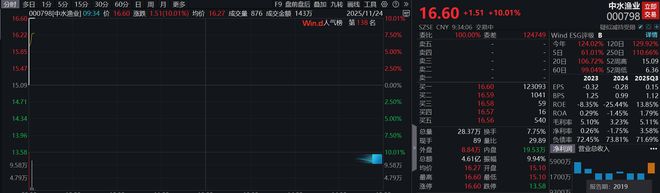
Group 1 - Hainan sector shows active trading with companies like Jingliang Holdings and Hainan Haiyao experiencing significant price increases [1] - Zhongshui Fisheries hits a limit up, marking its seventh consecutive trading day of gains [1] Group 2 - Solid-state battery concept stocks are active, with GAC Group hitting a limit up and companies like Funeng Technology and Liyuanheng also seeing gains [2] - The first large-capacity solid-state battery production line has been established by GAC Group, which is now in small-batch testing production [2] Group 3 - Lithium mining stocks continue to adjust, with companies like Guocheng Mining and Dazhong Mining hitting their daily limit down [3] - Other lithium-related companies such as Jinyuan Co. and Rongjie Co. also experience significant declines [3] Group 4 - A-shares open higher, with the Shanghai Composite Index up 0.36%, the Shenzhen Component Index up 0.53%, and the ChiNext Index up 0.90% [4] Group 5 - The Hong Kong stock market opens higher, with the Hang Seng Index up 0.92% and the Hang Seng Tech Index up 1.13%, driven by rebounds in tech and new energy vehicle stocks [6] Group 6 - The central bank conducts a 338.7 billion yuan reverse repurchase operation with a rate of 1.40%, while 283 billion yuan of reverse repos are set to mature today [7]



11月24日热门路演速递 | AI是泡沫还是机遇?美联储何时转向?地产风险如何演进?
Wind万得· 2025-11-24 00:54
Group 1 - The article discusses the potential AI bubble and the implications for the Federal Reserve's interest rate policies, highlighting the uncertainty surrounding rate cuts [2] - It examines the evolution of the real estate market, particularly the direct supply of housing by banks, and its impact on the sector [2] - The article also reflects on the implications of large banks merging with smaller banks, providing insights into the banking sector's future [2] Group 2 - The macroeconomic outlook suggests a stable global economy with a continued cycle of interest rate cuts by the Federal Reserve, emphasizing the shift towards "big fiscal" policies in major economies [5] - It indicates that while China's economy faces short-term pressures, the long-term outlook remains positive, with expectations of a slow bull market in Chinese stocks and a cautious approach to the bond market [5] - The article predicts a long-term upward trend in commodity prices, particularly in the context of a weakening US dollar [5] Group 3 - The discussion on precious metals highlights the fluctuating expectations for Federal Reserve rate cuts and the potential turning point for cyclical demand in gold and silver [7] - It also addresses the structural opportunities in the precious metals market arising from the macroeconomic reordering [7] Group 4 - The focus on AI and large models reveals investment opportunities within the internet and data center industries, emphasizing the growth potential in these sectors [9] - The article identifies five key questions for investors regarding the development trends in AI [9] Group 5 - The report on the technology sector indicates that the AI industry revolution is driving high growth in demand for computing power and hardware, alongside accelerating commercialization in application sectors [11] - It highlights critical growth directions such as 6G, quantum technology, and domestic semiconductor production [11]

