
现代化产业体系

Search documents
做好“海”的文章 国家开发银行以金融之力护航青岛高质量发展
Jin Rong Shi Bao· 2025-12-30 02:03
Group 1: Infrastructure Development - The Qingdao Jiaozhou Bay Second Undersea Tunnel is a major infrastructure project, measuring 17.48 kilometers, and is currently the largest and longest of its kind in the world, with a construction challenge that includes complex geological conditions [1][2] - The project aims to enhance traffic efficiency and reduce costs between Qingdao's urban area and Huangdao District, addressing the saturation of existing transportation links [2] - The China Development Bank (CDB) has provided significant financial support, including a customized financing plan and a total of 20.32 billion yuan in loans to facilitate the project's progress [2] Group 2: Marine Economy - The development of a modern marine fishery industry park is underway, focusing on the Atlantic salmon, which requires a land-sea relay model for successful cultivation [3] - The park aims to create a comprehensive industrial chain that includes research, breeding, farming, processing, and support services, leveraging digital management and automation [3][4] - CDB has provided 90 million yuan in new policy financial tools to support the project, addressing the capital needs of enterprises [4][5] Group 3: Cultural and Historical Preservation - Qingdao is focusing on the transformation and upgrading of its old port and city areas to protect historical culture while promoting urban development [6][7] - The Qingdao International Cruise Port area is being developed to connect new and old urban areas, enhancing the integration of cultural heritage and modern infrastructure [7] - CDB has issued loans totaling 3.1 billion yuan and 60 million yuan in new policy financial tools to support the transformation of the old port area into a modern cultural tourism hub [7][8] Group 4: Water Resource Management - The newly completed Gonglu Reservoir, with a total capacity of 2.11 billion cubic meters, is crucial for addressing Qingdao's water scarcity issues [9][10] - The reservoir will not only secure water supply but also improve the balance between urban and agricultural water use, contributing to food security and ecological sustainability [9] - CDB has provided 3.28 billion yuan in medium- and long-term loans and 915 million yuan from the infrastructure investment fund to support the reservoir's construction [10] Group 5: Future Development Plans - The CDB plans to continue supporting Qingdao's development by focusing on building a modern industrial system and enhancing marine economic capabilities [11] - The bank aims to contribute to the construction of an innovative industrial system and support key areas such as technological innovation, advanced manufacturing, and ecological protection [11]
上海市政府与国家电投集团在沪签署战略合作协议 陈吉宁龚正会见刘明胜徐树彪一行 实现央地优势互补、互利共赢
Jie Fang Ri Bao· 2025-12-30 01:53
Group 1 - The Shanghai Municipal Government and State Power Investment Corporation signed a strategic cooperation agreement to enhance collaboration in various energy sectors [1][2] - The agreement aims to leverage Shanghai's comprehensive advantages and State Power Investment's professional strengths, focusing on nuclear energy, gas turbines, power supply security, clean transformation of thermal power, green energy development, and international expansion [2] - The partnership is expected to accelerate the construction of a world-class clean energy enterprise and support Shanghai in building a modern industrial system and becoming a globally influential socialist modern international metropolis [2] Group 2 - The signing ceremony also included a memorandum of understanding between the Oriental Hub International Business Cooperation Zone Management Bureau and China Electric Power [3]
海南自贸港封关后:如何加快建设“样板间”?
Zhong Guo Xin Wen Wang· 2025-12-30 01:38
Group 1 - The core viewpoint of the articles emphasizes the rapid development and high-level opening-up of the Hainan Free Trade Port, particularly through the achievements of Yangpu in Danzhou as a model area for the Free Trade Port [1][2]. - The Danzhou Yangpu Economic Development Zone aims to expand high-level foreign openness and implement Free Trade Port policies, focusing on the development of a dual hub port and enhancing port infrastructure [2][3]. - The construction of a modern industrial system is prioritized, with plans to develop advanced manufacturing, emerging industries, and modern agriculture, including the establishment of a large petrochemical industry and the promotion of green and intelligent development [3][5]. Group 2 - The Yangpu International Container Terminal has achieved a record throughput of over 3 million standard containers, indicating significant growth and the potential for further expansion in the upcoming "14th Five-Year Plan" period [4]. - Future plans include enhancing the terminal's construction, expanding the shipping network, and transitioning towards green and smart operations to support the Free Trade Port's development [4]. - Danzhou will also focus on rural revitalization and improving public services, ensuring that the local population benefits from the Free Trade Port's development [5].
坚持创新引领聚力产业强市 推动经济持续向新向优发展
Xin Hua Ri Bao· 2025-12-30 00:18
Group 1 - The provincial government emphasizes the importance of strengthening the real economy and targeting industrial development goals, leveraging local resources and comparative advantages to enhance enterprise competitiveness through technological innovation [1] - Companies such as Jiangsu Wode Agricultural Machinery, Jiangsu Hengshun Vinegar, and Mingyue Lens are highlighted for their efforts in capital expansion, equipment upgrades, and brand development, indicating a focus on enhancing production capabilities and market reach [1] - The government supports the establishment of innovation consortia led by leading enterprises to promote industrial clustering and accelerate the development of a modern industrial system centered on advanced manufacturing [1] Group 2 - The modern agricultural industrial park in Jurong City is being developed to enhance agricultural productivity and quality, with a focus on promoting new varieties, technologies, and business models to increase farmers' income [2] - The expansion and renovation of the canal lock project are aimed at leveraging the province's extensive waterway network to enhance economic circulation, reduce logistics costs, and improve the business environment [2] - The government is pushing for the improvement of safety measures in residential areas, including the regulation of electric vehicle parking and charging facilities, to enhance community safety and living conditions [3]
盐城:勇当“碳”路先锋,塑造发展新动能新优势
Xin Hua Ri Bao· 2025-12-29 23:57
Core Viewpoint - Yancheng is emerging as a leader in green energy and low-carbon development, with significant advancements in its economic and social landscape, particularly in the context of the "14th Five-Year Plan" and the upcoming "15th Five-Year Plan" [1][2][12]. Group 1: Economic and Social Development - Yancheng's GDP is expected to exceed 800 billion yuan by 2025, marking a significant increase over five years [2]. - The number of high-tech enterprises has increased by over 1,800 in five years, ranking 6th in the province [2]. - Yancheng has been recognized as a national pilot city for carbon peaking and has achieved the status of an international wetland city [2][3]. Group 2: Green and Low-Carbon Initiatives - The city has established the largest tidal wind and solar power base globally, with over 40% of the country's offshore wind turbine production capacity [1]. - Yancheng has been awarded the title of "National Ecological Civilization Construction Demonstration City" and is leading in renewable energy integration and generation in the province [2][3]. Group 3: Strategic Planning for Future Development - The city aims to enhance its positioning as an "International Wetland, Coastal Green City, and Gateway to the Jianghuai Region" during the "15th Five-Year Plan" [4][5]. - Yancheng plans to focus on three key areas: "Sea," "Green," and "New," to drive high-quality development and innovation [6][7]. Group 4: Marine Economy Development - The marine economy currently contributes over 150 billion yuan, but there is a need for accelerated growth to match other coastal cities [9]. - Yancheng is committed to enhancing its marine economic capabilities through innovation and collaboration, particularly in renewable energy and marine equipment [10]. Group 5: Green Production and Sustainability - The city has cultivated 191 provincial-level green factories and is recognized for its efforts in sustainable industrial practices [11]. - Yancheng's focus on green low-carbon development is seen as a vital component for fostering new productive forces and achieving high-quality growth [12].
36氪研究院 | “十五五”时期重点产业前瞻与发展路径研究
3 6 Ke· 2025-12-29 23:32
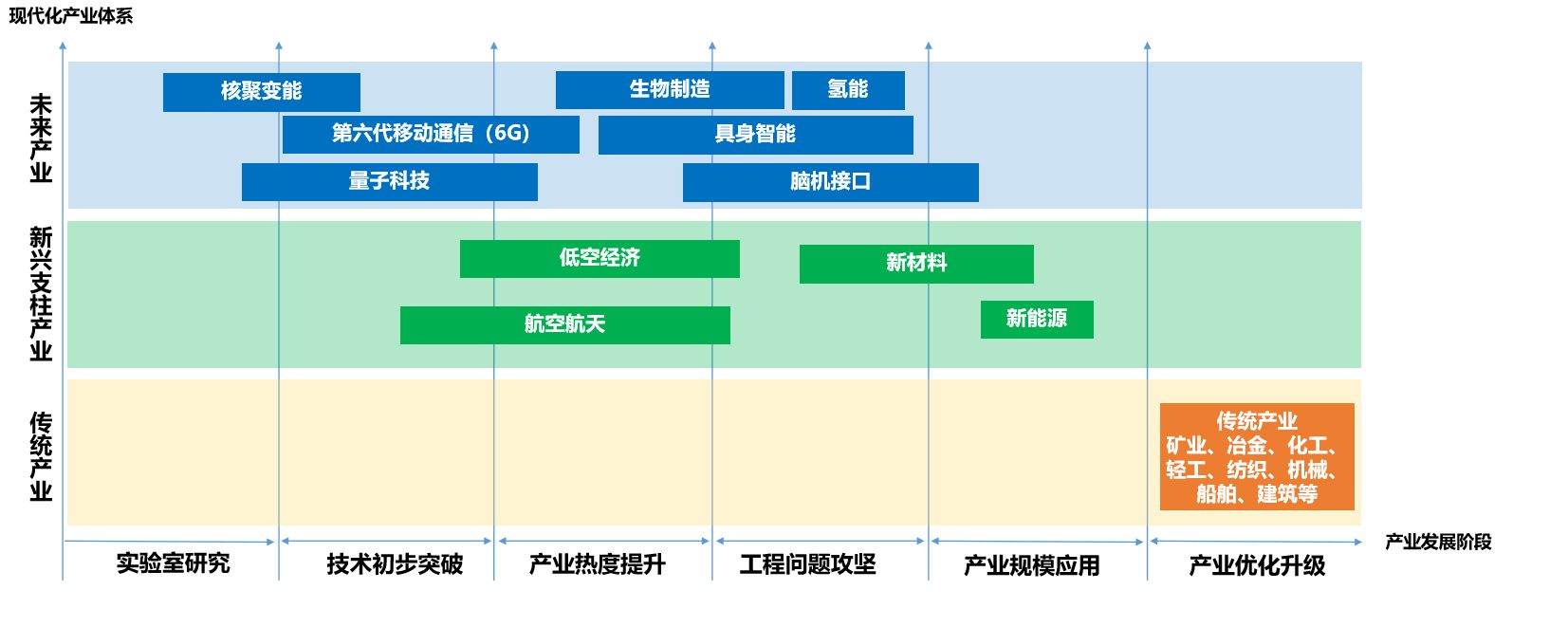
Core Insights - The "14th Five-Year Plan" emphasizes the construction of a modern industrial system as a primary strategic task, marking a shift from isolated technological breakthroughs to systematic industrial upgrades [4][10] - The new energy industry is transitioning from focusing on installed capacity to establishing a "source-network-load-storage" collaborative system, emphasizing dynamic balance between production and consumption [4][18] - The aerospace sector is developing a dual-driven model of national engineering and commercial spaceflight, with large aircraft industrialization and commercial spaceflight jointly promoting the scale and capability of the industrial chain [4][35] - Future industries such as 6G and quantum technology place China in the global leading tier of R&D, aiming to seize the high ground in technology standards and industrial ecosystems through forward-looking layouts [4][61] - The transformation of traditional industries emphasizes not only greening and intelligentization but also explicitly promotes "service-oriented manufacturing," guiding the manufacturing sector to extend services throughout the product lifecycle [4][93] Emerging Pillar Industries - The cultivation of emerging pillar industries is positioned as a core strategy for high-quality development, with a focus on sectors like aerospace and low-altitude economy that have industrialization foundations [14][35] - The new energy sector is expected to maintain a leading global position, with installed capacity projected to reach 1.41 billion kilowatts by the end of 2024, accounting for 83% of new installations [18][20] - The new materials industry is rapidly growing, with a total output value expected to exceed 8 trillion yuan by 2024, although about 30% of key high-end materials still rely on imports [29][30] Future Industries - Future industries represent cutting-edge directions, with a focus on quantum technology, biomanufacturing, hydrogen energy, brain-computer interfaces, and embodied intelligence [61][62] - The quantum technology sector is expected to grow significantly, with the global market projected to reach nearly 1 trillion USD by 2035, driven by advancements in quantum communication and measurement [64][66] - The biomanufacturing industry is anticipated to maintain rapid growth, with a total scale of approximately 1.1 trillion yuan, although it faces challenges in high-end industrial strains and precision technology [69][70] Traditional Industries - The modernization of traditional industries is crucial for maintaining competitiveness in global industrial division, with a focus on enhancing the self-controllability of industrial chains [93][94] - The transformation of traditional industries includes promoting digitalization and green initiatives, as well as extending manufacturing into service-oriented solutions [93][94] - The integration of emerging technologies into traditional industries is expected to create a resilient modern industrial system, laying a decisive foundation for achieving the goal of becoming a manufacturing powerhouse by 2035 [96]

现代化产业体系建设迈出坚实步伐(奋勇争先,决战决胜“十四五”)
Ren Min Ri Bao· 2025-12-29 22:36
柔性制造"千件千样",数智转型降本增效;具身智能融入实体应用场景,低空经济开启天空"新赛 道"…… 习近平总书记指出:"着眼发展新质生产力,强化科技创新和产业创新深度融合,建设具有国际竞争力 的现代化产业体系。" 产业强则经济强。"十四五"时期,我国传统产业高端化、智能化、绿色化加速推进,新质生产力蓄势成 长,现代化产业体系建设迈出坚实步伐。 全身拥有82个自由度,灵巧手1∶1复刻人手尺寸且有22个自由度……日前,小鹏汽车发布搭载3颗自研图 灵人工智能芯片的全新一代人形机器人,可实现对话、行走等功能。"我们的目标是2026年底实现新一 代人形机器人规模量产。"小鹏汽车董事长何小鹏表示。 "十四五"以来,低空经济"振翅高飞",前沿材料"破茧成蝶",载人航天"巡天揽月"……2024年,我国"三 新"经济增加值占国内生产总值比重约18%。 ——强基增效,现代化基础设施体系不断夯实。 今年前11月,我国快递业务量累计完成1807.4亿件。"快递送得越来越快了!"家住北京的王先生感叹, 头一天晚上8点下单,第二天早上6点,快递就送到了家门口。2020年至2024年,我国快递业务量年均增 长20%左右,服务时效性、服务质 ...
全省工业和信息化工作会议召开
Xin Hua Ri Bao· 2025-12-29 22:26
Core Viewpoint - The meeting held in Nanjing on December 29 summarized the achievements of the "14th Five-Year Plan" and outlined key tasks for the "15th Five-Year Plan" in Jiangsu's industrial and information sectors, emphasizing the importance of new industrialization and high-quality development [1] Group 1: Achievements and Progress - Since the implementation of the "14th Five-Year Plan," Jiangsu's industrial and information system has effectively executed the "Eight Major Actions" for a strong manufacturing province, leading to a stable industrial economy [1] - From 2021 to 2024, the province's industrial added value has steadily increased, with growth rates of 12.8%, 5.1%, 7.6%, and 7.7%, respectively, surpassing the national averages by 3.2, 1.5, 3.0, and 1.9 percentage points [1] - By 2025, Jiangsu is expected to maintain its position as the largest manufacturing province in China, with the highest index for high-quality manufacturing development nationwide [1] Group 2: Future Plans and Goals - The year 2026 marks the beginning of the "15th Five-Year Plan," where the industrial and information system aims to prioritize new industrialization as a key task [1] - The focus will be on promoting technological and industrial innovation, integrating information technology with industrialization, and enhancing the synergy between industrial chains, innovation chains, talent chains, and financial chains [1] - The goal is to develop a modern industrial system centered around advanced manufacturing, ensuring a strong start for the "15th Five-Year Plan" and demonstrating the responsibility of the industrial and information system in Jiangsu's economic development [1]
笃“实”夯基 向“新”而进 2025年中国现代化产业体系建设持续推进
Xin Lang Cai Jing· 2025-12-29 20:21
Group 1 - The modernization of the industrial system is the material and technical foundation of Chinese-style modernization, with advancements in industry, agriculture, services, and infrastructure [1] - The Central Economic Work Conference emphasized the continuous promotion of the modernization of the industrial system by 2025, focusing on innovation-driven growth and nurturing new momentum [1] - Companies are increasingly leveraging technological innovation to lead the development of new productive forces, aiming to build a modern industrial system centered around advanced manufacturing [1] Group 2 - The State Council's guidance emphasizes the importance of financial services for the real economy, with various departments implementing growth stabilization plans for key industries such as steel and automobiles [2] - Policy incentives are boosting confidence, showcasing the resilience of the real economy in facing multiple challenges [2]
2026年1月1日起,这些商品关税税率和税目将调整
Xin Hua She· 2025-12-29 14:29
Group 1 - The State Council Tariff Commission announced adjustments to import tariff rates and categories effective January 1, 2026, impacting 935 items with temporary tariff rates lower than the most-favored-nation (MFN) rates [1] - The adjustments aim to promote high-level technological self-reliance, support the construction of a modern industrial system, and lower import tariffs on key components and advanced materials such as hydraulic cushions and composite joints [1] - To facilitate a comprehensive green transition in economic and social development, import tariffs on resource-based products like regenerated black powder for lithium batteries will be reduced [1] Group 2 - The adjustments also focus on enhancing domestic circulation and responding to changes in domestic industry development and supply-demand conditions, including the cancellation of temporary tariff rates on micro motors and other products, reverting to MFN rates [1] - In line with deepening economic and trade cooperation, 24 free trade agreements will continue to apply preferential tariff rates for certain imported goods from 34 trading partners in 2026 [2] - To support the development of least developed countries, 100% tariff-free treatment will be maintained for products from 43 least developed countries with which China has diplomatic relations [2]