生成式人工智能

Search documents
连续4年!浪潮云入选Gartner中国云基础设施和平台服务市场标杆厂商
Da Zhong Ri Bao· 2025-09-23 06:25
Core Insights - Gartner's report highlights that Inspur Cloud has been recognized as a benchmark vendor for four consecutive years in the fields of distributed cloud and hybrid/private cloud [1] - The report emphasizes the shift of cloud service providers towards artificial intelligence/machine learning (AI/ML) and generative AI infrastructure investments to explore new market opportunities [1] Group 1: Company Performance - Inspur Cloud is positioned as a leading provider of private cloud solutions, offering a flexible infrastructure service to meet diverse enterprise needs [2] - The company has developed an operational private cloud as a key pathway for implementing distributed intelligent cloud, breaking traditional product-based boundaries [2] - Inspur Cloud has established an AI model factory that adapts to the market's demand for decentralized, small-scale, and customized AI computing power services [2] Group 2: Market Trends - The rapid development of China's cloud infrastructure and platform services market is attributed to the swift digitalization, government policy support, and the pivotal role of AI in modern enterprise transformation [3] - The transition of generative AI from "technological breakthrough" to "industry disruption" is noted, with Inspur Cloud aiming to leverage its distributed intelligent cloud and AI model factory to empower various industries [3]
大动作!英伟达豪掷1000亿美元,加码数据中心,业绩连续高增长概念股名单出炉
Zheng Quan Shi Bao· 2025-09-23 04:49
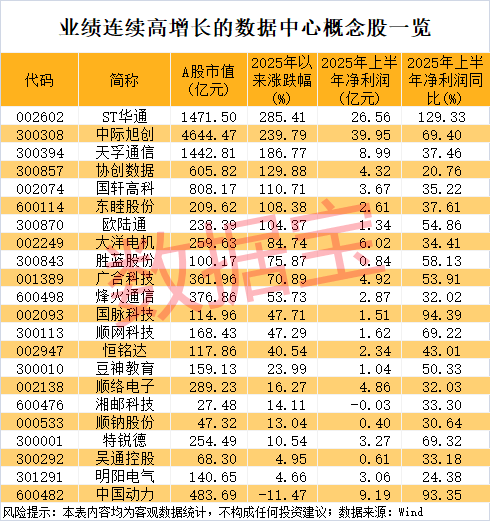
Group 1 - The core viewpoint of the articles highlights the significant growth potential in the data center industry driven by advancements in generative artificial intelligence technology [1][3] - NVIDIA and OpenAI have announced a strategic partnership, with NVIDIA committing to invest up to $100 billion to support the development of AI data centers, aiming to deploy at least 10 GW of AI infrastructure [2][3] - OpenAI has revised its cash consumption forecast to $115 billion by 2029, driven by the success of ChatGPT, and is seeking to develop its own data center server chips to manage costs [2][3] Group 2 - The data center industry is expected to experience a robust annual growth rate of 10% until 2030, with global investment in new facilities projected to reach $49 billion [3] - In China, the data center market is anticipated to reach 362.37 billion yuan by 2025, reflecting a year-on-year growth rate of 23.5% [3] - AI data center capacity is projected to grow at a compound annual growth rate of 40.5% by 2027, with energy consumption expected to increase by 44.7%, reaching 146.2 TWh [3] Group 3 - A list of 22 data center concept stocks has been identified, all showing positive net profits and year-on-year growth exceeding 20% for 2023, 2024, and the first half of 2025 [4][5] - The average increase in stock prices for these high-growth companies has been 75.55% year-to-date, significantly outperforming the Shanghai Composite Index [5][6] - ST Huatuo leads with a cumulative increase of 285.41% this year, benefiting from its involvement in major data center projects [6][7] Group 4 - Among the 22 high-growth stocks, institutional holdings average 40.61%, with nine stocks having over 50% institutional ownership, indicating strong market confidence [6][7] - China Power has the highest institutional holding at 72.84%, despite a year-to-date decline of 11.47% [6][7] - Valuation levels show five stocks with rolling P/E ratios below 30, indicating potential investment opportunities [7]


我国数字经济规模超50万亿元
Ge Long Hui A P P· 2025-09-23 01:20
Core Insights - The core viewpoint of the article highlights the significant growth of China's digital economy, which now accounts for approximately 10% of the GDP, and the emergence of new job roles within this sector [1] Industry Overview - The digital economy in China has surpassed 50 trillion yuan, indicating a robust growth trajectory [1] - The gaming industry is projected to exceed 325.7 billion yuan in 2024, showcasing the expanding market potential [1] Emerging Job Roles - New professions such as virtual reality developers and AI animation creators are emerging, driven by technological advancements and the integration of culture and technology [1] - In the aviation sector, simulation system engineers are facilitating the transition from imported to domestic flight simulation equipment, enhancing pilot training [1] - The rise of generative AI in animation is significantly improving production efficiency, reflecting the transformative impact of technology on traditional industries [1]
是工业革命的序章,还是巨大泡沫的前夜?万亿美金烧出的AI未来待解
3 6 Ke· 2025-09-22 23:18
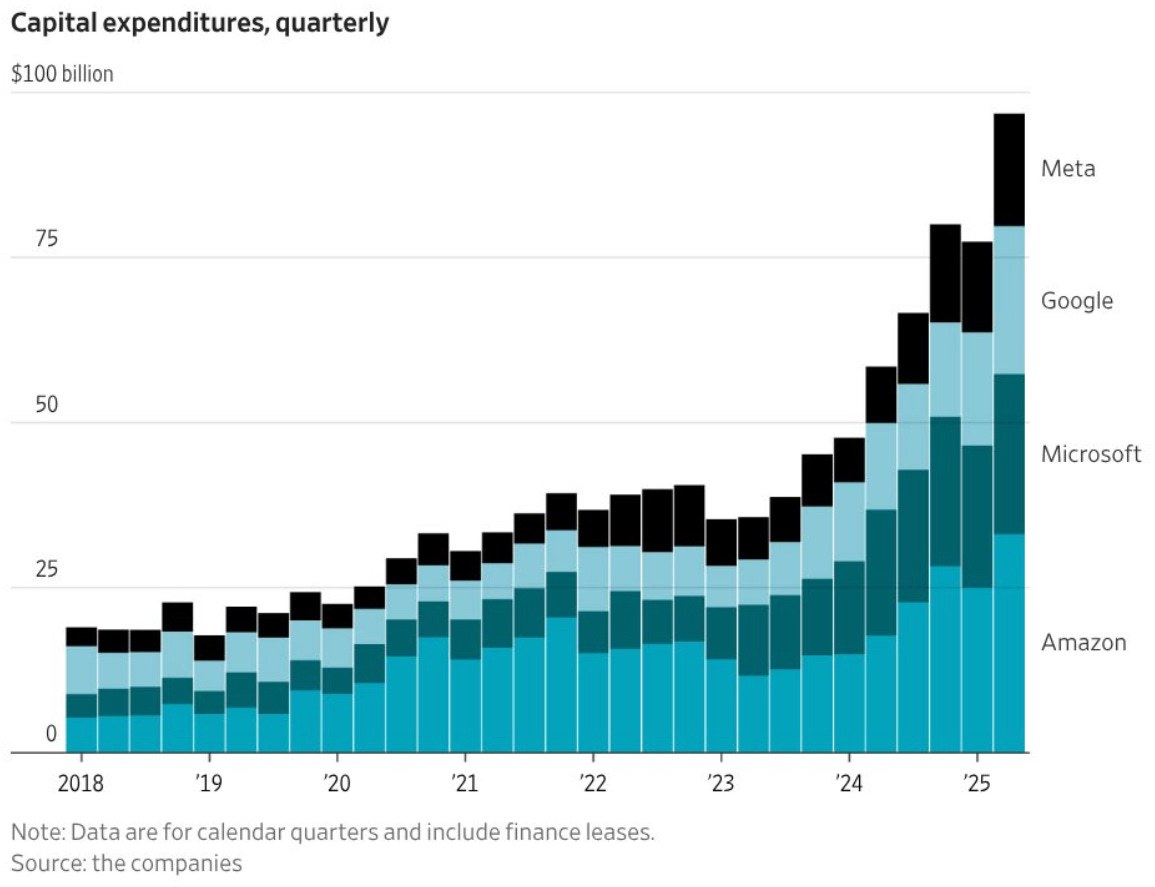
Group 1 - The U.S. economy is characterized by a duality, with a booming AI sector contrasted against a sluggish consumer economy [2][3] - AI-related spending has outpaced consumer spending, indicating that without AI, U.S. economic growth would be minimal [3] - Approximately 60% of stock market growth over the past two years has been attributed to AI-related companies such as Microsoft, Nvidia, and Meta [3] Group 2 - Major tech companies like Meta, Google, Microsoft, and Amazon have invested between $100 billion to $200 billion in AI infrastructure over the past six months [4] - This investment is the largest since the inception of the computer age in the 1960s or the peak of the railroad era in the 1880s [6] - Nvidia is expected to capture the highest share of market capital expenditure since IBM's peak in 1969, with AI capital expenditure surpassing levels seen during the internet bubble [7] Group 3 - The surge in AI infrastructure is fueled by unprecedented profits from leading tech companies, which have generated record free cash flow [12] - These companies are capable of investing hundreds of billions annually into AI-related R&D and infrastructure due to their existing business models [12] Group 4 - The stock market's peculiar performance is attributed to the dominance of the top ten companies in the S&P 500, which have significantly outperformed the rest of the market [15] - The majority of companies are experiencing cash depletion due to high spending on AI infrastructure, raising concerns about a potential historical infrastructure bubble [17] Group 5 - Generative AI tools are being adopted at a rapid pace, estimated to be twice as fast as the internet's adoption rate [19] - Over 50% of employees in information services and management roles are using AI technology, while adoption in traditional sectors remains low [22] Group 6 - AI is perceived to enhance productivity, particularly in repetitive tasks, with significant time savings reported by users [27] - A study indicates that AI agents are doubling the tasks they can complete every seven months, suggesting a rapid advancement in capabilities [29] Group 7 - Despite claims of productivity improvements, some studies indicate that the use of AI may actually increase task completion times for experienced developers [32] - The rise of large language models has transformed academic writing, with a notable increase in the use of AI-generated content in research papers [35]




行业首家!“万得企业库”完成生成式人工智能服务登记
Wind万得· 2025-09-22 22:26
依托万得二十余年数据与技术积累,万得企业库推出 商业查询智能助手——万得企业库Alice, 将生成式 人工智能深度融入产品与服务:智能语义理解精准匹配查询需求,自然语言生成转化数据为易懂结论,企 业关系挖掘商业深层关联。相较传统查询方式,相应速度、内容针对性与风险预警能力显著提升,为企业 决策提供高效智能支持。 "网信上海"微信公众号近日发布《上海市生成式人工智能服务登记信息公告 (9月11日)》。根据公告显示,截至9月11日,上海市 新增9款 已完成登 记的生成式人工智能服务,上海万得征信作为登记单位," 万得企业库 "榜 上有名,成为国内商业信息查询领域率先获得此资质的平台,标志着万得征 信在AI合规应用与商业数据服务领域实现关键突破。 上海市生成式人工智能服务登记信息 | 序号 | 应用/功能 | 登记单位 | 上线编号 | 登记时间 | | --- | --- | --- | --- | --- | | 1 | 商汤大医 | 上海商汤善萃医疗科技有限公司 | Shanghai-ShangTangDaYi- | 2025/9/11 | | | | | 20250911S0106 | | | 2 | 万得 ...

诺奖得主David Baker推出RFdiffusion3,颠覆蛋白质设计格局,开启全原子生物分子设计新时代
生物世界· 2025-09-22 04:14
Core Viewpoint - The article discusses the advancements in protein design using generative artificial intelligence, particularly focusing on the breakthrough of RFdiffusion3, which allows for atomic-level precision in designing proteins that can interact with specific small molecules, DNA, and other biomolecules [9][24]. Group 1: RFdiffusion3 Overview - RFdiffusion3 represents a significant advancement in protein design, enabling the design of proteins with atomic-level precision, including interactions with non-protein components [9][10]. - The model is built on previous versions, RFdiffusion and RFdiffusion2, and offers improvements in accuracy, efficiency, and versatility [10][28]. - RFdiffusion3 can handle complex atomic constraints, such as hydrogen bonds and solvent accessibility, and is capable of designing various interactions, including protein-protein, protein-small molecule, and protein-nucleic acid interactions [10][28]. Group 2: Performance and Applications - In benchmark tests, RFdiffusion3 demonstrated superior performance with a computational cost only one-tenth of previous methods, making it significantly more efficient [3][10]. - The model has shown excellent results in designing DNA-binding proteins and enzymes, achieving a binding activity of 5.89±2.15 μM for a designed DNA-binding protein and a Kcat/Km value of 3557 for a designed cysteine hydrolase [21][28]. - RFdiffusion3 has outperformed its predecessor in multiple target designs, producing an average of 8.2 unique successful clusters compared to 1.4 from RFdiffusion [15]. Group 3: Technical Innovations - The core innovation of RFdiffusion3 lies in its all-atom diffusion model, which allows for simultaneous simulation of protein backbone and side chains, as well as interactions with non-protein components [9][10]. - The model employs a unified representation of amino acids, standardizing them to 14 atoms, which facilitates the handling of varying side chain atom counts [13][14]. - The architecture is based on a Transformer U-Net, which includes downsampling, sparse transformer modules, and upsampling to predict coordinate updates [14]. Group 4: Future Implications - The introduction of RFdiffusion3 marks a paradigm shift in protein design, enabling unprecedented control over complex functionalities, such as specifying enzyme active sites and controlling hydrogen bond states [24][25]. - As the technology continues to evolve, it is expected to lead to innovative therapies, new types of proteases, and biomaterials, fulfilling the vision of "designing life molecules" [25].

东方国信(300166) - 300166东方国信投资者关系活动记录表(2025年9月19日)
2025-09-21 07:36
Company Strategy and Technology Development - The company focuses on core capabilities in big data, artificial intelligence, and cloud computing, evolving through three main stages: code development, low-code, and now generative AI [2] - Generative technology allows for 70% automation in development, significantly reducing costs and aligning with digital transformation needs across industries [2] - The company utilizes a symbolic approach to enhance data accuracy, addressing limitations of mainstream large language models [2] Knowledge Accumulation and AI Application - Emphasis on building knowledge graphs to convert multi-source data into high-value structured knowledge, particularly in telecommunications, finance, and industry [3] - The company has established six engineering frameworks to facilitate AI application deployment, completing numerous projects for ToB clients [3] - A dual-version product "Wenshengshu" targets both enterprise and individual users, with nearly 6,000 listed companies processed [4] Business Development and Growth Points - Despite recent performance pressures, the company maintains healthy cash flow and is at an inflection point with traditional business recovery and strong new business growth [5] - Opportunities in operator business due to data centralization initiatives by major telecom companies [5] - The company has a GPU resource pool of nearly 40,000 cards, serving over 70,000 C-end users and 6,000 enterprises [5] Collaboration with Shitop Cloud - Collaboration with Shitop Cloud enhances resource integration, ecosystem building, and commercial synergy, reinforcing the "cloud + AI + data" strategy [7] - Shitop Cloud leads the C-end computing retail market, with a business scale surpassing the combined total of its next nine competitors [9] - The company aims to capture 20% to 50% market share in the educational and research sectors, estimated at around 5 billion RMB [10] Future Outlook and Challenges - The company anticipates a recovery in performance driven by traditional business stabilization and new business contributions, particularly from the intelligent computing center [17] - Cost optimization and historical burden clearance are expected to support profit recovery [18] - The company is cautious about future acquisitions, focusing on growth potential and synergy [16]

三部门部署轻工业稳增长15项任务
Guang Xi Ri Bao· 2025-09-20 16:02
Core Viewpoint - The Ministry of Industry and Information Technology, the Ministry of Commerce, and the State Administration for Market Regulation have jointly issued the "Light Industry Stabilization and Growth Work Plan (2025-2026)" to enhance the role of the light industry in stabilizing economic growth [1] Group 1: Goals and Objectives - The main goals include highlighting the role of light industry in stabilizing growth, promoting consumption, and benefiting people's livelihoods from 2025 to 2026 [1] - Key industries are expected to maintain stable growth, with business performance remaining generally stable [1] - New growth points such as smart home products, elderly and infant products, and sports leisure fashion products are anticipated to develop rapidly, leading to an increase in consumer capacity [1] - The plan aims to promote 300 upgraded and innovative products and cultivate 10 characteristic industrial zones with a scale of over 100 billion [1] Group 2: Tasks and Strategies - The plan outlines 15 tasks focusing on optimizing supply, expanding consumption, maintaining international competitiveness, optimizing the industrial ecosystem, and enhancing high-quality development momentum [1] - Actions include enhancing the adaptability of consumer goods supply and demand, utilizing artificial intelligence to analyze consumer needs, and creating new growth engines around health, elderly care, childcare, home, and cultural tourism consumption hotspots [1] - Emphasis is placed on advancing generative artificial intelligence in product design and manufacturing, and actively supporting new foreign trade formats such as cross-border e-commerce [1] Group 3: Support Measures - The plan specifies the need for strengthened policy support, guiding enterprises to operate legally and resist unfair competition [1] - A dynamic monitoring and analysis system for the operation of segmented industries will be established, with regular publication of industry data and operational reports [1] - A coordination mechanism for inter-departmental discussions will be set up to regularly assess the light industry's stabilization and growth efforts and address industry and enterprise issues [1]
打破次元壁,汇聚众声成乐——2025上海网络视听内容创作者大会盛大启幕
第一财经· 2025-09-19 14:15
Core Viewpoint - The second Shanghai Network Audiovisual Content Creator Conference emphasizes the importance of creators in the network audiovisual industry, showcasing Shanghai's cultural strength and innovative drive as a hub for content creation [1][24]. Group 1: Conference Overview - The conference, themed "Many Voices Create Music," gathered renowned creators, industry leaders, and experts to discuss the future of the network audiovisual industry [1]. - The event has evolved since its inaugural session in 2023, becoming a significant indicator of the network audiovisual industry in China [1]. - The conference featured the release of the "2025 Network Audiovisual Content Creator White Paper," which outlines industry trends and highlights the shift towards high-quality content creation [1][11]. Group 2: Industry Trends - By the end of 2024, the number of network audiovisual users in China is expected to exceed 1 billion, accounting for over 90% of the internet population [5]. - The industry is witnessing rapid growth in segments such as short videos, audio, knowledge sharing, and live streaming, which are driving the digital cultural industry's expansion [5]. - There is a transition from fragmented content to high-quality, long-term value content, with AI reshaping the creative process [5][11]. Group 3: Shanghai's Role - Shanghai is positioned as an ideal observation point for these trends, with over 500 million registered users on key local platforms, covering more than half of the national internet population [5]. - The city has become a breeding ground for high-quality content, supported by policies and a vibrant urban environment [6][18]. - The "Shanghai Nine Measures" policy aims to establish content creation hubs in Huangpu and Yangpu districts, incentivizing quality content creation [6][24]. Group 4: Yangpu District Development - Yangpu has been designated as a national-level cultural industry demonstration zone and is home to over 8,300 digital economy enterprises, contributing significantly to Shanghai's digital economy [18][19]. - The district's digital economy enterprises accounted for over 30% of the total number in 2024, with revenue exceeding 320 billion yuan, representing one-fifth of the city's total [18]. - Yangpu is fostering a unique ecosystem by integrating educational resources from universities with the operational capabilities of internet giants, creating a "knowledge community" [22]. Group 5: Future Prospects - The conference highlighted the potential for creators to build cultural assets and emphasized the need for platforms to evolve into "cultural asset operating systems" [11][24]. - The event also showcased various activities, including a creator carnival, which aimed to engage the public and enhance the interaction between creators and the city [16][20]. - As more creators establish themselves in Shanghai, the network audiovisual industry is expected to generate greater cultural, social, and economic value, contributing to China's modernization narrative [24].

免费送书 |雷军作序推荐!AI已经无法阻挡,我们能做些什么?
Sou Hu Cai Jing· 2025-09-19 12:21
Core Insights - The article discusses the transformative impact of artificial intelligence (AI) on various aspects of life, including learning, work, and daily activities, highlighting the advancements made by AI technologies like ChatGPT, Sora, Deepseek, and Qwen [1][3] - It introduces the book "Artificial Intelligence 70 Years: From the Dartmouth Conference to the Era of Large Models," which provides a comprehensive overview of AI's evolution over the past seven decades [1][5] Summary by Sections - **Book Overview** - The book is not a dry technical manual but an immersive journey through 70 years of AI history, combining storytelling with technical insights [5] - Authored by Chen Zongzhou, a seasoned science writer and technology journalist, the book presents a dual narrative of stories and technology [5][10] - **Key Figures and Concepts** - The book features influential figures in AI, such as Geoffrey Hinton, who is recognized for his contributions to deep learning algorithms, emphasizing the importance of perseverance in scientific discovery [7] - It discusses significant milestones in AI, including the famous match between AlphaGo and a human champion, illustrating the role of extensive learning and computation in AI's success [8][10] - **Educational Value** - The book aims to demystify complex AI terminology, such as big data, deep learning, generative AI, and robotics, making it accessible for readers to relate AI knowledge to their lives [9] - It encourages a balanced view of AI, steering clear of extremes in perception, and emphasizes that AI's remarkable capabilities are built on decades of foundational work [10] - **Target Audience** - The book is suitable for both parents and children, providing insights into AI's past and present, and helping families understand how to nurture skills relevant to the AI era [13]