
资本市场改革

Search documents
“牛市旗手”发力,证券ETF(159841)昨日吸金超3亿元!剑指4000点?!
Sou Hu Cai Jing· 2025-08-26 01:57
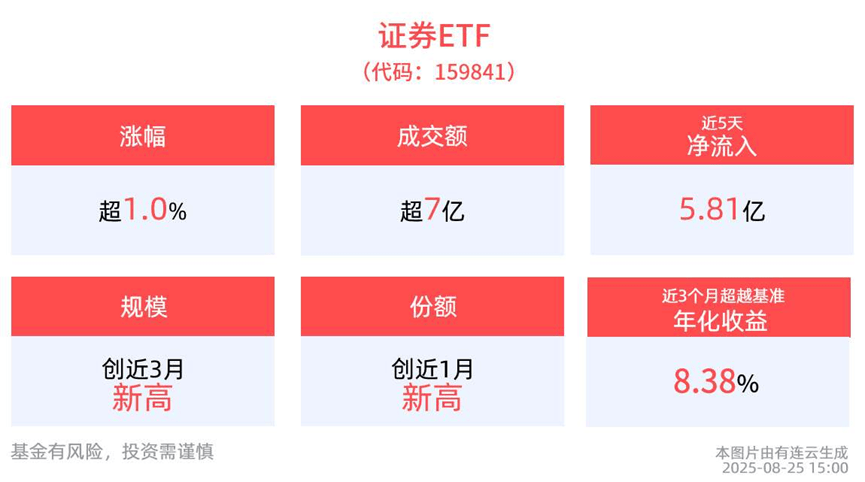
Group 1 - The core viewpoint highlights the active trading environment in the securities market, with the Securities ETF (159841) experiencing a 1.07% increase and a net inflow of 3.01 billion yuan as of August 25, 2025 [3][5][6] - The trading volume has reached a new high, with daily average trading amounting to 2.5 trillion yuan, indicating strong market participation [6][7] - The securities industry is expected to see significant growth in net profit, with a projected year-on-year increase of 61.23% for the first half of 2025, driven by active trading and favorable market conditions [7][8] Group 2 - Recent regulatory changes are optimizing the industry ecosystem, encouraging smaller institutions to focus on niche markets, which is expected to enhance competition within the sector [5][8] - The securities sector is benefiting from a recovery in market sentiment, with ongoing capital market reforms and increased liquidity contributing to improved business performance [8][10] - The valuation of the securities sector shows potential for recovery, with a favorable long-term growth outlook as the market becomes more active and performance expectations improve [9][10]






两市成交额破3万亿,三大指数继续“狂飙”
Huan Qiu Lao Hu Cai Jing· 2025-08-25 09:52
Group 1 - The trading volume in the Shanghai and Shenzhen markets exceeded 3 trillion yuan, reaching 3.14 trillion yuan, marking the second highest record after 3.45 trillion yuan on October 8, 2024 [1] - A-shares have seen a continuous increase in trading volume, with over 1 trillion yuan for 63 consecutive trading days and above 2 trillion yuan for 9 consecutive days, setting historical records [1] - Major A-share indices rose significantly, with the Shanghai Composite Index up 1.51% to 3883.56 points, a cumulative increase of over 25% since the low in April, approaching the 4000-point mark [1] Group 2 - There is a notable shift in asset allocation among residents, with a decrease in bank deposits and an increase in non-bank financial institution deposits, indicating a movement of funds from traditional savings to capital markets [2] - The number of new A-share accounts opened in July reached 1.9636 million, a nearly 71% increase year-on-year, reflecting strong interest from new investors [2] - Institutional investors are also increasing their participation, with a significant rise in their allocation to ETF and index-enhanced funds, contributing to the market's upward momentum [2] Group 3 - The A-share market is benefiting from multiple favorable factors, including ongoing capital market reforms, a slowdown in IPOs, and a tightening of refinancing, which collectively reduce market burdens [3] - Monetary policy remains accommodative, with continued foreign capital inflows providing ample liquidity to the market [3] - The improvement in the mid-year performance of listed companies, particularly in technology and consumer sectors, supports the ongoing market rally [3]
大摩闭门会:邢自强-牛市未歇-[AI 纪要]
2025-08-25 09:13
Summary of Key Points from Conference Call Records Industry Overview - **Chinese Economy**: The Chinese economy is showing a trend of high growth followed by a decline, with GDP growth expected to fall to around 4.5% in Q3 2025. The export rush effect is fading, and the real estate market continues to adjust, with limited effects from fiscal stimulus. High-frequency data indicates persistent economic weakness since July [1][4][9]. Market Dynamics - **Market Liquidity**: The market liquidity is relatively loose, with the Morgan Stanley Free Liquidity Index turning positive since late June. A net inflow of 1.5 to 1.7 trillion RMB into A-shares has been observed in the first half of the year, primarily from large asset allocators due to low bond yields and significant stock market returns [1][5]. - **Structural Market Changes**: There is a notable structural divergence in the Chinese stock market, with the CSI 300 index rising nearly 10%, while the CSI 2000 and ST sectors have seen remarkable gains. This indicates that the market is driven more by liquidity than by fundamental support, necessitating the identification of potential rebound opportunities [1][6]. Investor Sentiment and Risks - **Investor Confidence**: Although investor confidence in China has rebounded, there are significant risks to be cautious of, including challenges in corporate profits, cash flow, consumer confidence, and the real estate sector. Uncertainties in US-China relations and domestic policies, particularly regarding stock market decision-making, are also concerning [1][8]. - **Potential Risks**: Three main risk factors include fundamental challenges in corporate performance, external uncertainties particularly related to US-China relations, and domestic policy issues that could affect market sustainability [1][8]. Economic Projections - **GDP Growth Forecast**: The actual GDP growth rate is projected to decline from 5.3% in the first half of the year to below 4.5% in the second half, influenced by a slowdown in exports and fiscal stimulus tapering [1][9][11]. - **Infrastructure Investment**: Without significant expansion of deficits and prioritization of projects, infrastructure investment growth is expected to be lower in the second half of 2025 compared to the first half [1][11]. Tourism Industry Insights - **Inbound Tourism Growth**: The inbound tourism market in China is expected to grow at an annualized rate of approximately 19% over the next decade, with foreign arrivals increasing by 30% in the first half of 2025. The implementation of visa-free policies has been a significant driver of this growth [2][21]. - **Government Initiatives**: The Chinese government is actively expanding visa-free entry and transit policies, which has led to a rapid recovery in foreign tourist numbers, particularly in major cities like Beijing and Shanghai [22][23]. - **Impact of AI and Technology**: Recent advancements in AI and technology have significantly reduced language barriers in the tourism industry, enhancing the experience for foreign visitors [24]. Transportation Sector Performance - **Airline Industry**: The transportation sector, particularly airlines, has benefited from inbound tourism, with a 16% increase in turnover in the first half of the year, primarily driven by inbound and outbound demand. However, some foreign airlines have reduced their presence in China due to profitability challenges [26]. Consumer Behavior and Shopping - **Shopping Initiatives**: China has implemented measures to facilitate shopping for foreign visitors, such as lowering tax refund thresholds and establishing convenient tax refund counters at various locations, which is expected to enhance the shopping experience for tourists [27]. This summary encapsulates the key insights and projections regarding the Chinese economy, market dynamics, investor sentiment, tourism industry, and consumer behavior, providing a comprehensive overview of the current landscape and future outlook.
A股市场成交额突破3万亿元!证券ETF(512880)5日吸金近40亿元,当前规模超417亿元
Mei Ri Jing Ji Xin Wen· 2025-08-25 08:44
Group 1 - The A-share market continues to show strength with a trading volume of 3.18 trillion yuan, and the Securities ETF (512880) has risen by 1%, with a net inflow of nearly 4 billion yuan over the past five days, bringing its current scale to over 41.7 billion yuan, ranking first among its peers [1] - The non-bank team at CITIC Securities believes that the brokerage sector will present significant investment opportunities in the second half of the year, driven by strong half-year performance forecasts, deepening capital market reforms, liquidity easing, and expectations of an upward shift in market indices [1] - The Guotai Junan and Haitong non-bank research teams project that the brokerage industry's net profit attributable to shareholders will increase by 61.23% year-on-year in the first half of 2025, exceeding expectations [1] Group 2 - The brokerage sector exhibits strong beta characteristics, with its main business performance closely linked to capital market performance; as global liquidity narratives resonate, active trading in capital markets enhances market risk appetite, leading to a recovery in the securities industry's prosperity [1] - Investors without stock accounts can seize investment opportunities in the brokerage sector through the Securities ETF's connecting fund (012363) [1]
近60个交易日涨超27%,证券ETF(159841)成交额破6.5亿元,机构:券商估值和基本面有望持续改善
2 1 Shi Ji Jing Ji Bao Dao· 2025-08-25 06:18
Group 1 - The securities sector is experiencing a narrow fluctuation with the Securities ETF (159841) rising by 0.16% as of the report, with a trading volume exceeding 650 million yuan and a turnover rate over 10% [1] - Over the past 60 trading days, the Securities ETF has accumulated a gain of 27.55% [1] - As of August 22, the latest scale of the Securities ETF is 6.365 billion yuan, making it the largest ETF in the same category in the Shenzhen and Shanghai markets [1] Group 2 - The A-share market has seen a significant increase in trading enthusiasm since August, with transaction amounts maintaining above 2 trillion yuan for several consecutive trading days, leading to a monthly increase of over 8% in the brokerage sector [2] - The mid-term performance of brokerages is showing significant growth, with companies like Southwest Securities and Guosheng Jin控 reporting revenue and net profit increases exceeding 24% year-on-year in their 2025 semi-annual reports [2] - The current PB valuation of the securities sector is at a near 10-year low, contrasting with the improving profitability trend, indicating potential for a complete cycle from performance-driven to valuation reconstruction [2]
A股市值十强座次洗牌
Di Yi Cai Jing· 2025-08-25 03:46
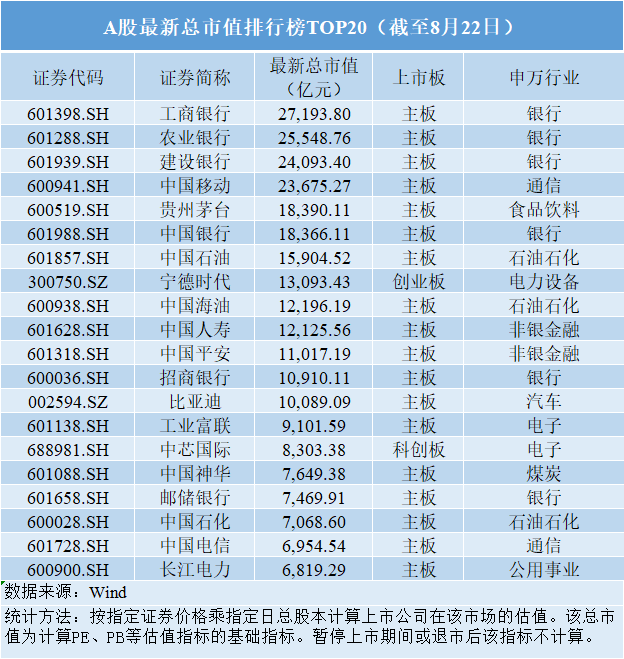
Core Points - A-shares have seen a significant rally, with the Shanghai Composite Index surpassing 3800 points for the first time in 10 years, closing at 3825.76 points on August 22 [2] - The total market capitalization of all listed companies in A-shares reached approximately 116 trillion yuan, with the Shanghai and Shenzhen markets accounting for 61.41 trillion yuan and 40.48 trillion yuan respectively [2][17] - There are currently 13 companies in A-shares with a market capitalization exceeding 1 trillion yuan, including major state-owned banks and industry leaders [3][4] Market Capitalization Changes - The top three companies by market capitalization are all state-owned banks: Industrial and Commercial Bank of China (ICBC) at 2.72 trillion yuan, Agricultural Bank of China at 2.55 trillion yuan, and China Construction Bank at 2.41 trillion yuan [4][14] - Compared to the end of 2016, the top three market cap positions have been dominated by state-owned banks, with ICBC maintaining its position as the "king of market value" [10][13] - Notable changes in the market cap rankings include the decline of companies like Sinopec and Bank of Communications, which have fallen out of the top ten [13] Year-to-Date Market Capitalization Growth - As of August 23, the number of companies with a market cap exceeding 1 trillion yuan has increased from 10 at the beginning of the year to 13, with new entrants including Ping An Insurance, China Merchants Bank, and BYD [6] - A total of 22 stocks have seen their market capitalization increase by over 100 billion yuan since the beginning of the year, with notable performers including Industrial Fulian and Cambricon Technologies [7] Significant Market Movers - The largest market cap increases year-to-date have been observed in stocks like Shuangwei New Materials, which saw a staggering increase of 1161% [8] - Other significant gainers include *ST Songfa and *ST Yushun, with increases of 1019% and 738% respectively [9] Industry Trends - The banking, electronics, and non-bank financial sectors are the top three industries with the highest number of companies exceeding 1 billion yuan in market capitalization [5][15] - The electronics industry has experienced a remarkable growth of over 460% in market capitalization over the past decade, reflecting the shift in economic structure and technological advancements [15][16] Overall Market Growth - The A-share market has expanded significantly over the past decade, with the number of listed companies increasing from 3052 to 5434 and total market capitalization rising from 55.66 trillion yuan to 116.37 trillion yuan [17]






A股市值十强洗牌:贵州茅台、宁德时代入列,昔日龙头股掉队
Di Yi Cai Jing· 2025-08-25 03:35
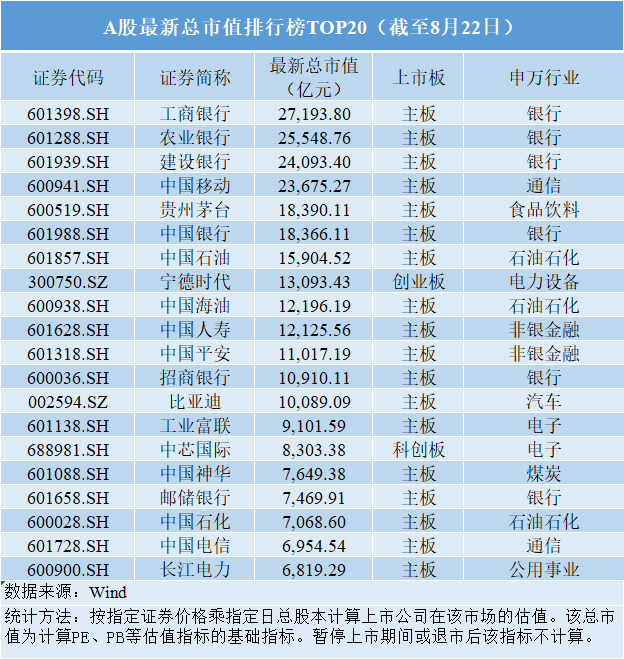
Core Points - A-shares have seen a significant rally, with the Shanghai Composite Index surpassing 3800 points for the first time in ten years, closing at 3825.76 on August 22 [1] - The total market capitalization of all listed companies in A-shares reached approximately 116 trillion yuan, with the Shanghai and Shenzhen markets accounting for 61.41 trillion and 40.48 trillion yuan respectively [1][2] - The number of companies with a market capitalization exceeding 1 trillion yuan has increased to 13, with major state-owned banks dominating the top positions [2][3] Market Capitalization Changes - As of August 23, 2023, the top three companies by market capitalization are Industrial and Commercial Bank of China (ICBC) at 2.72 trillion yuan, Agricultural Bank of China at 2.55 trillion yuan, and China Construction Bank at 2.41 trillion yuan [2][3] - Other notable companies in the top ten include China Mobile (2.37 trillion yuan), Kweichow Moutai (1.84 trillion yuan), and Ningde Times (1.31 trillion yuan [2][3] - Compared to the end of 2016, the top three companies by market capitalization have all been state-owned banks, with ICBC maintaining its position as the market leader [7][10] Historical Comparison - In 2016, there were five companies with a market capitalization exceeding 1 trillion yuan, with ICBC leading at 1.57 trillion yuan [7][8] - The market landscape has shifted, with some former leaders like Sinopec and Bank of Communications dropping out of the top ten by market capitalization [9] - Kweichow Moutai has seen a substantial increase in market capitalization from 419.76 billion yuan in 2015 to 1.84 trillion yuan currently, marking a 338% increase [9][10] Sector Performance - The banking sector remains the largest by market capitalization, followed by electronics and non-bank financials, with total market capitalizations of 15.8 trillion, 12.14 trillion, and 8.36 trillion yuan respectively [11][12] - The electronics sector has experienced significant growth, with its market capitalization increasing from approximately 2.16 trillion yuan in 2016 to over 10 trillion yuan now, reflecting a growth of over 460% [11][12] - The real estate sector has seen a decline, with its market capitalization dropping from 2.63 trillion yuan in 2016 to 1.2 trillion yuan [11][12] Company Growth - Year-to-date, the number of companies with a market capitalization exceeding 1 trillion yuan has increased from 10 to 13, with new entrants including Ping An Insurance, China Merchants Bank, and BYD [4][5] - Notable growth in market capitalization has been observed in companies like Industrial Fulian and Cambricon Technologies, with increases of 113% and 89% respectively [4][5] - Some companies have experienced exponential growth, such as Upwind New Materials, which saw its market capitalization rise from 2.686 billion yuan at the beginning of the year to 33.882 billion yuan, a staggering increase of 1161% [5][6]

鲍威尔释放鸽派信号,证券ETF(159841)涨超2%,近4个交易日“吸金”2.8亿
Sou Hu Cai Jing· 2025-08-25 03:33
Group 1 - The securities sector is experiencing significant activity, with the Securities ETF (159841) rising by 2.06% and achieving a trading volume exceeding 450 million yuan, indicating high trading activity and a turnover rate of over 7% [1] - As of August 22, the Securities ETF (159841) has a total size of 6.365 billion yuan, making it the largest ETF in the same category in the Shenzhen and Shanghai markets [1] - The Securities ETF (159841) has seen a net inflow of 280 million yuan over the past four trading days (August 19-22), reflecting strong investor interest [1] Group 2 - The non-bank team at CITIC Securities believes that the brokerage sector presents significant investment opportunities in the second half of the year, driven by strong half-year performance forecasts, deepening capital market reforms, and expectations of liquidity easing [2] - The active trading in the capital market, particularly in the second quarter, has benefited multiple brokerage businesses, leading to a high increase in net profits [2] - Huolong Securities indicates that sustained market activity is directly boosting brokerage and proprietary trading businesses, with a positive trend in net profit forecasts for brokerages and an expected further increase in ROE [2]
A股市值十强座次洗牌:贵州茅台、宁德时代入列 昔日市值龙头股掉队
Di Yi Cai Jing· 2025-08-25 03:19
Core Points - A-shares have seen a significant rally, with the Shanghai Composite Index surpassing 3800 points for the first time in ten years, closing at 3825.76 points on August 22 [1] - The total market capitalization of all listed companies in A-shares reached approximately 116 trillion yuan, with the Shanghai and Shenzhen markets accounting for 61.41 trillion yuan and 40.48 trillion yuan respectively [1][13] - The number of companies with a market capitalization exceeding 1 trillion yuan has increased to 13, with major state-owned banks dominating the top positions [2][4] Market Capitalization Changes - As of August 23, 2023, the top three companies by market capitalization are Industrial and Commercial Bank of China (ICBC) at 2.72 trillion yuan, Agricultural Bank of China at 2.55 trillion yuan, and China Construction Bank at 2.41 trillion yuan [2][10] - The total market capitalization of A-shares has increased significantly compared to the beginning of the year, with three new entrants joining the trillion-yuan club: Ping An Insurance, China Merchants Bank, and BYD [4][10] - The market capitalization of ICBC has grown by 73% over the past ten years, while Agricultural Bank of China has seen a 154% increase [10][11] Industry Trends - The banking sector remains the largest in terms of market capitalization, followed by the electronics and non-bank financial sectors, with total market capitalizations of 15.8 trillion yuan, 12.14 trillion yuan, and 8.36 trillion yuan respectively [11][12] - The electronics industry has experienced a remarkable growth of over 460% in market capitalization over the past decade, reflecting the shift towards technology and innovation [11] - The real estate sector has seen a decline in market capitalization, dropping from 2.63 trillion yuan in 2016 to 1.2 trillion yuan currently [11] Historical Comparison - A comparison of the top market capitalization companies from the end of 2016 to now shows that all top three positions are held by state-owned banks, with ICBC maintaining its position as the market leader [7][9] - Companies like Sinopec and Bank of Communications have fallen out of the top ten, while new industry leaders such as Kweichow Moutai and Contemporary Amperex Technology Co. (CATL) have emerged [9][10] - The total number of A-share companies has increased from 3052 in 2016 to 5434 in 2023, with total market capitalization rising from 55.66 trillion yuan to 116.37 trillion yuan [13]

A股市值十强座次洗牌:贵州茅台、宁德时代入列,昔日市值龙头股掉队
Di Yi Cai Jing· 2025-08-25 03:15
Core Viewpoint - The A-share market has seen significant growth, with the Shanghai Composite Index surpassing 3800 points for the first time in ten years, reflecting a "slow bull" market trend and an increase in total market capitalization to approximately 116 trillion yuan [1][13]. Group 1: Market Capitalization Overview - As of August 22, the total market capitalization of all listed companies in A-shares reached 102.81 trillion yuan, with the Shanghai Stock Exchange at 61.41 trillion yuan and the Shenzhen Stock Exchange at 40.48 trillion yuan [1]. - The number of companies with a market capitalization exceeding 1 trillion yuan has increased to 13, including major state-owned banks and industry leaders like China Mobile and Kweichow Moutai [2][4]. Group 2: Top Companies by Market Capitalization - The top three companies by market capitalization are all state-owned banks: Industrial and Commercial Bank of China (ICBC) at 27.19 trillion yuan, Agricultural Bank of China at 25.55 trillion yuan, and China Construction Bank at 24.09 trillion yuan [3][10]. - Other notable companies in the top ten include China Mobile (23.68 trillion yuan), Kweichow Moutai (18.39 trillion yuan), and Ningde Times (13.09 trillion yuan) [3][10]. Group 3: Changes Over Time - Compared to the end of 2016, the top three companies by market capitalization have all been replaced by state-owned banks, with ICBC maintaining its position as the market leader [7][9]. - Historical data shows that in 2016, the top companies included China Petroleum and Bank of Communications, which have since fallen out of the top rankings [9][10]. Group 4: Significant Market Growth - Since the beginning of the year, the number of companies with a market capitalization exceeding 1 trillion yuan has increased from 10 to 13, with new entrants including Ping An Insurance, China Merchants Bank, and BYD [4]. - A total of 22 stocks have seen their market capitalization increase by over 100 billion yuan since the start of the year, with notable growth from Industrial Fulian and Cambrian Biologics [4][5]. Group 5: Industry Trends - The banking sector remains dominant, with a total market capitalization of 15.8 trillion yuan, followed by the electronics sector at 12.14 trillion yuan and non-bank financials at 8.36 trillion yuan [11][12]. - The electronics industry has experienced significant growth, with its market capitalization increasing by over 460% in the past decade [11]. Group 6: Market Structure Changes - The number of listed companies in A-shares has grown from 3052 in 2016 to 5434 in 2025, with total market capitalization increasing by 109% [13]. - The Shanghai Stock Exchange continues to hold a significant portion of the total market capitalization, while the ChiNext and STAR Market have also seen substantial growth in both the number of companies and total market value [13].