军民融合

Search documents
郭永航走访慰问驻穗部队官兵
Guang Zhou Ri Bao· 2025-07-29 01:33
Core Points - The Guangzhou municipal government, represented by Secretary Guo Yonghang, expressed gratitude and support for the stationed troops in the city during the 98th anniversary of the People's Liberation Army [1][2] - The local military has actively participated in urban development, emergency rescue, and social governance, contributing significantly to Guangzhou's economic and social progress [2] - The city aims to deepen reforms, expand high-level opening-up, and enhance quality of life while promoting high-quality development and modernization [2] Summary by Sections - **Military Contribution**: The stationed troops have implemented Xi Jinping's military thought and contributed to the city's development through various initiatives [2] - **Government Initiatives**: The municipal government is focused on achieving the missions assigned by the central leadership, emphasizing economic growth, safety, and quality improvements [2] - **Future Collaboration**: There is a call for continued military support in upcoming events and initiatives, including the 15th National Games and the development of low-altitude economy [2] - **Military-Civilian Integration**: The government aims to strengthen military-civilian integration and support national defense modernization, fostering unity between military and civilian sectors [2]
中国军工全球竞争优势或推动军贸份额扩张
Huafu Securities· 2025-07-28 11:17
Group 1 - The global military expenditure is continuously increasing, with a projected total of $2.68 trillion by 2024, reflecting a compound annual growth rate (CAGR) of 3.3% from 2015 to 2024 [10] - The weakening of the dollar system is diminishing the United States' control over global military trade, with the U.S. expected to hold a 47% share of the global military trade market in 2024 [11] - Russia's military trade market share has collapsed to 7% due to sanctions and conflicts, creating an opportunity for China to fill the gap [16] Group 2 - China has transitioned from a military trade deficit to a surplus, with the share of military trade rising from an average of 2.17% from 1996 to 2009 to a significant increase from 2010 to 2024 [18] - The completeness of China's military manufacturing has significantly improved, nearing that of Germany and France, particularly in shipbuilding, enhancing export potential [21][24] - The military-civilian integration strategy in China is a key advantage, supported by practical validation through real combat scenarios, which enhances the reliability of Chinese military technology [31][33] Group 3 - The military trade structure has shifted, with China increasing exports to "Belt and Road" countries while U.S. and Russian exports to these regions have declined [25] - The visible comparative advantage (RCA) index indicates that China's shipbuilding industry has a strong global competitive edge, surpassing Germany and France, while the aviation and weapon sectors still have room for improvement [33][36]
兵装重组概念下跌4.64%,主力资金净流出6股
Zheng Quan Shi Bao Wang· 2025-07-23 08:48
Group 1 - The military equipment restructuring concept has declined by 4.64%, ranking among the top declines in the concept sector, with companies like Changcheng Military Industry, Huachuang Technology, and Zhongguang Optical leading the declines [1] - The military equipment restructuring concept experienced a net outflow of 1.041 billion yuan in main funds today, with six stocks seeing net outflows, and five stocks having outflows exceeding 30 million yuan [2] - The stock with the highest net outflow is Changcheng Military Industry, which saw a net outflow of 791 million yuan, followed by Chang'an Automobile, Huachuang Technology, and Hunan Tianyan with net outflows of 111 million yuan, 56.65 million yuan, and 49.12 million yuan respectively [2] Group 2 - The top decliners in the military equipment restructuring concept include Changcheng Military Industry with a decline of 7.86%, Huachuang Technology with a decline of 6.58%, and Zhongguang Optical with a decline of 6.08% [2] - The trading volume for Changcheng Military Industry was 15.52%, while the trading volume for Huachuang Technology was 3.27% [2] - The only stock in the military equipment restructuring concept that saw a positive net fund flow was Jianshe Industrial, with a net inflow of 33.09 million yuan [2]




高压氧舱概念涨1.55%,主力资金净流入这些股
Zheng Quan Shi Bao Wang· 2025-07-23 08:40
Group 1 - The high-pressure oxygen chamber concept increased by 1.55%, ranking second among concept sectors, with three stocks rising, including a 20% limit up for Tiebian Heavy Industry [1] - The leading gainers in the high-pressure oxygen chamber sector were International Medicine and Yinkang Life, which rose by 0.93% and 0.20% respectively [1] - The sector saw a net inflow of 0.50 billion yuan from main funds, with Tiebian Heavy Industry receiving the highest net inflow of 1.03 billion yuan [2][3] Group 2 - The main fund inflow ratios for Tiebian Heavy Industry, International Medicine, and Jinling Pharmaceutical were 29.36%, 10.10%, and 5.54% respectively [3] - The trading performance of stocks in the high-pressure oxygen chamber sector showed varied results, with Tiebian Heavy Industry leading in both price increase and fund inflow [3][4] - Stocks such as Weiao and Innovation Medical experienced significant declines, with net outflows of -3214.35 million yuan and -4427.60 million yuan respectively [4]


佳驰科技总经理陈良:建立持续稳定激励机制 推动“军民两翼”协同发展
Zheng Quan Ri Bao· 2025-07-18 16:07
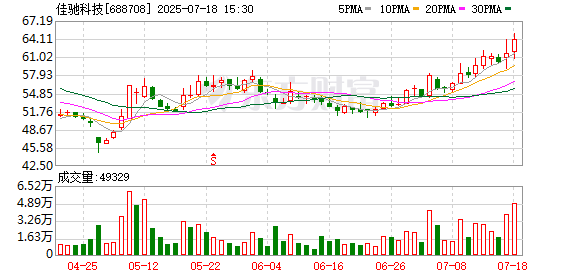
Core Viewpoint - Chengdu Jiachi Electronic Technology Co., Ltd. (Jiachi Technology) is a leading provider of electromagnetic functional materials and structures (EMMS) in China, focusing on the dual development of military and civilian sectors, and has entered a comprehensive development phase with its upcoming A-share listing in 2024 [2][4]. Group 1: Strategic Development - Jiachi Technology has outlined three strategic development phases: "consolidating the foundation," "rapid growth," and "comprehensive development," with the company now in the "comprehensive development" phase [2]. - The recent approval of the 2025 restricted stock incentive plan at the shareholders' meeting is seen as a move to bind core talent and promote steady growth [2][6]. Group 2: Technological Innovation - The company emphasizes technology as its core, with over one-third of its workforce dedicated to R&D, achieving significant national awards for its innovations in the EMMS industry [3]. - Jiachi Technology's products have been applied in major military projects, including the fourth and fifth generation fighter jets, showcasing its capability to break foreign technology barriers and achieve technological self-sufficiency [3][4]. Group 3: Financial Performance - In 2024, Jiachi Technology achieved a revenue of 957 million yuan and a net profit of 517 million yuan, indicating strong financial performance [4]. - The company has established the largest stealth coating material production base in China, with ongoing projects aimed at enhancing its core capabilities in R&D, manufacturing, and testing [4]. Group 4: Growth Targets - The stock incentive plan includes performance targets for annual revenues of 1.1 billion yuan, 1.37 billion yuan, and 1.6 billion yuan from 2025 to 2027, reflecting the company's confidence in future growth [6]. - Jiachi Technology is focusing on new product directions, including the design and integration of electromagnetic wave dark rooms, which are crucial for both military and civilian applications [6][7]. Group 5: Market Outlook - The global electromagnetic compatibility materials market is projected to grow from approximately 6.8 billion USD in 2020 to 8.2 billion USD by 2025, indicating a robust market opportunity for Jiachi Technology [7]. - The company aims to be a leader in stealth materials technology and a disruptor in electromagnetic compatibility solutions, driving continuous innovation in the EMMS sector [7].

华夏基金举办“DeepTalk月月谈”系列节目 专家热议航空航天与军工行业新机遇
Zheng Quan Ri Bao· 2025-07-17 07:44
Core Insights - The aerospace and defense industry is experiencing unprecedented development opportunities, driven by national security needs and technological advancements [1][2] - China's rapid progress in the aerospace sector is attributed to significant government investment in technological innovation and a robust manufacturing supply chain [1] - The shift in focus from quantity expansion to quality improvement in the aerospace sector indicates a maturation of the industry [2] Industry Analysis - The defense budget is steadily increasing, and the military reform benefits are being realized, leading to a clear upward trend in the aerospace industry [2] - China's comprehensive strength in the aerospace field is now at an advanced global level, making it a key area for long-term investment [2] - The integration of military and civilian technologies is enhancing the profitability of private enterprises in the aerospace sector, making them more attractive for investment [2] Investment Opportunities - Ordinary investors are encouraged to focus on the aerospace and defense sectors due to their high certainty and long product life cycles [2] - Investment tools like the 华夏航空航天ETF (Fund Code: 159227) are recommended for a steady and long-term investment approach in this sector [2]
外媒:被裁定列入所谓“清单”,中国激光雷达制造商禾赛科技提出上诉
Huan Qiu Wang· 2025-07-15 01:41
Group 1 - Hesai Technology has appealed against a U.S. government decision that placed it on a list of companies suspected of collaborating with the Chinese military [1][3] - The CEO of Hesai Technology expressed disappointment with the court's ruling and stated that the Department of Defense's findings lack factual and legal basis [3] - The court acknowledged that there was no evidence showing Hesai's products were used for military purposes or that the company had any direct or indirect ties to the Chinese military [3] Group 2 - Hesai Technology was added to the "Chinese military enterprise list" by the U.S. Department of Defense in January last year, and the company filed a lawsuit against the Department in May [3] - In August of the same year, Hesai was removed from the list, but in October, the Department of Justice reinstated the company on the list based on updated information [3] - A U.S. court ruled against Hesai Technology in a lawsuit against the government in July this year [3] Group 3 - The Chinese Foreign Ministry has opposed the U.S. government's actions, stating that it undermines normal economic and trade cooperation between China and the U.S. [4] - The Ministry emphasized that the U.S. government is the main proponent of military-civil fusion policies, which have been in place since before World War I [4] - The Ministry urged the U.S. to correct its discriminatory practices and provide a fair environment for Chinese companies [4]


国际镍价暴跌40%的当口,中国出手抄底10万吨高纯度镍!
Sou Hu Cai Jing· 2025-07-14 23:47
Group 1 - The core viewpoint highlights China's strategic move to purchase 100,000 tons of high-purity nickel amidst a 40% drop in international nickel prices, aiming to bolster its military industrial capacity for the next three years [1][4] - The collaboration between China and Russia is seen as a counteraction against Western technology blockades, with China leveraging strategic reserves and alliances to break through these barriers [1][2] - China's military industrial sector has significantly advanced, with the development of indigenous technologies such as the WS-15 engine for the J-20B fighter jet, showcasing a departure from reliance on Russian technology [2][6] Group 2 - The acquisition of nickel is part of a broader strategy to secure essential resources, as 67% of global nickel mines are located in Indonesia, and potential supply disruptions could arise from geopolitical tensions [4][6] - The integration of civilian and military production capabilities allows for rapid adaptation of manufacturing lines, enabling companies to switch from consumer goods to military hardware efficiently [7] - China's military production capacity has surpassed that of the U.S., with an annual output of 240 fighter jets, indicating a significant shift in the global military manufacturing landscape [7]

3500点新起点如何布局?盘点A股下半年投资主线
天天基金网· 2025-07-11 11:22
Group 1 - The core viewpoint of the article emphasizes that the A-share market has rebounded to 3500 points, driven by a combination of policy support, industrial upgrades, and capital restructuring, marking a new starting point for investment opportunities [2][4]. - The article identifies key investment themes for the second half of 2025, including the application of AI, the global expansion of innovative pharmaceuticals, and the undervaluation of Hong Kong stocks [2][4]. Group 2 - AI applications are transitioning from hardware competition to scenario breakthroughs, with significant growth expected in AI intelligent agents and humanoid robots, driven by enterprise-level demand [4][6]. - The innovative pharmaceutical sector in China is experiencing a global breakthrough, with overseas licensing driving valuation reshaping, as evidenced by 31% of the top 10 global pharmaceutical pipelines originating from Chinese companies [7][8]. - The Hong Kong stock market is attracting southbound capital, with a net inflow of 67.41 billion HKD in 2025, and the Hang Seng Technology Index trading at a PE ratio of only 28 times, indicating significant room for valuation recovery [10][11]. Group 3 - The article highlights the shift in consumer behavior among Generation Z, where emotional value is prioritized over functional consumption, leading to the rise of new consumer brands [12]. - In a low-interest-rate environment, high dividend stocks are becoming a new necessity, with A-share dividends growing by 5% in 2024, and the average dividend yield for telecommunications and banking sectors exceeding 6% [13][14]. - The military industry is expected to benefit from stable growth in military spending, with a 7.2% increase over three consecutive years, and the potential for significant demand driven by global military trade cycles [16][17].

快讯!周治平已任兵工集团董事长
Zheng Quan Ri Bao Wang· 2025-07-08 10:47
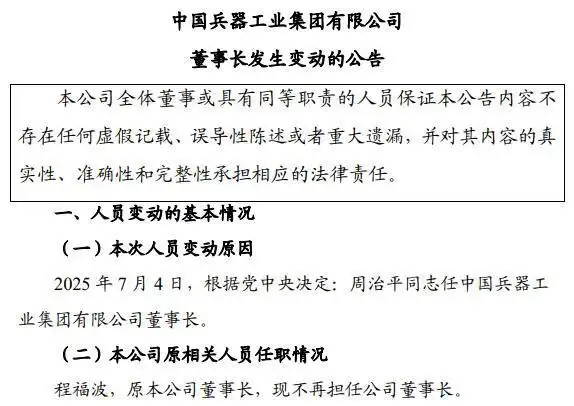
Group 1 - The core point of the article is the appointment of Zhou Zhiping as the new chairman of China Ordnance Industry Group Co., Ltd., following the decision by the Central Committee of the Communist Party of China [1][9] - Zhou Zhiping's background includes extensive experience in the automotive industry and various leadership roles in related companies, which may provide valuable insights for his new position in the military industry [6][9] - The transition from the previous chairman, Cheng Fubo, to Zhou Zhiping fills a critical leadership gap in the company, which focuses on the development of military equipment and technology [9] Group 2 - Zhou Zhiping's educational qualifications include a Ph.D. in Management Science and Engineering from Beijing Institute of Technology, and he is a senior engineer [6] - The company is expected to leverage Zhou Zhiping's understanding of military-civilian integration to enhance its operations in the defense sector [9] - The future direction of the "new Ordnance Group" under Zhou Zhiping's leadership is anticipated to be a focal point for stakeholders, particularly in advancing military capabilities [9]